💡 Key answer
Full-arch implant treatment (All-on-X) goes through four stages: diagnosis, surgery, several months with a temporary prosthesis, and fabrication of the final prosthesis. The overall duration differs from person to person depending on how quickly the bone bonds to the implants and whether bone grafting is needed. Temporary teeth can be attached on the day of surgery only when the implants are firmly secured in the bone. If stability is insufficient, you use an adjusted existing denture or a temporary denture while waiting for the bone to bond, and the teeth are attached afterward.
Summary for patients
- Please tell us about your medications and any history of treatment for diabetes or osteoporosis.
- Eat soft foods while using temporary teeth.
- Contact us right away if the temporary teeth break or lift away.
- Have your first checkup 3 months after the final prosthesis is fitted, then every 6 months.
❓ What this article covers
- What stages make up the overall schedule?
- How many visits are needed before surgery, and what happens at them?
- Can I use temporary teeth right on the day of surgery?
- How many visits are needed while I have temporary teeth?
- When and in what order is the final prosthesis made?
- What do we check in the treatment room before moving to the next stage?
- When does the schedule take longer, or another method fit better?
- How many visits are needed in total?
What stages make up the overall schedule?
There are four main stages, and different factors determine the duration of each.
| Stage | What happens | What determines the duration |
|---|
| ① Diagnosis and planning | CT and intraoral scan, general health review, deciding which teeth to keep and which to remove | Whether gum treatment or a physician’s assessment is needed first |
| ② Surgery | Removal of remaining teeth as planned, implant placement, attachment of a temporary prosthesis if conditions allow | Whether one or both jaws are treated, and whether bone grafting is done at the same time |
| ③ Temporary prosthesis period | Adjusting the temporary prosthesis while waiting for the bone to bond to the implants | Bone hardness, upper or lower jaw, smoking and diabetes |
| ④ Final prosthesis | Taking impressions, trying it in, attaching the final prosthesis | How much needs changing at the try-in, and the prosthesis material |
All-on-X (Korean) is a method in which usually 4~6 implants are placed in one jaw and a single connected prosthesis is secured on top with screws. It began with a report of 4 implants placed in a completely toothless lower jaw with a fixed prosthesis attached immediately,[1] and today the number is chosen according to the bone conditions. The process of deciding the number is covered in How the number of implants you need is decided.
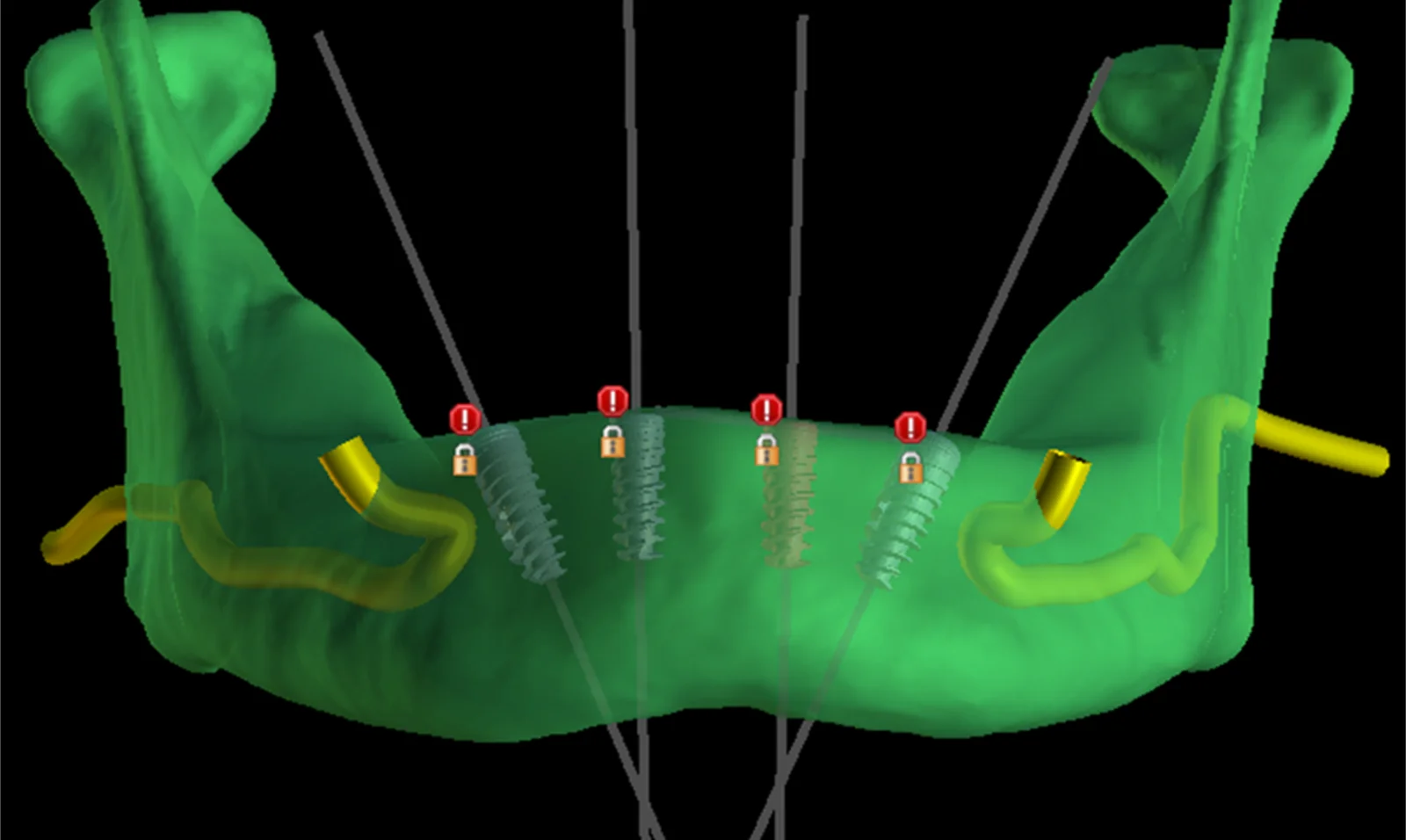
Figure cited from an external paper · Not a case from our clinicA planning view of 4 implants in a toothless lower jaw. The front 2 are placed straight and the rear 2 tilted; yellow shows the path of the lower jaw nerve.Datarkar et al. · Figure 1(A) · DOI: 10.3390/dj14080480 · CC BY 4.0 · Cropped to panel (A) only
How many visits are needed before surgery, and what happens at them?
Usually two or three visits are needed for diagnosis and planning, with additional visits if other treatment is needed first.
Initial consultation and examination
With 3D CT, we check the height and width of the upper and lower jawbone, the path of the lower jaw nerve, and the distance to the hollow space at the back of the upper jaw (maxillary sinus). We record the remaining teeth and gums with an intraoral scanner (TRIOS 6), and also check the lip position and how much tooth shows when you smile to plan the shape of the final prosthesis first.
Explaining the plan
We choose the implant positions to suit the planned tooth shape and the direction of chewing force, and explain how many implants will be placed and where.
Treatment needed first
If gum inflammation is severe, we treat the gums first. We schedule surgery after consulting the prescribing clinicians about diabetes control, blood-thinning medication and osteoporosis medication. The time needed for these checks determines the first part of the overall schedule.
If you currently use a denture, please bring it to your consultation. Its height and tooth positions help us plan the new prosthesis, and if temporary teeth cannot be attached on the day of surgery, that denture will be adjusted for you to use.
Can I use temporary teeth right on the day of surgery?
Temporary teeth are attached on the day of surgery or within a few days only when the bone condition and implant stability meet the required criteria. We estimate this from the CT before surgery, but make the final decision during surgery after measuring how firmly the implants are actually secured.
| Findings during surgery | Temporary teeth |
|---|
| Implants are firmly secured in the bone, and their number and positions are sufficient to support the prosthesis | A fixed temporary prosthesis is attached from the day of surgery~within a few days |
| Some implants have weak stability, or extensive bone grafting has been done | An existing denture is adjusted, or a temporary denture is used, with attachment after the bone has bonded |
An analysis of 62 studies of fixed prostheses in edentulous patients found similar implant and prosthesis survival rates for immediate attachment (immediate loading) and attachment after bone bonding when patients were carefully selected. Most immediate-loading studies used a minimum tightening force at implant placement (insertion torque of at least 30Ncm) as a criterion.[2] These findings cannot be applied directly when those conditions are not met. The definitions of loading timing follow the recommendations of an international consensus conference.[3]
How many visits are needed while I have temporary teeth?
During the months spent waiting for the bone to bond, visits are frequent in the first few weeks, then every one or two months.
The first few weeks after surgery
The day after surgery, we clean and dress the surgical site and check the wound and swelling. Stitches are removed within 1~2 weeks. Around this time, we adjust any areas where the temporary prosthesis presses on the gums or makes contact too early when you bite.
The months when the bone bonds
It usually takes 3~6 months for the implants to bond to the bone. The lower jaw, with its harder bone, is often closer to the shorter end, while the upper jaw or grafted sites are often closer to the longer end. During this period, the gums and bone at the extraction sites heal and change shape, so if a gap opens between the temporary prosthesis and the gums, we add material to its inner surface or readjust the bite.
Chewing force is what you need to be most careful about during this period. Hard or tough foods can place heavy force on implants that have not yet fully bonded to the bone, which may compromise their stability. A temporary prosthesis is made from weaker material than the final one and is more prone to breaking; these prosthetic fractures are a commonly reported problem with All-on-X.[5] If it breaks or lifts away, do not put up with it and keep using it; contact us right away.
A fixed temporary prosthesis cannot be taken out for cleaning. Food can easily collect underneath, where the prosthesis meets the gums, so after meals, clean the gum border with a soft toothbrush and clean beneath the prosthesis with an interdental brush or a water flosser. For the first few days after surgery, we give you separate instructions on how to clean without disturbing the wound.
When and in what order is the final prosthesis made?
After confirming that the bone has bonded, we proceed with impressions, a try-in and attachment, usually over three or four visits across several weeks.
- Taking impressions — We use an intraoral scanner and impressions to accurately transfer the implant positions. Because several implants are joined by one prosthesis, even a small positional error can keep it from seating properly.
- Recording the bite and facial features — We record the height between the jaws, the degree of lip support and how much tooth shows when you smile. Any discomfort you experienced during the months with the temporary prosthesis is taken into account here.
- Trying it in (try-in) — Before completion, we check the tooth arrangement and color, pronunciation and lip shape. If many changes are needed, another try-in adds one more day of visits.
- Attachment — We secure the final prosthesis with screws and adjust the upper and lower teeth so they make even contact.
The prosthesis material (full zirconia, or zirconia combined with a titanium framework) is chosen according to chewing force, opposing teeth and your ability to care for it. Laboratory fabrication time may vary with the material.
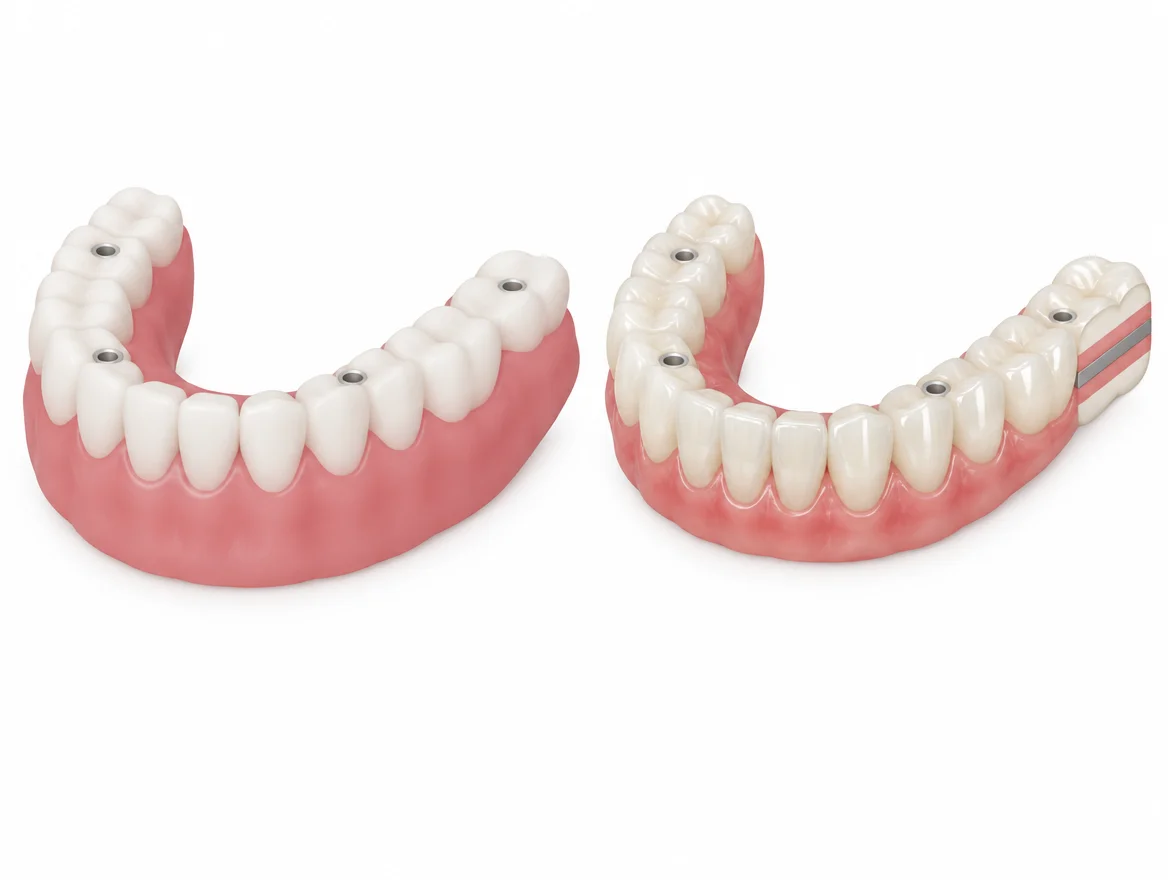
AI-generated explanatory illustrationLeft: a resin temporary prosthesis. Right: a zirconia final prosthesis (the internal titanium framework is visible at the cut end)
What do we check in the treatment room before moving to the next stage?
We move to the next stage based on what we have confirmed, rather than a fixed date.
- Before attaching the temporary prosthesis — The stability measured during surgery, and whether the implant number and positions are sufficient to support the prosthesis
- During the temporary prosthesis period — Whether swelling or pain is limited to a particular implant, or the temporary prosthesis lifts on one side. If these signs are present, we check the cause before moving to the next stage
- Before taking impressions for the final prosthesis — Whether the implants are free of movement, the surrounding bone is stable on X-ray, and the gums have fully healed
- On the try-in day — Lip support, pronunciation, the gum line visible when smiling, and the contact points between the upper and lower teeth
- After attachment — Whether the screws are firmly tightened and the shape allows cleaning beneath the prosthesis. The X-ray taken that day serves as a baseline for comparing bone levels at later checkups
Using a temporary prosthesis for several months is also a rehearsal for the final one. If you tell us during this period about areas where speech sounds escape, you often bite your cheek, or food gets caught, we take these into account in the final prosthesis.
When does the schedule take longer, or another method fit better?
The schedule is longer when bone is insufficient or general health needs to be controlled first, and some people may be better suited to another method instead of a fixed prosthesis.
- When extensive bone grafting is needed — Time is added to allow the grafted bone to integrate, and temporary teeth are less likely to be attached on the day of surgery. Bone grafting timelines are covered in Implants: why does the duration differ from person to person?.
- When the bone at the back of the upper jaw is thin — If surgery to add bone toward the maxillary sinus is needed first, that time is added at the beginning.
- When smoking or blood sugar is difficult to control — Bone bonding and gum healing are slower, lengthening the intervals between stages.
- When you are taking osteoporosis medication — Depending on the type of medication and how long you have used it, we consult the prescribing clinician about timing, which may delay the surgery date. Do not stop the medication on your own.
- When tooth grinding is severe — Frequent damage to the temporary prosthesis leads to more adjustment visits, and we consider both the final prosthesis material and a protective appliance worn at night.
- When cleaning beneath a fixed prosthesis is difficult — If using your hands is difficult or no family member can help, an implant overdenture (Korean) held by 2~4 implants may be more suitable for daily care. It can be removed for cleaning, and the extent of surgery is usually smaller as well.
How many visits are needed in total?
For one jaw, there are roughly ten visits from diagnosis to the final prosthesis, with more if bone grafting or other treatment is needed first.
| Stage | Visits | Notes |
|---|
| Diagnosis and planning | 2~3 visits | Additional visits for gum treatment or similar needs |
| Surgery | 1 visit | We discuss whether to treat both jaws on the same day |
| Recovery and adjustments after surgery | 2~3 visits | Stitches, temporary prosthesis adjustments |
| Checks during bone bonding | Every one or two months | Refining the temporary prosthesis |
| Final prosthesis | 3~4 visits | 1 additional visit if another try-in is needed |
Swelling is at its greatest two or three days after surgery, so we recommend scheduling surgery away from important appointments or events. After the final prosthesis is attached, we check it at the first visit 3 months later, then at regular checkups every 6 months. When to unscrew the prosthesis to clean underneath or retighten the screws is decided after assessing its condition at a checkup. Treatment fees are listed in the fee list (non-covered fees).
Frequently asked questions
Q. Will I go home with no teeth on the day of surgery?
If the conditions for attaching a temporary prosthesis are met, fixed temporary teeth are fitted that day or within a few days. Otherwise, your existing denture is adjusted to the surgical site, or you use a temporary denture. We explain the possibilities before surgery and decide based on what we find during surgery.
Q. How do temporary teeth and the final prosthesis differ?
A temporary prosthesis is usually made from a material such as resin that is easy to trim and add to, allowing adjustments as the gums heal and change shape. The final prosthesis is made from a hard material such as zirconia, with a metal framework if needed, for use over several years. This means the thickness, shape and feel when chewing are slightly different.
Q. Are the remaining teeth removed on the same day the implants are placed?
If there is no severe inflammation around the teeth to be removed and there is enough bone, extraction and implant placement are often done on the same day. If inflammation is extensive or much of the bone has been lost, the teeth are removed first and the sites are allowed to heal before implant placement, adding time at the beginning.
Q. Can both jaws be operated on the same day?
In some cases, yes. However, this makes surgery longer and recovery more demanding, so we may split it into separate procedures depending on your general health, the extent of bone grafting and your schedule.
Q. What is daily life like while using temporary teeth?
Speaking and smiling usually cause little difficulty, but pronunciation may feel awkward and saliva may increase in the first few weeks. Eat mainly soft foods, and leave hard or tough foods such as nuts or chewy meat until after the final prosthesis is fitted. Even after that, be careful with excessively hard foods, as they can break the prosthesis.
Q. Can the final prosthesis still be removed after it is attached?
It is not a prosthesis you remove yourself. It is secured with screws that the dentist can loosen and retighten, making cleaning underneath or repairs at checkups relatively straightforward.
Q. What should I bring to an All-on-X consultation near Bongcheon Station?
When you visit Joy Dental Clinic Bongcheon, please bring any CT or X-ray files taken elsewhere. Writing down the names of your medications also helps the consultation move along. We may repeat examinations at the clinic.
Limits of the evidence
- The analysis comparing immediate and delayed attachment[2] pooled studies with carefully selected participants, so the same results cannot be expected in people with weak bone or systemic disease.
- Most of the cited All-on-Four survival data[4] have around 3 years of follow-up, so results beyond 10 years need to be considered alongside later studies.
- Implant types, prosthesis materials and surgical approaches differ between studies, so their treatment durations and visit counts cannot be applied directly.
- The speed of bone bonding varies from person to person with bone hardness, age, smoking and blood sugar.
DOCTOR’S NOTE
I do not promise before surgery that temporary teeth will be attached on the day of surgery. During surgery, I measure how firmly the implants are actually secured. If they do not meet the criteria, I wait until the bone has bonded before attaching the teeth, rather than attaching them that day.
— Jeong Jinwoo, Director, Joy Dental Clinic Bongcheon
This post reflects information as of the date of writing and was written to provide general information in compliance with Korea’s Medical Service Act and the Ministry of Health and Welfare’s medical advertising guidelines. Implant surgery can have side effects such as bleeding, swelling, pain and infection, and in rare cases nerve damage or altered sensation can occur. Prostheses can have complications such as fractures and screw loosening. Individual diagnosis and the direction of treatment depend on the condition of your mouth, so please be sure to consult fully with your treating clinician before deciding.
We are right next to Exit 1 of Bongcheon Station (Line 2), and directions from Seoul Nat’l Univ. Station, Sillim, Nakseongdae and Sadang are in Getting here.
Joy Dental Clinic Bongcheon
5F Jehyeong Bldg., 1738 Nambusunhwan-ro, Gwanak-gu, Seoul (Bongcheon Station, Exit 1)
Hours: Mon·Wed·Thu·Fri 09:30–18:30 / Tue 09:30–20:30 / Sat 09:30–13:30 (closed Sun & public holidays)
Booking: Naver Booking / Phone 02-877-2867
Related pages: Full-arch implant treatment guide · Implant treatment guide · Treatment fees
References
- Maló P, Rangert B, Nobre M. "All-on-Four" immediate-function concept with Brånemark System implants for completely edentulous mandibles: a retrospective clinical study. Clin Implant Dent Relat Res. 2003;5(Suppl 1):2-9. — [Cohort] The first retrospective report of the All-on-Four concept, placing 4 implants in a completely toothless lower jaw and immediately attaching a fixed prosthesis.
- Papaspyridakos P, Chen CJ, Chuang SK, Weber HP. Implant loading protocols for edentulous patients with fixed prostheses: a systematic review and meta-analysis. Int J Oral Maxillofac Implants. 2014;29(Suppl):256-270. — [Meta-analysis] 62 studies of fixed prostheses in edentulous patients. With careful patient selection, implant and prosthesis survival rates were similar for immediate, early and conventional loading; estimated 1-year survival was at least 99% for all three protocols. Most immediate-loading studies recommended an insertion torque of at least 30Ncm. The authors explicitly advised caution in interpretation because many factors affect the results.
- Gallucci GO, Benic GI, Eckert SE, et al. Consensus statements and clinical recommendations for implant loading protocols. Int J Oral Maxillofac Implants. 2014;29(Suppl):287-290. — [Guideline] Definitions of loading timing (immediate, early and conventional) and clinical recommendations from the ITI Consensus Conference.
- Patzelt SB, Bahat O, Reynolds MA, Strub JR. The all-on-four treatment concept: a systematic review. Clin Implant Dent Relat Res. 2014;16(6):836-855. — [Systematic review] Cumulative All-on-Four implant survival rates: 98.6% at 12 months and 99.0% at 36 months. Lack of long-term data was noted as a limitation.
- Soto-Peñaloza D, Zaragozí-Alonso R, Peñarrocha-Diago M, Peñarrocha-Diago M. The all-on-four treatment concept: systematic review. J Clin Exp Dent. 2017;9(3):e474-e488. — [Systematic review] Summary of indications, surgical and prosthetic approaches, and mechanical and biological complications of All-on-Four in function for at least 3 years. Prosthetic problems such as temporary prosthesis fractures were reported as common complications.
- Datarkar A, Pawar NG, Pandilwar PK, Cinar IC, Mijiritsky E. Biomechanical Comparative Evaluation of the Atrophic Edentulous Mandible Using All-on-4, All-on-5 and All-on-6 Concepts: A Finite Element Analysis. Dent J (Basel). 2026;14(8):480. — [Finite element analysis] Comparison of stress distribution in All-on-4, All-on-5 and All-on-6 arrangements in a lower jaw with bone loss. Source of the figure in this article (Figure 1(A), CC BY 4.0) — cropped to panel (A) only.


 한국어
 日本語
 简体中文