💡 Key answer
A ceramic inlay is bonded to a tooth, not simply fitted into it. Adhesives are usually cured with light, but enough light may not reach the base of an inlay. At Joy Dental Clinic Bongcheon, we bond inlays with a combination of 3M Scotchbond Universal Plus (adhesive) and RelyX Universal (resin cement). This combination is designed so that the resin cement cures the adhesive even without light, allowing it to cure down to the base, and the adhesive layer shows up on X-rays, reducing the chance of mistaking the margin for decay or a gap.
Summary for patients
- On the day your inlay is bonded, you keep your mouth open for a while because we need to prevent saliva from reaching the tooth.
- Please let us know if sensitivity persists or worsens after bonding, or if chewing hurts.
- If floss catches or breaks, we check the margin again.
- We also examine the margins of bonded inlays on X-rays at regular checkups.
❓ What this article covers
- Why is an inlay “bonded” rather than simply “fitted”?
- What layers are there between the tooth and the inlay?
- How does the adhesive cure when little light reaches the base of an inlay?
- Why does it matter that the adhesive shows up on X-rays?
- Glass ceramic and zirconia need different surface treatments. Can one adhesive work for both?
- Why do bonding material costs differ, and how are they included in the treatment fee?
- What do we check in the treatment room?
- How long does treatment take, and how many visits are needed?
Why is an inlay “bonded” rather than simply “fitted”?
An inlay sits inside a tooth, so it does not grip the tooth by wrapping around it as a crown does. A crown fits like a cap over a prepared tooth, so the shape itself holds the restoration in place. An inlay is a piece made to fit the space left after decay is removed, so most of the force keeping that piece in place comes from bonding.
Ceramic is hard, but thin areas are vulnerable to bending forces. When firmly bonded to the tooth, the ceramic and tooth bear forces as one unit. In a laboratory study comparing lithium disilicate restorations, those bonded with an adhesive resin cement withstood about 26% more force than those luted with a conventional cement. How much this translates into actual inlay longevity needs to be established separately[2]. An analysis of clinical studies with at least 5 years of follow-up found that ceramic inlays and onlays had survival rates of 92~95% at 5 years and 91% at 10 years, with fracture and bonding failure reported among the causes of failure[1].
What layers are there between the tooth and the inlay?
There are two layers: an adhesive layer that penetrates the tooth surface, and a resin cement layer above it that holds the inlay in place. The adhesive penetrates the enamel and dentin surfaces roughened by acid treatment and cures to create a bonding surface. The resin cement sits on top of this, holding both the inner surface of the inlay and the adhesive layer together.
Commonly used glass ionomer cements mainly fill the space between the tooth and the restoration. This is often enough for a crown, where the tooth’s shape holds the restoration in place. For an inlay, which is not retained by shape, the cement needs to bond chemically to both the tooth and the ceramic. We therefore prepare the tooth with an adhesive and the ceramic with surface treatment, then bond them with resin cement. In a clinical trial comparing ceramic inlays placed by these two methods after 1 year, those bonded with resin had better marginal adaptation[4].
| Category | Conventional luting (filling the space with cement) | Adhesive bonding (bonding with resin) |
|---|
| Source of retention | The tooth’s shape holds the restoration, and cement fills the space | Chemical bonding to both the tooth surface and the inner surface of the restoration |
| Sensitivity to saliva and blood | Relatively less sensitive | Contact greatly weakens the bond, so moisture control is essential |
| Restorations commonly used | Metal and zirconia crowns when the tooth has sufficient height | Ceramic inlays and onlays, veneers, and crowns on short remaining teeth |
| Material unit cost | Low | High (two materials: adhesive and resin cement) |
Among bonding materials, an adhesive designed to treat both teeth and various restorative materials with one product is called a universal adhesive. Scotchbond Universal Plus, which we use, is one such adhesive, and RelyX Universal is a resin cement designed to be used with it[14][15].
How does the adhesive cure when little light reaches the base of an inlay?
This combination is designed so that the resin cement cures the adhesive even without light, allowing the adhesive to cure at the base where light is limited. Most dental adhesives are light-cured materials that harden under blue light. The adhesive layer of an inlay lies beneath the ceramic piece. Even when light is applied from above, it reaches the base and deep walls with reduced intensity, depending on the ceramic’s thickness and translucency. The usual approach is therefore to light-cure the adhesive before inserting the inlay. However, if cured adhesive pools in a thick layer, the inlay may not seat fully and its margin may lift. Conversely, if the inlay is inserted without curing the adhesive first, the adhesive cures less fully at the base where light does not reach.
Scotchbond Universal Plus and RelyX Universal were developed to be used together to address this problem. Components in the resin cement make the adhesive cure chemically, so it cures down to the base even when the inlay is placed immediately without light-curing the adhesive first. Manufacturer information describes equal bond strength with and without light-curing the adhesive[14][15]. In a laboratory study, when the adhesive was not separately light-cured, bond strength also did not differ between light-curing the cement and allowing it to self-cure[6]. This ability to cure where light does not reach is often called dark curing.
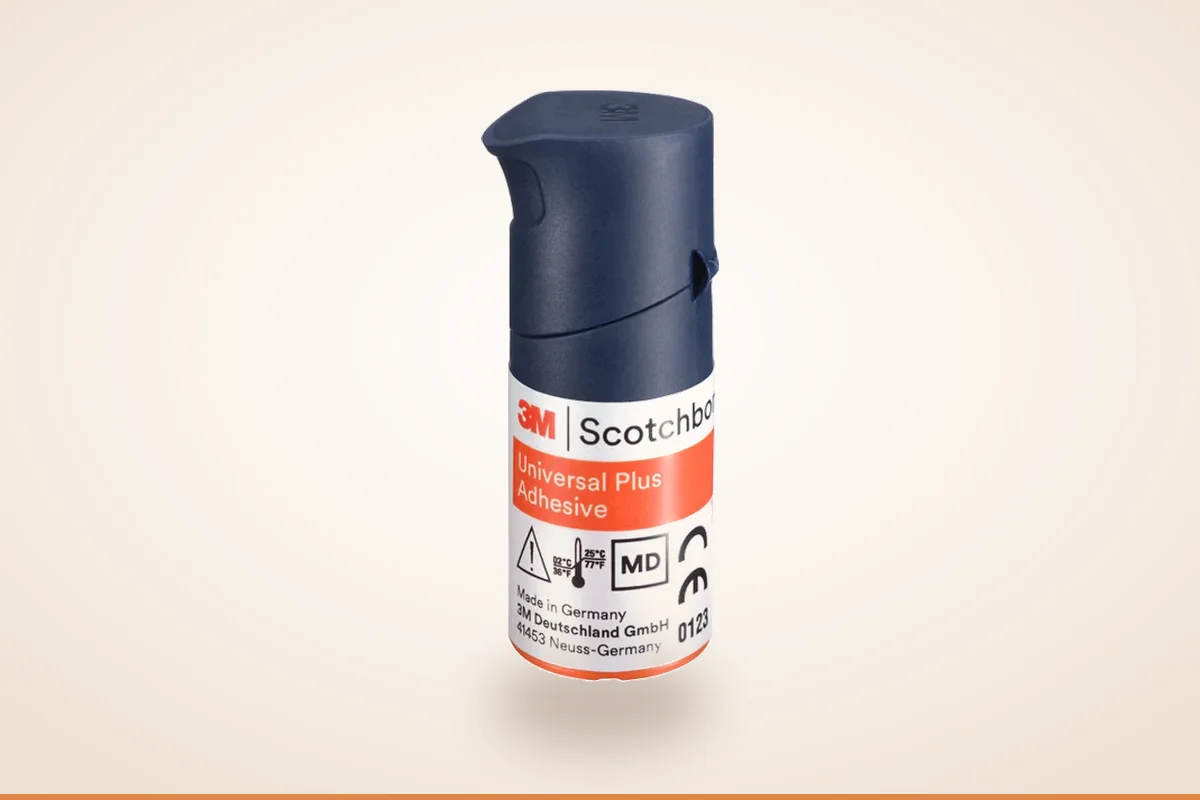
Photo cited from publicly available external material · Not a case from our clinic3M Scotchbond Universal Plus Adhesive. A universal adhesive applied to the tooth surface, containing a radiopaque monomer, silane, and MDP.Manufacturer product photo · Solventum product information · Background edited
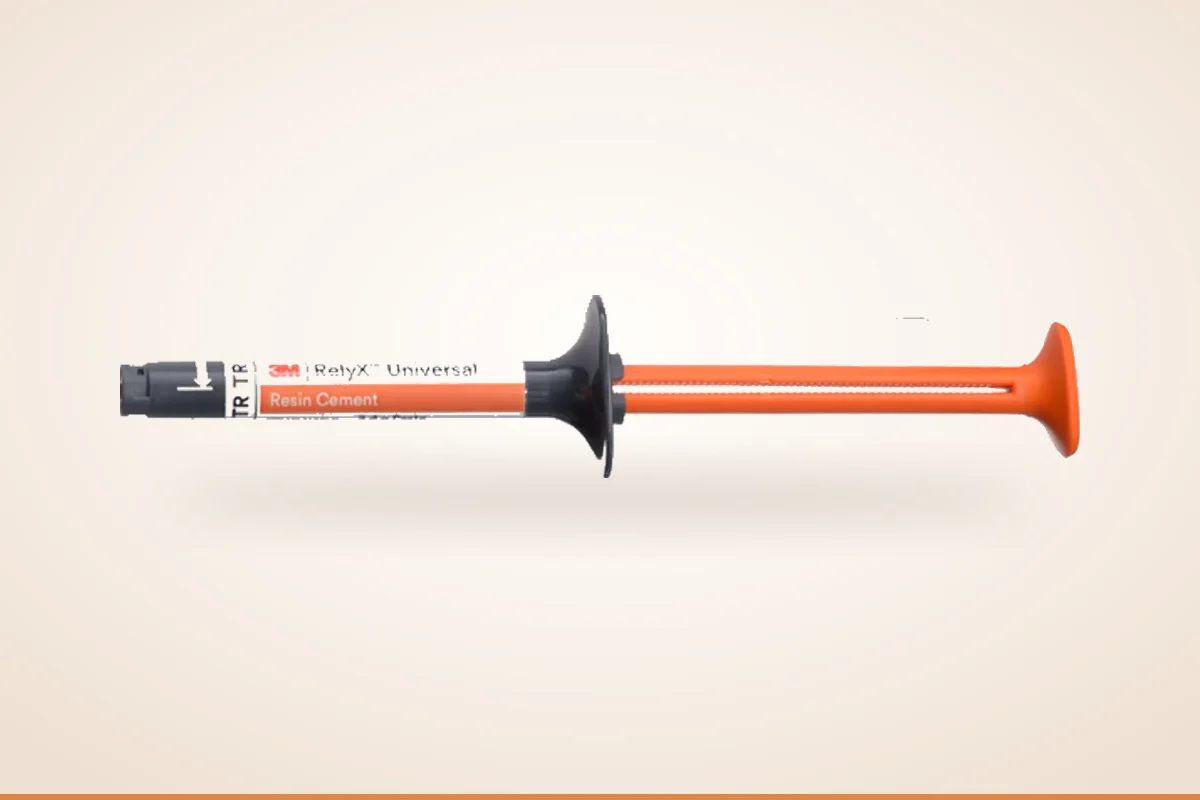
Photo cited from publicly available external material · Not a case from our clinic3M RelyX Universal Resin Cement. A dual-cure resin cement that cures the adhesive without light when used with the adhesive shown above.Manufacturer product photo · Solventum product information · Background edited
Dark curing is for the base where light does not reach; margins that light can reach are still thoroughly light-cured. This is because laboratory results showed lower strength when resin cement was allowed to self-cure alone[13].
Why does it matter that the adhesive shows up on X-rays?
If the adhesive layer does not show up on X-rays, the inlay margin can appear as a dark line and be mistaken for decay or a gap. On dental X-rays, metal, ceramic, and teeth appear white, while empty spaces and decay appear dark. Most adhesives are plastic-based and appear dark because they do not show up on X-rays. One study found that thicker adhesive layers increased the rate of interpreting the margin as a gap or decay and recommending restoration replacement to 1.6~2 times the original rate[7].
This misunderstanding can cause harm in two ways. A sound inlay may be replaced, or actual decay may be missed because the dark area is dismissed as “probably just the adhesive.” The manufacturer describes Scotchbond Universal Plus as an adhesive made to show up on X-rays[14]. A separate micro-CT study also found that, while 3 other universal adhesives were indistinguishable from air, this product appeared as bright as dentin[8]. When adhesive remaining at the margin looks similar to the tooth, it is less likely to be mistaken for a gap. However, we assess the cause of a dark area using clinical findings such as probing and symptoms as well as X-rays.
Glass ceramic and zirconia need different surface treatments. Can one adhesive work for both?
Glass ceramic needs silane, while zirconia needs a component called MDP, and this adhesive contains both. The method of bonding to the inner surface of a restoration depends on its material. For ceramics containing glass (lithium disilicate such as e.max), resin bonds after the surface is roughened with acid and a coupling agent called silane is applied. Zirconia contains no glass and cannot be etched in the same way, so its surface must be finely abraded and treated with a phosphate component called MDP for resin to bond. When only resin cement was used on zirconia, the bond did not last; pretreatment with this adhesive maintained bond strength equal to that with a dedicated primer[11].
| Restorative material | Surface treatment | Component that aids bonding | Component in the adhesive |
|---|
| Glass ceramic (such as lithium disilicate) | Roughening with hydrofluoric acid | Silane | Contains silane |
| Zirconia | Surface abrasion with fine particles | MDP primer | Contains MDP |
For resin blocks and metals, treatment depends on the product’s composition, so we follow the instructions for that material. Having both silane and MDP in one adhesive bottle reduces the steps of selecting and applying different primers for each material. However, findings differ on whether the silane in an adhesive alone is enough for glass ceramic. A review of laboratory studies and a recent experiment found higher bond strength when separate silane was applied after hydrofluoric acid treatment than when only the adhesive’s silane was used[9][10]. Without hydrofluoric acid treatment, there was almost no bonding regardless of the adhesive[6]. We therefore treat the inner surface of ceramic inlays with hydrofluoric acid and then apply silane separately. We apply the adhesive only to the tooth surface, not the inlay, and do not omit the silane step on the inlay even though the adhesive contains silane.
Why do bonding material costs differ, and how are they included in the treatment fee?
We use both an adhesive and a resin cement, each with a higher unit cost, so the material cost per bonding procedure is around four times that of using a single conventional luting cement. Glass ionomer cement involves just one material made by mixing powder and liquid. Adhesive bonding uses separate adhesive, restoration surface treatment agents, and resin cement, each also carrying a higher price per package.
These material costs are included in the ceramic inlay treatment fee, and there is no separate charge for choosing adhesive bonding. Treatment fees are listed in the fee list (non-covered fees). We choose this method despite the higher material cost because an inlay can come off when its bond fails, and its margins need to be checked on X-rays for years after bonding.
What do we check in the treatment room?
Before bonding, we check that the inlay fits; during bonding, that saliva does not reach the tooth; and afterward, for residual cement and the bite. We first place the finished inlay in position for a try-in, run a probe along the margins to check for lifting, and use floss to check contact with the neighboring tooth. We adjust the bite after bonding because biting hard on unbonded ceramic can break it.
During bonding, we pay particular attention to saliva and blood. Saliva on the tooth surface where the adhesive needs to penetrate greatly reduces bond strength, so we keep the tooth dry throughout bonding. After applying the adhesive, we seat the inlay with resin cement, remove excess cement before it sets, and then light-cure it.
After bonding, we pass floss along the margins to check for catches and remove remaining cement. Because the adhesive and cement show up on X-rays, it is easier to check the margins and residual material on X-rays at subsequent regular checkups. Sensitivity after bonding has been reported not to differ greatly by bonding method[12].
How long does treatment take, and how many visits are needed?
A ceramic inlay usually takes two visits. On the first day, we remove the decay, take an impression with an intraoral scanner (TRIOS 6) or impression material, and place a temporary filling. When the inlay is ready, the second visit includes a try-in, bonding, and bite adjustment. Time is needed on the bonding day to keep the tooth dry and cure the materials. You can eat once the anesthetic wears off that day, and the margins are checked at regular checkups afterward. Treatment fees are listed in the fee list (non-covered fees).
Frequently asked questions
Q. What is a universal adhesive?
A universal adhesive is a dental adhesive designed to treat tooth enamel and dentin as well as restorative materials such as ceramic, zirconia, and metal with one product. It can be used with or without acid etching, and ingredients and instructions vary by product. Scotchbond Universal Plus, discussed here, contains both MDP for zirconia and metal and silane for glass ceramic[14].
Q. What is dark curing?
Dark curing is the ability of a material to harden on its own without light. Most dental adhesives and resin cements are cured with blue light, but areas where light does not reach, such as the inside of an inlay or crown, need components that cure without light to harden all the way to the base. Scotchbond Universal Plus and RelyX Universal are designed to achieve this through the resin cement curing the adhesive, while areas that light can reach are still thoroughly light-cured.
Q. Can an inlay bonded with resin cement be removed later?
Once resin cement has set, it cannot be dissolved or tapped off, so an inlay that needs replacement is removed by grinding it away. That is why we check the shape, color, and margins during the try-in before bonding.
Q. Does the adhesive contain bisphenol A (BPA)?
Many dental resin materials contain components derived from bisphenol A, such as Bis-GMA. According to the manufacturer, Scotchbond Universal Plus is made without bisphenol A-derived ingredients. However, this does not apply to all the other materials used with it, so please mention any concerns during your consultation.
Q. How can I consult about a ceramic inlay near Bongcheon Station?
At Joy Dental Clinic Bongcheon (Bongcheon Station, Exit 1, 5F Jehyeong Bldg.), we use intraoral photos and X-rays to check the extent of decay and the remaining tooth walls, then explain whether an inlay is enough or a crown is needed, along with the materials for making and bonding it. If a previous inlay has come off, bringing the piece can help us assess it.
Limits of the evidence
- Inlay survival rates[1] are averages pooled from studies at university hospitals and private dental clinics, not results separated by adhesive and cement type. There are still few long-term clinical studies directly comparing how much survival changes with bonding materials alone, and one clinical trial found no difference from resin-modified glass ionomer at 5 years[5].
- X-ray transmission[7][8] and comparisons of bond strength and curing methods[2][3][6][9][10][11][13] are laboratory results and do not fully reflect years of forces and temperature changes in the mouth. The sources cited in this article alone are not enough to judge the long-term clinical outcomes of this product combination.
- Manufacturer information[14][15] describes product characteristics. How those characteristics translate into outcomes in patients’ teeth needs further confirmation in independent clinical studies.
- The material cost comparison is based on the products and packaging our clinic uses, so the multiple may differ with other products or purchasing conditions.
DOCTOR’S NOTE
On the day I bond an inlay, I first check whether the tooth is dry, before considering the materials. Even a good adhesive cannot perform as it should on a saliva-contaminated surface. If moisture cannot be controlled, I do not bond the inlay that day and reconsider the design. After bonding, I look at how the margins appear on regular checkup X-rays together with the patient.
— Jeong Jinwoo, Director, Joy Dental Clinic Bongcheon
This post reflects information as of the date of writing and was written to provide general information in compliance with Korea’s Medical Service Act and the Ministry of Health and Welfare’s medical advertising guidelines. Ceramic inlay treatment may have side effects such as sensitivity after bonding, loss or fracture of the restoration, secondary caries at the margins, gum inflammation, and hypersensitivity to materials. Results may vary with tooth condition and the oral environment, so please visit a dental clinic for a consultation and an accurate diagnosis.
We are right next to Exit 1 of Bongcheon Station (Line 2), and directions from Seoul Nat’l Univ. Station, Sillim, Nakseongdae and Sadang are in Getting here.
Joy Dental Clinic Bongcheon
5F Jehyeong Bldg., 1738 Nambusunhwan-ro, Gwanak-gu, Seoul (Bongcheon Station, Exit 1)
Hours: Mon·Wed·Thu·Fri 09:30–18:30 / Tue 09:30–20:30 / Sat 09:30–13:30 (closed Sun & public holidays)
Booking: Naver Booking / Phone 02-877-2867
Related pages: Tooth decay treatment guide · Luting and bonding (restoration cementation) (Korean) · Ceramic inlays (Korean)
References
- Morimoto S, Rebello de Sampaio FB, Braga MM, Sesma N, Özcan M. Survival rate of resin and ceramic inlays, onlays, and overlays: a systematic review and meta-analysis. J Dent Res. 2016;95(9):985-994. — [Meta-analysis] 14 clinical studies with at least 5 years of follow-up. Ceramic inlays, onlays, and overlays had survival rates of 92~95% at 5 years and 91% at 10 years. Causes of failure were fracture or chipping at 4%, nerve problems at 3%, secondary caries at 1%, and loss of retention at 1%. Adhesive types were not compared.
- Lim MJ, Lee KW. Effect of adhesive luting on the fracture resistance of zirconia compared to that of composite resin and lithium disilicate glass ceramic. Restor Dent Endod. 2017;42(1):1-8. — [Experimental study] Compared the force needed to fracture the same restorations luted with a conventional cement (zinc phosphate) or bonded with an adhesive resin cement. Bonded lithium disilicate withstood about 26% more force and resin blocks about 29% more, while zirconia showed almost no difference.
- van den Breemer CR, Gresnigt MM, Cune MS. Cementation of glass-ceramic posterior restorations: a systematic review. Biomed Res Int. 2015;2015:148954. — [Systematic review] 88 studies on cementation methods for glass-ceramic posterior restorations. In laboratory studies, adhesive methods with separate treatment of the tooth surface had greater dentin bond strength and fracture resistance than self-adhesive cements. The review could not conclude that one method was clearly better clinically.
- van Dijken JW, Hörstedt P. Marginal breakdown of fired ceramic inlays cemented with glass polyalkenoate (ionomer) cement or resin composite. J Dent. 1994;22(5):265-272. — [Randomized clinical trial] Ceramic inlays were placed in 12 people using either glass ionomer or resin, and the margins were compared after 1 year. Resin showed better marginal adaptation on all surfaces, while glass ionomer showed substantial loss at the chewing-surface margins.
- van Dijken JW. Resin-modified glass ionomer cement and self-cured resin composite luted ceramic inlays. A 5-year clinical evaluation. Dent Mater. 2003;19(7):670-674. — [Randomized clinical trial] 79 ceramic inlays in 29 people were luted with either resin-modified glass ionomer or resin cement and followed for 5 years. No difference in durability was found between the two materials. This is why this article does not state that resin-modified glass ionomer is unsuitable.
- Tang C, Mercelis B, Ahmed MH, Yoshihara K, Peumans M, Van Meerbeek B. Adhesive performance assessment of universal adhesives and universal adhesive/composite cement combinations. J Adhes Dent. 2023;25:b4646953. — [Experimental study] Bond strength of the Scotchbond Universal Plus and RelyX Universal combination. Dentin bond strength with the acid-etching approach was maintained after thermocycling, and there was no difference between light-curing the adhesive and allowing the cement alone to cure it without prior light-curing. Lithium disilicate showed almost no bonding without hydrofluoric acid treatment.
- Fröhlich TT, Nicoloso GF, Lenzi TL, Soares FZM, De Oliveira Rocha R. The thickness of the adhesive layer increases the misdiagnosing of the radiolucent zones and restoration replacement indication. J Esthet Restor Dent. 2017;29(3):193-200. — [Experimental study] Adhesive was applied in one or two layers to 80 extracted molars, and the X-rays were interpreted. As the adhesive layer became thicker, the margins appeared dark, and the rate of interpreting them as gaps or decay and recommending restoration replacement increased to 1.6~2 times the original rate.
- Hamba H, Nakano T, Okamura S, Muramatsu T. Three-dimensional micro-CT assessment of radiopacity and intra-cavity distribution of universal adhesives. Materials (Basel). 2026;19(14):3080. — [Experimental study] Micro-CT was used to measure X-ray transmission through 4 universal adhesives. The 3 conventional adhesives transmitted X-rays to a degree indistinguishable from air, while only Scotchbond Universal Plus appeared as bright as dentin. This was a small study with 3 bovine tooth specimens per group.
- De Melo LA, Moura IS, Almeida EO, Freitas Junior AC, Dias TGS, Leite FPP. Efficacy of prostheses bonding using silane incorporated to universal adhesives or applied separately: a systematic review. J Indian Prosthodont Soc. 2019;19(1):3-8. — [Systematic review] 5 laboratory studies. Applying silane separately after hydrofluoric acid treatment of glass ceramic consistently produced higher bond strength than using only the silane contained in an adhesive.
- Tannen DL, Wallum AJ, Mitchell TM, Renda JJ, Vandewalle KS. Bond strength of silane-containing universal bonding agents to lithium disilicate. J Clin Exp Dent. 2025;17(4):e358-e365. — [Experimental study] 4 silane-containing universal adhesives were applied to lithium disilicate, and bond strength was measured after thermocycling. Scotchbond Universal Plus showed a large increase in bond strength when separate silane was added compared with using it alone.
- Ramos RQ, Mercelis B, Ahmed MH, Peumans M, Lopes GC, Van Meerbeek B. Bonding of composite cements containing 10-MDP to zirconia ceramics without dedicated ceramic primer. J Adhes Dent. 2024;26:b5362103. — [Experimental study] When RelyX Universal alone was used on zirconia, almost no bond remained after thermocycling. Pretreatment with Scotchbond Universal Plus maintained bond strength equal to that with a dedicated primer. The findings indicate that MDP must be included somewhere in the zirconia bonding process.
- Alghauli MA, Alqutaibi AY, Wille S, Kern M. Clinical reliability of self-adhesive luting resins compared to other adhesive procedures: a systematic review and meta-analysis. J Dent. 2023;129:104394. — [Meta-analysis] 9 randomized clinical trials of inlays and partial crowns. Sensitivity after cementation did not differ by bonding method, while retention and survival were better with separate adhesive treatment of the tooth surface than with self-adhesive cement alone.
- Benkeser S, Karlin S, Rohr N. Effect of curing mode of resin composite cements on water sorption, color stability, and biaxial flexural strength. Dent Mater. 2024;40(6):897-906. — [Experimental study] Properties of dual-cure resin cements including RelyX Universal. Self-curing without light produced much lower flexural strength than light-curing, with greater water absorption and color changes after aging. This supports adequately light-curing areas that light can reach.
- 3M (Solventum). 3M Scotchbond Universal Plus Adhesive — Technical Product Profile. — [Manufacturer information] Describes a monomer that appears similar to dentin on X-rays, inclusion of silane for glass ceramic and MDP for zirconia and metal, curing of the adhesive by the cement when used with RelyX Universal without separate light-curing of the adhesive, and no use of BPA-derived ingredients (BisGMA).
- 3M (Solventum). 3M RelyX Universal Resin Cement — Technical Product Profile. — [Manufacturer information] A dual-cure resin cement used in either self-adhesive or adhesive mode (with Scotchbond Universal Plus). Adhesive mode is recommended for inlays and onlays. Describes equal bond strength with light-curing and self-curing, and radiopacity of 251% relative to aluminum.


 한국어
 日本語
 简体中文