💡 Key answer
There is not enough evidence to support removing all wisdom teeth that do not hurt in advance.[1] But that does not mean you should wait until it hurts. Whether to keep or remove a wisdom tooth without symptoms is decided by whether a toothbrush can reach it, whether it is damaging the molar in front, and how close it is to the nerve, rather than whether it hurts now.
Summary for patients
- Even if wisdom teeth are not visible, we check for them on a panoramic X-ray.
- If you decide to keep them, compare X-rays every 1~2 years.
- If swelling or frequent food trapping occurs in between, do not wait for your checkup.
- Reach behind the wisdom tooth with your toothbrush to clean it.
- Tell us about osteoporosis medication before extraction, and do not stop it on your own.
❓ What this article covers
- Why am I told to have a wisdom tooth removed when it does not hurt?
- What kinds of wisdom teeth can be left in place?
- When is extraction considered even without symptoms?
- What is the difference between removing it now and monitoring it?
- What do we check in the treatment room?
- What happens if a wisdom tooth close to the nerve develops a problem?
- How long does treatment take, and how many visits are needed?
Why am I told to have a wisdom tooth removed when it does not hurt?
Because many wisdom tooth problems progress quietly before pain begins. “Does it really need to come out if it does not even hurt?” is the first question we hear when wisdom teeth come up in the treatment room. Wisdom teeth (third molars) are the last molars to emerge, at the very back of the mouth, usually at ages 17~25. If there is not enough room in the jaw, they cannot emerge fully and remain partly or completely buried in the gum or bone. These are called impacted wisdom teeth (Korean).
- Decay at the back of the molar in front: A toothbrush cannot reach the gap between a sideways wisdom tooth and the molar in front, so food gets trapped and the molar in front decays before the wisdom tooth does. This area is not visible even in a mirror, so the problem is often first found on an X-ray.
- Bone loss around the molar in front: If inflammation persists in the same gap, bone is lost behind the molar in front.
- Gum inflammation around the wisdom tooth: When bacteria build up beneath the gum covering a partly erupted wisdom tooth, sudden swelling and difficulty opening the mouth can occur (pericoronitis (Korean)).
A follow-up study found that retained wisdom teeth without symptoms, especially those that have only partly emerged, are associated with an increased risk of disease at the back of the molar in front.[2] On the other hand, a systematic review concluded that there is still not enough evidence that removing all asymptomatic wisdom teeth preventively is better than keeping them.[1] That is why we assess each wisdom tooth individually.
What kinds of wisdom teeth can be left in place?
Wisdom teeth that have grown in straight and can be cleaned well, or that are completely buried in bone without changes, are generally monitored with regular checkups as long as there are no symptoms.
- ✅ The tooth has fully emerged upright, the upper and lower teeth bite together, and a toothbrush reaches its back surface (it may also be possible to use it in place of the molar in front if that molar is lost)
- ✅ There is no decay or gum inflammation, and food does not get trapped between it and the molar in front
- ✅ It is completely buried in bone with no opening into the mouth, and the surrounding bone has not changed compared with previous X-rays
- ✅ The roots of a lower wisdom tooth wrap around or touch the nerve canal (inferior alveolar nerve, nerve canal (Korean)), so the risks of extraction outweigh the benefits
- ✅ Bone healing after extraction would be difficult because of a condition such as taking osteoporosis medication (antiresorptive medication) or a history of radiotherapy to the jaw
- ✅ Surgery would pose a considerable burden because of uncontrolled diabetes or cardiovascular disease — in this case, consultation with a physician comes first
When the tooth is close to the nerve canal, it is not a matter of “it should come out, but we cannot remove it.” Rather, we choose to keep it after weighing what could be lost through extraction (sensation in the lip and chin) against the risks of leaving it in place. We take panoramic X-rays every 1~2 years to compare changes in these teeth. There are also times when postponing extraction is preferable because of the timing, such as early or late pregnancy.
When a wisdom tooth is in a place a toothbrush cannot reach, or is already damaging the molar in front.
- ✅ It is partly covered by gum, out of reach of a toothbrush, and frequently traps food
- ✅ It tilts or lies sideways toward the molar in front and touches its back surface
- ✅ X-rays show decay at the back of the molar in front or a reduction in bone height
- ✅ The wisdom tooth itself has decay that is difficult to treat because of its position
- ✅ A dark area suggesting a fluid-filled sac (cyst) is visible around the impacted wisdom tooth
- ✅ It is fine now, but has swollen or hurt before — we also consider when and how often this happened
- ✅ The wisdom tooth’s position interferes with an orthodontic, prosthetic or implant treatment plan
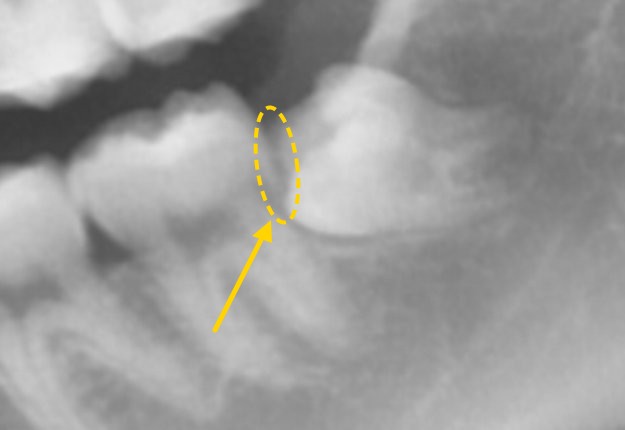
Part of a panoramic X-ray · Yellow markings addedThe gap between a lower wisdom tooth lying toward the molar in front and the back of that molar
When a wisdom tooth lies sideways toward the molar in front, a narrow gap forms between the two teeth. A toothbrush cannot reach this gap, so food and bacteria build up, and decay or bone loss at the back of the molar in front is difficult to see from the outside. If decay on the back of that molar becomes deep, it may need root canal treatment or a crown even after the wisdom tooth is removed, so it is worth checking this gap before symptoms appear.
What is the difference between removing it now and monitoring it?
Removal can reduce the risk of damage to the molar in front or gum inflammation caused by the wisdom tooth, but swelling, pain and complications after surgery must also be considered. Keeping it avoids the burden of surgery, but requires regular comparison of X-rays.
| Item | Extraction now | Keeping it with regular checkups |
|---|
| Benefits | Reduced risk of damage to the molar in front and gum inflammation around the wisdom tooth; recovery tends to be faster at a younger age | No surgical burden or surgical complications |
| Risks | Swelling, pain, dry socket and, rarely, altered nerve sensation[3] | If problems develop later, extraction may be needed at an older age |
| What is needed | Panoramic X-ray, CT if close to the nerve, and 2~3 days of flexibility in your schedule | X-ray comparisons every 1~2 years and brushing behind the wisdom tooth |
| Korean National Health Insurance | Extraction, necessary CT and medication are covered | Checkup X-rays are covered |
Why does age matter? Complications from wisdom tooth extraction tend to increase with age.[3] As roots finish developing and bone becomes harder, surgery takes longer and recovery slows. The late teens to early twenties, before the roots are fully formed, are known as a period when the bone is softer and recovery is faster. That is why removing wisdom teeth likely to cause problems eventually, such as partially impacted teeth, tends to be less burdensome in your twenties. Conversely, if you are already in your 40s~50s and a wisdom tooth lies quietly buried in bone, it is often preferable to leave it alone.
What do we check in the treatment room?
On a panoramic X-ray, we look at the direction and depth of the wisdom tooth, the back of the molar in front, and its relationship to the nerve canal. If it appears to overlap the nerve, we use 3D CT to check the actual distance.
Panoramic X-ray
A single panoramic X-ray (Korean) shows the direction and depth of all four wisdom teeth and the shape of their roots. The back of the molar in front and the nerve canal, which are central to wisdom tooth problems, cannot be seen by looking inside the mouth, so an X-ray is needed. These are the areas we examine on it.
- The gap between the wisdom tooth and the molar in front, and decay and bone height at the back of that molar
- Whether the roots of a lower wisdom tooth appear to overlap the nerve canal inside the lower jaw
- The distance between the roots of an upper wisdom tooth and the hollow space beside the nose (maxillary sinus)
- Whether there is a dark area around the wisdom tooth (suggesting a cyst)
3D CT
If the roots and the nerve canal appear to overlap on a panoramic X-ray, or if the white border of the canal appears interrupted near the roots, we consider this a sign of a higher risk of nerve injury. In that case, we use 3D CT to check the actual distance and positions of the roots and the nerve canal in three dimensions before deciding whether and how to extract the tooth.
Examination inside the mouth
We check whether the gum partly covering the tooth is swollen or tender when pressed, whether the opposing upper wisdom tooth is biting the lower gum, and whether a toothbrush can reach the back of the wisdom tooth. We also ask about your medications and existing medical conditions at this stage.
What happens if a wisdom tooth close to the nerve develops a problem?
Because the risks of extraction and the risks of keeping it conflict, we consider other options as well before deciding. A typical example is a wisdom tooth very close to the nerve that repeatedly becomes inflamed. In such cases, we also explain a method of removing only the upper part while leaving part of the roots close to the nerve (coronectomy), as well as referral to an oral and maxillofacial surgeon.
If the roots of a lower wisdom tooth are close to the nerve, sensation in the lower lip and chin may become reduced after extraction. In most cases, it returns within a few weeks to a few months, but rarely it may last longer. A nerve that supplies sensation to the tongue also passes along the inner side of the extraction site, so tongue sensation or taste may rarely change as well. If the roots of an upper wisdom tooth are close to the maxillary sinus, a small opening connecting the nose and mouth may form after extraction, so we advise you not to blow your nose forcefully for a few days.
If you are taking osteoporosis medication, please be sure to tell us before extraction, and do not stop it on your own. For medication that affects bone healing, we consult the prescribing physician to decide the timing and method of extraction.
How long does treatment take, and how many visits are needed?
If you decide to monitor the tooth, we compare X-rays every 1~2 years. If you decide to have it removed, the sequence is consultation and imaging, extraction, and stitch removal.
- Consultation and imaging — We assess the tooth on a panoramic X-ray and add CT if it appears to overlap the nerve.
- When there is inflammation — If the gum is very swollen, anesthesia may not work well and infection may spread, so we first settle the inflammation with cleaning and medication before extraction. The usual wait is 1~2 weeks.
- Extraction — An upright wisdom tooth takes 10~20 minutes, a partially impacted tooth 20~40 minutes, and a fully impacted tooth around 30~60 minutes.
- Stitch removal — If stitches were placed, we remove them around 1 week later and check healing.
- When removing several teeth — Upper and lower wisdom teeth on the same side are often removed together. Removing both sides at once makes eating difficult for a few days, so the other side is treated 1~2 weeks later.
Swelling after extraction of an impacted wisdom tooth is greatest on days 2~3 and then subsides, so avoid scheduling it during a week with a presentation or another important event. Care after extraction is covered in Precautions after wisdom tooth extraction. Treatment fees are listed in the fee list (non-covered fees).
Frequently asked questions
Q. Do some people have no wisdom teeth?
Yes. Some people never develop wisdom teeth, and in many other cases the teeth are simply buried in bone and cannot be seen inside the mouth. Not seeing them does not mean they are absent, so we check with a panoramic X-ray.
Q. Are the criteria different for upper and lower wisdom teeth?
Upper wisdom teeth are generally easier to remove because the bone is relatively soft and there is no nerve canal issue. However, if a lower wisdom tooth is removed and the upper one is left, the upper tooth has no opposing tooth to bite against and may move downward, causing cheek biting or food trapping, so we assess them together.
Q. Must wisdom teeth be removed before orthodontic treatment?
There is no clear evidence that wisdom teeth are a main cause of front tooth crowding. In a randomized study comparing lower front tooth crowding in people whose wisdom teeth were removed and those who kept them, the difference between the groups was not clinically meaningful,[4] and a systematic review of related studies also found insufficient evidence for removing wisdom teeth to prevent front tooth crowding.[5] If the orthodontic plan needs space or the teeth interfere with tooth movement, we decide together with the clinician providing your orthodontic treatment.
Q. Is it better to have them removed before planning a pregnancy?
During pregnancy, hormonal changes can make gum inflammation worse, and there are limitations on medication and X-rays. If you have a history of inflammation around a partially impacted wisdom tooth, we recommend having its condition checked before pregnancy.
Q. Can a decayed wisdom tooth be filled and kept?
A wisdom tooth that has grown in straight and can be reached with a toothbrush and treatment instruments can sometimes be filled and kept. If instruments cannot easily reach it at the very back, or if the area would still be hard to clean and prone to further decay after filling, we also consider extraction.
Q. How can I have my wisdom teeth checked near Bongcheon Station?
You can have them checked with a panoramic X-ray at Joy Dental Clinic Bongcheon (Bongcheon Station, Exit 1, 5F Jehyeong Bldg.). If you have previous X-rays, bringing them helps us compare changes.
Limits of the evidence
- The systematic review comparing removal and retention of asymptomatic impacted wisdom teeth[1] could not conclude which was preferable because there were few well-designed comparative studies.
- The association between retained wisdom teeth and disease in the molar in front[2] comes from an observational study following a specific population. It does not prove that wisdom teeth are the cause and cannot readily be applied to everyone.
- The relationship between age and complications[3] is based on a review of multiple studies. Even at the same age, the risk differs according to wisdom tooth position and general health.
- The orthodontic studies[4][5] examined only front tooth crowding and did not address cases where space is needed for an orthodontic plan.
DOCTOR’S NOTE
I do not decide whether to keep or remove a wisdom tooth solely on whether it hurts now. Looking at the X-rays together, I point out whether damage has begun at the back of the molar in front and how close the roots of a lower wisdom tooth are to the nerve. Based on those findings, I decide whether removal now is preferable or whether to keep the tooth and compare X-rays every 1~2 years.
— Jeong Jinwoo, Director, Joy Dental Clinic Bongcheon
This post reflects information as of the date of writing and was written to provide general information in compliance with Korea’s Medical Service Act and the Ministry of Health and Welfare’s medical advertising guidelines. Wisdom tooth extraction can have side effects such as bleeding, swelling, pain and infection, and in rare cases nerve damage (altered sensation) can occur. Individual diagnosis and the direction of treatment depend on the condition of your mouth, so please be sure to consult fully with your treating clinician before deciding.
We are right next to Exit 1 of Bongcheon Station (Line 2), and directions from Seoul Nat’l Univ. Station, Sillim, Nakseongdae and Sadang are in Getting here.
Joy Dental Clinic Bongcheon
5F Jehyeong Bldg., 1738 Nambusunhwan-ro, Gwanak-gu, Seoul (Bongcheon Station, Exit 1)
Hours: Mon·Wed·Thu·Fri 09:30–18:30 / Tue 09:30–20:30 / Sat 09:30–13:30 (closed Sun & public holidays)
Booking: Naver Booking / Phone 02-877-2867
Related pages: Wisdom tooth extraction guide · My wisdom tooth hurts · Impacted wisdom teeth (Korean) · Pericoronitis (Korean)
References
- Ghaeminia H, Nienhuijs ME, Toedtling V, et al. Surgical removal versus retention for the management of asymptomatic disease-free impacted wisdom teeth. Cochrane Database Syst Rev. 2020;5(5):CD003879. — [Systematic review] Cochrane review: insufficient evidence to conclude whether preventive removal or retention is preferable for asymptomatic, disease-free impacted wisdom teeth.
- Nunn ME, Fish MD, Garcia RI, et al. Retained asymptomatic third molars and risk for second molar pathology. J Dent Res. 2013;92(12):1095-1099. — [Cohort study] Retained asymptomatic wisdom teeth, especially partially impacted teeth, were associated with an increased risk of decay and alveolar bone loss at the back of the molar in front (the second molar).
- Bouloux GF, Steed MB, Perciaccante VJ. Complications of third molar surgery. Oral Maxillofac Surg Clin North Am. 2007;19(1):117-128. — Overview of wisdom tooth extraction complications (dry socket, infection and altered nerve sensation). Complication risk increases with age.
- Harradine NW, Pearson MH, Toth B. The effect of extraction of third molars on late lower incisor crowding: a randomized controlled trial. Br J Orthod. 1998;25(2):117-122. — [Randomized clinical trial] Randomized controlled study: the difference in late lower front tooth crowding between the extraction and retention groups was not clinically meaningful, making extraction to prevent this difficult to justify.
- Zawawi KH, Melis M. The role of mandibular third molars on lower anterior teeth crowding and relapse after orthodontic treatment: a systematic review. ScientificWorldJournal. 2014;2014:615429. — [Systematic review] Insufficient evidence that lower wisdom teeth cause front tooth crowding or relapse after orthodontic treatment, making preventive extraction for these reasons difficult to recommend.


 한국어
 日本語
 简体中文