💡 Key answer
Pain with a new denture is most often due to excessive pressure at one spot, an uneven bite or inflammation of the gums beneath the denture, and most cases improve with denture adjustment and care. If there is a sharp pain at one spot, we first suspect a pressure spot; if it hurts only when chewing or the pain moves around, the bite; and if the whole area touching the denture is red and burning, inflammation. Continuing to wear it through the pain makes the sore deeper, so the next step when it hurts is to come in for an adjustment.
Summary for patients
- Use your finger or a mirror to remember where it hurts.
- If you can tolerate wearing it, wear your denture for a few hours before coming in.
- Do not grind or trim your denture yourself at home.
- Take your denture out at bedtime, clean it and leave it soaking in water.
❓ What this article covers
- Is it common for a new denture to hurt?
- What do we suspect if there is a sharp pain at one spot?
- What do we suspect if it hurts only when chewing or the pain moves around?
- What do we suspect if all the gums touching the denture are red and burning?
- Can you get some idea of the cause at home?
- What do we check in the treatment room?
- Are there cases that do not improve with adjustment?
- How many adjustments are needed, and over how long?
Is it common for a new denture to hurt?
Yes, it is common to develop one or two sore spots within the first few weeks. A denture is made of a hard material, while the gums underneath are soft tissue, so no matter how accurately the impression is taken, some spots come under particularly heavy pressure when chewing force is applied.
In a study that followed 122 new complete dentures after placement, sores were common where the denture borders touched, such as the gum fold on the cheek side in the upper jaw and the inner fold toward the back of the tongue in the lower jaw, and they occurred more frequently in the lower jaw.[1] The researchers concluded that the day the denture is fitted should not be regarded as the end of care, and that subsequent adjustment visits should be considered part of treatment.
There is a reason lower dentures hurt more. The lower jaw has a smaller gum surface to support the denture than the upper jaw, and the tongue and lip muscles next to it move constantly, making the denture rock. The same force falls on a smaller area, so pressure spots develop more easily.
However, being common does not mean you should simply put up with the pain and keep wearing it. A pressure spot is red at first, then develops a whitish sore; if force continues to fall on it, the sore gets deeper and takes longer to heal.
What do we suspect if there is a sharp pain at one spot?
If you can pinpoint the pain to one spot, the inner surface or border of the denture is often pressing too hard on that area.
Why it happens — The thickness and firmness of the gums vary from place to place. Force becomes concentrated where the gums covering the bone are thin, where bone protrudes, or where the denture border extends down into the fold where muscles move. A recent extraction site is more easily pressed because the gums are still healing and changing shape.
How to tell
- It hurts in the same place each time.
- In a mirror, that spot looks red or has a whitish sore in the center.
- It hurts more the longer you wear the denture and when you chew.
- It feels much better when you take the denture out.
How we approach it — We find the pressure spot and trim a little from just that part of the inner surface, or shorten a border that is too long. The force on that spot is reduced from the day it is adjusted.
What do we suspect if it hurts only when chewing or the pain moves around?
We suspect that one side touches first when the upper and lower dentures meet, causing the denture to shift.
Why it happens — When you close your mouth, the upper and lower artificial teeth need to touch evenly on both sides for the dentures to seat in place. If one tooth touches first, the denture slides toward the opposite side and presses on gums away from the actual problem area. This is why the pain can move elsewhere even after trimming. If the bite height is set too high, the gums and jaw also remain under pressure without a chance to rest.
How to tell
- It feels fine when you are just wearing the denture, but hurts when you chew.
- The painful spot is a little different each day.
- When you chew on one side, the denture on the other side rocks upward.
- The upper and lower teeth click together when you speak, or your jaw aches by evening.
How we approach it — We ask you to bite on thin colored paper (articulating paper) to find the teeth that touch first, and grind those areas so both sides touch evenly. A study of 99 denture wearers also found lower satisfaction with chewing when the bite height was excessively high.[2] If the height itself is wrong, this is beyond what grinding alone can correct, so we consider recording the height again and rearranging the artificial teeth.
If repeated biting of the inner cheek or tongue causes pain, we also check the bite and the arrangement of the artificial teeth. If the molars sit too far toward the cheek or are arranged too narrowly toward the tongue, soft tissue gets caught during chewing. In this case, we round off the edges of those teeth, and if the arrangement itself is the problem, we consider rearranging them or remaking the denture. It sometimes settles on its own as the muscles get used to the new denture, so if you have bitten yourself only once or twice, we may watch for a few days.
What do we suspect if all the gums touching the denture are red and burning?
If a broad area covered by the denture is evenly red, rather than a single spot, we first suspect inflammation of the gums beneath the denture (denture stomatitis).
Why it happens — Saliva does not circulate easily between the denture and the gums, making it easy for bacteria and fungi (Candida) to grow. If you sleep with your denture in or only rinse the inner surface with water, this film gets thicker. It is common enough to be reported in 15% to over 70% of denture wearers across studies, with wearing dentures overnight and inadequate cleaning identified as major factors.[3]
How to tell
- A broad area is red, such as the roof of the mouth covered by the upper denture.
- It burns or stings rather than causing a sharp, pinpoint pain.
- It gets worse the longer you wear the denture.
- Cracks at the corners of the mouth or bad breath may also develop.
How we approach it — We start with taking the denture out at bedtime to rest the gums, brushing the inner surface with a denture brush, and using denture cleanser according to the product instructions before storing the denture in water.[4] Ordinary toothpaste contains abrasives that make fine scratches on the denture surface where microbes can attach more easily, so it should not be used on dentures. If a fungal infection is suspected, we also prescribe antifungal medication. The fit of the denture needs to be checked again after the inflammation settles to assess it accurately. A denture fitted over swollen gums becomes loose again once the swelling goes down.
Can you get some idea of the cause at home?
To some extent, yes. Remembering the pattern of pain before you come in helps us find where to adjust.
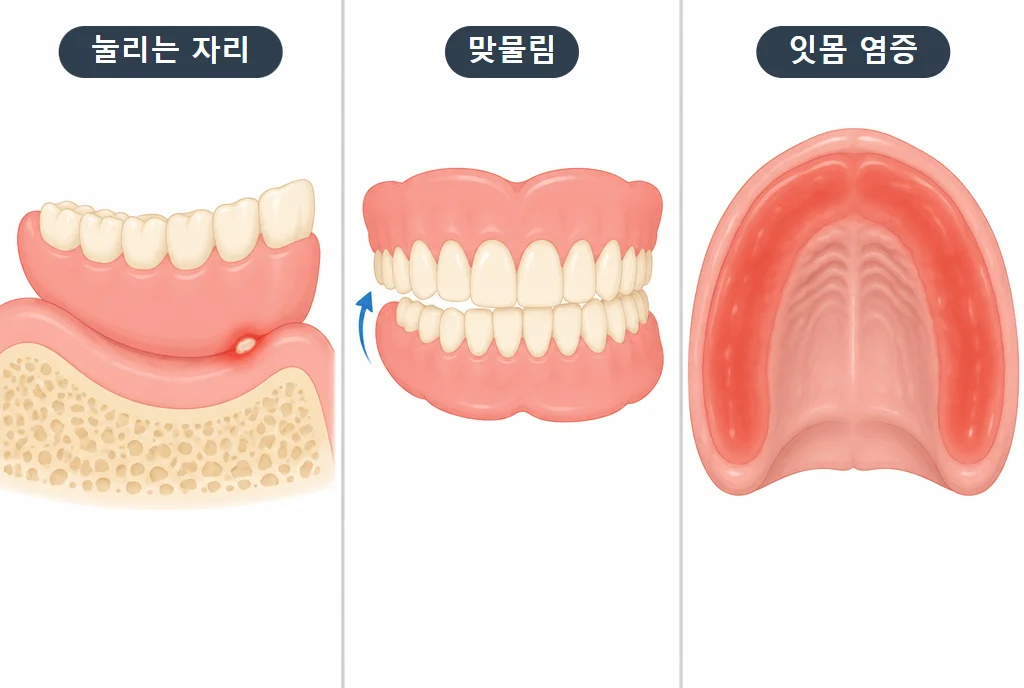
AI-generated explanatory illustrationFrom left: pressure spot (the denture border presses on one point of the gum) · bite (one side touches first and lifts the denture) · gum inflammation (the whole roof of the mouth covered by the denture is red)
| Pattern of pain | Suspected cause | Approach |
|---|
| Sharp pain at the same spot, with a whitish sore | Pressure spot | Trim the inner surface or border at that spot |
| Pain only when chewing, with the painful spot moving around | Bite | Grind the teeth that touch first; record the height again if needed |
| Redness and burning over a broad area | Gum inflammation | Advice on cleaning and removal at night; antifungal medication if needed |
It is also common for two causes to overlap in one person. For example, an uneven bite may keep pressing on the gums on one side, which then develop a sore and become inflamed. Use the table only as a guide to what might be happening; the decision is made after we look directly in the treatment room.
Before coming in for an adjustment
- Wearing your denture for a few hours before coming in leaves pressure marks on the gums, making it easier to find the areas that need adjustment.
- If it hurts too much to wear, leave it out. In that case, make a note of where and when it hurt (when chewing, immediately after putting it in, and so on) and bring it with you.
- Do not trim your denture yourself with sandpaper or a knife. Once a surface has been trimmed, it is difficult to restore, and trimming the wrong spot makes the denture loose.
- Please also avoid using a lot of adhesive to put up with the pain. It only raises the height while leaving the pressure spot unchanged.
What do we check in the treatment room?
We check the condition of the gums where it hurts, then how the denture presses on that area.
The gums
With the denture removed, we look at the location and extent of red, sore and swollen areas. This is where we distinguish between a single spot and a broad area. We also check whether the shape of the sore follows the line of the denture border. We may ask you to put the denture back in, bite gently and point with your finger to the spot that hurts most.
The inner surface of the denture
We apply a thin layer of paste that shows pressure (pressure-indicating paste, PIP) to the inside of the denture, then put it in and take it out. Where the pressure is heavy, the paste is displaced, revealing the spot. We trim only the areas found this way.
The bite
We ask you to bite on articulating paper to see where the upper and lower teeth touch, and check whether the opposite side lifts when you chew on one side. We also listen for clicking when you speak.
For a partial denture, the teeth holding the clasps
When a partial denture hurts, the teeth holding the clasps are sometimes the cause. We check whether those teeth are loose or sensitive, and whether the clasps grip them too tightly.
Are there cases that do not improve with adjustment?
Yes. If the cause cannot be resolved by trimming, we move on to other methods.
- If the bite height or the position of the artificial teeth is substantially off — We consider recording the height again and rearranging the artificial teeth, or remaking the denture.
- If sharp bone remains beneath the denture — If a sharp point of bone remains at an extraction site, that spot may keep hurting no matter how much the denture is trimmed. We check with an X-ray and assess whether a minor procedure to smooth the bone is needed.
- If the jawbone has shrunk considerably and is thin — Particularly in the lower jaw, the gum surface supporting the denture is small, concentrating force in a narrow area. We discuss placing a soft material inside the denture or an implant overdenture (Korean), which uses a few implants to hold the denture in place.
- A sore that has not healed after 2 weeks — If the sore remains even after the area causing it has been adjusted, we also need to check for the possibility of a condition unrelated to the denture. If needed, we refer you to a facility that can perform a biopsy.
- If your mouth is very dry — With little saliva, the gums develop sores more easily and the denture does not stay in place well. We assess this together with the medications you take.
How many adjustments are needed, and over how long?
New dentures often need several adjustments during the first few weeks, and the number and spacing of visits depend on the cause of pain and the condition of the gums. In a study that followed new complete dentures, 87% of dentures needed adjustment at week 1 after placement, 50% at week 2 and 7% at week 3, with no further visits afterward.[1] If there are only one or two pressure spots, one visit may be enough; if the bite also needs adjusting or we need to wait for inflammation to settle, you may need a few more visits. With a denture placed on the day teeth are extracted (an immediate denture), the gums change shape over several months as they heal, so adjustments and filling in the inner surface (relining) are needed more frequently during that time.
We plan to cover the overall adaptation period and daily life during the first few weeks separately. Treatment fees are listed in the fee list (non-covered fees).
Frequently asked questions
Q. Can I take painkillers and keep wearing the denture when it hurts?
Even if painkillers reduce the pain, the pressure remains, so the sore keeps getting larger. Please think of painkillers only as a way to manage until you come in for an adjustment.
Q. Can I just leave the denture out while it hurts?
It is fine to leave it out for a day or two to let the gums rest. However, leaving it out for a long time delays the muscles getting used to it, and the pressure marks that help us find where to adjust also disappear. On the day of your adjustment, wear it for a few hours before coming in if you can tolerate it.
Q. Why does only my new denture hurt when my old one did not?
A denture you have worn for a long time has been adjusted repeatedly to fit your gums, and your gums are used to its shape. A new denture is made from scratch to fit the changed gums, so the same process starts again. If the height of the new denture differs from the old one, that difference may also make it feel unfamiliar and painful.
Q. Will putting a soft material in the denture make it hurt less?
It may help people whose gums are thin or whose bone is sharp. However, bacteria attach easily to soft materials, and the material hardens or comes off over time, so it needs frequent replacement. We first adjust the pressure spots and bite, then decide whether it is needed.
Q. Can I put an oral ointment on the sore spot?
An ointment may temporarily reduce stinging at the sore, but the cause of the pressure remains. A thick layer of ointment inside the denture may lift it and cause it to press on other spots. On the day you come in for an adjustment, please do not apply it so that the pressure marks are visible.
Q. The sore spot has turned white. Is that okay?
When the surface at a pressure spot breaks down, it often looks white. After adjusting that area, we usually watch to see whether it settles within a few days. If it is unchanged after 2 weeks, we check it again.
Q. Can I have a denture made elsewhere adjusted near Bongcheon Station?
Yes, you can have it adjusted. At Joy Dental Clinic Bongcheon, we check pressure spots and the bite in the same way even if the denture was made elsewhere. However, we can tell you whether the denture itself needs to be remade only after examining it directly.
Limits of the evidence
- The study of sore locations[1] observed people with new complete dentures at one university hospital, so its findings cannot be applied directly to partial dentures or other clinical settings.
- The study on the relationship between bite height and satisfaction[2] was conducted at one point in time, so it did not prove that the height caused discomfort.
- The prevalence of denture stomatitis[3] varies widely because the populations and diagnostic criteria differ between studies.
- The severity of pain and the speed of healing vary from person to person according to gum thickness, remaining bone, the amount of saliva and systemic conditions.
DOCTOR’S NOTE
On the day I fit a new denture, I also schedule the next adjustment visit. I consider seeing you a few more times during the first few weeks part of denture treatment, so that if a sore spot develops, I can adjust it on the day you come in.
— Jeong Jinwoo, Director, Joy Dental Clinic Bongcheon
This post reflects information as of the date of writing and was written to provide general information in compliance with Korea’s Medical Service Act and the Ministry of Health and Welfare’s medical advertising guidelines. Denture use may have side effects such as pressure on the gums, ulcers, inflammation and strain on the teeth holding the clasps of a partial denture. Individual diagnosis and the direction of treatment depend on the condition of your mouth, so please be sure to consult fully with your treating clinician before deciding.
We are right next to Exit 1 of Bongcheon Station (Line 2), and directions from Seoul Nat’l Univ. Station, Sillim, Nakseongdae and Sadang are in Getting here.
Joy Dental Clinic Bongcheon
5F Jehyeong Bldg., 1738 Nambusunhwan-ro, Gwanak-gu, Seoul (Bongcheon Station, Exit 1)
Hours: Mon·Wed·Thu·Fri 09:30–18:30 / Tue 09:30–20:30 / Sat 09:30–13:30 (closed Sun & public holidays)
Booking: Naver Booking / Phone 02-877-2867
Related pages: Denture treatment guide · Denture guide · What to check when your denture keeps moving · Treatment fees
References
- Kivovics P, Jáhn M, Borbély J, Márton K. Frequency and location of traumatic ulcerations following placement of complete dentures. Int J Prosthodont. 2007;20(4):397-401. — [Cohort study] Observation of adjustment visits after placement of 122 new complete dentures in 61 patients. Sores were common in the buccal sulcus in the upper jaw (41%), and in the retromylohyoid region (17%), lingual sulcus (14%) and buccal sulcus (13%) in the lower jaw, and were more frequent in the lower jaw. Adjustments were needed for 87% of dentures at week 1, 50% at week 2 and 7% at week 3 after placement, with no additional visits afterward. The authors concluded that placement should not be regarded as the end of care and that adjustment visits should be included in the treatment process.
- Bilhan H, Erdogan O, Ergin S, Celik M, Ates G, Geckili O. Complication rates and patient satisfaction with removable dentures. J Adv Prosthodont. 2012;4(2):109-115. — [Cross-sectional study] 99 removable denture wearers. Loss of retention, gum ulcers and an excessively high bite were associated with lower satisfaction with chewing, and ulcers were also associated with lower satisfaction with speech.
- Gendreau L, Loewy ZG. Epidemiology and etiology of denture stomatitis. J Prosthodont. 2011;20(4):251-260. — [Systematic review] The prevalence of denture stomatitis ranged from 15% to over 70% across studies. Sleeping with dentures in, inadequate cleaning and Candida (a fungus) were major factors.
- Felton D, Cooper L, Duqum I, et al. Evidence-based guidelines for the care and maintenance of complete dentures: a publication of the American College of Prosthodontists. J Prosthodont. 2011;20(Suppl 1):S1-S12. — [Guideline] American College of Prosthodontists guidelines for complete denture care. Daily cleaning, removal during sleep and regular checkups are recommended.


 한국어
 日本語
 简体中文