Dentures: Types, How to Choose, Adjusting, Side Effects, Costs and Care at a Glance
A denture guide covering the difference between partial and complete dentures, how to choose between dentures and implants, the adjustment period, side effects such as looseness and stomatitis, Korean national health insurance conditions (age 65 or older, once every 7 years) and how to care for dentures, all in one article.
Director Jeong Jinwoo · Published 2026.09.09 · Updated 2026.10.12
At a glance
A denture is a removable prosthesis (one you take out and put back in) that rests on the gums and remaining teeth to restore chewing. If some teeth remain, it is a partial denture; if one jaw (upper or lower) has no teeth at all, it is a complete denture.
Whether to choose a denture or an implant depends on the amount of jawbone, your general health, the number of remaining teeth and how you can manage care. Before deciding, we look at the panoramic X-ray and models together with you.
Getting used to a new denture usually takes a few weeks, and during that time we adjust pressure spots several times.
A denture becoming loose after a few years is not a defect; it happens because the jawbone keeps shrinking. In most cases this can be managed with a reline (refitting the inner surface) and habits of cleaning and removing the denture at night.
Korean national health insurance applies from age 65 or older, once every 7 years per jaw, with a 30% co-payment, and maintenance such as relines and repairs is also covered within set limits on the number of times.[8]
If a complete lower denture keeps lifting even after adjustment, a denture held in place by 2 implants is an alternative.[7]
What this guide covers
The structure of, and differences between, partial, complete and implant-supported dentures
How to choose between dentures and implants
What we check and look at together with you before making a denture
The making process, how long it takes, and getting used to it when you first wear it
Why side effects such as looseness, stomatitis, pressure ulcers and problems with clasped teeth occur, and how they are checked
How to care for dentures, and when to reline or remake them
Korean national health insurance conditions and the factors that affect cost
Cases where a denture may not be suitable, and other options
22 frequently asked questions and questions to ask at your consultation
What types of dentures are there?
Partial denture
It is held in place by clasps or special attachments on the remaining teeth, and the missing areas are filled with artificial teeth and gum-colored resin. Because the remaining teeth support the denture, it generally stays in place better than a complete denture. However, the teeth that carry clasps take more force, so the gums and roots of those teeth also need to be looked after. The design and components are explained separately in the entries on partial dentures (Korean) and clasps (Korean).
Figure cited from an external paper · Not a case from our clinicA figure showing the parts of a partial denture (clasps, rests, connector, artificial teeth and denture base).Zhu et al. · Figure 1 · DOI: 10.3389/fdmed.2025.1667504 · CC BY 4.0 · Korean labels added
Complete denture
When a jaw has no teeth at all, the denture is fitted closely against the gums (the alveolar ridge) and the palate. In the upper jaw, the whole palate acts as a suction surface, so it stays on relatively well; in the lower jaw, the space where the tongue and muscles move is narrow, so it is comparatively easy to feel loose. The structure and materials are in the entry on complete dentures (Korean).
Implant denture (implant-supported denture)
When a complete denture keeps moving and is uncomfortable, 2 or more implants are placed in the jawbone and the denture is held on them with devices such as snap-on attachments (Locators). Chewing force and stability improve, but the implant placement procedure and its cost are added. For a fully toothless lower jaw, there is an international consensus proposing the two-implant-supported denture as the first-choice standard.[7] More details are in implant overdenture (Korean).
Dentures or implants: how do I choose?
We look at five things together: the amount of jawbone, your general health, the number of missing teeth, the treatment period and how you can manage care. No single one of these decides it.
Criterion
Toward a denture
Toward a fixed implant
Remaining jawbone
Much bone loss has occurred
Enough height and width for placement remains
General health and medications
Surgery would be a heavy burden
Surgery can be managed
Number of missing teeth
Several to all
One to several (by area)
Treatment period and process
Short and non-surgical
Several months, including the osseointegration period
Care
Remove and clean daily, periodic adjustment
Cared for like natural teeth, regular checkups
The table shows general tendencies, not absolute rules. There are certainly cases where a denture is the better choice: when surgery is a burden because of general health, when several teeth need to be dealt with at once, or when cost and treatment time need to be reduced. If many teeth remain and only a few are missing, an implant or a bridge (Korean) may be the simpler choice; an article comparing the three is Are there options other than implants? (Korean).
What do we check and show you before making a denture?
Before deciding on a denture, Joy Dental Clinic Bongcheon looks at the panoramic X-ray and models together with you and checks the items below. Problems we can foresee at this stage are reflected in the design.
What we check
Why we look at it
What changes depending on the result
Height and shape of the jawbone
How well the denture will hold and how quickly it will lift
Complete denture vs implant-supported denture
Condition of the remaining teeth (partial denture)
Whether a tooth can carry a clasp
Clasp position, whether the abutment teeth need treatment first
Relationship between the upper and lower jaws
Whether the structure makes a lower denture tend to lift
Extent of the denture, whether 2 implants are recommended
Saliva flow, medications
A dry mouth makes the denture lift and stomatitis more likely
Need for adhesive, guidance on moisturizing
Previous denture (if any)
What was uncomfortable
Changes to thickness, extent and arrangement of artificial teeth
General health, hand movement
Whether you can remove and clean it yourself
Simplified design, guidance for caregivers
In what order is a denture made, and how long does it take?
From diagnosis to fitting there are usually five steps; including adjustments after fitting, it takes a few weeks, and longer if extraction or gum treatment is needed first.
Diagnosis and consultation — We check the remaining teeth and the jawbone and decide on the type. If needed, extraction or gum treatment is done first.
Impressions — An impression of the gums is taken. For complete dentures, a custom tray is sometimes made separately for a precise impression.
Bite registration — We record the height and position at which the upper and lower teeth meet.
Completion and fitting — After corrections, the final denture is fitted.
Getting used to it and adjustment — Over a few days to a few weeks after fitting, pressure spots are smoothed several times.
If extraction or gum treatment comes first, the period is extended accordingly. Right after extraction, an immediate denture is sometimes made first to use temporarily while the gums heal.
What discomfort is there at first, and when does it get better?
A foreign-body feeling, changes in speech and extra saliva usually lessen within 1–2 weeks; pain in a specific spot improves right away with adjustment, so do not just put up with it.
Foreign-body feeling, unclear speech — Usually lessens over 1–2 weeks. Sounds such as “s” and “ch” may feel awkward, and practicing reading aloud helps. If nothing has changed after a few months, we adjust the denture thickness or the position of the front teeth.
Extra saliva, gagging — Common with complete upper dentures that cover the palate, and settles within a few days.
Dulled taste — This happens because the upper denture covers the palate, reducing the sense of temperature and texture. Most people adapt, but if it is severe we consider a design that covers less of the palate.
Pain in a specific spot (pressure ulcer) — A spot where the denture edge or a particular point presses too hard on the gum. Do not put up with it; come in and we smooth just that spot, which usually takes only a few minutes. If you keep wearing it while it hurts, the ulcer gets deeper.
Looseness — Early on, it happens because the muscles are not yet used to the denture; later, it happens because the jawbone shrinks. This is explained separately below.
What side effects can dentures have?
Most denture side effects occur not because “the denture was made wrong” but because the jawbone keeps shrinking and the mouth changes. The table below sums up the problems worth knowing about in advance.
Problem
When it occurs
How common
Signs you may notice
What the director checks
Loosening
Months to years after fitting
Can occur with changes in the jawbone[2]
Lifts when speaking, food gets underneath
Jawbone changes, fit of the denture’s inner surface, whether a reline is needed
Denture stomatitis
Any time after fitting
15–70% or more of wearers[4]
Gums under the denture are red and sting, bad breath
Extent of redness, presence of Candida, night wear and cleaning habits
Pressure ulcer
Right after fitting, or after loosening
Common during the adjustment period
A specific spot is sore and raw
Pressure point, length of the denture edge
Loosening or decay of clasped teeth
Years after fitting
A common issue with partial dentures
The clasped tooth is sensitive or loose
Mobility of the abutment tooth, gums, decay
Fracture, wear of artificial teeth
Years after fitting
Increases with years of use
Cracks in the denture, chewing surfaces become flat
Fracture lines, bite height
Changes in taste or speech, gagging
Right after fitting
Common during the adjustment period
Food tastes dull, “s” sounds come out unclear
Denture thickness and extent, progress in adapting
The figures in the table vary widely because each study uses different subjects and criteria. They are for reference, not absolute values.
Why do dentures become loose?
Jawbone that has lost its teeth gradually shrinks whether or not you wear a denture. The denture stays the same while the bone supporting it gets lower, so a gap forms. A systematic review found that in the first 6 months after extraction, bone width decreases by about 29–63% and height by about 11–22%,[3] and a classic study that followed complete denture wearers for 25 years found that loss of bone height in the front of the lower jaw was about 4 times that of the upper jaw.[2] So a denture that fit well becoming loose after a few years is not a defect but an expected change, and lower dentures lift sooner than upper ones.
Why do denture stomatitis and pressure ulcers occur?
Denture stomatitis (Korean), in which the gums under the denture become red and swollen, is very common among denture wearers, and the main causes are sleeping with the denture in and insufficient cleaning. A literature review reported prevalence ranging from 15% to over 70%, with bacterial film and fungus (Candida) on the inner surface of the denture irritating the gums.[4] It is often painless, so people may not notice it until it is discovered through bad breath or cracks at the corners of the mouth. In most cases it improves by correcting habits of removing the denture at night and cleaning it, with antifungal treatment added if needed.
Sleeping with your denture in is not only a problem for the gums. In a study that followed older adults for 3 years, those who slept with their dentures in had about 2.3 times the risk of developing pneumonia.[5] This is because bacteria on the denture can enter the airway. Pressure ulcers are common while getting used to a new denture, and can also occur when a loose denture moves. The quickest fix is to point out the sore spot and have it adjusted.
What happens to teeth that carry partial denture clasps?
Teeth that carry partial denture clasps take more force supporting the denture, and food easily gets trapped around the clasps, making decay, gum disease and loosening more likely. If a clasped tooth is damaged, the whole denture may need to be redesigned, so these are the teeth that most need protecting with a partial denture. During design, we first look at which teeth to put clasps on and whether those teeth are strong enough.
At home, clean around the clasped teeth once more with an interdental brush, and at regular checkups we check these teeth for mobility and gum condition. If a clasped tooth is already weak, we consider an attachment denture (Korean), which does not use clasps, or using implants to create support points.
How long do dentures last, and when should they be relined or remade?
The denture itself can be used for a long time if it does not break, but because the jawbone changes, how long it stays “in a well-fitting state” needs to be considered separately. The American College of Prosthodontists’ guidelines recommend a checkup every year, and since the timing of a reline differs for each wearer, it is judged by fit rather than a set schedule.[6] Relines may be needed more often in the first few years, when bone shrinks quickly, and in the lower jaw.
If the artificial teeth are not badly worn and the denture has not deformed, a reline is often enough. On the other hand, when the artificial teeth wear down so the chewing surfaces become flat and the bite height drops, the lower face can look shorter and the jaw joint can be strained, so in that case we consider a remake rather than a reline. There is no fixed lifespan, but a reline or remake is often done at around 5–7 years, and the health insurance cycle is also 7 years.
How do I care for dentures at home, and what do we check at the clinic?
The two most important things at home are brushing the denture every day with a denture brush and taking it out at night to soak in water.[6]
After meals, take it out and rinse it under running water, and once a day clean it with a denture brush and a mild detergent or denture cleanser. Regular toothpaste contains abrasives that make fine scratches on the denture surface, where stains and bacteria collect.
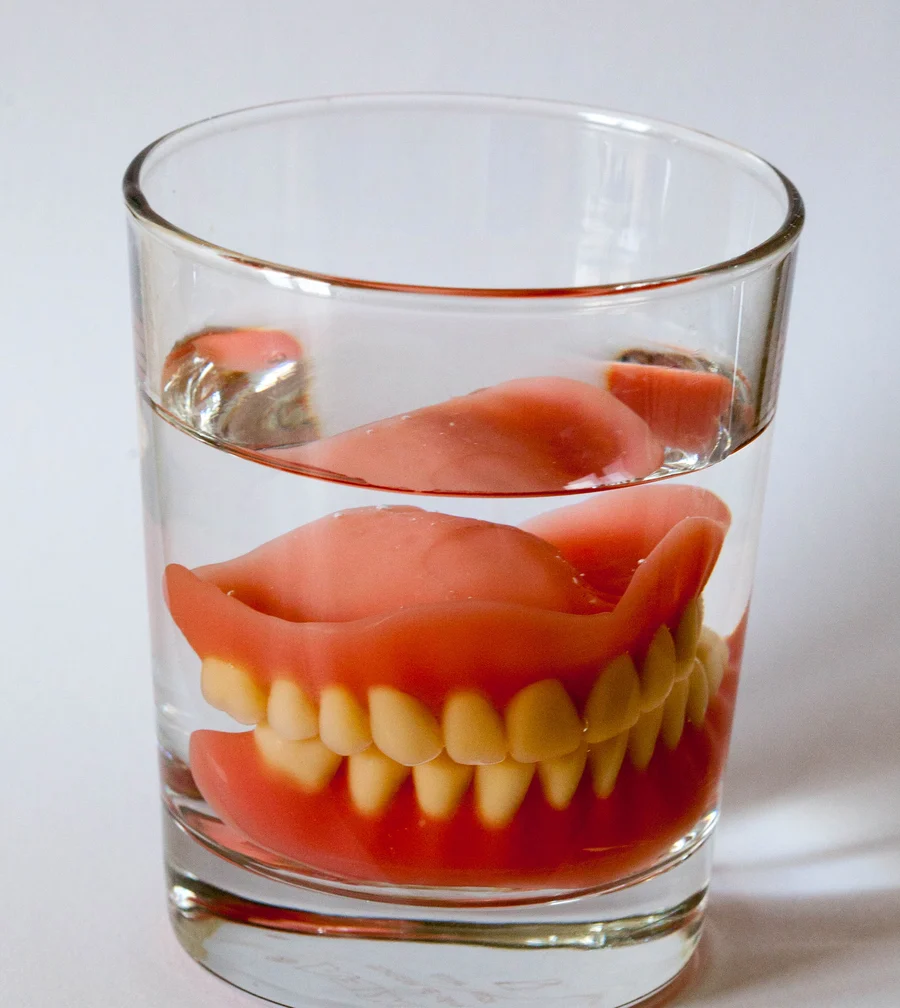
When you sleep, take it out and soak it in water or a cleaning solution. Constant pressure on the gums can speed up bone loss, so they need a few hours of rest each day. Leaving the denture dry can deform it, and soaking it in hot water as if to sterilize it deforms it with heat.
Brush your remaining teeth and gums as usual, and clean the teeth that carry partial denture clasps once more with an interdental brush.
If you leave the denture out for a long time, the shape of the gums can change so that it no longer fits when you put it back in. Even if you are not using it, have it checked regularly.
Photo cited from an external public source · Not a case from our clinicAn example photo of dentures removed for the night and soaked in water so they do not dry out.Bin im Garten, "Totalprothesen im Wasserglas" · Wikimedia Commons · Public domain · Lower part cropped
At the clinic, we adjust pressure spots within 1 week of fitting, make a few more adjustments up to 1 month, and after that check the fit, gums and remaining teeth every 6 months to 1 year. At checkups we look at three things: whether the gums under the denture are red (stomatitis), whether the denture has started lifting or pressing at any point (time for a reline), and, for a partial denture, whether the clasped teeth have become loose or decayed. If we see a problem, we tell you first. Looseness is dealt with by a reline, stomatitis by correcting cleaning and night removal, and problems with clasped teeth by treating those teeth; when caught at this stage, it is often possible to avoid making a new denture. Step-by-step care tips are explained separately in denture care (Korean).
When does health insurance apply, and what affects the cost?
Dentures under Korean national health insurance require age 65 or older, are covered once every 7 years for each of the upper and lower jaws, with a 30% co-payment, and include both resin-base complete dentures and metal-base partial dentures.[8] Maintenance items such as relines, repairs and tissue conditioning are also covered, but each item has a limit on the number of times, which we explain at your consultation. The original coverage criteria are in the National Health Insurance Service guide to denture coverage for older adults (checked 2026-10-12), and the detailed conditions are explained in denture health insurance (Korean) and detailed coverage criteria (Korean).
When it does not apply: under age 65, a remake within the insurance cycle (7 years), the implant portion of an implant-supported denture, choosing non-covered materials, and so on.
Remaking before 7 years: one additional covered remake is allowed only under limited conditions, such as when a major change in oral condition makes it medically necessary, or loss or damage caused by a natural disaster. Ordinary breakage or loss does not qualify.
Factors that affect cost: partial or complete, material (resin base, metal base, flexible material, etc.), preliminary treatment (extraction, gum treatment, immediate denture), whether implants are combined, and the scope of repair or remake for non-covered dentures. Specific amounts are explained with a range at the consultation after diagnosis.
This varies from person to person and is explained after a detailed diagnosis and consultation. Health insurance criteria may change, so we confirm the latest criteria when you visit.
When might a denture not be suitable, and what are the other options?
In the following cases, we first consider other options before a conventional denture. We set out the limits of dentures up front rather than hiding them.
When a complete lower denture keeps lifting even after adjustment — In the lower jaw, the space where the tongue and muscles move is narrow and bone shrinks quickly, so the denture tends to lift. An international consensus has set out evidence that an implant overdenture (Korean) held by 2 implants gives better chewing ability and satisfaction than a conventional denture.[7]
When strong gagging makes it impossible to wear an upper denture — We consider a design that does not cover the palate, or an implant-supported prosthesis.
When all the teeth that would carry clasps are weak — We first look at a design without clasps or implant support points.
When remaining teeth can be saved to reduce the extent of a partial denture, or when there is enough jawbone for a fixed prosthesis — we discuss those options with you first instead of a denture.
When it is hard to take the denture out and put it in yourself — A fixed prosthesis may be better; on the other hand, if cleaning is difficult, a denture you can take out to clean may be safer. We look at your living circumstances together.
Dentures cannot produce as much chewing force as natural teeth or fixed implants, so hard or sticky foods are limited, and jawbone loss continues even while wearing a denture, so loosening cannot be completely prevented. Periodic adjustment and relines are a given. Even after switching to an implant-supported denture, the part that rests on the gums is affected by bone changes and may need a reline, and the parts of the attachments are replaced periodically.
Frequently asked questions
Candidacy and choice
Q. I have no teeth top or bottom. Can I get by with complete dentures?
Many people eat their daily meals with complete dentures. However, if lack of retention in the lower jaw causes a lot of discomfort, we discuss a denture supported by 2 implants.[7]
Q. Can dentures and implants be used together?
Yes. Depending on the situation, we also use a combined approach: a fixed implant prosthesis where there is remaining bone, with the rest filled by a partial denture.
Q. How many implants are placed for an implant-supported denture?
Usually 2 in the lower jaw; in the upper jaw, 2–4 or more are considered depending on retention and bone condition. The exact number is decided after checking the bone with a CT scan.
Q. If I switch to an implant-supported denture, will looseness go away completely?
Retention improves greatly, but the part that rests on the gums is still affected by bone changes and may need a reline, and the parts of the attachments are replaced periodically. We do not tell you that it “goes away completely.”
Process and getting used to it
Q. Can I get a denture right after an extraction?
The gums need time to heal. During that time an immediate denture is used temporarily, and once the gums have settled, it is relined or a final denture is made.
Q. Will I be able to chew well right away with a denture?
At first, chewing is difficult because of the foreign-body feeling and looseness. You start with soft foods and practice chewing on both sides, getting used to it over several weeks.
Q. Will my speech be unclear with a denture?
At first, sounds such as “s” and “ch” may feel awkward. Practicing reading aloud usually helps within a few weeks, and if nothing has changed after a few months, we adjust the position or thickness of the artificial teeth.
Q. Food tastes weaker when I wear my denture.
This happens because the upper denture covers the palate, reducing the sense of temperature and texture. Most people adapt, but if it is severe we consider a design that covers less of the palate.
Q. It bothers me that the partial denture clasps are visible.
For the front teeth, we can consider gum-colored or clear material instead of metal clasps, moving the clasp position, or an attachment design without clasps. However, retention and protecting the remaining teeth come first, so we look at the pros and cons of each design together.
Side effects and looseness
Q. My denture keeps moving. Is it all right to keep using adhesive?
Using it occasionally, or a small amount as an aid with a well-fitting denture, is fine.[6] If you need more and more to get the same hold, or the denture lifts even with a proper amount, that is a sign the fit needs to be checked. Adhesive covers up looseness; it does not fix it.
Q. When it gets loose, do I need a new one, or is a reline enough?
If the artificial teeth are not badly worn and the denture has not deformed, a reline is often enough. If the bite height has dropped or the denture has cracked, we consider a remake.
Q. The gums under my denture are red, but they don’t hurt.
It is likely to be denture stomatitis. Even without pain, correct your cleaning habits and remove the denture at night right away, and antifungal treatment is given if needed.[4]
Q. A tooth that carries a clasp is loose.
It should be checked soon. If the tooth is at a stage where it can be saved, we respond with gum treatment and clasp adjustment; if that is difficult, the denture design may need to change.
Q. My mouth is often dry. Is that related to my denture?
Yes. With less saliva, the denture lifts and stomatitis develops more easily. It is often caused by medications (blood pressure medications, antidepressants, etc.), so if you tell us your list of medications, we will guide you on moisturizing and care.
Q. Does wearing a denture slow down jawbone loss?
No. A denture does not prevent bone loss, and a poorly fitting denture can actually speed it up.[2] Implant support is what reduces bone loss.
Q. Can a denture make my jaw joint hurt?
When the artificial teeth wear down and the bite height drops, the jaw muscles and joint can be strained. A remake that restores the height sometimes improves this.
Care and lifespan
Q. Can I wear it while sleeping?
We recommend taking it out. Sleeping with it in makes stomatitis more likely, and a study found about 2.3 times the risk of pneumonia in older adults.[5] The gums also need a few hours of rest a day. That said, depending on the situation, we sometimes advise wearing it while sleeping for the first few days after fitting.
Q. Can I clean my denture with toothpaste instead of denture cleanser?
Regular toothpaste contains abrasives that make fine scratches on the denture surface, where stains and bacteria collect. We recommend a denture cleanser or a mild detergent.[6]
Q. My denture broke. Can it be fixed?
If you have the broken pieces and there is no deformation, it can often be repaired. Gluing it at home with instant glue makes repair harder, so please bring all the pieces when you come in. If it breaks repeatedly, the cause lies in the bite or the denture thickness, so we remake it with a different design or material.
Q. I’ve used my denture for more than 7 years and it’s still fine. Do I need to replace it?
If you have no discomfort and the gums and fit are fine at checkups, there is no need to replace it. However, wear of the artificial teeth and bite height are hard to notice yourself, so they are checked at checkups.
Q. What happens if I go without wearing my denture?
The remaining teeth tip into the gaps or drift upward, and chewing shifts to one side, straining the jaw joint and gums. If you are not wearing it because it is uncomfortable, it is better to have the cause adjusted.
Cost and insurance
Q. Are dentures covered by health insurance?
If you are 65 or older, resin-base complete dentures and metal-base partial dentures are covered once every 7 years per jaw, with a 30% co-payment.[8] Outside the conditions on age, cycle and material, they are non-covered. Maintenance such as relines and repairs is also covered within set limits on the number of times.
Questions worth asking at your consultation
Given my jawbone, which suits me better, a complete denture or an implant-supported denture? Can you show me on the panoramic X-ray?
Are there any of my remaining teeth that can be saved and used as support for a partial denture? Are the teeth that will carry clasps strong enough?
If it is a complete lower denture, how does it differ from a denture supported by 2 implants, and which is right for my bone condition?
How many visits does it take to make, and roughly how long is the whole process?
Is it covered by health insurance? If so, which materials are covered, and how far are relines and repairs covered later?
How many adjustments should I expect during the initial adjustment period, and when should I come in if it hurts? Who does the checkups after fitting, and how often?
This guide was written and reviewed by Director Jeong Jinwoo (board-certified prosthodontist and specialist in integrated dentistry) of Joy Dental Clinic Bongcheon, based on standard dental knowledge. At Joy Dental Clinic Bongcheon, the director personally handles everything from diagnosis to making and adjusting dentures and regular care afterward. We are right next to Exit 1 of Bongcheon Station on Line 2, and directions from Seoul Nat’l Univ., Sillim, Nakseongdae and Sadang Stations are in Directions.
This guide is for general information. Actual treatment plans, materials, costs, insurance coverage, and the risks of side effects and how they are handled are explained individually after a detailed diagnosis and consultation. Health insurance criteria may change, so we confirm the latest criteria when you visit.
국민건강보험공단. 노인틀니 급여안내 — National Health Insurance Service guide to denture coverage for older adults: coverage criteria such as age 65 or older, once every 7 years per jaw and a 30% co-payment, plus maintenance items. Checked 2026-10-12.


 한국어
 简体中文