💡 Key answer
Making dentures usually involves four or five to six visits over 3~4 weeks, and many people need another 2~4 weeks or so to get used to wearing them. Adaptation may take longer depending on whether the denture is for the lower jaw, whether it is your first denture, the condition of your jawbone, and the amount of saliva you have. During that time, adjustment visits are concentrated in the first 1~2 weeks and gradually become less frequent.
Summary for patients
- For the first few days, eat soft food cut into small pieces.
- Reading a book aloud helps you practice speaking.
- Rather than putting up with sore spots, tell us about them at your adjustment visit.
- Take your dentures out at bedtime, clean them, and leave them in water.
❓ What this article covers
- How many visits are needed while the dentures are being made?
- What does the first week with new dentures feel like?
- When are adjustments made, and how many are needed?
- How do you gradually get used to chewing?
- When does speech become natural again?
- Why does the time it takes to adapt differ from person to person?
- What do we check in the treatment room?
- What if you still cannot get used to your dentures after a long time?
How many visits are needed while the dentures are being made?
Complete dentures usually require 5~6 visits over 3~4 weeks, and partial dentures require 4~5 visits over 3~4 weeks. The steps are taking impressions, recording the height between the upper and lower jaws, trying the dentures in before completion, and fitting the finished dentures. What happens at each stage is covered in the Denture treatment guide, and the purpose of the try-in stage is covered in Why is there a try-in stage before dentures are finished?.
When this period becomes longer, the reason usually lies in the steps before making the dentures.
- When teeth need to be extracted — The gums change shape as the extraction sites heal, so we take impressions after healing or first make a denture to use in the meantime.
- When gum inflammation or tooth decay needs treatment first — The teeth that will hold the clasps of a partial denture need to be treated before the denture can be designed.
- When many changes are needed at the try-in — If the height needs to be recorded again or the shape of the front teeth needs a major change, another try-in is needed, which may increase the number of visits and the duration.
Treatment fees are listed in the fee list (non-covered fees).
What does the first week with new dentures feel like?
A feeling of fullness in the mouth, more saliva, and unclear speech are the most common experiences, and in most cases they lessen within a few days to 1~2 weeks.
The mouth is sensitive enough to make even a single hair feel large. When a large appliance is put in, saliva increases as it does when food enters the mouth, and it naturally decreases as you get used to the denture after a few days. An upper denture covering the roof of the mouth may initially make you gag; breathing slowly through your nose while putting it in can make this easier. If gagging is strong, you can put the denture in for short periods and take it out repeatedly during the first few days, gradually increasing the time you wear it.
A rocking sensation is also common in the first week. Dentures do not stay stable through adhesion to the gums alone: the cheek, tongue, and lip muscles also need to press against and hold the edges. Because these muscles need time to learn the shape of a new denture, a denture that feels loose at first often moves less after a few weeks.
The area around your mouth may also look fuller in the mirror. People whose old dentures had become lower through years of use sometimes say their face looks different as the lips are supported again. If this is the shape we checked together at the try-in, it usually looks more familiar within a few days.
When are adjustments made, and how many are needed?
Usually, 2~3 adjustments are needed during the first 1~2 weeks, and from the 3rd week onward, the need for adjustments drops considerably.
In a study that followed 122 new complete dentures weekly after fitting, 87% needed adjustment after 1 week, 50% after 2 weeks, and 7% after 3 weeks; in that study, no patients needed further adjustments after that.[1] This means that dentures rarely fit perfectly on the day they are fitted, and that settling in through several adjustments is part of the usual process.
At your adjustment visit, it helps to describe your discomfort in the order it occurred. Bringing notes on when it hurt (as soon as you put the denture in, while chewing, or toward evening), where it hurt, and which foods caused discomfort makes it easier to find the areas to adjust. If pain makes the denture difficult to wear before your scheduled visit, you can come in earlier. Wearing the denture for a few hours before your visit makes it easier to see pressure marks and adjust it. However, if pain is severe enough to make wearing it difficult, please do not force yourself to keep it in. During adjustments, we use pressure marks and pressure-indicating paste to find and adjust areas of heavy contact. How we identify the cause of pain is covered in Three possible causes when new dentures hurt too much to wear.
How do you gradually get used to chewing?
Start with soft food cut into small pieces and chew on both sides, then gradually move on to firmer foods over a few weeks.
| Stage | Foods that are easier to eat | Chewing tips |
|---|
| First few days | Porridge, steamed eggs, tofu, well-cooked fish | Take small spoonfuls and eat slowly |
| 1~2 weeks | Rice, cooked vegetables, tender meat cut into small pieces | Divide food between the molars on both sides and chew at the same time |
| After 2~4 weeks | Gradually return to your usual meals | Break food into pieces by hand and use your molars instead of biting it off with your front teeth |
The reason for chewing on both sides is that pressing down on only one side of a denture makes the other side lift. Each natural tooth moves separately, but a denture is a single unit, so applying force on only one side tilts the whole denture and presses on other parts of the gums.
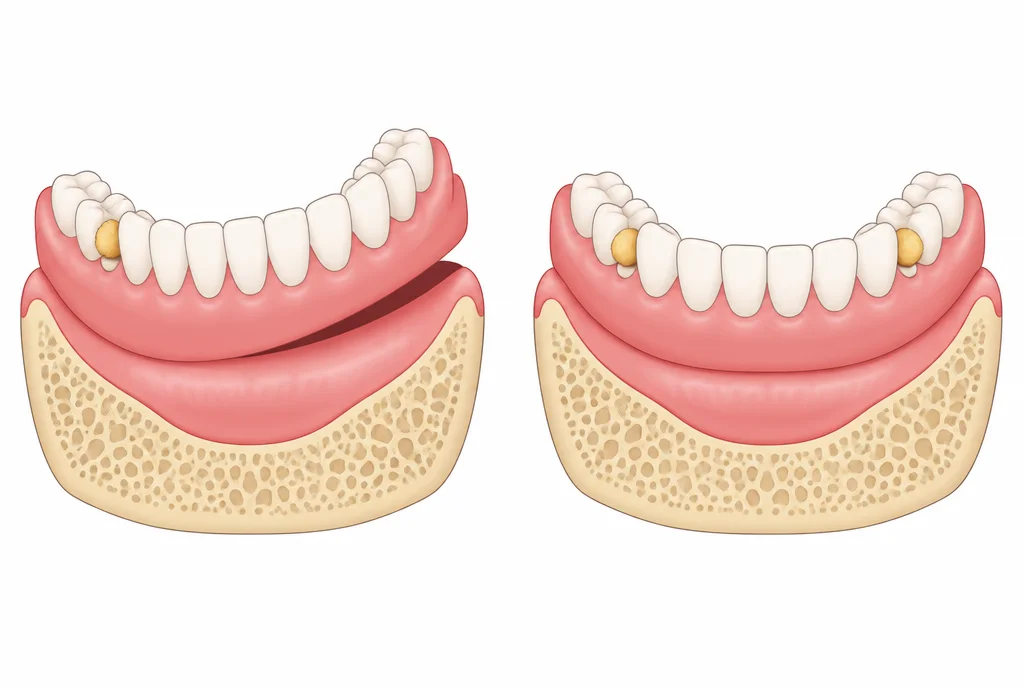
AI-generated explanatory illustrationLeft: a lower denture lifted on the opposite side by chewing on one side. Right: a denture pressed evenly by dividing food between the molars on both sides
Biting into an apple or tearing tough meat with the front teeth is among the actions most likely to dislodge a denture, so it is good to be careful even after adapting. Chewing force with dentures is weaker than with natural teeth, so even after you get used to them, please limit the amount of foods such as hard nuts or squid that require prolonged chewing.
Small particles such as sesame seeds or strawberry seeds can slip between the denture and the gums and cause sudden pain. If you feel this during a meal, remove and rinse the denture before putting it back in, and rinse both the denture and your mouth with water after eating.
When does speech become natural again?
For most people, speech improves considerably within 1~2 weeks and returns close to how it was over a few weeks.
As the denture occupies some of the space where the tongue used to touch, sounds made with the tongue tip behind the front teeth or against the roof of the mouth (the Korean sounds ‘s, ss, j, ch’) may initially sound lispy or unclear. This often improves as the tongue learns the new positions, and the following practice can help.
- Read a newspaper or a book aloud for a few minutes each day
- Slowly repeat Korean words with frequent ‘s’ sounds (sagwa, siso, susemi)
- If the denture clicks when you speak, speak a little more slowly and open your mouth less widely
- Record yourself on your phone and listen to which sounds are unclear
- Keep speaking with your family as usual instead of avoiding conversation
If the same sounds remain lispy after a few weeks, the thickness of the denture or the position of the front teeth may not be right, so please tell us at your adjustment visit.
Why does the time it takes to adapt differ from person to person?
Because the gums supporting the denture, the strength of the muscles holding it in place, and the amount of saliva differ from person to person.
Upper and lower jaws
An upper denture covers the roof of the mouth, giving it a broad supporting surface and good adhesion. A lower denture has a narrow horseshoe shape because the tongue occupies the center, and it can lift easily whenever the tongue moves, so adaptation often takes longer.
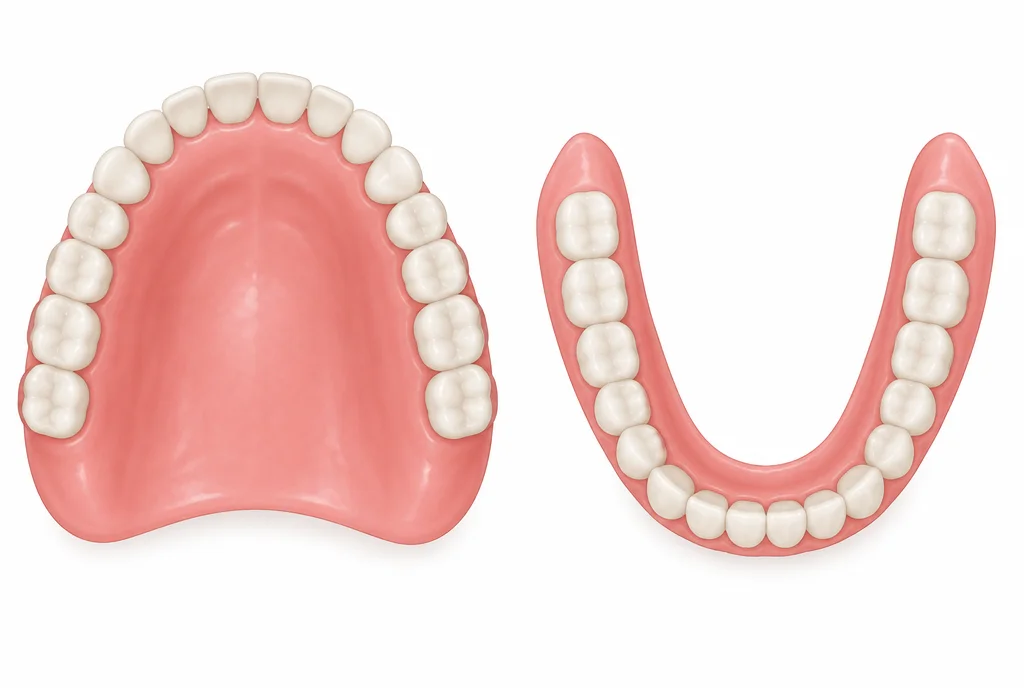
AI-generated explanatory illustrationLeft: an upper denture with a broad supporting area covering the palate. Right: a narrow, horseshoe-shaped lower denture with space left for the tongue (inner surfaces that touch the gums)
First dentures and replacement dentures
People wearing dentures for the first time need to get used to the feeling of having something in the mouth itself. People replacing dentures they have worn for a long time are familiar with that sensation, but the new dentures differ in height from the old ones that have worn down, so some find them unexpectedly awkward during the first few days.
Partial and complete dentures
Partial dentures are held by clasps on the remaining teeth, so they move less than complete dentures and people tend to get used to chewing sooner. However, you need to learn to insert and remove them in a specific direction. Biting a denture into place can bend the clasps or strain the teeth holding them, so please use your fingers to push it into its proper position.
With a denture fitted on the day teeth are extracted (an immediate denture), the gums keep changing shape for several months as they heal. For that reason, we add material to the inner surface (relining) whenever it becomes loose, and sometimes make a new denture after the gums have stabilized.
Age and muscle control
As people get older, the tongue and cheek muscles tend to need more time to learn the shape of a new denture, especially when there is hand tremor or a condition that makes muscle control difficult. If you were well adapted to your old denture, we check its shape and tooth positions and make the new one using a duplicate denture (copy denture) technique, carrying over the parts that can be retained. We incorporate the necessary corrections into the new denture while preserving familiar contours, which often makes adaptation less demanding.
Saliva and general health
If you take medication that dries the mouth, such as blood pressure medication or antidepressants, dentures do not adhere as well and the gums are easily chafed. For people who have difficulty inserting and removing dentures because of problems with their hands, adaptation is easier when family members learn the method alongside them.
What do we check in the treatment room?
At every adjustment visit, we look at the gums, the bite, and your denture-wearing habits together.
- Gums — Whether there are red or sore spots from pressure, or redness across the entire area covered by the denture
- Bite — Using thin colored paper (articulating paper) to check whether the upper and lower teeth contact evenly on both sides
- Denture movement — Whether it lifts when you open your mouth or speak, and whether the lower denture lifts when you move your tongue
- What you eat — We ask which foods you eat and which you have come to avoid; if you avoid many foods, we look for the reason in the bite and gums
- Habits — How many hours a day you wear the dentures, whether you remove them for sleep, and how you clean them
Even after the adaptation period, the jawbone continues to change little by little, so at regular checkups every 6 months, the director personally checks the gums and the fit of the dentures.
What if you still cannot get used to your dentures after a long time?
If the cause lies in the denture, we correct it; if conditions make stability difficult with a denture alone, we discuss using implants to hold it in place.
Most people who wear complete dentures are satisfied, but some cannot adapt even after a long time. Reports suggest that for some of these people, making the denture more precisely may not substantially change the outcome.[2] In these situations, we check the following in order.
- Problems with the denture itself — The bite can be adjusted little by little, but major changes to the tooth arrangement or bite height may require a new denture.
- When much of the lower jawbone has been lost — An international consensus proposes a denture held by 2 implants as the first choice for people with no teeth in the lower jaw.[3] Less rocking helps stabilize chewing and speech, but surgery and the time it requires are added. Details are covered in Implant overdentures (Korean).
- When the gag reflex is strong — We check whether a design that covers less of the palate is possible, or whether holding the denture with implants would allow the palatal portion to be reduced.
- When surgery is difficult — We may line the inside of the denture with a soft material, or take a more gradual approach by allowing more time for adaptation practice and longer intervals between adjustments.
Frequently asked questions
Q. Do I need to wear my dentures all day to get used to them?
Wearing them as much as possible while awake helps the muscles get used to them. However, take them out at bedtime to let the gums rest, clean them, and leave them in water. If you use a denture cleanser, follow the soaking time on the product label.[4] Sleeping with dentures in makes inflammation of the gums beneath them more likely.
Q. Is it okay to take them out only for meals?
Eating may feel the most difficult at first, so you may want to take them out for meals. However, you need time spent chewing with the dentures in to get used to chewing. Try eating with them in, starting with soft foods.
Q. Can I use denture adhesive from the beginning?
It is okay to use a small amount when you feel unsure during the first few days. However, if the denture will not stay in place at all without adhesive, its fit should be checked first. Instructions are covered in Is it okay to use denture adhesive every day?.
Q. Will food taste less flavorful with dentures?
When an upper denture covers the palate, you may notice food temperature and texture less. The tongue that senses taste remains unchanged, so most people get used to this, but if it continues to bother you, we discuss whether a design covering less of the palate is possible.
Q. What can family members look for to see whether a parent is adapting well to dentures?
Watch for whether they take their dentures out at meals, speak less, or avoid particular foods. These behaviors may reflect sore spots or rocking, so it is helpful to accompany them to an adjustment visit and tell us what you have noticed.
Q. Can I travel or eat out during the adaptation period?
Eating out is fine if you choose soft foods. For a trip far from home, it is better to plan around the adjustment visits in the first 1~2 weeks. Bring a denture storage container and a denture brush, and if pain makes the denture difficult to wear while traveling, do not force yourself to wear it; contact the dental clinic.
Q. Can I come in just for a denture adjustment near Bongcheon Station?
Yes. At Joy Dental Clinic Bongcheon, the same director sees you for adjustments and regular checkups after your dentures are fitted. For dentures made elsewhere, we can tell you whether adjustment is possible after examining them in person.
Limits of the evidence
- The study on adjustment frequency[1] observed complete denture wearers at one university hospital, so its findings are difficult to apply directly to partial or immediate dentures.
- The information on patients who cannot adapt[2] comes from a review that interprets several studies, so it does not give a single figure for the proportion of patients unable to adapt.
- The consensus on implant overdentures[3] is a recommendation for patients with no teeth in the lower jaw and cannot be applied directly to the upper jaw or partial dentures.
- The adaptation period differs from person to person depending on age, muscle control, saliva quantity, and systemic conditions.
DOCTOR’S NOTE
On the day I fit your dentures, I also schedule the next adjustment visit with you. I consider addressing each discomfort during the first few weeks to be part of denture treatment, so I hope you will not feel apologetic about telling me what is bothering you.
— Jeong Jinwoo, Director, Joy Dental Clinic Bongcheon
This post reflects information as of the date of writing and was written to provide general information in compliance with Korea’s Medical Service Act and the Ministry of Health and Welfare’s medical advertising guidelines. Denture treatment can have side effects such as pressure on the gums, pain, ulcers, inflammation, and damage to the teeth holding partial denture clasps. Implant surgery can have side effects such as bleeding, swelling, pain and infection, and in rare cases nerve damage can occur. Individual diagnosis and the direction of treatment depend on the condition of your mouth, so please be sure to consult fully with your treating clinician before deciding.
We are right next to Exit 1 of Bongcheon Station (Line 2), and directions from Seoul Nat’l Univ. Station, Sillim, Nakseongdae and Sadang are in Getting here.
Joy Dental Clinic Bongcheon
5F Jehyeong Bldg., 1738 Nambusunhwan-ro, Gwanak-gu, Seoul (Bongcheon Station, Exit 1)
Hours: Mon·Wed·Thu·Fri 09:30–18:30 / Tue 09:30–20:30 / Sat 09:30–13:30 (closed Sun & public holidays)
Booking: Naver Booking / Phone 02-877-2867
Related pages: Denture treatment information · Denture guide · Treatment fees
References
- Kivovics P, Jáhn M, Borbély J, Márton K. Frequency and location of traumatic ulcerations following placement of complete dentures. Int J Prosthodont. 2007;20(4):397-401. — [Cohort study] 122 newly made complete dentures (61 patients). Adjustments were needed for 87% at 1 week, 50% at 2 weeks, and 7% at 3 weeks after fitting; no patients needed additional visits after that. Gum sores were more frequent in the lower jaw.
- Carlsson GE, Omar R. The future of complete dentures in oral rehabilitation. A critical review. J Oral Rehabil. 2010;37(2):143-156. — [Literature review] Many complete denture wearers are satisfied, but some never adapt; for these patients, the precision of denture fabrication or the condition of the gums does not substantially change the outcome. The review concludes that implants have broadened the options for patients who cannot adapt.
- Feine JS, Carlsson GE, Awad MA, et al. The McGill consensus statement on overdentures. Mandibular two-implant overdentures as first choice standard of care for edentulous patients. Int J Oral Maxillofac Implants. 2002;17(4):601-602. — [Guideline] International consensus proposing a denture supported by 2 implants as the first choice for patients with no teeth in the lower jaw.
- Felton D, Cooper L, Duqum I, et al. Evidence-based guidelines for the care and maintenance of complete dentures: a publication of the American College of Prosthodontists. J Prosthodont. 2011;20(Suppl 1):S1-S12. — [Guideline] American College of Prosthodontists guidelines for complete denture care. Recommends daily cleaning, removal during sleep, and regular checkups.


 한국어
 日本語
 简体中文