Partial Dentures or Implants: Which Is Right for You?
When choosing between partial dentures and implants to replace missing teeth, your remaining teeth, jawbone, general health and ability to manage daily care come before age. This article explains the differences and what to check before a consultation.
Director Jeong Jinwoo · Published 2026.10.22
💡 Key answer
Having several missing teeth does not mean older people should get partial dentures and younger people should get implants. First, we need to look at how many teeth can still be saved, whether your general health allows you to undergo surgery, and whether you can manage the daily care required. At Joy Dental Clinic Bongcheon, we assess each remaining tooth and check the bone on CT, then compare the two approaches, partial dentures and implants, to plan treatment.
❓ What this article covers
Whether partial dentures are safer for older people
Four criteria for choosing between partial dentures and implants
Differences in the treatment process and care required
When the two methods are combined or the scope of treatment is reduced
What to check for yourself before a consultation
Hello. I am Jeong Jinwoo, Director of Joy Dental Clinic Bongcheon.
Patients with several missing teeth often ask, “Can I have implant surgery at my age?” or “Wouldn’t a denture be safer?” The key to the choice is not just age or the number of teeth, but whether you can manage the treatment process and care for the result yourself afterward.
If a method is chosen based on age alone before looking at images, teeth that could still be saved may be extracted too soon, or a partial denture may be attached to teeth with weak support. I will explain, step by step, how to choose a method that suits you.
Are partial dentures safer for older people?
Age is not the first criterion. Among people aged 75, some have well-controlled blood pressure and diabetes and manage brushing and medication on their own. Others may be younger but have just had a heart procedure or need help with care because they have difficulty using their hands.
I look at the following four things.
Remaining teeth — Based on looseness, decay, root fractures and jawbone, I classify each tooth as keep / treat and keep / extract.
Bone for implant placement — On 3D CT, I check the height and width of the bone and the distance to the nerve canal and maxillary sinus.
General health and medications — I check diabetes control, cardiovascular disease, osteoporosis medication, anticoagulants and smoking. Do not stop medication on your own; if needed, we consult the clinician who prescribed it.
Ability to manage daily care — I ask whether you can remove, clean and reinsert a partial denture every day, use interdental brushes around implants, and whether you need help with care.
In practice, when might a partial denture be chosen?
A partial denture (Korean) is a removable prosthesis that attaches to the remaining teeth with metal clasps and fills the gaps with artificial teeth and gum-colored material. Its main advantages are that it can replace teeth missing in several places with a single appliance and does not require surgery.
Figure cited from an external paper · Not a case from our clinicThis figure shows the parts of a partial denture (clasps, rests, connector, artificial teeth and denture base).Zhu et al. · Figure 1 · DOI: 10.3389/fdmed.2025.1667504 · CC BY 4.0 · Korean labels added
The clasps wrap around the remaining teeth to hold the denture in place, and the rests beside the clasps sit on the remaining teeth to prevent the denture from sinking toward the gums when you chew. A metal connector joins the two sides so they move as a single appliance.
A partial denture may be advantageous in the following situations.
When surgery needs to be postponed because of heart or lung disease, uncontrolled diabetes or similar conditions
When there is a substantial lack of bone for implants and you do not want extensive bone grafting
When missing teeth are scattered across several sites and replacing all of them with implants would be a considerable burden
When the outlook for the remaining teeth needs to be observed further before deciding on the next treatment
When it is difficult to care for a fixed prosthesis on your own
However, partial denture treatment does not end once it is made and fitted. More chewing force falls on the teeth holding the clasps, and changes in the jawbone can cause the denture to lift or press on certain areas. You need time to adapt to chewing and speaking at first, and afterward you still need to check the causes of looseness and have adjustments made.
If you are aged 65 or older, partial dentures are eligible for Korean National Health Insurance coverage.[1] There are intervals and detailed conditions for repeat coverage in the same upper or lower jaw, so your existing registration history and the condition of your remaining teeth need to be checked together.
When are implants a better fit?
An implant (Korean) is a treatment in which an artificial root is placed in the bone at a missing tooth site and a tooth is attached on top. It stays in the mouth during use and, unlike a partial denture, does not attach clasps to the remaining teeth.
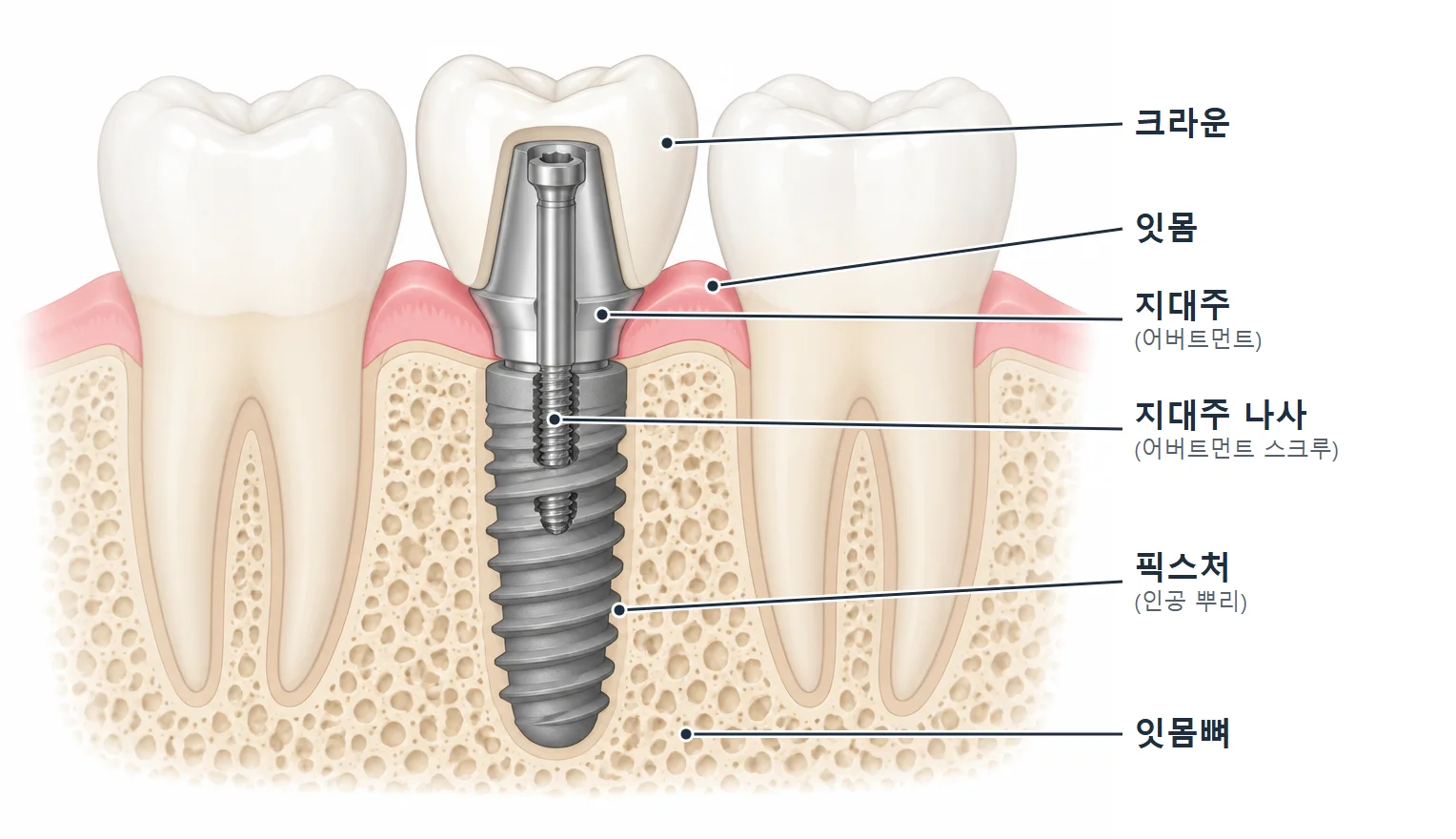
An implant restoration consists of three main parts: the fixture (artificial root) placed in the jawbone, the abutment connected on top of the fixture to match the gum height, and the crown placed over it. The abutment is secured to the fixture by an abutment screw that passes through its center.
We consider implants first under the following conditions.
When only a few teeth are missing and there is enough bone at those sites
When the neighboring teeth are healthy and you do not want to burden them by preparing them or attaching clasps
When removing and reinserting a denture by hand is difficult, but cleaning with a toothbrush and interdental brushes is possible
When you have a strong gag reflex or find it difficult to adapt to a large appliance in your mouth
When you clearly want a fixed prosthesis even if treatment takes longer
However, because implants are fixed, care is even more important. Food can become trapped between implants and inflammation can develop, so interdental brushes or special floss suited to the shape of the prosthesis are needed. If bone is lacking, bone grafting increases the extent of surgery and treatment time, and blood glucose control and a medication review need to come first.
For people aged 65 or older who meet the conditions, Korean National Health Insurance covers up to 2 implants in a lifetime. When several teeth are missing, the overall plan needs to consider where to place the 2 covered implants, how to connect the remaining replacements, and whether they can be used together with a partial denture.
Can I compare partial dentures and implants at a glance?
What to check
Partial denture
Implants
How it is used
An appliance removed and reinserted every day
A prosthesis fixed in the mouth
Source of support
Remaining teeth and gums
Jawbone at the missing tooth sites
Surgery
Generally not needed
Placement surgery is needed
Treatment duration
Relatively short if no extractions or gum treatment are needed
Can take several months while waiting for osseointegration
Adaptation
Adjustment for a foreign-body sensation, speech and pressure spots
Healing after surgery and adaptation to the prosthesis
Care
Remove the denture and clean it and the remaining teeth separately
Clean around the prosthesis with interdental brushes and floss
Problems that may develop over time
Looseness, strain on clasp-bearing teeth, wear of artificial teeth
Inflammation of the surrounding gums, screw loosening, prosthesis wear
Korean National Health Insurance
Aged 65 or older, every 7 years if coverage conditions are met
Aged 65 or older, 2 in a lifetime if coverage conditions are met
※ This is a general comparison. Treatment duration, insurance coverage and the extent of surgery required depend on the diagnosis.
Research does not conclude that one method is always better for every older patient. Although they did not directly compare partial dentures with implants, randomized clinical trials in partially dentate patients aged 65 or older compared partial dentures with an approach that restores function around the remaining teeth. Both strategies improved quality of life, showing that the choice can depend on the patient’s condition and goals.[2][3] Implant-supported prostheses also help improve quality of life,[4] but surgery and ongoing maintenance need to be considered as well.
Can combining the two methods or reducing the scope of treatment be better?
Yes. You do not have to choose only one of partial dentures and implants.
There are cases in which implants and a partial denture are used together. Placing some implants on the side where a partial denture lifts because the rearmost molars are missing can reduce movement of the appliance. In other cases, implants are used to restore key sites first, and a partial denture fills the larger gaps. However, the design needs to account for how force is shared between the implants and the clasp-bearing teeth.
There are also plans that do not fill every gap all the way to the back. Even if some rearmost molars are missing, restoring contact between the front teeth and premolars on both sides may allow function to be maintained without a large partial denture. This is called the Shortened Dental Arch approach, a treatment strategy compared with partial dentures in studies of older patients.[2][3] However, we first need to check that there are enough teeth in contact and sufficient balance between the left and right sides, then regularly compare whether the teeth around the gaps left open are moving.
There are also cases in which the remaining teeth need treatment first. If gum inflammation is not controlled or treatment of teeth that can be saved is not yet finished, we do not start by deciding on dentures or implants. The appropriate order is to make the final plan once the supporting teeth and gums are stable.
What should I check before a consultation?
What bothers me most: chewing, pain, looseness or appearance?
Do I know the names of my current medications and when I received osteoporosis injections?
Can I remove and clean a denture or use interdental brushes on my own?
Can I manage the schedule of repeated visits and the treatment duration?
Which feels more burdensome to me: surgery or a removable appliance?
Have I been shown images explaining why a tooth recommended for extraction is difficult to save?
The final choice should be made by you after you understand your condition and the care required for each treatment. In the treatment room, we explain the options separately so you can ask questions while looking at your own images and, if needed, discuss them with your family.
How long does treatment take, and how many visits are needed?
Partial dentures usually take 4~5 visits over 3~4 weeks, while implants take several months because time is needed for the bone to bond.
Partial dentures
The finished denture is fitted after taking impressions, recording the bite height, and trying the arranged artificial teeth in your mouth. If no treatment is needed beforehand, you usually visit 4~5 times over 3~4 weeks. After fitting, you come back a few more times to adjust pressure spots, and it takes a few weeks to get used to chewing and speaking. The try-in stage before completion is covered in Dentures: why is there a try-in before the final fitting?.
Implants
While waiting for the bone to bond after placement, you visit about once every one or two months so we can check that the gums are healing well. Once we confirm that the bone has bonded, we take an impression. From the impression to attaching the prosthesis, it usually takes 1 week, or 2 weeks if it takes longer. Bone grafting adds time if it is needed. The time for each stage is covered in Implants: why does the duration differ from person to person?.
If teeth need to be extracted or gum treatment is needed, that time is added beforehand. Treatment fees are listed in the fee list (non-covered fees).
Frequently asked questions (FAQ)
Q. Can people in their 80s get implants?
Suitability is judged by the control of systemic conditions, medications, and the condition of the bone and gums rather than age. Older age alone does not rule out implants, but if the burden of surgery outweighs its benefits, we may recommend a partial denture.
Q. Will a partial denture cause the remaining teeth to deteriorate quickly?
Extra force may be placed on the teeth holding the clasps. That is why we first check whether their roots and supporting jawbone can withstand it, then regularly check for decay and looseness after fitting.
Q. Do implants always last longer than partial dentures?
We cannot say they always do. The lifespan of implants is affected by care of the bone and surrounding gums, while that of partial dentures depends on adjustments to changes in the clasp-bearing teeth and gums. Regular checkups are essential for either method.
Q. Can I use a partial denture first and switch to implants later?
In many cases, this is possible. However, bone loss after tooth loss may mean that bone grafting is needed later, so it is advisable to check the bone on CT in advance at sites where you are considering future implants.
Q. What if removing, reinserting or cleaning a denture is difficult?
If you have difficulty using your hands, removing, reinserting and cleaning a large partial denture can be hard. On the other hand, if using interdental brushes is difficult, fixed implants also carry a greater risk of inflammation. Your choice needs to account for the care you can actually perform and the help available when you need it.
Q. Does having diabetes mean I cannot get implants?
What matters is whether blood glucose is stably controlled, rather than diabetes itself. We review recent test results and medications, and if control is insufficient, we recommend medical care and blood glucose management first.
Q. Can I get both partial dentures and implants under Korean National Health Insurance?
They can be planned together if each meets its coverage criteria. We first check your previous coverage history before starting treatment.
Q. Do I have to decide on extraction or surgery on the day of the consultation?
No. Unless an infection needs urgent control, you can decide after understanding the images and treatment options. If you need time to discuss things with other family members, we explain the changes to expect and when to return.
What should I check when choosing a dental clinic?
Do they explain, tooth by tooth, whether the remaining teeth can be saved?
Do they discuss the care required as well as the advantages of partial dentures and implants?
Do they explain CT and intraoral photos so you can look at them yourself?
Do they distinguish between what is covered by Korean National Health Insurance and what is not covered before treatment?
Who will continue to handle denture adjustments and regular implant checkups?
Partial dentures and implants differ in their source of support and care requirements. Please check the condition of your remaining teeth and jawbone together, understand the process and care required for each treatment, and take enough time to consider your decision.
Limits of the evidence
The trials comparing partial dentures and shortened dental arches[2][3] mainly used oral health-related quality-of-life questionnaires; they did not directly compare the lifespan of the remaining teeth or chewing ability.
The quality-of-life findings for implant-supported prostheses[4] involve different types of prostheses and study populations, so they cannot be viewed as direct comparisons with partial dentures under the same conditions.
The study participants’ ages, numbers of remaining teeth and treatment settings may differ from those of patients in Korea.
Korean National Health Insurance criteria[1] can change with the system, so we check the criteria in effect at the time of treatment.
DOCTOR’S NOTE
When discussing partial dentures or implants, if there are teeth that need to be extracted, I first use X-rays and gum pocket depth measurements to explain why those teeth are difficult to save, and only then begin discussing how to replace them. This is because we need to decide which teeth will be extracted before deciding which teeth will hold the clasps and where the implants will be placed.
— Jeong Jinwoo, Director, Joy Dental Clinic Bongcheon
This article provides general medical information. The actual treatment method, duration, cost and Korean National Health Insurance coverage depend on the diagnosis. Treatment may have side effects and limitations.
We are right next to Exit 1 of Bongcheon Station (Line 2), and directions from Seoul Nat’l Univ. Station, Sillim, Nakseongdae and Sadang are in Getting here.
This post reflects information as of the date of writing and was written to provide general information in compliance with Korea’s Medical Service Act and the Ministry of Health and Welfare’s medical advertising guidelines. Implant surgery can have side effects such as bleeding, swelling, pain and infection, and in rare cases nerve damage can occur. Partial dentures can have side effects such as pressure and sores on the gums, and decay or gum inflammation around the teeth holding the clasps. Individual diagnosis and the direction of treatment depend on the condition of your mouth, so please be sure to consult fully with your treating clinician before deciding.
국민건강보험공단. 다빈도 질의응답(노인틀니). — Guidance from the Korean National Health Insurance Service on eligibility, patient co-payment rates and coverage procedures for dentures for people aged 65 or older.


 한국어
 日本語
 简体中文