💡 Key answer
Guided implant surgery is not a different type of implant, but a method that helps place an implant according to a plan made in advance. CT and an intraoral scan are used to set the position, angle and depth on a computer first. A custom-made template (surgical guide) made to that plan is then fitted in the mouth to direct the drill. It may help at sites close to a nerve or the maxillary sinus, or when placing several implants, but guides also have errors, so safety margins and judgment during surgery are still needed.
Summary for patients
- The product is chosen to suit the bone condition and the prosthetic plan.
- Whether to use a guide is decided after looking at the CT and scan.
- Checks during surgery continue even when a guide is used.
- If you have difficulty opening your mouth, please tell us at the consultation.
- Aftercare and regular checkups are needed just the same.
❓ What this article covers
- Does guided implant surgery use a different implant itself?
- How is a surgical guide made, and how is it used during surgery?
- What do we check in the treatment room?
- When do we use a guide?
- Are implants also placed without a guide?
- Does a guide place the implant exactly as planned?
- How long does treatment take, and how many visits are needed?
Terms explained
Does guided implant surgery use a different implant itself?
No. Guided implant surgery is not a separate category of product; it means placing an implant using a surgical guide. When you hear names such as “guided implant” or “navigation implant” at a consultation, it is easy to think they are separate premium products. But these names refer to the sequence of planning implant placement and the tools used to transfer that plan to the mouth.
The fixture that goes into the bone, the parts connected above it, and the crown are chosen based on the bone condition and the prosthetic plan, whether or not a guide is used. When using a guide, we also check whether a guided drill set is available for that product. Differences between products are covered separately in When you hear several company names at an implant consultation.
What changes is the preparation before surgery and the way the drill is introduced during surgery.
- When using a guide: the position, angle and depth set on a computer are transferred to the mouth with a custom-made template, and the drill passes through its holes.
- When placing without a guide: after making the same plan with CT, the dentist directly controls the direction and depth of the drill while checking the bone condition during surgery.
Whether to open the gums or make only a small opening is decided according to the bone and gum condition, separately from whether a guide is used.
Either way, the step of measuring the positions of the bone and nerve with CT first is not skipped. A guide is one of the tools used to transfer that plan.
How is a surgical guide made, and how is it used during surgery?
We superimpose CT and an intraoral scan to decide where the crown will sit first, then work backward to plan the fixture position below it and make the template accordingly.
The planning stage
- CT (Korean) images show the height and width of the bone and the positions of the nerve canal and maxillary sinus.
- An intraoral scanner (Korean) records the shape of the remaining teeth and gums. Joy Dental Clinic Bongcheon uses TRIOS 6.
- After superimposing the two sets of data in software, we first set the position and shape of the crown.
- We set the fixture’s position, length and angle so that it can support the crown while keeping a distance from the nerve canal and maxillary sinus.
- We design and make a template with holes for the drill to pass through according to this plan.
On the day of surgery
Surgery is performed under local anesthesia. First, we fit the guide over the remaining teeth or gums and check that it does not lift or rock. We then prepare the site through the guide’s holes using drills of gradually increasing diameter, and insert the fixture.
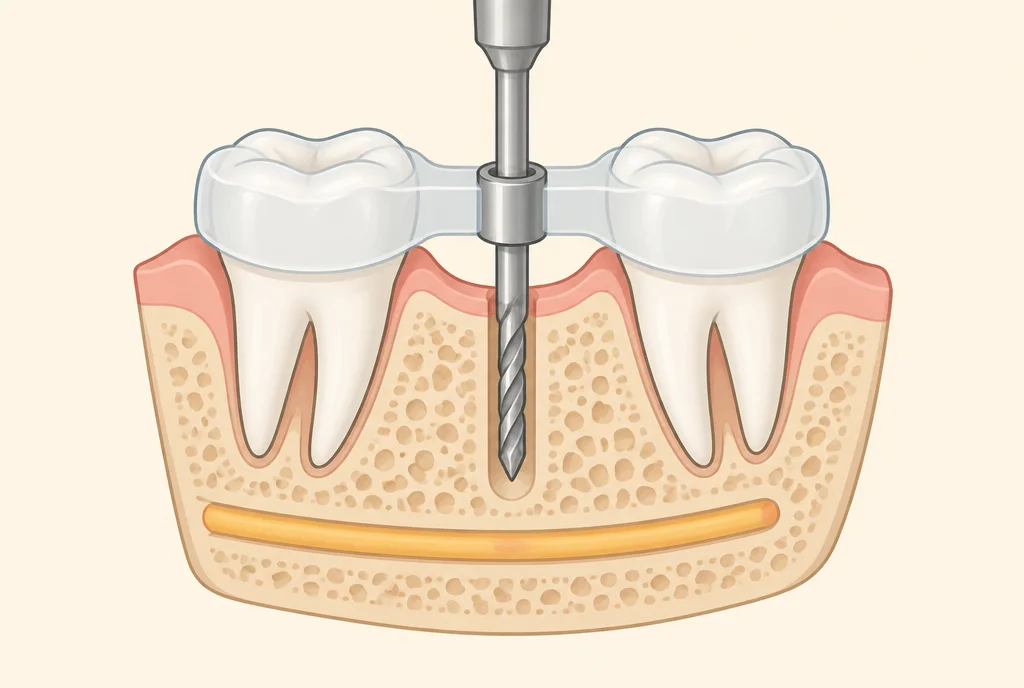
AI-generated explanatory illustrationA surgical guide resting on neighboring teeth, a drill entering the bone through its metal hole (sleeve), and the distance of bone left between the drill tip and the nerve canal below
During surgery, we tell you which stage we are at, and we explain beforehand that you can raise your hand if you would like a short pause. The sequence on the day of surgery is covered in detail in What happens on the day of implant surgery?.
What do we check in the treatment room?
We measure the width and height of the bone and the distance to the nerve canal and maxillary sinus in mm on CT cross-sections, and check whether the conditions allow the guide to fit properly in your mouth.
| What we check | How we check it | What we look at in relation to the guide |
|---|
| Bone width and height | Measurements on CT cross-sections | Whether the planned length and diameter will fit |
| Distance to the nerve canal and maxillary sinus | Measurements on CT cross-sections | Whether a safety margin can be maintained |
| Remaining teeth and gums | Intraoral scan, examination | Whether the guide will have firm support |
| How far you can open your mouth | Examination | Space for the guide and a long drill |
| Number and positions of implants to be placed | CT, prosthetic plan | Whether several implants need to be aligned |
We measure the distance to the nerve canal or maxillary sinus directly on CT cross-sections and plan, ideally, to leave about 2mm between the fixture tip and the nerve. An analysis of guide accuracy also recommends keeping a safety margin of at least 2mm to account for errors.[1]
Because a guide rests on teeth or gums that serve as its reference, errors may increase if that support moves. We take this into separate consideration when remaining teeth are very loose or the gums are thick and soft. If you have a CT taken at another dental clinic, please bring it. We can open the files at our clinic.
When do we use a guide?
We consider using a guide when the placement site is close to the nerve canal or maxillary sinus, or when several implants need to be placed in alignment. At Joy Dental Clinic Bongcheon, we also sometimes use a guide when placing several implants.
- Sites close to the nerve canal or maxillary sinus: there may be little bone left between the lower molars and the nerve canal, or between the upper molars and the maxillary sinus. Keeping to the planned depth and angle becomes important.
- When placing several implants: implant spacing and direction need to be aligned so that the prosthesis connected above them fits without difficulty.
- Sites where crown position matters: at visible sites such as front teeth, or where the space between neighboring teeth is narrow, it is important to place the implant in line with the intended crown direction.
There is evidence that guides can help place implants closer to their planned position. In a randomized clinical trial of 101 people with some teeth remaining, the mean difference between planned and actual angles was 7.03° for placement without a guide and 3.04° for placement guided from start to finish.[2]
Are implants also placed without a guide?
Yes. We place implants without a guide when the conditions do not specifically require one, or when the conditions make a guide difficult to use.
- A single site with ample bone and enough distance from surrounding structures: we sometimes place the implant without a guide based on the CT plan and the bone condition checked during surgery.
- Difficulty opening the mouth: a long drill needs to fit above the guide, so there may not be enough space, especially at the back molars.
- When extensive bone grafting is also needed: it may be more suitable to open the gums, directly inspect the bone shape, and carry out grafting and placement together.
- When the support for the guide is unstable: if the remaining teeth are very loose, the guide may not stay fixed in position.
| Category | With a guide | Placement without a guide |
|---|
| Preparation before surgery | CT and scan planning + guide fabrication | CT planning |
| How the direction is set | Drilling through guide holes | Direct control based on the plan |
| Changing the plan during surgery | Limited within the guide | Easier to adjust to the situation |
| Suitable situations | Close to a nerve or sinus, several implants | Sites with ample bone, extensive bone grafting |
This is a general overview; the actual choice depends on CT and the condition of your mouth.
A review comparing implant and prosthesis failure and complications did not find a significant difference between the two methods. However, only 2 clinical trials were included, so there is insufficient evidence to judge the difference.[4] We therefore decide on the surgical method by considering the bone condition, the prosthetic plan, and whether the guide can rest stably in place.
Does a guide place the implant exactly as planned?
No. It helps place the implant close to the plan, but guides also have a measurable average error. In an analysis of 2,238 implants placed with guides, the mean differences between planned and actual positions were 1.2mm at the entry point, 1.4mm at the tip and 3.5° in angle.[1] These are averages, and larger deviations were also reported.[3]
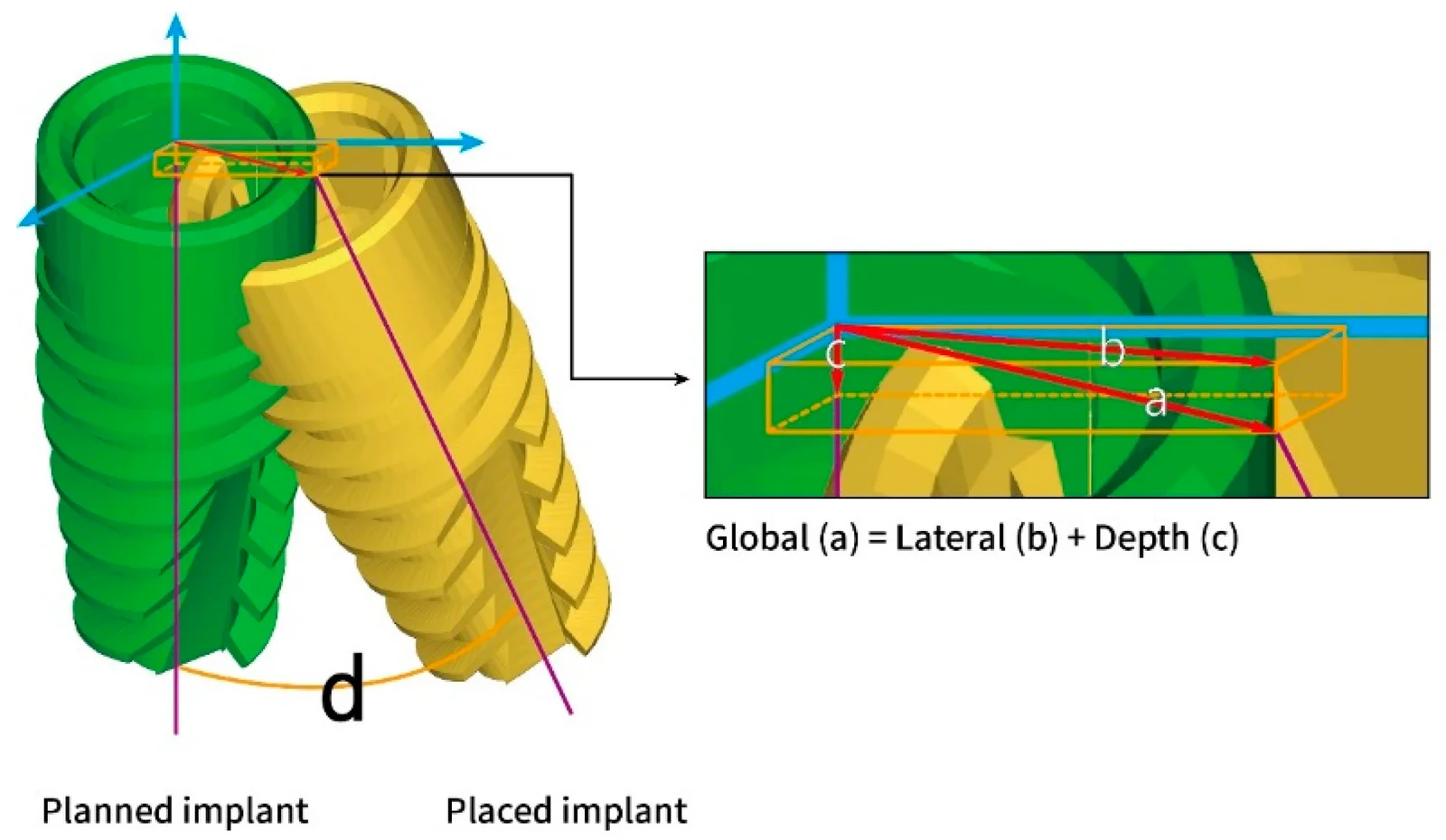
Figure cited from an external paper · Not a case from our clinicGreen shows the implant planned on the computer, and yellow shows the implant actually placed. The lateral distance at the entry point (b) combined with the depth difference (c) gives the overall difference (a), and the angle between the two axes (d) is the angular difference. The entry-point, tip and angular errors discussed in the text are measured in this way.Lin et al. · Figure 6 · DOI: 10.3390/jcm9040980 · CC BY 4.0 · Used without modification (resized only)
Limitations of guides
- Even a slight change in where the guide sits in the mouth changes the drill direction as well.
- Jaws with no teeth tended to have larger errors than those with some teeth remaining.[1]
- CT alone cannot accurately determine how hard the bone is, so we also check the bone condition during surgery.
- Problems during surgery or at the prosthetic stage have also been reported at certain rates in guided surgery.[3]
That is why we do not plan a smaller distance from the nerve even when using a guide. Depending on the bone condition found during surgery, we may adjust the plan by adding a bone graft or switching to a method in which the gums are closed over the implant after placement to allow healing (the 2-stage method). Nerve injury and ways to reduce its risk are covered in Implant-related nerve injury (Korean).
How long does treatment take, and how many visits are needed?
Using a guide adds time before surgery to design and make it, and the subsequent stages follow the same sequence as placement without a guide. The time for the implant to bond with bone (osseointegration (Korean)) is generally 2~3 months in the lower jaw and 3~6 months in the upper jaw. A bone graft at the same time may add 1~2 months.
- Examination and consultation: we check the bone condition with CT and the shape of the teeth and gums with an intraoral scan, then decide whether to use a guide.
- Guide fabrication: once the plan is confirmed, we make the guide and schedule surgery accordingly.
- Placement: the fixture is placed under local anesthesia. We recommend returning the next day for wound cleaning (dressing).
- Osseointegration period: you come in for a check during this period.
- Prosthetic treatment: we take an impression and attach the crown. We take a periapical X-ray on the day it is attached and use it as a baseline for comparison at later checkups.
- Regular checkups: the usual schedule is a first check 3 months after the prosthesis is attached, then every 6 months.
Why the duration of each stage differs from person to person is covered in Implants: why does the duration differ from person to person?. Treatment fees are listed in the fee list (non-covered fees).
Frequently asked questions (FAQ)
Q. Do “navigation implant” and “guided implant” mean the same thing?
It is difficult to tell the actual method from the name alone. There is a static guided method that directs the drill with a template made beforehand, and a dynamic navigation (Korean) method that tracks instrument positions on a screen during surgery. Please ask which method is meant at your consultation. Neither is a type of implant product.
Q. Does using a guide mean the gums will not be cut?
If conditions are suitable, flapless placement (Korean), in which only a small opening is made in the gums, is possible. However, we open the gums if they are thin, if we need to see the bone shape directly, or if bone grafting is done at the same time. Using a guide does not always mean there is no incision.
Q. Does using a guide mean less pain and swelling?
In one clinical trial, patients in the conventional surgery group reported more pain and swelling, but the small number of studies makes it difficult to generalize.[4] Swelling and pain are also affected by factors such as how much of the gums are opened and whether bone grafting is performed, so they are difficult to predict from guide use alone.
Q. What happens if the guide does not fit during surgery?
If the guide lifts or rocks, we do not proceed as it is. We recheck the teeth or gums supporting it and, if needed, remove the guide and place the implant while checking the bone condition and adjusting the direction.
Q. What should I prepare for a guided implant consultation near Bongcheon Station?
If you have a CT taken at another dental clinic, please bring it. Telling us in advance about medications you take, difficulty opening your mouth wide, or jaw joint discomfort also helps us check whether the conditions allow a guide to be used.
Limits of the evidence
- The accuracy analyses[1][3] mostly pooled observational studies without control groups, and guide types and measurement methods differed between studies.
- The clinical trial comparing guided and conventional surgery[2] included only people with some teeth remaining and was conducted at one institution using one product.
- The review comparing implant failure and complications[4] analyzed only 2 randomized clinical trials, so the finding is closer to “insufficient evidence to demonstrate a difference” than “no difference.”
- How positional errors affect implant outcomes several years later has not yet been studied sufficiently.
DOCTOR’S NOTE
In implant surgery, a guide is simply an assisting tool. I recommend guided surgery only when using a guide makes the procedure convenient and accurate. I will let you know when it is needed.
— Jeong Jinwoo, Director, Joy Dental Clinic Bongcheon
This post reflects information as of the date of writing and was written to provide general information in compliance with Korea’s Medical Service Act and the Ministry of Health and Welfare’s medical advertising guidelines. Implant surgery may have side effects such as bleeding, swelling, pain, infection and peri-implantitis, and in rare cases nerve injury, maxillary sinus perforation or failure of osseointegration may occur. Individual diagnosis and the direction of treatment depend on the condition of your mouth, so please be sure to consult fully with your treating clinician before deciding.
We are right next to Exit 1 of Bongcheon Station (Line 2), and directions from Seoul Nat’l Univ. Station, Sillim, Nakseongdae and Sadang are in Getting here.
Joy Dental Clinic Bongcheon
5F Jehyeong Bldg., 1738 Nambusunhwan-ro, Gwanak-gu, Seoul (Bongcheon Station, Exit 1)
Hours: Mon·Wed·Thu·Fri 09:30–18:30 / Tue 09:30–20:30 / Sat 09:30–13:30 (closed Sun & public holidays)
Booking: Naver Booking / Phone 02-877-2867
Related pages: Implant treatment guide · Surgical guide (Korean) · CT (Korean)
References
- Tahmaseb A, Wu V, Wismeijer D, Coucke W, Evans C. The accuracy of static computer-aided implant surgery: A systematic review and meta-analysis. Clin Oral Implants Res. 2018;29 Suppl 16:416-435. — [Meta-analysis] 20 clinical studies covering 2,238 implants placed with surgical guides in 471 patients. The mean differences between planned and actual positions were 1.2mm at the entry point, 1.4mm at the tip and 3.5° in angle. Accuracy was higher in people with some teeth remaining than in those with no teeth. A safety margin of at least 2mm was recommended.
- Varga E Jr, Antal M, Major L, Kiscsatári R, Braunitzer G, Piffkó J. Guidance means accuracy: A randomized clinical trial on freehand versus guided dental implantation. Clin Oral Implants Res. 2020;31(5):417-430. — [Randomized clinical trial] Comparison of 207 implants of the same product placed in 101 people with some teeth remaining. The mean angular difference was 7.03° for placement without a guide and 3.04° for placement guided from start to finish. Accuracy increased as more stages were guided.
- Schneider D, Marquardt P, Zwahlen M, Jung RE. A systematic review on the accuracy and the clinical outcome of computer-guided template-based implant dentistry. Clin Oral Implants Res. 2009;20 Suppl 4:73-86. — [Systematic review] Mean differences in guided surgery were acceptable at 1.07mm at the entry point and 1.63mm at the tip, but the maximum differences were relatively large. Problems during surgery were reported in 9.1%, and early prosthetic problems in 18.8%. Implant survival over 12~60 months of follow-up was 91~100%.
- Colombo M, Mangano C, Mijiritsky E, Krebs M, Hauschild U, Fortin T. Clinical applications and effectiveness of guided implant surgery: a critical review based on randomized controlled trials. BMC Oral Health. 2017;17(1):150. — [Systematic review] Only 2 randomized clinical trials comparing guided and conventional surgery were included in the analysis. There were no significant differences in implant or prosthesis failure and complications. In one study, patients in the conventional surgery group reported more pain and swelling.
- Lin CC, Wu CZ, Huang MS, Huang CF, Cheng HC, Wang DP. Fully digital workflow for planning static guided implant surgery: a prospective accuracy study. J Clin Med. 2020;9(4):980. — [Prospective accuracy study] A study measuring differences between planned and actual implant positions in guided surgery planned by superimposing intraoral scans and CT. Source of the figure in the article (Figure 6, CC BY 4.0) — the figure defining the differences between planned and placed implants (entry point, depth and angle) is used without modification.


 한국어
 日本語
 简体中文