💡 Key answer
Implant companies and products differ in surface treatment, body shape and threads, and the connection that fits the components placed on top, but a 2014 Cochrane review found no evidence that any particular type among the implants compared had better long-term outcomes.[1] This was not a comparison of every product in use today. Treatment outcomes depend on the product together with the quantity and condition of bone, placement position, gum disease and smoking, prosthetic design, and care after treatment. That is why, beyond the company name, whether the design suits your bone condition and whether the product placed is recorded so that components can be sourced later may be more important.
Summary for patients
- It is difficult to judge quality by the company name alone.
- The product is chosen with the bone seen on CT and the prosthetic plan in mind.
- Be sure to keep track of the name and size of the product placed.
- Regular checkups are necessary regardless of the product.
❓ What this article covers
- How do company names and product names differ?
- What actually differs between products?
- Do more expensive products last longer?
- What do we check in the treatment room?
- Should you consider another option even if you have a preferred company?
- What if you need components later?
- How long does treatment take, and how many visits are needed?
Terms explained
- Fixture (Korean) (implant body): the screw-shaped artificial root placed in the jawbone
- Abutment (Korean) (connecting post): the component connected to the fixture to support the crown
- Surface treatment: processing that roughens the outside of the fixture or makes it more easily wetted by water to help bone attach
- Primary stability: how firmly the fixture engages the bone immediately after placement
How do company names and product names differ?
The company name refers to the manufacturer, and products (lines) from the same company can have different surfaces and shapes. At a consultation, you may hear company names such as “Osstem” or “Straumann,” but the actual differences often lie in the product name that follows.
An implant is not just a fixture: it is a set of fixtures, abutments, screws and impression components made to fit a common specification. This is why dentists also call it a “system.” Both Korean-made and imported systems are used in Korea, and each company offers several lines.
At Joy Dental Clinic Bongcheon, we use the following lines.
- Neo (Korean-made)
- Osstem BA, Osstem SOI (Korean-made)
- Straumann BLX — SLA surface, SLActive surface (Switzerland)
Even within Osstem, BA and SOI have different surface treatments, and within Straumann BLX, SLA and SLActive have different surfaces. Some names, such as BA, SOI and SLActive, refer to surface treatments, so at the consultation it is helpful to check the actual product name as well as the company name. The features of each system are covered separately in Implant manufacturers (brands) (Korean).
What actually differs between products?
They differ in surface treatment, body shape and threads, and the connection that fits the abutment. Here is what each affects.
Surface treatment
Rather than leaving the fixture surface smooth, it is often blasted with sand-like particles and then treated with acid to create very small irregularities. These irregularities provide more places for bone cells to attach. Some products also make the surface more easily wetted by water (hydrophilic) or add a thin coating.
Many studies show that surface roughness affects the bone’s attachment response. However, reviews note that because surface measurement methods differ between studies, it is difficult to directly compare which surface performs better in the human mouth and by how much.[2]
Body shape and threads
Fixtures may be cylindrical, with the same width from top to bottom like a column, or root-shaped (tapered), narrowing toward the bottom. Thread depth and spacing also differ between products. These differences are discussed in relation to how firmly the implant engages soft bone immediately after placement (primary stability).
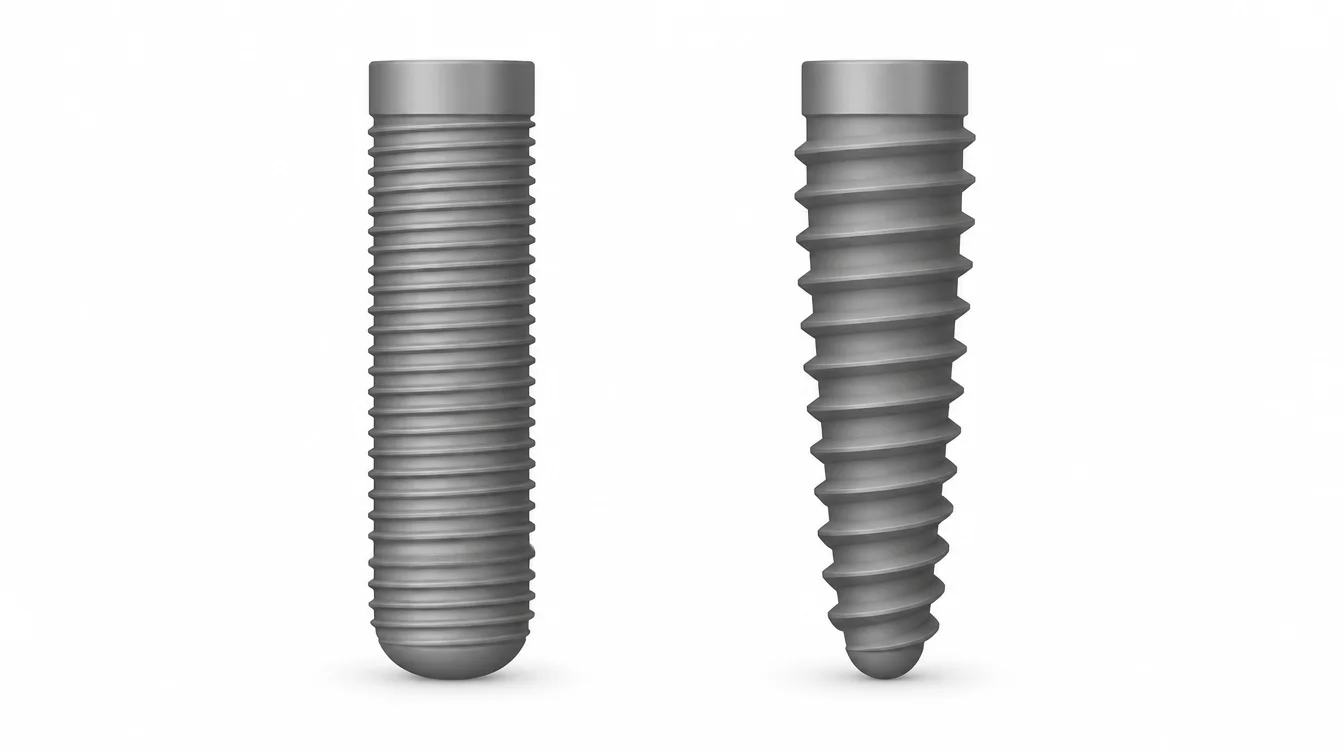
AI-generated explanatory illustrationA schematic showing a cylindrical fixture with the same width from top to bottom on the left and a root-shaped (tapered) fixture that narrows toward the bottom on the right, with different thread depths and spacing
In an analysis pooling randomized clinical trials, root-shaped implants tended to have higher stability measurements at placement than cylindrical implants, but the difference was not statistically significant, and no significant difference in failure rates was found either.[3] Shape is therefore one factor selected according to the bone condition; it does not determine the outcome on its own.
Connection design
The way the fixture and abutment fit together differs by company and product. There are external connections that fit over a protruding hexagon, internal connections that fit inside the fixture, and conical connections with a tight funnel-shaped fit inside. In an analysis pooling clinical studies, bone height was better maintained in the short and medium term with internal connections, particularly conical connections.[4]
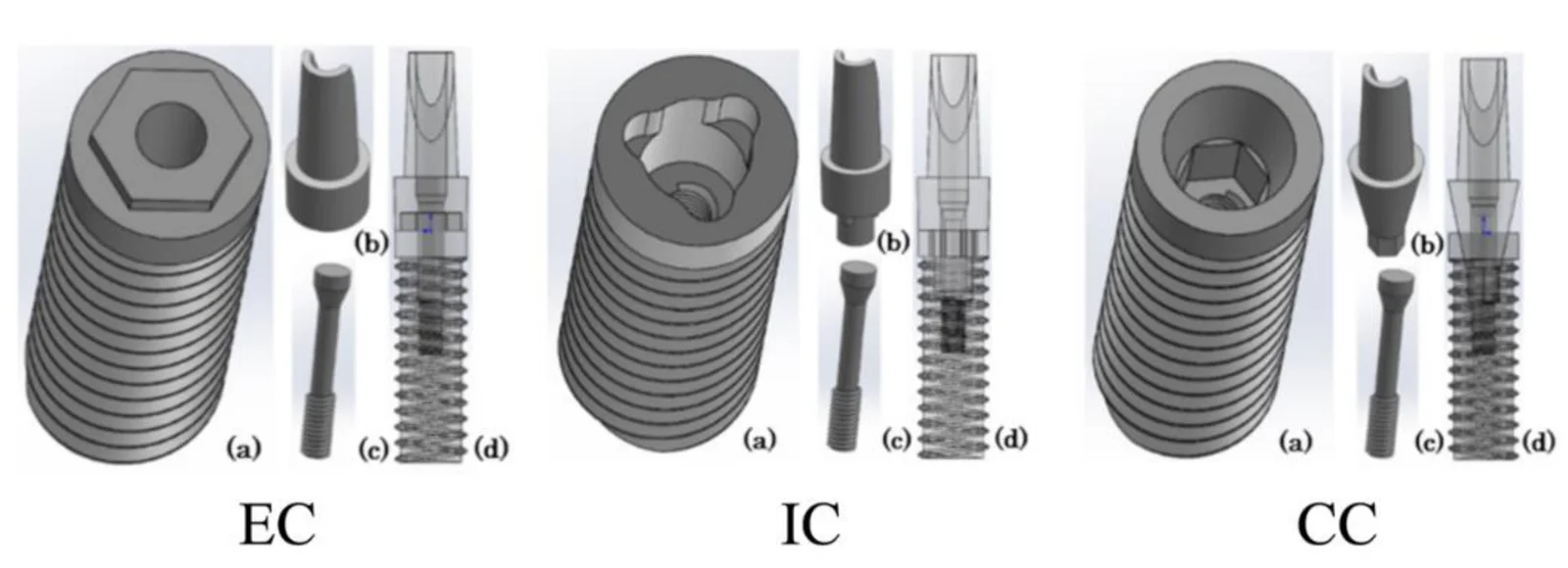
Figure cited from an external paper · Not a case from our clinicOn the left (EC) is an external connection where the abutment fits over a hexagon protruding from the fixture; in the middle (IC) is an internal connection that fits into a recess inside the fixture; and on the right (CC) is a conical connection with a funnel-shaped fit inside. In each group, (a) is the fixture, (b) the abutment, (c) the screw, and (d) the three assembled.Matsuoka et al. · Figure 1 · DOI: 10.3390/ma14092421 · CC BY 4.0 · Used without modification (resized only)
With different connection designs, components may not fit one another. Compatibility is therefore checked using the fixture’s product name and connection specification, rather than the company name alone. This becomes important when replacing components later.
| Difference | What it affects | What to check |
|---|
| Surface treatment | The bone’s attachment response | Bone quality, whether a bone graft is needed |
| Body shape and threads | Stability immediately after placement | Whether the bone is soft, whether placement is on the day of extraction |
| Connection design | Fit with the abutment, component compatibility | Whether components matching the connection specification are available |
| Available diameters and lengths | Whether a suitable size is available for a narrow or low site | Bone width and height measured on CT |
This is a general overview; detailed designs differ between products.
Do more expensive products last longer?
It is difficult to judge how long an implant will last by price or company name alone. A 2014 review pooling 27 randomized clinical trials comparing 38 different implant types found no evidence that any particular type had better long-term outcomes.[1] However, the review did not compare every product in use today, so we do not use it alone to rank current products.
This does not mean there are no product differences at all. A Swedish study of implant loss reviewed the treatment records of 2,765 people and examined 596 of them 9 years after treatment,[5] while a study of peri-implantitis in the same population examined 588 people.[6] Both studies observed associations between certain products and implant loss or peri-implantitis. Other factors associated with increased risk in these studies were as follows.
- Smoking and a history of gum disease[5]
- Implants shorter than 10mm (loss before restoration)[5]
- 4 or more implants, the lower jaw, and restoration margins within 1.5mm of bone (peri-implantitis)[6]
Taken together, the product is one of several factors affecting the outcome, alongside your gum disease and smoking, placement position and depth, prosthetic design, and care (Korean) after treatment. That is why our diagnostic and placement criteria are the same whichever line you choose.
What do we check in the treatment room?
We measure bone width and height and the distances to the nerve canal and maxillary sinus on CT, and check the gums and bite together. Whether the bone is soft or hard is judged using both the bone structure visible on CT and the resistance during placement. These findings guide the fixture diameter, length and shape, and whether a bone graft is needed.
| What we check | How we check it | What it helps decide |
|---|
| Bone width and height | Measured in mm on CT (Korean) cross-sections | Fixture diameter and length, whether a bone graft is needed |
| Bone condition | CT cross-sections, resistance during placement | Shape, placement method, waiting period |
| Distances to the nerve canal and maxillary sinus | CT cross-sections | Length, maintaining a safe distance |
| Gum thickness and gum disease | Examination, periodontal pocket assessment | Whether gum treatment should come first |
| Bite and teeth grinding | Articulating paper, examination of chewing surfaces | Prosthetic design, whether an appliance is needed |
Primary stability is important at sites with soft bone (common around the upper molars) or where an implant is placed on the day of extraction, so we consider shape and threads more closely. We also refer to ISQ measurements to assess how firmly the implant is held and judge how long to wait before placing the restoration.
If you have a CT scan taken at another dental clinic, please bring it. We can open the files at our clinic. Options when bone is insufficient are covered separately in When you are told you cannot have an implant because there is not enough bone.
Should you consider another option even if you have a preferred company?
Even if you have a preferred product, we may recommend another one based on your bone condition or the connection specifications of existing implants. If so, we explain the reason and discuss the choice with you again.
- When narrow or low bone requires a particular diameter or length: if your preferred product does not offer that size, another product may be a better fit.
- When you already have another implant: having the same system next to it can make matching components and instruments easier, so we may consider the same system for maintenance reasons.
The plan may also change independently of whether the product changes.
- When the bone is soft or a bone graft is performed at the same time: the placement method and timing of the restoration are decided with primary stability and healing in mind.
- When gum disease is not controlled or you smoke heavily: whichever product you choose, we make a plan for gum treatment and smoking cessation together. A history of gum disease and smoking were risk factors in the Swedish study mentioned earlier.[5]
Situations where a bridge or partial denture may be more suitable than an implant are covered in Is there no other way besides an implant?.
What if you need components later?
A record of the company, product name and specifications of the implant placed helps identify compatible components. Whether it can actually be repaired is judged after checking component supply and the implant’s condition. During use, a screw may loosen, an abutment may need replacing, or a crown may need to be remade. At that point, components confirmed to match the original fixture’s connection specification are needed. How we work on it also depends on whether the crown is screw-retained or cement-retained (Screw retention and cement retention (Korean)).
If the product is unknown, it has to be estimated from its shape on an X-ray. This is not easy because many products look similar. Even in a study that trained a model to distinguish 6 products from 3 companies on panoramic X-rays, the proportion correctly identified for each product was 0.50~0.82.[7] Cases have also been reported where the product could not ultimately be identified and even the impression component had to be custom-made.[8]
Records worth obtaining
| Item | Example |
|---|
| Company and product name | Company, system and model name, including the surface name |
| Connection specification and product code | Product code on the packaging, connection size |
| Fixture diameter and length | Numbers such as 4.0 × 10mm |
| Placement site and date | Lower right first molar, year and month |
| Abutment type | Prefabricated or custom-made (Korean) |
| Crown retention method | Screw-retained or cement-retained |
We keep this information in your treatment records, and provide a copy of the records on request. If you expect to receive care at another dental clinic because of a move or a stay abroad, we recommend obtaining a copy containing the product information in advance.
If an implant placed at another clinic feels loose or its screw has loosened, please also bring any records you received from that clinic. The order of checks when something feels loose is covered in When an implant feels loose.
How long does treatment take, and how many visits are needed?
The duration varies with bone condition, whether a bone graft is needed, and placement site, rather than the product. The time for an implant to bond with bone (osseointegration (Korean)) is generally 2~3 months in the lower jaw and 3~6 months in the upper jaw, and a simultaneous bone graft may add 1~2 months.
- Examination and consultation — We assess the bone with CT and a clinical examination, and discuss the line and size.
- Placement — We place the fixture under local anesthesia. We recommend returning the next day for disinfection (dressing).
- Osseointegration period — You return for interim checks, and we may measure stability again with ISQ.
- Restoration — We take an impression and connect the abutment and crown. A periapical X-ray taken on the day they are connected serves as a baseline for comparison at later checkups.
- Regular checkups — The first check is 3 months after the restoration is connected, followed by checks every 6 months as the standard schedule.
Some manufacturers’ data suggest that surface treatment shortens the time for bone attachment, but the actual period is decided after checking bone condition and stability. You visit at each stage, and adding bone grafting or temporary teeth increases the number of visits. Why the length of each stage differs between people is covered in Why does implant treatment take different amounts of time for different people?. Treatment fees are listed in the fee list (non-covered fees).
Frequently asked questions (FAQ)
Q. Which is better, Korean-made or imported implants?
It is difficult to judge quality by country of origin alone. We consider the product’s clinical data, whether it offers diameters, lengths and shapes suited to your bone condition, and whether components will remain available.
Q. Is it okay to have implants from different companies in the same mouth?
Having a mixture does not in itself create a problem. However, each site may need different components and instruments, so keeping a record of which product each implant is becomes more important.
Q. What if the product placed is discontinued later?
How long components remain available after discontinuation differs by company. We first check whether components matching the connection specification can still be obtained. If they are difficult to obtain, we examine the current abutment and restoration to judge whether repair or remaking is possible. In either case, a record of the product name and specifications helps us check more quickly.
Q. Do abutments and crowns also differ by company?
An abutment must match the fixture’s connection specification to fit. The crown sits on the abutment, so its material (such as zirconia) and retention method are decided separately.
Q. What should I prepare for an implant consultation near Bongcheon Station?
Please bring any CT scans taken at another dental clinic or records of implants already placed. It also helps to tell us about your medications, whether you smoke, and whether you grind your teeth.
Limits of the evidence
- The review comparing implant types[1] included many studies with a high risk of bias, small samples and short observation periods, so its findings are closer to “insufficient evidence showing a difference” than “there is no difference.”
- The Swedish studies[5][6] were observational studies looking back at patients in one country, so the relationship between product and outcome cannot be described as causal, and the products studied are not the same as the lines used in Korea.
- Much of the research on surfaces[2] and connections[4] consists of animal or experimental studies or short- and medium-term outcomes, making it difficult to apply directly to outcomes decades later.
- The product identification study[7] was an early study covering products from only 3 companies, and the custom-made component case[8] was a case report on one person.
DOCTOR’S NOTE
Whichever line you choose, I use the same criteria to decide the size and position: bone width and height and distance to the nerve measured on CT. After placement, I record the company, product name, diameter and length in your treatment records so that, even if another dental clinic needs to find components years later, it can immediately check what was placed.
— Jeong Jinwoo, Director, Joy Dental Clinic Bongcheon
This post reflects information as of the date of writing and was written to provide general information in compliance with Korea’s Medical Service Act and the Ministry of Health and Welfare’s medical advertising guidelines. Implant surgery can have side effects such as bleeding, swelling, pain, infection, screw loosening and peri-implantitis, and in rare cases nerve damage or failure of osseointegration can occur. Individual diagnosis and the direction of treatment depend on the condition of your mouth, so please be sure to consult fully with your treating clinician before deciding.
We are right next to Exit 1 of Bongcheon Station (Line 2), and directions from Seoul Nat’l Univ. Station, Sillim, Nakseongdae and Sadang are in Getting here.
Joy Dental Clinic Bongcheon
5F Jehyeong Bldg., 1738 Nambusunhwan-ro, Gwanak-gu, Seoul (Bongcheon Station, Exit 1)
Hours: Mon·Wed·Thu·Fri 09:30–18:30 / Tue 09:30–20:30 / Sat 09:30–13:30 (closed Sun & public holidays)
Booking: Naver Booking / Phone 02-877-2867
Related pages: Implant treatment guide · Implant manufacturers (brands) (Korean) · Fixture (Korean)
References
- Esposito M, Ardebili Y, Worthington HV. Interventions for replacing missing teeth: different types of dental implants. Cochrane Database Syst Rev. 2014;(7):CD003815. — [Systematic review] A Cochrane review pooling 27 randomized clinical trials (1,512 people, 3,230 implants) comparing 38 different implant types. It found no evidence that any particular type had better long-term outcomes. Many included studies had a high risk of bias and small samples.
- Wennerberg A, Albrektsson T. Effects of titanium surface topography on bone integration: a systematic review. Clin Oral Implants Res. 2009;20 Suppl 4:172-184. — [Systematic review] A review of 100 animal and experimental studies on how titanium surface roughness affects the bone response. It noted that differences in surface measurement methods made comparisons between studies difficult.
- Atieh MA, Alsabeeha NHM, Duncan WJ. Stability of tapered and parallel-walled dental implants: A systematic review and meta-analysis. Clin Implant Dent Relat Res. 2018;20(4):634-645. — [Meta-analysis] 5 randomized clinical trials (303 people, 336 implants). Root-shaped (tapered) implants tended to have higher stability measurements at placement than cylindrical implants, but the difference was not statistically significant, and no significant difference in failure rates was found either.
- Caricasulo R, Malchiodi L, Ghensi P, Fantozzi G, Cucchi A. The influence of implant-abutment connection to peri-implant bone loss: A systematic review and meta-analysis. Clin Implant Dent Relat Res. 2018;20(4):653-664. — [Meta-analysis] 14 clinical studies. Bone height was better maintained in the short and medium term with internal connections, particularly conical connections, than with external connections. The authors concluded that further research was needed.
- Derks J, Håkansson J, Wennström JL, Tomasi C, Larsson M, Berglundh T. Effectiveness of implant therapy analyzed in a Swedish population: early and late implant loss. J Dent Res. 2015;94(3 Suppl):44S-51S. — [Cohort] A review of treatment records for 2,765 randomly selected people in Sweden (11,311 implants), of whom 596 were examined 9 years later. Loss before restoration was associated with smoking, a history of gum disease, implants shorter than 10mm, and certain products; later loss also differed by product.
- Derks J, Schaller D, Håkansson J, Wennström JL, Tomasi C, Berglundh T. Effectiveness of implant therapy analyzed in a Swedish population: prevalence of peri-implantitis. J Dent Res. 2016;95(1):43-49. — [Cohort] Examination of 588 people who had received implant treatment 9 years earlier. Moderate to severe peri-implantitis was found in 14.5%, with higher risk associated with gum disease, 4 or more implants, certain products, the lower jaw, and restoration margins within 1.5mm of bone, among other factors.
- Takahashi T, Nozaki K, Gonda T, Mameno T, Wada M, Ikebe K. Identification of dental implants using deep learning—pilot study. Int J Implant Dent. 2020;6(1):53. — [Experimental study] A study using 1,282 panoramic X-rays to train a model to distinguish 6 products from 3 companies. The proportion correctly identified for each product was 0.50~0.82, showing that identification from images alone was still incomplete.
- Alkhallagi TS. Customized Closed-Tray Impression Post for Unknown Implant System: Case Report. Case Rep Dent. 2026;2026:3673906. — [Case report] 1 case in which an implant from an unknown company could not be matched even to an impression component, so a component was custom-made to complete the restoration.
- Matsuoka T, Nakano T, Yamaguchi S, Ono S, Watanabe S, Sato T, Yatani H. Effects of implant-abutment connection type and inter-implant distance on inter-implant bone stress and microgap: three-dimensional finite element analysis. Materials (Basel). 2021;14(9):2421. — [Experimental study] A finite element study calculating stress in the bone between implants and microgaps using models of three connection types: external, internal and conical. Source of the illustration in the article (Figure 1, CC BY 4.0) — the fixture, abutment and screw models for each connection type are used without modification.


 한국어
 日本語
 简体中文