💡 Key answer
A little blood-tinged nasal discharge for a day or two after surgery, or a blocked feeling on the operated side for about a week, can often be watched. The maxillary sinus (Korean) connects to the nose through a passage, so bleeding and swelling at the surgical site can show up in the nose. However, if a nosebleed does not stop with pressure, yellow nasal discharge with fever and cheek pain develops after a few days, or water or air leaks between the mouth and nose, we do not regard this as normal recovery and check it promptly.
Summary for patients
- For about 2 weeks, do not blow your nose; just wipe away any discharge.
- Sneeze with your mouth open.
- Let us know if white powder comes out of your nose.
- Tell us about any nasal symptoms on the day your stitches are removed.
❓ What this article covers
- Why do I have nasal symptoms after implant surgery?
- From the day of surgery to 2 weeks later, which symptoms can I watch?
- What should I do at home if I have a nosebleed?
- What should I do when I want to blow my nose or need to sneeze?
- What do we check in the treatment room?
- Can lasting nasal symptoms affect the implant too?
- Could the nasal symptoms be unrelated to surgery?
- How long does treatment take, and how many visits are needed?
- Please contact us promptly in these situations
Why do I have nasal symptoms after implant surgery?
The maxillary sinus, just above the roots of the upper molars, connects to the nose, so the effects of surgery involving its floor can appear as nasal symptoms. The maxillary sinus is a hollow space inside the cheekbone, connected to the inside of the nose through a small passage in its inner wall.
A sinus lift (Korean) is surgery that lifts the thin membrane lining the floor of this space and fills the area beneath it with bone graft material (Korean) to create enough height for implant placement. Minor bleeding that occurs while lifting the membrane, or swelling of the membrane, can remain within the sinus; blood can then drain into the nose through the passage, or swelling can narrow the passage and cause a blocked feeling.[1]
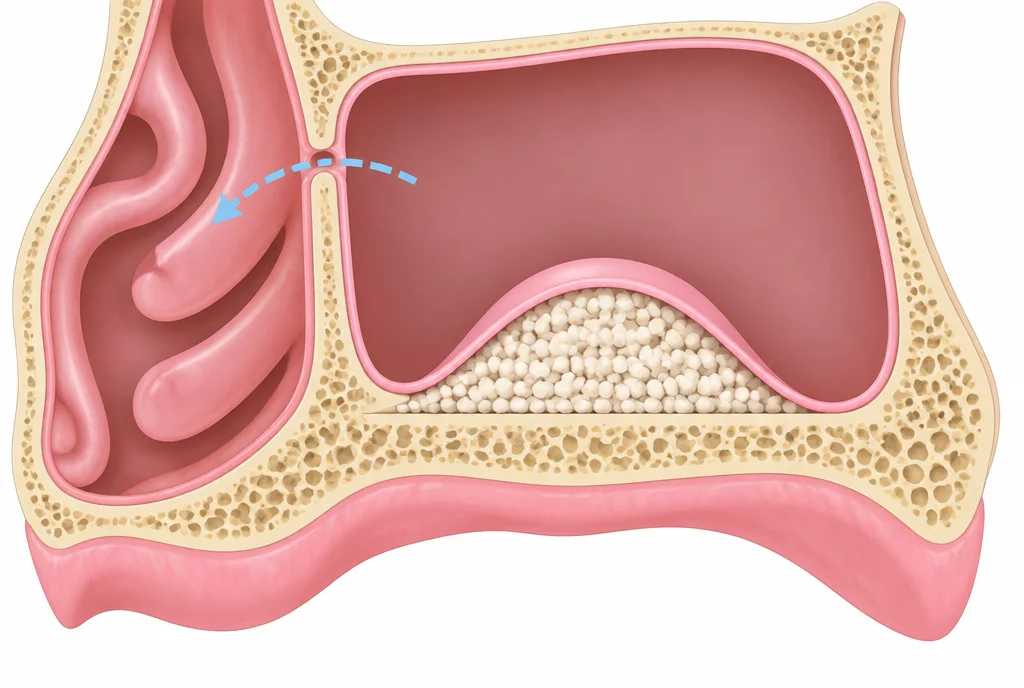
AI-generated explanatory illustrationCross-section of the upper molar region — the passage high in the inner wall connecting the nasal cavity on the left to the maxillary sinus on the right (dashed arrow), the membrane lifted above the bony sinus floor, and graft particles placed beneath it toward the sinus. The membrane continues without a break from the sinus wall to the top of the graft material
The extent of nasal symptoms differs with the surgical approach
| Category | Crestal approach | Lateral window approach (Korean) |
|---|
| Method | Gently pushes the membrane up a little through the hole prepared for the implant | Creates a small window in the bone at the side of the gum and lifts a wider area of membrane |
| Area lifted | Narrow | Wide |
| Nasal symptoms after surgery | Often absent or mild | Blood-tinged discharge and congestion may continue for a few days |
| Bruising of the cheek or below the eye | Rare | May occur |
We explain which approach was used on the day of surgery, but if you do not remember, please call and ask. Keep this difference in mind when reading the timeline below.
From the day of surgery to 2 weeks later, which symptoms can I watch?
If symptoms are decreasing day by day, you may watch them; if they improve and then get worse again, please contact us. First checking whether symptoms are decreasing each day makes it easier to judge.
| Timing | Symptoms you can watch | Symptoms that call for contact |
|---|
| Day of surgery~day 2 | Blood-tinged discharge from the nostril on the operated side, a taste of blood draining down the back of the throat, congestion | A nosebleed that does not stop despite leaning forward and applying pressure |
| Days 3~7 | Nasal discharge changing from red to brown or a lighter color, gradually easing congestion, bruises on the cheek or below the eye turning yellow | Foul-smelling yellow discharge with fever, pressure-like pain in the cheek on the operated side |
| Weeks 1~2 | Occasional stuffiness on the operated side | Congestion that gets worse instead of easing, powder coming out of the nose |
Blood can drain down the back of the throat because the sinus passage opens deep inside the nose. It can be difficult to tell whether blood in your saliva is from the surgical site or has drained from the nose; both are common on the first day.
Bruises change color as they move down the face. A bruise that starts on the cheek and appears near the jaw a few days later has often moved downward. However, please contact us if swelling or pain suddenly increases again.
What should I do at home if I have a nosebleed?
Sit down, lean your head slightly forward, and pinch the soft part just above the nostrils from both sides continuously for 10~15 minutes. Tilting your head back sends blood down your throat, making it hard to tell how much you are bleeding, and may cause nausea.
- Do not push tissue or cotton deep into your nostrils. Removing it can disturb the wound again.
- Holding a cold towel against the bridge of your nose and cheek can help.
- When lying down, use an extra pillow to keep your head elevated.
- Do not take aspirin-type painkillers in addition to your prescribed medication. They can make bleeding harder to stop.
If you regularly take blood-thinning medication, you will likely have told us before surgery, but if a nosebleed lasts longer than usual, please contact us and give us the medication name. Do not stop it on your own.
What should I do when I want to blow my nose or need to sneeze?
Do not blow your nose; just wipe away any discharge, and sneeze with your mouth open. Blowing your nose forcefully or sneezing with your mouth closed can suddenly raise pressure inside the sinus and displace the healing membrane and graft material.[1]
Things to avoid for about 2 weeks
- Blowing your nose forcefully or sniffing hard
- Drinking through a straw and smoking — these change pressure in the mouth and delay recovery
- Lifting heavy objects or exercises that involve holding your breath and straining
- Activities involving large pressure changes, such as flying, diving or playing a wind instrument
If heavy nasal discharge makes you uncomfortable, gently wiping it away one side at a time is fine. We usually prescribe a 1-week course of medication to ease congestion (a nasal decongestant). Use it only for that period, and do not separately use an over-the-counter nasal spray for a prolonged time.
Nasal rinsing involves pushing water into the nose, which creates pressure. Even if you normally rinse your nose, please ask when you can restart after surgery.
What do we check in the treatment room?
Before surgery, we use CT to check whether the inside of the sinus is clear; afterward, on the day your stitches are removed, we check the surgical site and nasal symptoms and use a panoramic X-ray to check the position of the graft material.
Before surgery
On cross-sectional CBCT (dental 3D CT) images (Korean), we check the remaining bone height, whether the membrane along the sinus floor is thickened, whether there is inflammation or fluid inside the sinus, and whether there are partition-like bony walls along the floor. Operating when the sinus is inflamed can make the inflammation worse afterward, so if these findings are present, we arrange the surgery date after you have been seen by an ear, nose and throat specialist.[2] We also check at this point whether you have been treated for rhinitis or sinusitis.
There are other things it helps to mention during the consultation: daily rhinitis medication or nasal sprays, a positive airway pressure device used for sleep apnea, and frequent flight schedules. A positive airway pressure device pushes air through the nose, so please discuss in advance how to use it after surgery and do not stop using it on your own. It is preferable to schedule surgery around business trips or travel.
On the day of surgery
A small hole developing while the membrane is being lifted is the most common intraoperative problem in this surgery, and surgery often continues after the hole is covered with a membrane patch.[3][5] If this has happened, we explain it after surgery because you will have additional precautions to follow at home.
After surgery
On the day your stitches are removed, we check whether the surgical site has closed well and whether there is any air leakage between the mouth and nose, and ask whether your nasal symptoms are easing. As a standard check, we take a panoramic X-ray to confirm whether the graft material is in the planned position.
Can lasting nasal symptoms affect the implant too?
Congestion or blood-tinged discharge lasting a few days often does not affect the healing of the grafted bone. The concern is when inflammation develops inside the sinus and spreads to the graft material.
The graft material sits beneath the lifted membrane, so as long as the membrane stays in place, it does not come into contact with air or nasal mucus inside the sinus. If a hole made in the membrane during surgery was not sealed well, or if forceful nose-blowing after surgery opens the membrane again, graft material can escape into the sinus and inflammation can develop there.[1][3] Postoperative maxillary sinusitis or graft infection is uncommon, but when it occurs, some grafted bone may be lost or the implant schedule may be delayed.[5]
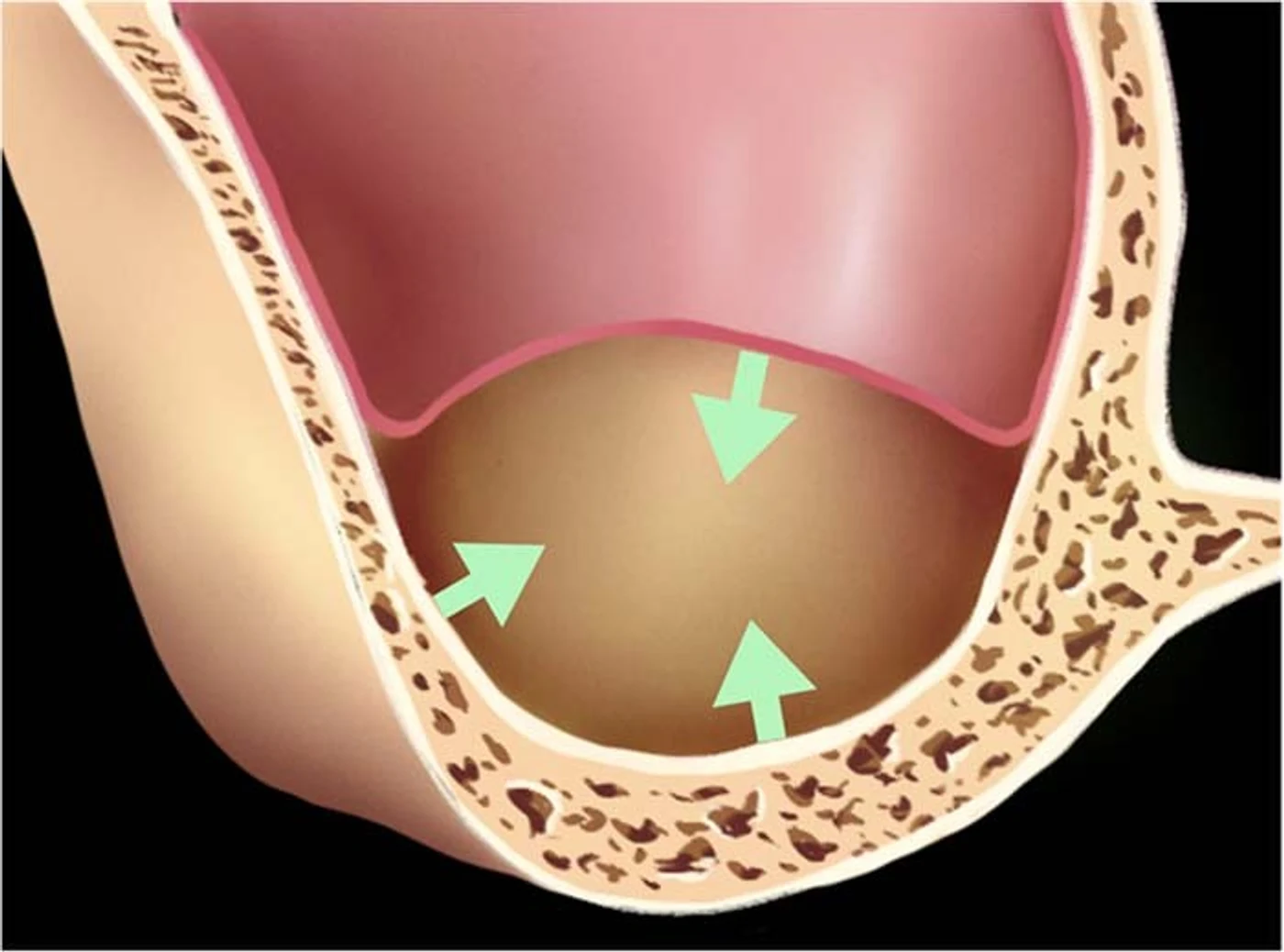
Figure cited from an external paper · Not a case from our clinicFrontal cross-section of the sinus floor — the thin elevated membrane (red line) and the graft-filled space beneath it (brown). When the membrane is intact, the graft does not contact air or nasal mucus inside the sinus. The arrows indicate the outer bony wall, alveolar bone and elevated membrane, the three walls forming this spaceLyu et al. · Figure 1 · DOI: 10.1038/s41368-023-00248-x · CC BY 4.0 · No changes other than enlargement
This is why we ask you not to blow your nose forcefully. If the stuffy feeling is easing each day without other signs such as fever or yellow discharge, you can regard it as the membrane swelling settling down.
Yes. If symptoms are on the side that was not operated on, or were present before surgery, we consider other causes first.
- Both sides of the nose are blocked, with clear discharge and sneezing — a cold or allergic rhinitis may be occurring at the same time. Catching a cold when you are tired after surgery is also common.
- One side of the nose was always blocked before surgery — there may be a pre-existing problem, such as a deviated nasal septum or longstanding sinusitis.
- Symptoms are only on the operated side and are getting worse — in this situation, we first check for inflammation related to surgery.
Even if the symptoms seem unrelated to surgery, please tell the dental clinic first if you are within 2 weeks of surgery. Frequent sneezing and nose-blowing because of a cold can themselves put strain on the surgical site, so we will explain how to manage day to day. If the symptoms appear to be a nasal condition unrelated to surgery, we recommend seeing an ear, nose and throat specialist.
How long does treatment take, and how many visits are needed?
Nasal symptoms are usually checked at one visit, on the day the stitches are removed, and the overall treatment duration depends on how long the grafted bone takes to heal.
- Stitch removal — you come in 1~2 weeks after surgery to have the stitches removed, the nasal symptoms and surgical site checked, and a panoramic X-ray taken.
- Time for the grafted bone to heal — if an implant was placed on the same day using the crestal approach, a few months may be added to the usual implant schedule; if bone was built up first using the lateral window approach, the implant may be placed after waiting several months. There are checkup visits during the waiting period.
- If symptoms occur — if you notice the warning signs in the table above, please come in without waiting for your scheduled visit.
The timelines for each approach are covered in I was told I cannot have an implant because there is not enough bone. Is there really no way?. Treatment fees are listed in the fee list (non-covered fees).
- A nosebleed does not stop even after leaning forward and applying pressure for 10~15 minutes
- You have foul-smelling yellow nasal discharge, or develop fever or pain in the cheek or around the eye on the operated side
- Water leaks from your nose when you drink, or you feel air passing between your mouth and nose (oroantral communication (Korean)) — do not pinch your nose and blow to test it
- White powder like grains of sand comes out of your nose — this may be graft material escaping[1]
- Swelling and pain improve and then increase again
If a nosebleed will not stop outside clinic hours, or your face swells enough to make breathing difficult, please go to the nearest emergency department.
Frequently asked questions
Q. My nose is blocked after surgery, so I am breathing through my mouth. Is this okay for the wound?
Mouth breathing itself does not open the wound. However, your mouth can dry out easily, so take small sips of water frequently and chew on the side opposite the surgical site.
Q. Can I sleep lying on the operated side?
For the first few days, it is preferable to lie on your back with your head raised on pillows. Lying on the operated side for a long time can allow more swelling to collect in that cheek and prevent blood and mucus from draining well from the nose, making the blocked feeling worse. Once the swelling has eased, you may sleep in a comfortable position.
Q. Do I need to finish the prescribed antibiotics even if I have no nasal symptoms?
As a rule, take them for the prescribed period. Because a sinus lift involves placing graft material, antibiotics are often prescribed to prevent infection, and stopping them on your own because you have no symptoms does not fulfill that purpose. If you develop diarrhea, please contact us before stopping. If you develop hives, or swelling of the lips or face with difficulty breathing, stop taking the medication and contact us immediately or go to an emergency department.
Q. My upper cheek on the operated side aches and my head feels heavy. Is that okay?
If the membrane is swollen and a little blood has collected in the sinus, the upper cheek may feel heavy or your head may feel heavy when you lean forward during the first few days. If this settles with the prescribed painkillers and eases each day, you may watch it. Please contact us if it gets worse after a few days and you develop a fever.
Q. I feel a cold coming on. Can I still have my scheduled surgery?
If nasal discharge, sneezing or coughing is severe on the day of surgery, we consider postponing it. This is to avoid frequent sneezing and nose-blowing immediately after surgery, so please let us know about symptoms by the day before your appointment.
Q. When can I exercise or use a sauna after surgery?
Rest is advisable for the first few days because bleeding may restart or swelling may increase. Gentle walking is fine; for exercise that makes you sweat heavily, saunas and alcohol, we will advise you after checking the surgical site when the stitches are removed.
Q. If I develop sinusitis after a sinus lift, does the implant need to be removed?
Usually not. Inflammation of the maxillary sinus after surgery is uncommon, and even when it occurs, it often settles with medication and observation.[4][5] If it does not settle with medication, or if the graft material is infected, we consider a procedure to remove some of the graft material and may coordinate care with an ear, nose and throat specialist.
Q. How can I have nasal symptoms checked after a sinus lift near Bongcheon Station?
If you had surgery at another dental clinic, it is preferable to contact that clinic first, because your surgical records and images are there. If you cannot reach them, Joy Dental Clinic Bongcheon (Bongcheon Station, Exit 1, 5F Jehyeong Bldg.) can also check the inside of the sinus with CT, so please tell us the surgery date and your symptoms when booking.
Limits of the evidence
- The complication studies cited[3][4] reviewed surgical records from a single institution, so outcomes may differ with the surgical technique and patient conditions.
- The timeline table is a guide based on the literature[1][2] and typical recovery patterns; there is considerable variation between people depending on whether the lateral window or crestal approach was used and on the extent of grafting.
- The literature review[5] pooled studies of the lateral window approach, so it is difficult to apply it directly to nasal symptoms after the crestal approach.
DOCTOR’S NOTE
If a sinus lift appears necessary for an upper molar, we need to check not only the bone height on CT but also the condition of the membrane inside the sinus. If the membrane is thickened or inflammation is visible, an ear, nose and throat evaluation should come first. I believe that much of what determines how well we can reduce nasal symptoms after surgery is decided before surgery.
— Jeong Jinwoo, Director, Joy Dental Clinic Bongcheon
This post reflects information as of the date of writing and was written to provide general information in compliance with Korea’s Medical Service Act and the Ministry of Health and Welfare’s medical advertising guidelines. Sinus lift and implant surgery can have side effects such as bleeding, nosebleeds, swelling, bruising, pain, infection, maxillary sinusitis and graft displacement. Individual diagnosis and the direction of treatment depend on the condition of your mouth, so please be sure to consult fully with your treating clinician before deciding.
We are right next to Exit 1 of Bongcheon Station (Line 2), and directions from Seoul Nat’l Univ. Station, Sillim, Nakseongdae and Sadang are in Getting here.
Joy Dental Clinic Bongcheon
5F Jehyeong Bldg., 1738 Nambusunhwan-ro, Gwanak-gu, Seoul (Bongcheon Station, Exit 1)
Hours: Mon·Wed·Thu·Fri 09:30–18:30 / Tue 09:30–20:30 / Sat 09:30–13:30 (closed Sun & public holidays)
Booking: Naver Booking / Phone 02-877-2867
Related pages: Implant treatment guide · Swelling and pain after implant surgery: how many days is normal? · Sinus lift (Korean) · Oroantral communication (Korean)
References
- Kim J, Jang H. A review of complications of maxillary sinus augmentation and available treatment methods. J Korean Assoc Oral Maxillofac Surg. 2019;45(4):220-224. — A literature review of complications during and after sinus lift surgery (membrane perforation, bleeding, graft infection, maxillary sinusitis, graft displacement, etc.) and their management.
- Testori T, Weinstein T, Taschieri S, Wallace SS. Risk factors in lateral window sinus elevation surgery. Periodontol 2000. 2019;81(1):91-123. — A review of risk factors in lateral window sinus lift surgery — recommends assessing the preoperative sinus condition (mucosal thickening and inflammation), anatomy and smoking before surgery, and coordinating with an ear, nose and throat specialist when needed.
- Schwarz L, Schiebel V, Hof M, Ulm C, Watzek G, Pommer B. Risk factors of membrane perforation and postoperative complications in sinus floor elevation surgery: review of 407 augmentation procedures. J Oral Maxillofac Surg. 2015;73(7):1275-1282. — [Cohort] A retrospective study of 407 sinus lift procedures — analyzed factors associated with membrane perforation and postoperative complications.
- Moreno Vazquez JC, Gonzalez de Rivera AS, Gil HS, Mifsut RS. Complication rate in 200 consecutive sinus lift procedures: guidelines for prevention and treatment. J Oral Maxillofac Surg. 2014;72(5):892-901. — [Cohort] Complications and guidelines for prevention and management in 200 consecutive sinus lift procedures — most complications resolved with observation or simple treatment.
- Pjetursson BE, Tan WC, Zwahlen M, Lang NP. A systematic review of the success of sinus floor elevation and survival of implants inserted in combination with sinus floor elevation. J Clin Periodontol. 2008;35(Suppl 8):216-240. — [Systematic review] A literature review pooling the outcomes of implants placed in conjunction with lateral window sinus lifts — membrane perforation was the most common intraoperative complication, and postoperative maxillary sinusitis was rarely reported.
- Lyu M, Xu D, Zhang X, Yuan Q. Maxillary sinus floor augmentation: a review of current evidence on anatomical factors and a decision tree. Int J Oral Sci. 2023;15(1):41. — [Figure source] A literature review summarizing anatomical risk factors for sinus lifts (membrane condition, sinus width and septa) and proposing a decision tree for selecting a surgical technique. The figure in the text (the elevated membrane and the graft space) is Figure 1 from this paper (CC BY 4.0).


 한국어
 日本語
 简体中文