💡 Key answer
It is okay to use adhesive every day if you apply a pea-sized amount to a well-fitting denture once a day and clean it off thoroughly every night. However, if the denture will not stay in place at all without adhesive, or you use enough to finish a tube in just 2~3 weeks, it is time to check whether the denture fits your gums rather than try to solve the problem with adhesive.
Summary for patients
- Do not squeeze adhesive in a long line along the edge.
- Take your denture out at night and soak it in water or a cleaning solution.
- If you need to reapply adhesive at lunchtime, have your denture checked.
- Check the ingredient list for zinc.
- A loose denture can often be corrected by refitting just the inner surface.
❓ What this article covers
- Does using adhesive mean something is wrong with my denture?
- How should I apply and remove it if I use it every day?
- Which should I choose: cream, powder or sheets?
- Is adhesive containing zinc dangerous?
- How do adhesive, relining, a new denture and an implant overdenture differ?
- What do we check in the treatment room?
- When should I stop relying on adhesive?
- How long do relining and making a new denture take, and how many visits are needed?
Does using adhesive mean something is wrong with my denture?
No. There are situations where adhesive helps even a well-fitting denture. When bringing up adhesive in the treatment room, many people ask a little apologetically, “I’m not supposed to use this, am I?” Denture adhesive is a product that makes the thin film of saliva between the denture and gums stickier to help them stay in close contact.
- A complete lower denture: The tongue and cheek muscles keep moving, and the gum area in the lower jaw is small, making it harder for a lower denture to stay in place than an upper one.
- People with a dry mouth: When there is little saliva, the denture does not adhere well to the gums. Common causes include medicines such as blood pressure medicines and antidepressants, or age-related dry mouth (Korean).
- People whose jawbone is already low: If a long time has passed since extraction and much of the bone has shrunk, the ridge supporting the denture is low.
A systematic review pooling several studies also found that adhesives improve complete denture retention, stability, chewing force and satisfaction.[3] Filling the space between the denture and gums also reduces food getting trapped underneath.
Even with the same adhesive, using it because “my lower denture has always been hard to keep in place” differs from using it because “I never used to need it, but now I cannot do without it.” The first is using it as an aid; the second may mean that the jawbone has shrunk in the meantime, leaving a gap.
How should I apply and remove it if I use it every day?
Apply small dots at a few points on the inner surface of the denture, and before bed clean off what remains on your gums as well as on the denture. There is little evidence that adhesive harms the gums when used as directed.[3] Most problems arise from using too much or leaving residue behind.
Amount and placement
For cream adhesive, apply pea-sized amounts at 3~4 points on the upper denture: the center at the front, the molar areas on both sides, and the center of the palate. On the lower denture, place it at the molar areas on both sides and 1 point at the front. If adhesive squeezes out of the denture when you chew, you have used too much.
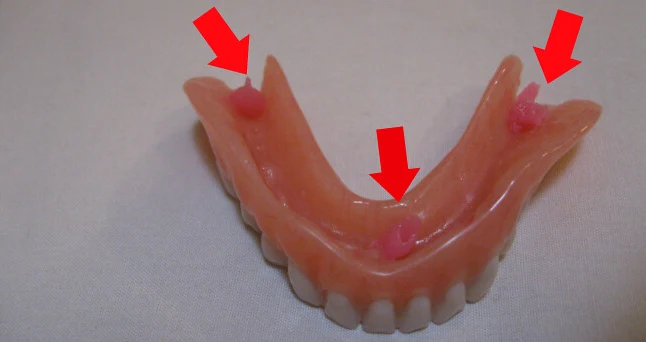
Photo cited from publicly available external material · Not a case from our clinicPea-sized dots of adhesive have been placed at three points on the inner surface of a lower denture: both molar areas and the center at the front. Small dots like these are enough, rather than a long line along the edge.Kathy McGraw, “New Dentures how to keep them #1” · Flickr · CC BY 2.0 · Used with the English instructions above and below the photo cropped out
Applying adhesive and putting the denture in
Rinse the inner surface of the denture, lightly shake off the water, and apply the adhesive. Put it in your mouth, bite together gently and hold it in place for a few seconds. Avoid hot drinks for the first few minutes.
Removing it at night
Before bed, take the denture out and wash all the adhesive off the inner surface with lukewarm water and a denture brush. Rinse your gums with lukewarm water, then wipe off any remaining adhesive with damp gauze. If residue is left in place, bacteria can grow underneath and lead to denture stomatitis (Korean), in which the gums beneath the denture become red and swollen. The American College of Prosthodontists guidelines also recommend removing adhesive completely every day and not sleeping with dentures in.[1] Cleaning and storage are covered in Denture care (Korean).
How many times a day
Adhesive applied in the morning usually lasts until the evening. If you need to reapply it around lunchtime, we see that as an early sign that the denture is lifting away from the gums.
Which should I choose: cream, powder or sheets?
Cream or powder is enough for most people, and thicker sheets are used only briefly.
| Form | Features | Points to watch |
|---|
| Cream | Lasts longer and is easy to control the amount | Too much squeezes out and can instead lift the denture |
| Powder | Sprinkled onto a wet denture. Spreads thinly and leaves less residue | Tends not to last as long |
| Sheet (pad) | Cut to the shape of the denture and attached | The thickness can change the bite height, so it is not used long term |
If you are trying adhesive for the first time, one approach is to start with a small amount of powder and switch to cream if it does not last the day.
Is adhesive containing zinc dangerous?
Using the directed amount is not a level of concern; the problem is applying thick layers several times a day for years. Some cream adhesives contain zinc to improve adhesion.
In cases reported in 2008, patients who had used more than two tubes of zinc-containing adhesive a week over a long period were found to have high blood zinc and low copper levels, along with tingling in the hands and feet, altered sensation, muscle weakness and unsteady walking.[2] Major US manufacturers subsequently introduced zinc-free products. The American College of Prosthodontists guidelines also caution against using large amounts of zinc-containing adhesive over a long period.[1]
Look for zinc on the ingredient list, and choose a zinc-free product if one is available. If you use a lot of adhesive and have tingling in your hands and feet or weakness, tell your physician about that use at your medical appointment.
How do adhesive, relining, a new denture and an implant overdenture differ?
They do different jobs and suit different situations. Depending on why the denture is loose, we first check whether only the inner surface needs refitting or whether the artificial teeth also need to be remade.
| Comparison | Adhesive | Relining | New denture | Implant overdenture |
|---|
| What it does | Improves contact between the denture and gums for that day | Adds material to the inner surface to refit it to shrunken gums | Replaces both the artificial teeth and the denture base | Secures the denture by attaching it to implants |
| When it fits | An aid for a well-fitting denture | The denture itself is sound, but the inner surface no longer fits closely | Artificial teeth are worn or cracked, or the denture becomes loose again soon after relining | The denture does not stay in place well, as with a complete lower denture, and bone conditions allow |
| How long it lasts | One day | A few years (depending on how quickly the jawbone shrinks) | Often reassessed at around 5~7 years | A long time, depending on implant care |
| Korean National Health Insurance | Not applicable | Some services covered for those aged 65 or older | Once every 7 years for those aged 65 or older, with a 30% patient co-payment[4] | Separate conditions apply |
The jawbone shrinks a little each year even when you wear dentures. A denture that fitted well at first often becomes loose after a few years because of this change, rather than because it was made incorrectly. In many cases, relining (Korean), which fills in just the inner surface, can restore the fit. The criteria for choosing between relining and a new denture are covered separately in What to check when your denture keeps moving.
What do we check in the treatment room?
We examine you with the denture both in and out, starting by identifying where the looseness comes from. If there is a sore spot, wearing the denture for a few hours before your visit leaves pressure marks that make the spot easier to find.
- Gaps between the denture and gums — With the denture in place, we press on it to see where it lifts and how well it stays in place without adhesive.
- Wear on the artificial teeth — We check whether the chewing surfaces have flattened or the bite height has decreased. This is something relining cannot restore.
- Gum condition — We check for redness or sores beneath the denture and for adhesive residue. If we suspect stomatitis, we also ask how you clean the denture and whether you take it out at night. It often goes unnoticed because it does not hurt.
- For a partial denture, the clasps and the teeth they attach to — We check whether the clasps have opened up and whether those teeth are loose or decayed.
- Jawbone height — A panoramic X-ray shows how much bone remains to support the denture. If the lower jawbone is very low, we also discuss an implant overdenture.
When should I stop relying on adhesive?
If any of the following apply, have your denture checked rather than increasing the amount of adhesive. If a loose denture keeps moving over the gums, the bone underneath may shrink faster.
- ☐ The denture will not stay in place at all without adhesive
- ☐ A tube (around 40g) runs out in just 2~3 weeks
- ☐ Food keeps getting under the denture
- ☐ The gums under the denture are red and sore, or one spot keeps hurting
- ☐ The denture rocks back and forth or lifts on one side when you chew
- ☐ The denture is cracked or an artificial tooth has come off
- ☐ A partial denture clasp has opened up, or the tooth it attaches to is loose
By contrast, a complete lower denture lifting slightly when you speak, reduced adhesion on days when your mouth is dry, and the first few weeks of adjusting to a new denture are situations where using adhesive as an aid is acceptable.
How long do relining and making a new denture take, and how many visits are needed?
Relining takes around a day, while making a new denture takes a few weeks.
- Relining (direct method) — Material is applied to the inner surface of the denture in the treatment room and allowed to set in your mouth, so you leave wearing it again that day.
- Relining (indirect method) — An impression is taken inside the denture and replaced with a hard material at the dental laboratory, so you need to leave your denture with us for a day or two.
- New denture — A partial denture usually requires 4~5 visits over 3~4 weeks, and a complete denture 5~6 visits over 3~4 weeks. There is a stage in the middle where you try in the artificial teeth, and the reason is explained in Dentures: why is there a try-in stage before completion?.
- After fitting — Usually, pressure spots are adjusted over 2~3 visits in the first 1~2 weeks.
Treatment fees are listed in the fee list (non-covered fees).
Frequently asked questions
Q. Can I sleep with my denture in if I have applied adhesive?
We do not recommend it. Saliva pooled under the denture overnight and adhesive residue provide a good environment for bacteria to grow and are common causes of denture stomatitis and bad breath. Research in older adults on the relationship between sleeping with dentures in and pneumonia is covered in the Denture treatment guide. At night, take the denture out and soak it in water or a denture cleaning solution.
Q. My lower denture is loose whatever I do. Is there another option?
A complete lower denture is difficult to keep in place because of the movement of the tongue and cheeks. An implant overdenture (Korean), secured by attaching it to 2 implants, can be considered, and an international consensus has proposed this as the first choice for the lower jaw. Whether it is possible is decided by looking at the remaining bone on CT.
Q. Is adhesive used with partial dentures too?
Partial dentures usually do not need adhesive because the clasps and remaining teeth hold them in place. If a partial denture moves enough to make you want to use adhesive, the clasps have often opened up or a problem has developed in the teeth they attach to.
Q. Can I apply adhesive if I have a wound on my gums?
If there is a wound or sore, it is better to check the cause before applying adhesive. If the edge of the denture is pressing on one spot, adjusting just that part is often enough.
Q. Can I fill the denture myself with relining material sold at a pharmacy?
We do not recommend it. Filling it at home can leave an uneven thickness, alter the bite and injure the gums.
Q. Can an insurance-covered denture be remade before 7 years have passed?
As a rule, Korean National Health Insurance covers a denture for the same jaw once every 7 years. One additional denture is covered only under limited conditions, such as when a major change in oral condition is recognized.[4] We check whether you qualify at the consultation.
Q. If I bring my current denture to a clinic near Bongcheon Station, can you check whether relining will be enough?
Yes. Bring your current denture to Joy Dental Clinic Bongcheon (Bongcheon Station, Exit 1, 5F Jehyeong Bldg.), and we will start by checking whether relining will be enough.
Limits of the evidence
- Most findings on the effectiveness and safety of adhesives[3] come from short-term studies of complete denture wearers, so they do not apply directly to partial dentures or use for 10 years or longer.
- The relationship between zinc and neurological symptoms[2] comes from case reports involving a small number of patients. The amount at which risk begins has not been established.
- Korean National Health Insurance conditions[4] may change, so we check them again against the criteria in effect at the time of consultation.
- The times given for relining and making a new denture are general ranges used in practice, rather than values measured in research.
DOCTOR’S NOTE
Adhesive is a useful tool when used properly. However, if you are using more than before, your denture may have become loose, so that is when I bring up the denture before the adhesive. Before buying a new tube, please let me take a look at your denture.
— Jeong Jinwoo, Director, Joy Dental Clinic Bongcheon
This post reflects information as of the date of writing and was written to provide general information in compliance with Korea’s Medical Service Act and the Ministry of Health and Welfare’s medical advertising guidelines. Using dentures and denture adhesives can have side effects such as gum pain, inflammation and gum irritation. Individual diagnosis and the direction of treatment depend on the condition of your mouth, so please be sure to consult fully with your treating clinician before deciding.
We are right next to Exit 1 of Bongcheon Station (Line 2), and directions from Seoul Nat’l Univ. Station, Sillim, Nakseongdae and Sadang are in Getting here.
Joy Dental Clinic Bongcheon
5F Jehyeong Bldg., 1738 Nambusunhwan-ro, Gwanak-gu, Seoul (Bongcheon Station, Exit 1)
Hours: Mon·Wed·Thu·Fri 09:30–18:30 / Tue 09:30–20:30 / Sat 09:30–13:30 (closed Sun & public holidays)
Booking: Naver Booking / Phone 02-877-2867
Related pages: Denture treatment guide · My denture is loose or uncomfortable — symptom guide · Denture FAQ
References
- Felton D, Cooper L, Duqum I, et al. Evidence-based guidelines for the care and maintenance of complete dentures: a publication of the American College of Prosthodontists. J Prosthodont. 2011;20(Suppl 1):S1-S12. — [Guidelines] American College of Prosthodontists guidelines for complete denture care. Adhesive may supplement the retention of a well-fitting denture but must not substitute for correcting an ill-fitting denture; remove it completely every day, avoid wearing dentures at night, and take care with long-term excessive use of zinc-containing products.
- Nations SP, Boyer PJ, Love LA, et al. Denture cream: an unusual source of excess zinc, leading to hypocupremia and neurologic disease. Neurology. 2008;71(9):639-643. — Copper deficiency and neurological symptoms reported in people who used excessive amounts of zinc-containing adhesive over a long period.
- Papadiochou S, Emmanouil I, Papadiochos I. Denture adhesives: a systematic review. J Prosthet Dent. 2015;113(5):391-397. — [Systematic review] Adhesives improve complete denture retention, stability, chewing force and satisfaction; evidence of harm to oral tissues is limited when used as directed.
- 국민건강보험공단. 노인 틀니 급여 안내 — 만 65세 이상, 7년 1회, 본인부담률 30%, 첨상·수리 급여 항목.


 한국어
 日本語
 简体中文