💡 Key answer
Once dentures are finished, it is difficult to make major changes to the position of the artificial teeth or the bite height, so we try them in your mouth before the material is hardened. We first try in dentures with artificial teeth arranged in wax, check how the upper and lower teeth meet, the bite height, speech, and the appearance of the lips and face, then make any changes before completing them. This stage of placing unfinished dentures in the mouth to check them is called a try-in (Korean) (checking the wax dentures).[1]
Summary for patients
- On the try-in day, you practice speaking and closing your mouth while looking in a mirror.
- It helps to bring a family member, old photos, and your existing dentures.
- You do not try chewing food that day because the dentures are still in wax.
- After completion, have pressure spots adjusted instead of putting up with them.
❓ What this article covers
- Where does the try-in fit into the denture-making process?
- How is the bite height decided?
- What do we check in the treatment room on the try-in day?
- How are the color and shape of the artificial teeth chosen?
- Can’t changes be made after completion?
- What should you do on the try-in day?
- Can dentures still fail to fit even after a successful try-in?
- How long does treatment take, and how many visits are needed?
Where does the try-in fit into the denture-making process?
After taking impressions and recording the bite, just before final completion. Complete dentures (Korean) are usually made in the following order.
| Order | Stage | What we do |
|---|
| 1 | Diagnosis and consultation | Check the remaining teeth and jawbone and decide on the denture type |
| 2 | Impression taking (Korean) | Take impressions of the gums |
| 3 | Bite registration | Record the height and position at which the upper and lower jaws meet |
| 4 | Try-in (checking the wax dentures) | Try the artificial teeth arranged in wax in the mouth, check them and make changes |
| 5 | Completion and fitting | Replace the wax with denture material (resin), finish the dentures and fit them |
| 6 | Adaptation and adjustment | Adjust pressure spots several times after fitting |
Complete dentures
We use the initial impression to make an impression tray tailored to your gums (a custom tray), then use it to take another impression that includes the range of movement of the lips, cheeks and tongue. These borders need to be accurate for the dentures to lift less when you speak or chew. Depending on the case, impressions and bite registration may be done during the same visit.
If your teeth have just been extracted, we may first make immediate dentures to use temporarily while the gums heal, then make the final dentures after the gums have settled. In that case, it takes that much longer to reach the try-in stage. At diagnosis, we also ask whether you can remove and clean the dentures yourself. If using your hands is difficult, we simplify the design and explain the care routine to your caregiver as well.
Partial dentures
For partial dentures (Korean), there is a separate stage where we try in just the metal framework before arranging the artificial teeth. We check whether the clasps (Korean) that wrap around the remaining teeth fit closely, whether the rests that sit on the teeth are seated in the right places, and whether the framework lifts or presses on one side. Once we have confirmed that the framework fits, we arrange the artificial teeth on it and do another try-in.
How is the bite height decided?
We record it during bite registration, then check it again against your actual facial appearance and speech at the try-in. This is because the bite height cannot be decided by a single number.
During bite registration, you bite on wax rims while we record the height and position at which the upper and lower jaws meet, the length of the lower face from the tip of the nose to the tip of the chin, and how much support the front teeth give the lips. If this height is not right, chewing can be uncomfortable and the jaw joints may be strained, so this is a stage we spend considerable care on when making dentures.
When your jaw is relaxed and at rest, it is normal for the upper and lower teeth to be slightly apart rather than touching. We set the denture height so that this space remains. If the height is too low, the area around the mouth draws inward and the lower face looks shorter; if it is too high, closing your mouth takes effort and the upper and lower artificial teeth hit each other when you speak. If the artificial teeth on dentures you have worn for a long time have worn down and lowered the bite height, we also consider at this stage how much to restore with the new dentures. We set a reference for how much of the upper front tooth edges should show below the upper lip, then check it at the try-in as you actually smile.
What do we check in the treatment room on the try-in day?
We look at the bite height, how the teeth meet, speech and facial appearance.
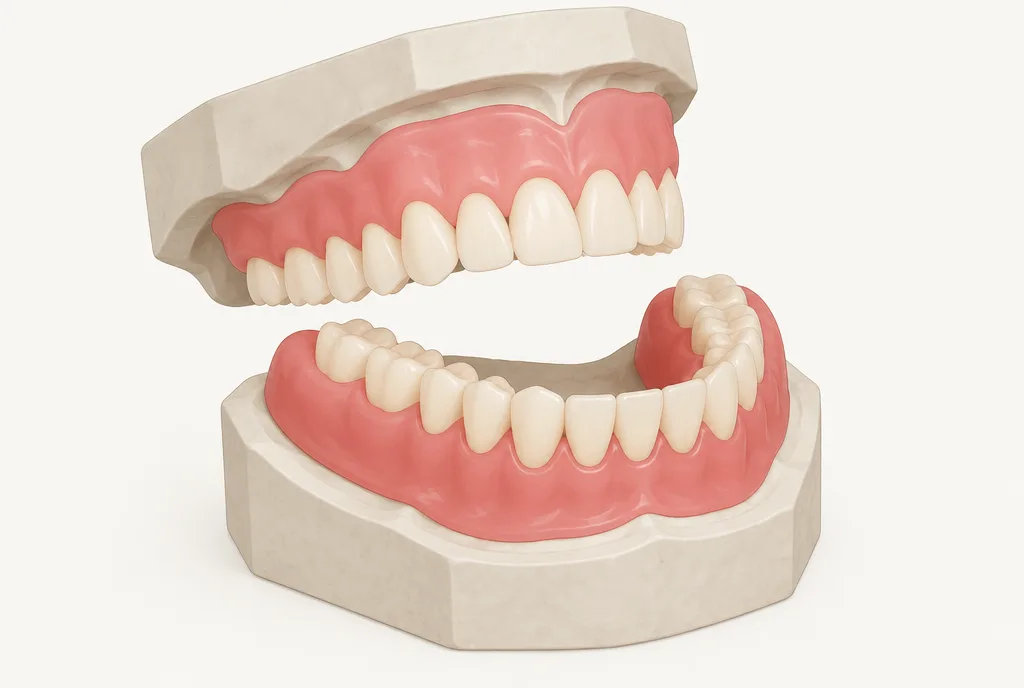
AI-generated explanatory illustrationUpper and lower trial dentures (wax dentures) on plaster models
| What we check | How we check it | If it is not right |
|---|
| Bite height | The distance between the lips and chin when the mouth is closed, and the space between the upper and lower artificial teeth when the jaw is at rest | Record the bite again and change the arrangement |
| Occlusion (Korean) (how the teeth meet) | Whether one side touches first or the jaw slides sideways | Move the artificial teeth |
| Speech | Whether air escapes or the teeth click when you make sounds such as “seu” and “peu” | Adjust the position and angle of the front teeth |
| Facial appearance | Whether the lips look sunken or protruding, the midline and length of the front teeth, and how much shows when you smile | Change the arrangement and length of the front teeth |
If air escapes when you make the “s” sound, we mainly consider the position and angle of the front teeth; if the upper and lower artificial teeth click together when you speak, we first suspect the height. We do not assess the bite by feel alone: we ask you to bite on thin colored paper (articulating paper) and check the marks to see which teeth touch first. You may be tense on the try-in day and close your mouth differently than usual, so we check again after you have closed it comfortably a few times.
How are the color and shape of the artificial teeth chosen?
They can be changed at the try-in because they are still in wax, and we assess whether they suit your face and age.
If artificial teeth are too white or too evenly aligned, they can look unnatural and make it more obvious that you are wearing dentures. We therefore choose the color and size by considering your skin tone, lip shape and how much of the teeth shows when you smile. For partial dentures, we match the color of your remaining natural teeth. Natural teeth look whiter than they really are when they dry out after the mouth has been open for a long time, so we check the color first, while the teeth are still wet.
Looking at the color only under treatment-room lighting can give a skewed impression, so it helps to look in a mirror in a bright place as well. If the color or shape feels unnatural when you try the dentures in, please tell us that day.
Can’t changes be made after completion?
The surfaces touching the gums and pressure spots can still be adjusted after completion, but major changes to the arrangement or bite height may require remaking the dentures. This is because the wax is replaced with hard resin during completion, fixing the artificial teeth in place. Very small differences can arise when the wax is replaced with resin, so we adjust the bite again on the day the finished dentures are fitted.
- What can still be adjusted after completion: smoothing areas that press on the gums, making small adjustments to the bite, and adding material to the inner surface to fit the gums again (relining (Korean))
- What needs to be decided at the try-in: the shape, length and midline of the front teeth, the bite height, and the overall arrangement of the artificial teeth
What should you do on the try-in day?
With the dentures in, look in a mirror, read a short sentence and close your mouth comfortably a few times.
- Look in the mirror at the shape, length and color of the front teeth and how much shows when you smile.
- Check your speech by counting or reading a short sentence aloud.
- Close your mouth comfortably several times and tell us if it feels as though only one side touches.
- Let us know if your lips feel pulled or sunken.
If these are your first dentures, this will be the first day you see your face with them in. We discuss with you there and then whether the odd feeling is simply unfamiliarity or whether the length or height actually needs changing.
If a family member who knows your usual appearance comes with you, they can help assess whether you look like you used to. If a caregiver comes along, we show and explain to them as well where and how we are making changes. It also helps to bring old photos or your current dentures. They give us a reference for the height and shape you are used to, and make it easier to compare and explain what you would like changed. Because the dentures are still made with wax, you do not try chewing food that day.
Can dentures still fail to fit even after a successful try-in?
Yes. Many people are satisfied with their complete dentures, but some find it difficult to adapt. Reports indicate that, in people who have difficulty adapting, making the dentures with greater care did not substantially reduce discomfort,[2] so we reassess the problem in cases such as these.
- The lower jawbone has shrunk considerably and the denture keeps lifting
- A strong gag reflex makes it difficult to tolerate a denture covering the palate
- Pain keeps recurring when chewing even after several adjustments
If gagging is the problem, we can first consider a design that covers less of the palate; if all the teeth available for clasps on a partial denture are weak, we may consider an attachment denture (Korean) without clasps. If the cause is the jawbone, we also consider an implant overdenture (Korean), in which implants help hold the denture in place. We check the jawbone on CT and review systemic conditions and the medications you take before explaining the possible options.
How long does treatment take, and how many visits are needed?
Complete dentures usually require 5~6 visits over 3~4 weeks, and partial dentures 4~5 visits over 3~4 weeks. If extractions or gum treatment are needed first, the duration increases accordingly; if impressions and bite registration are done on the same day, there may be one fewer visit.
- When an additional try-in is needed — If we have recorded a new bite height or jaw position, or made substantial changes to the shape or length of the front teeth, we try the dentures in once more before completion. This adds one more visit.
- Adjustments after fitting — Usually, pressure spots are adjusted 2~3 times during the first 1~2 weeks, and getting used to new dentures generally takes 2~4 weeks.
- Checkups afterward — The jawbone continues to shrink gradually while you wear dentures. At regular checkups every 6 months, the director personally checks the gums and how the dentures fit.
Treatment fees are listed in the fee list (non-covered fees). You can find the full denture process in the Denture treatment guide.
Frequently asked questions
Q. If I do not like the dentures at the try-in, do you start over?
No. Because they are still in wax, the artificial teeth can be removed and rearranged. If the bite height is considerably off, we record the bite again and change the arrangement to match it.
Q. Can I ask you to make them exactly like my current dentures?
If your current dentures are comfortable, we can use their height and front tooth shape as a reference. However, dentures worn for a long time often have worn artificial teeth and a lowered bite height, so rather than copying them as they are, we ask what was comfortable and what was not, and change only the aspects of thickness, coverage or arrangement that need changing.
Q. I gag badly when impressions are taken. Will that be all right?
Please let us know in advance. We adjust the size of the impression tray and your sitting position, and use an intraoral scanner where possible to reduce gagging.
Q. My speech sounds lispy with new dentures. How long should I wait?
At first, the “s” and “ch” sounds may feel awkward, and this usually lessens over 1~2 weeks with practice reading aloud. If it remains unchanged after several months, we adjust the denture thickness or the position of the front teeth.
Q. My finished denture presses painfully on one spot. Can I file it down a little at home?
We do not recommend it. Using sandpaper or a file at home can distort the shape and cause more injury to the gums. If you wear the dentures for a few hours before coming in, the pressure marks remain, allowing us to adjust (Korean) that specific spot accurately.
Q. I have heard that food has less taste with new dentures. Is that true?
This is because an upper denture covers the palate, reducing the sensation of temperature and texture. Most people adapt, but if the discomfort is substantial, we consider a design that covers less of the palate.
Q. Can I schedule a try-in after work near Bongcheon Station?
Joy Dental Clinic Bongcheon (Bongcheon Station, Exit 1, 5F Jehyeong Bldg.) is open until 8:30 p.m. on Tuesdays. Because try-ins and adjustments require several visits, we plan the schedule together at the start.
Limits of the evidence
- The definition of try-in[1] comes from a glossary of prosthodontic terms, not a study measuring how much better dentures fit after a try-in.
- The information on people who have difficulty adapting[2] comes from a review of complete dentures and does not apply directly to partial dentures.
- Treatment duration and visit counts are general ranges used in practice, not values measured in research, and vary with the condition of the remaining teeth and gums.
DOCTOR’S NOTE
When I mention the try-in appointment, many people ask, “They aren’t finished yet?” It means the effort of one more visit, but this is the day we settle things such as front tooth length and bite height that are difficult to change after completion. That is why I ask you to tell me there and then, rather than brushing it aside with “It feels a little odd, but I’ll probably get used to it.”
— Jeong Jinwoo, Director, Joy Dental Clinic Bongcheon
This post reflects information as of the date of writing and was written to provide general information in compliance with Korea’s Medical Service Act and the Ministry of Health and Welfare’s medical advertising guidelines. Dentures may have side effects such as gum pain, inflammation, speech difficulties and discomfort when chewing. Individual diagnosis and the direction of treatment depend on the condition of your mouth, so please be sure to consult fully with your treating clinician before deciding.
We are right next to Exit 1 of Bongcheon Station (Line 2), and directions from Seoul Nat’l Univ. Station, Sillim, Nakseongdae and Sadang are in Getting here.
Joy Dental Clinic Bongcheon
5F Jehyeong Bldg., 1738 Nambusunhwan-ro, Gwanak-gu, Seoul (Bongcheon Station, Exit 1)
Hours: Mon·Wed·Thu·Fri 09:30–18:30 / Tue 09:30–20:30 / Sat 09:30–13:30 (closed Sun & public holidays)
Booking: Naver Booking / Phone 02-877-2867
Related pages: Denture treatment information · What to check when dentures keep moving · Is it okay to use denture adhesive every day?


 한국어
 日本語
 简体中文