💡 Key answer
A gold restoration feeling comfortable does not necessarily mean the tooth beneath it is healthy. Decay underneath can be hidden by the metal on X-rays and grow without pain until it approaches the nerve. We therefore decide whether to replace a long-used gold restoration based on signs such as gaps at the margin, discoloration and floss catching, together with regular examination results. If we decide to replace it, the plan may change depending on the tooth’s condition after removal. The choice between gold and a tooth-colored material depends on the tooth’s location, the amount of remaining tooth structure and the bite.
Summary for patients
- If you have a gold restoration, have the margin of that tooth checked at your checkup.
- Decay beneath a gold restoration is difficult to see even on X-rays.
- Come in sooner if floss catches or the margin turns dark.
- The treatment plan may change after the gold restoration is removed.
- If you grind your teeth heavily, discuss whether to use gold again.
❓ What this article covers
- Can I leave a gold restoration in place if it feels fine?
- Why might I not feel decay beneath a gold restoration?
- Can’t an examination or X-ray show what is beneath a gold restoration?
- What signs lead us to recommend replacing a gold restoration?
- What may change after a gold restoration is removed?
- How do we decide between gold again and a tooth-colored material?
- What if I want to replace a sound gold restoration because of its color?
- How long does treatment take, and how many visits are needed?
Terms explained
- Gold inlay (Korean): A gold piece made from an impression of the space left after decay is removed, then fitted and bonded in place. It fills only part of the tooth
- Crown (Korean): A restoration that covers the entire tooth. Many restorations commonly called “gold teeth” are gold crowns
- Secondary caries (Korean): Decay that develops again at the margin of an existing restoration or beneath it
- Margin (Korean) (boundary): The edge where the restoration meets the tooth. Food and bacteria can enter if a gap opens here
Can I leave a gold restoration in place if it feels fine?
If the examination finds no problems at the margin or around the gold restoration, you can continue using it. However, we do not judge it to be healthy simply because it feels comfortable. Problems with gold restorations usually occur in the tooth beneath rather than in the gold itself, and these problems are not visible from the outside.
Gold is a long-lasting restorative material. It is malleable, allowing the margins to fit closely to the tooth, and it rarely fractures under chewing forces. In a study following around 300 gold inlays and onlays for an average of more than 18 years, 96% remained at 10 years and 87% at 20 years.[1] In the clinic, we also often see people whose gold restorations are still in place after more than 20 years.
However, in two studies of gold inlays and onlays, the most common cause of failure was recurrent decay at the margin and beneath it, rather than fracture or wear of the gold.[1][2] The gold can remain intact while decay progresses in the tooth underneath. That is why the decision to leave a long-used gold restoration in place is based on “no abnormalities found at the margin or surrounding area on examination,” rather than “no pain.”
Why might I not feel decay beneath a gold restoration?
Pain may not be obvious while decay progresses within the dentin, and the metal covering the outside hides any holes or color changes. If a gold crown was placed after root canal treatment, the nerve is no longer there, so it is difficult to notice progressing decay through sensitivity.
Decay beneath a gold restoration begins when bacteria enter through a small gap at the margin. Over years of use, the margin may gradually open, or the adhesive (cement) holding the restoration in place may dissolve and leave a gap. Bacteria entering this gap dissolve the dentin beneath the gold and spread inward, but sensitivity or pain from dentin decay is not obvious until it reaches a certain depth.
Symptoms appear when decay approaches the nerve and causes sensitivity to cold or a sharp pain when chewing, or when the nerve becomes inflamed and hurts even at rest. By then, the decay may already be deep enough to require root canal treatment, or the remaining tooth walls may have become so thin that saving the tooth is difficult. A tooth that has had root canal treatment and a gold crown lacks this sensitivity warning, so the problem may only become apparent after inflammation develops at the root tip and the gum swells or chewing becomes uncomfortable.
The gold restoration itself does not decay. It is the tooth beneath that decays. The gold still shines and seems to work well for chewing, so from the patient’s perspective, the tooth feels fine.
Can’t an examination or X-ray show what is beneath a gold restoration?
We can examine the margin and surrounding area, but the area directly beneath a gold restoration is hard to see even on X-rays. Metal blocks X-rays, so the part covered by gold is obscured by white on the image.
In the clinic, we check the following.
- Examination inside the mouth: We run an explorer (a fine-tipped instrument) along the margin to check for gaps or ledges, dark discoloration around the margin, and swollen or bleeding gums.
- X-rays: A close-up X-ray of the root (a periapical image) is used to check for decay at the side margins, inflammation at the root tip and previous root canal treatment. The chewing surface covered by gold cannot be seen.
- Nerve tests: A cold test checks how the tooth responds to a cold stimulus, and percussion checks whether tapping causes pain.
- Checking for cracks: If a crack is suspected, we ask you to bite on a bite stick to check for pain and take images with Q-ray. Areas hidden by the gold remain difficult to assess with these tests as well.
- Occlusion (bite): We use articulating paper to see how chewing forces fall on the gold restoration and look for signs of tooth grinding.
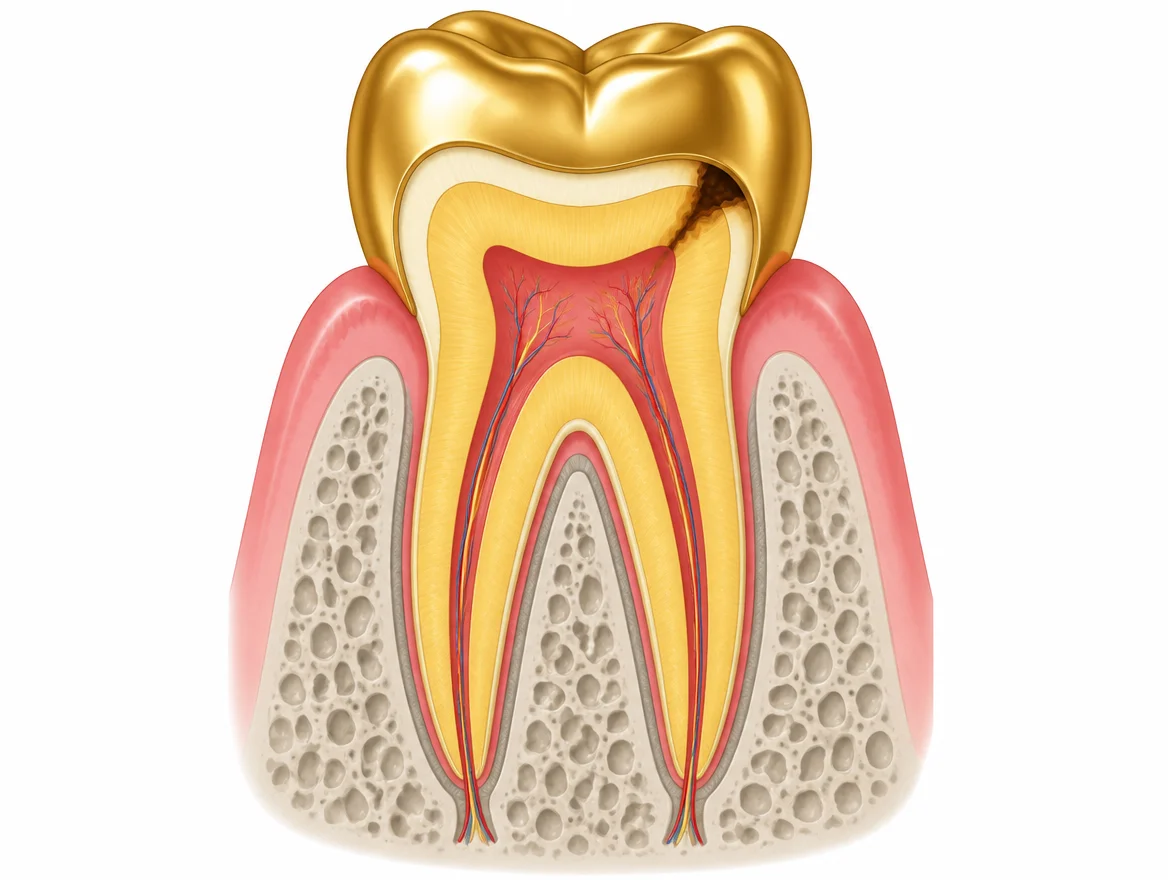
AI-generated explanatory illustrationSecondary caries (brown) spreading from a gap at the margin of a gold crown (yellow metal) into the dentin (yellow layer) beneath the metal — an area hidden from outside view and on X-rays
Because decay beneath a gold restoration usually starts at the margin, carefully checking the margins with these examinations is most important. However, when a gap is hidden below the gum or decay has already spread beneath the gold, the examinations may not detect everything. We therefore check the margins of teeth with gold restorations specifically at regular checkups and advise you to come in sooner if any of the following signs appear between visits.
What signs lead us to recommend replacing a gold restoration?
If a gap or decay is confirmed at the margin, or the gold has worn through and developed a hole, we recommend removing it, checking the tooth underneath and making a new restoration. If new sensitivity or pain develops in that tooth, we decide after examining for decay, cracks, nerve condition and bite to identify the cause.
| Sign | What we suspect | Response |
|---|
| Floss catches or shreds, or food keeps getting stuck | A gap at the margin | Check the margin with an explorer and X-rays; replace if decay is present |
| Dark discoloration around the margin | Staining or decay at the margin | Check by examination and X-rays; replace if it is decay |
| Decay visible on X-ray at the side margin of the gold restoration | Secondary caries | Replace |
| Gold worn thin with a hole, or the tooth beneath is visible | A gap caused by wear | Replace |
| The gold restoration is loose or has come off and been reattached before | Cement failure, secondary caries | Remove and check the tooth underneath |
| Sharp pain when chewing on that tooth or sensitivity to cold | Secondary caries, a crack, a nerve problem | Decide after nerve tests |
This is a general overview; the actual decision depends on examination results.
Even without symptoms, we recommend replacement if a gap or decay is confirmed at the margin. Leaving a gap can allow decay underneath to progress toward the nerve, sometimes making root canal treatment necessary. Conversely, we do not replace a gold restoration simply because it is a certain number of years old. There is no fixed replacement interval; we judge by its condition. Whether to crown a cracked tooth immediately or monitor it is covered separately in Does a cracked tooth need a crown right away?.
What may change after a gold restoration is removed?
The extent of treatment may change depending on the condition of the tooth revealed after removal. Even if only decay at the margin was visible during the examination, it may turn out to be wider or deeper once the restoration is removed.
After removal, we check the following.
- Whether there is decay beneath the gold and, if so, how close it is to the nerve
- Whether there are crack lines in the tooth and, if so, their direction and depth
- Whether the filling material (core) or post beneath the gold is firm
- How thick the remaining tooth walls are
| Condition after removal | Response |
|---|
| No decay or cracks | Proceed as planned after checking the remaining tooth, the core and the space required for the material |
| Shallow decay | Remove the decay, fill and proceed. If the inlay cavity becomes larger, a crown may be needed instead |
| Deep decay close to the nerve | Protect the pulp and monitor progress, or consider root canal treatment (Korean) |
| A crack line in the tooth wall | Depending on its depth, cover and protect with a crown; if deep, reassess whether the tooth can be saved |
This is a general overview; the actual decision depends on the tooth’s condition after removal.
Before removing a gold restoration, we explain the possible findings in advance, then discuss the plan again after checking the tooth’s condition. If decay that began at the margin has spread widely beneath the gold, the remaining tooth walls may be thin enough to require a crown even where an inlay was used before. If decay has reached the nerve, we first assess whether the conditions for trying to preserve the pulp are met. If we judge this to be difficult, we proceed with root canal treatment followed by restoration.
How do we decide between gold again and a tooth-colored material?
We consider the tooth’s location, the amount of remaining tooth structure, the bite and any tooth-grinding habit. Gold crowns on molars are usually replaced with zirconia crowns, and gold inlays with ceramic inlays, though gold may be used again in some cases.
| Existing restoration | Usual replacement | What to check |
|---|
| Gold inlay | Ceramic inlay (Korean) | Further preparation if space is insufficient or the shape is unsuitable. A crown may be needed if the remaining walls are thin |
| Gold crown on a molar | Zirconia crown (Korean) (usually monolithic zirconia) | Strength comes first because the site bears substantial chewing force |
| Gold crown on a front tooth | Zirconia or e.max (Korean) crown | We use e.max only for front teeth. Match the color to the surrounding teeth |
Material choice depends on the tooth’s location, the amount of remaining tooth structure and the bite.
Gold holds up well even when thin, but ceramic and zirconia need a specified thickness for each material and product to reduce the risk of fracture. If the space under the existing gold restoration is less than that thickness, the tooth may need a little more preparation. Once removed, tooth structure does not grow back, so less of the tooth remains. Fracture can still occur even when sufficient thickness is provided.
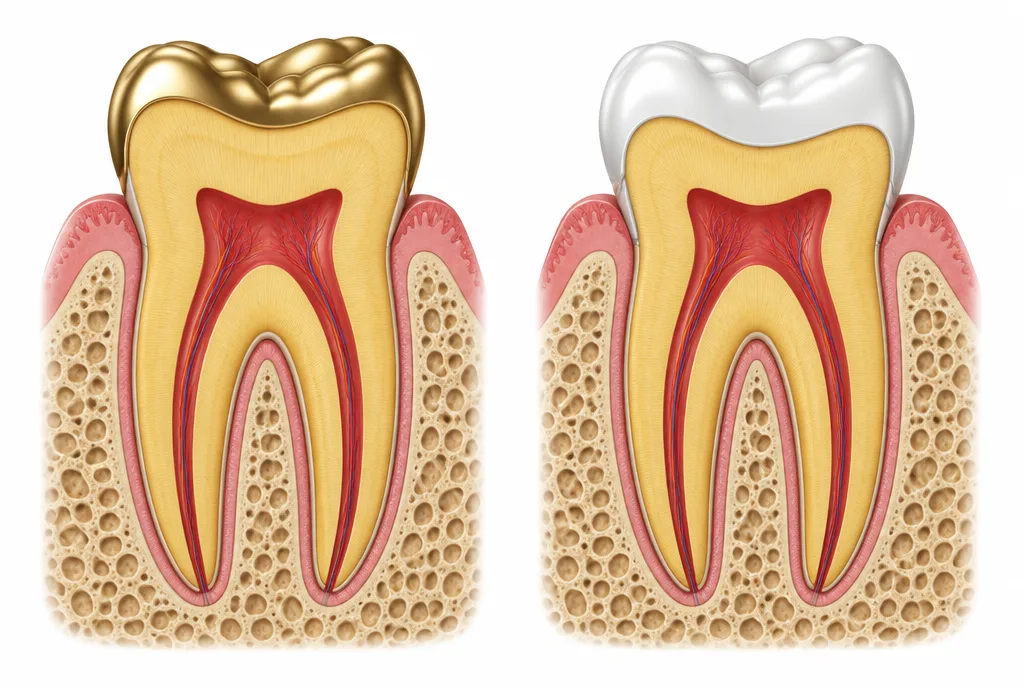
AI-generated explanatory illustrationCross-sectional comparison of a gold crown (left) and a tooth-colored crown (right) — a slight difference in the remaining tooth (yellow dentin) according to material thickness (schematic; actual thickness varies by tooth)
If the tooth’s nerve is still alive, preparing the tooth again may irritate it. In a long-term study of initially vital teeth fitted with metal-ceramic crowns, about 84% still had healthy pulps at 10 years.[4] Although the study was not limited to replacement of gold restorations, it shows that some crowned teeth need root canal treatment over time. We consider this more carefully when a tooth that has already been prepared is prepared again.
A review of long-term studies of ceramic inlays and onlays found that about 92~95% remained at 5 years and 91% at 10 years, with fracture or chipping the most common forms of failure.[3] We therefore check for clenching habits, the thickness of the remaining tooth walls and the bite before deciding between an inlay and a crown and choosing a material. We do not use e.max crowns on molars; we mainly use zirconia. Most monolithic zirconia crowns remained in good condition in short-term studies.[5] Depending on the treatment, we may take a digital impression with an intraoral scanner (TRIOS 6).
Immediately after replacement, the tooth may be sensitive to cold or feel unusual when chewing. This usually diminishes over time, but please contact us if the sensitivity worsens or the tooth starts hurting on its own.
What if I want to replace a sound gold restoration because of its color?
It is possible. However, if color is the only reason, please take time to consider your decision after hearing the examination results and the expected burden on the tooth. Because the purpose is to change the appearance, we first weigh the burden on the tooth.
If you grind or clench heavily, the remaining tooth structure is already thin, or the base of the gold restoration appears close to the nerve on X-ray, replacement may place a greater burden on the tooth, so we may recommend keeping it. We also explain that there may be little to gain by replacing a restoration in a place barely visible even when you smile, such as the rearmost lower molar. If you grind your teeth, please discuss this before replacement.
Even when replacement is for color alone, the extent of treatment may change if decay or a crack is found after removal. If you want several restorations replaced, it is advisable to decide after separately checking the condition and expected burden for each tooth.
How long does treatment take, and how many visits are needed?
After the examination and consultation, both inlays and crowns usually take about 2 visits if no problems are found after removal. If root canal treatment becomes necessary after removal, more visits are needed. We explain the expected schedule based on the examination results.
| Stage | What happens | Typical number of visits |
|---|
| Examination and consultation | Examination, X-rays, nerve tests and discussion of materials | First visit |
| Removal and preparation | Remove the gold restoration, check the tooth underneath, remove decay, prepare the tooth, take an impression and provide temporary protection | 1 visit |
| Fitting | Check color and bite, then bond in place | 1 visit |
| If root canal treatment is needed | Reinforce the remaining tooth after root canal treatment, then proceed with the restoration | Increases to about 3~5 visits |
These are typical visit counts and vary with the tooth’s condition after removal.
Until the new restoration is bonded, the tooth is protected with a temporary material or a temporary crown (Korean), depending on the type of treatment. Precautions during this period are covered in What to be careful about while wearing a temporary crown. Treatment fees are listed in the fee list (non-covered fees).
Frequently asked questions (FAQ)
Q. How often should a gold restoration be replaced?
There is no fixed replacement interval. Some remain trouble-free for more than 20 years, while others develop decay at the margin within a few years. We judge by the condition of the margin and what is visible on X-rays, rather than by age, so have that tooth checked at your regular checkups.
Q. Can you leave the gold restoration in place and just cover it with a tooth-colored material?
We generally do not recommend this. Tooth-colored materials such as resin do not bond firmly to gold easily, so chewing forces can dislodge them or gaps can form at the boundary. The standard way to change the color is to remove the gold restoration and make a new one.
Q. Does removing a gold restoration hurt?
If the tooth’s nerve is alive, we use anesthesia before removal. There is vibration and noise during removal, and the tooth may be sensitive for a few days after the anesthesia wears off.
Q. Will a tooth-colored restoration need replacing sooner than gold?
Different materials tend to have different problems. In studies of gold inlays, secondary caries and loss of retention were major causes of failure, while ceramic inlay studies mainly reported fracture or chipping.[2][3] Because these are different studies, it is difficult to compare directly how much longer one lasts than the other. For any material, care of the margins and regular checkups affect how long it can be used.
Q. Will the color match the neighboring teeth exactly?
We record the color of the neighboring teeth and match it, but natural teeth vary in color and translucency across their surfaces, so the result may not look completely identical. We try the restoration in your mouth and check the color before bonding it.
Q. I want to replace mine because I am worried about a metal allergy. Is that appropriate?
If a metal allergy is suspected, please have testing at a dermatology clinic and tell us the results. Our judgment may differ between a confirmed allergy and a general concern without confirmation.
Q. What should I prepare for a consultation about replacing a gold restoration near Bongcheon Station?
Please tell us which tooth you want to change, whether you grind your teeth and, if you know, whether that tooth has had root canal treatment. Bring any X-rays taken at another dental clinic.
Limits of the evidence
- The two gold inlay studies report long-term observations from a single institution or dental practice each. They do not establish that the same rates will occur in other settings, and neither looked at gold crowns alone.[1][2]
- The review of ceramic inlay studies includes studies using different materials and fabrication methods.[3]
- The study of pulps beneath crowns examined teeth receiving metal-ceramic crowns for the first time. It did not separately examine teeth being prepared again after already having crowns.[4]
- The studies included in the cited review of monolithic zirconia crowns had short observation periods of 0.3~2.1 years, making long-term outcomes difficult to judge from these data alone.[5]
DOCTOR’S NOTE
For patients with long-used gold restorations, I specifically check those teeth’s margins and X-rays at checkups. Decay beneath gold can progress before the patient feels it, so I do not judge a tooth to be fine simply because it is comfortable. If we decide on replacement, I explain before removal that the plan may change once the restoration is off.
— Jeong Jinwoo, Director, Joy Dental Clinic Bongcheon
This post reflects information as of the date of writing and was written to provide general information in compliance with Korea’s Medical Service Act and the Ministry of Health and Welfare’s medical advertising guidelines. Replacing an existing restoration can involve side effects such as sensitivity and pain, additional removal of tooth structure, damage to the tooth during removal of the old restoration, fracture or loss of the new restoration, and inflammation of the pulp. Individual diagnosis and the direction of treatment depend on the condition of your mouth, so please be sure to consult fully with your treating clinician before deciding.
We are right next to Exit 1 of Bongcheon Station (Line 2), and directions from Seoul Nat’l Univ. Station, Sillim, Nakseongdae and Sadang are in Getting here.
Joy Dental Clinic Bongcheon
5F Jehyeong Bldg., 1738 Nambusunhwan-ro, Gwanak-gu, Seoul (Bongcheon Station, Exit 1)
Hours: Mon·Wed·Thu·Fri 09:30–18:30 / Tue 09:30–20:30 / Sat 09:30–13:30 (closed Sun & public holidays)
Booking: Naver Booking / Phone 02-877-2867
Related pages: Cavity treatment guide · Aesthetic treatment guide · Crown (Korean)
References
- Studer SP, Wettstein F, Lehner C, Zullo TG, Schärer P. Long-term survival estimates of cast gold inlays and onlays with their analysis of failures. J Oral Rehabil. 2000;27(6):461-472. — [Cohort] 303 gold inlays and onlays followed for an average of 18.7 years. Survival was 96.1% at 10 years and 87.0% at 20 years. Among 42 failures, secondary caries (17 cases) was the most common biological cause, and root canal-treated teeth were a risk factor.
- Mulic A, Svendsen G, Kopperud SE. A retrospective clinical study on the longevity of posterior Class II cast gold inlays/onlays. J Dent. 2018;70:46-50. — [Cohort] 391 gold inlays and onlays in patients attending regular checkups at a general dental practice followed for an average of 11.6 years. 82.9% remained without problems; causes of failure, in descending order, were secondary caries (41.3%), loss of retention, and fracture.
- Morimoto S, Rebello de Sampaio FB, Braga MM, Sesma N, Özcan M. Survival rate of resin and ceramic inlays, onlays, and overlays: a systematic review and meta-analysis. J Dent Res. 2016;95(9):985-994. — [Meta-analysis] Survival of ceramic inlays and onlays was 92~95% at 5 years and 91% at 10 years. Fracture and chipping were the most common causes of failure, followed by pulp problems and secondary caries.
- Cheung GS, Lai SC, Ng RP. Fate of vital pulps beneath a metal-ceramic crown or a bridge retainer. Int Endod J. 2005;38(8):521-530. — [Cohort] Teeth with vital pulps followed for an average of about 14 years after crown placement. In teeth with single crowns, the proportion retaining a healthy pulp was 84.4% at 10 years and 81.2% at 15 years.
- Leitão CIMB, Fernandes GVO, Azevedo LPP, Araújo FM, Donato H, Correia ARM. Clinical performance of monolithic CAD/CAM tooth-supported zirconia restorations: systematic review and meta-analysis. J Prosthodont Res. 2022;66(3):374-384. — [Systematic review] Survival of monolithic zirconia single crowns was reported as 91~100%, but follow-up in the included studies was short, at 0.3~2.1 years. One study that included patients with bruxism reported lower ratings for marginal fit.


 한국어
 日本語
 简体中文