💡 Key answer
A crack in a tooth does not heal on its own, and the force applied each time you chew can make it extend deeper into the tooth. If you have a sharp pain when biting, decay or a large filling next to the crack, or a crack visible on an X-ray, we recommend a treatment that covers the tooth, such as a crown, before the crack extends toward the root. Once a crack reaches the root, it may become difficult to save the tooth even with a crown, so the timing of coverage matters. If there are no symptoms, the examination indicates a superficial craze line, and there is no decay or large filling, the tooth can be monitored, but only on the condition that the same findings continue to be checked at regular visits.
Hello. I am Jeong Jinwoo, Director of Joy Dental Clinic Bongcheon. The decisions to make after being told that your tooth has a crack are easier to understand when divided by timing. On the day it is first found, we examine the tooth to decide whether it needs to be covered now. For a tooth we decide to monitor, we check at each regular visit for changes in pain, the visible crack line, decay around the crack, and periodontal pocket depth. A tooth crack (Korean) does not heal on its own,[6] and the available treatments differ depending on whether the crack remains in the enamel or extends toward the root, so it is important not to miss the right time to cover the tooth.
Does being told my tooth has a crack mean it is already broken?
No. Some cracks visible on the tooth surface are fine craze lines confined to the enamel (the hard outer layer of the tooth), and these are common in adult teeth.[6] The concern is when the crack extends into the dentin, the nerve, or toward the root.
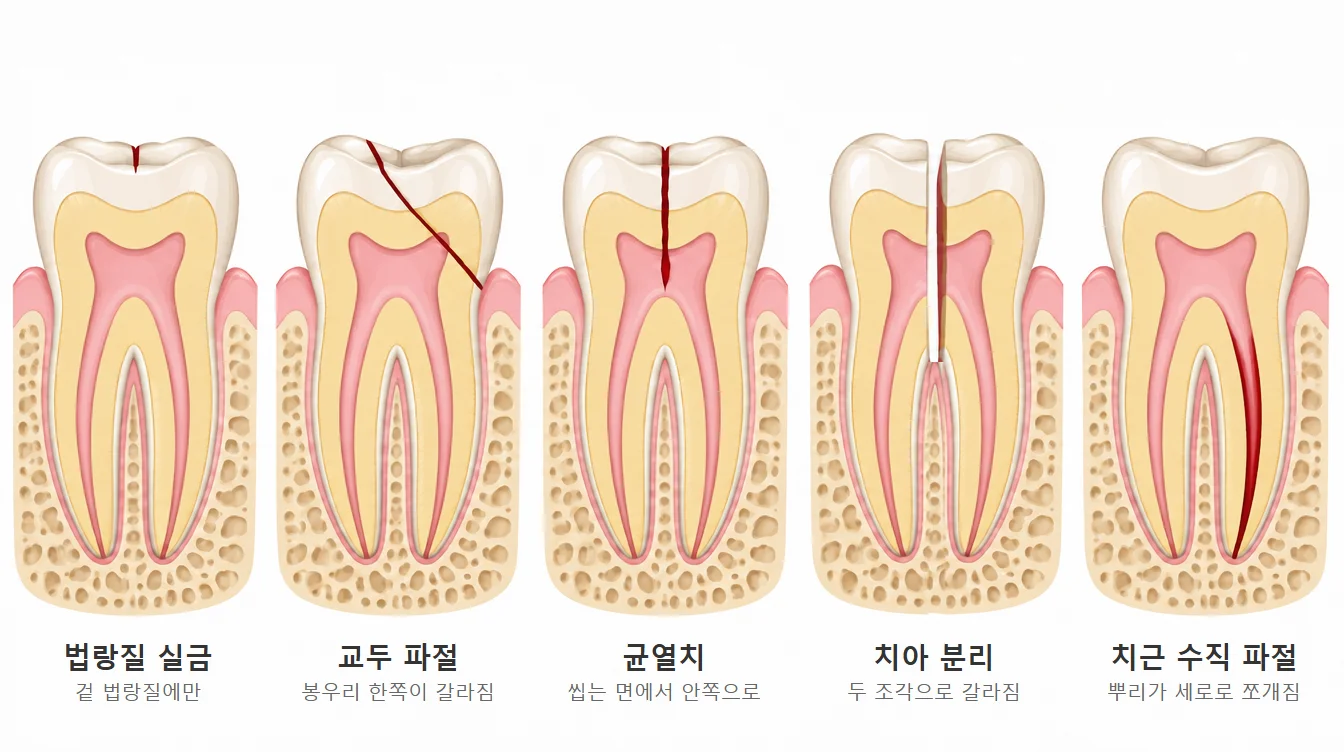
AI-generated explanatory illustrationTypes of cracks: enamel craze lines · fractured cusp · cracked tooth · split tooth · vertical root fracture
However, it is difficult to tell how far a crack extends from its appearance alone. That is why we make the assessment based on symptoms and examination findings, rather than the length of the crack.
What do you check when a crack is first found?
We first ask about your symptoms and then carry out the examinations needed for those symptoms.
- Pain on biting: We ask whether you feel a brief, sharp pain when chewing something hard, especially when releasing the bite. We have you bite on a bite stick (a small stick), one cusp (the raised part of the chewing surface) at a time, to find where it hurts.
- The location of the crack: We take Q-ray images to check the crack line on the tooth surface. Images alone cannot easily show how deep it extends, so we consider symptoms and other examination findings together.
- The condition of the nerve: If sensitivity to cold lingers or the tooth hurts on its own, we use a cold test, percussion (gently tapping the tooth), and X-rays to check for pulpitis (Korean) (inflammation of the nerve).
- Force on the tooth: An occlusion (Korean) (bite) examination checks whether force is concentrated on that tooth, and we also look for signs of tooth grinding (Korean) or clenching.
- The area around the crack: We check for decay next to the crack and for any previous large fillings.
Grinding or clenching, molars, cracks on the back surface of the tooth, and cracks that block light when illuminated have been reported to be associated with symptoms.[5] Stained cracks showed a lower association with symptoms, but we do not judge when a crack formed or how deep it is from its color alone.
When do you recommend a crown?
In a study of 2,858 teeth with cracks, decay, pain on biting, and cracks visible on radiographs were strongly associated with recommendations for restorative treatment.[1] When the first three findings in the table below are present, we recommend covering the tooth before the crack deepens. If symptoms involving the nerve or a crack extending toward the root are suspected, we investigate those first.
| Examination finding | Response |
|---|
| Sharp pain on biting, especially when releasing the bite | Recommend coverage of the tooth (crown (Korean) or onlay (Korean)) |
| Decay next to the crack, or a crack connected to a large filling | Treat the decay and recommend coverage according to the amount of remaining tooth structure and the condition of the crack |
| A crack visible on an X-ray | Recommend coverage because the crack may extend into the tooth |
| Sensitivity that lingers after something cold, or pain without a trigger | Check the nerve first, and if needed, place a crown after root canal treatment (Korean) |
| A crack extending toward the root and a deep periodontal pocket (Korean) (gum pocket) measured at one site | First assess whether the tooth can be kept (see “When might coverage alone not be enough?” below) |
| No symptoms, a short superficial craze line, and no decay or large filling next to the crack | Monitor — recheck the same findings at regular visits |
The table summarizes general criteria; the actual decision is made by considering the examination findings together.
After explaining the examination results, we discuss the treatment options.
If we decide to monitor it, could the crack open further in the meantime?
A crack can deepen even while it is being monitored, so we recheck the tooth at every regular visit. Delaying a checkup may mean that a deepening crack is found later. If you develop a new sharp pain on biting or sensitivity that lingers after something cold, please let us know without waiting for your scheduled checkup.
What changes when the tooth is covered?
In an observational study that followed pain in cracked teeth for 3 years, pain on biting often resolved even in untreated teeth, but the proportion in which it resolved was higher among treated teeth.[3] Also, treatments that only filled the inside of the tooth were associated with failure compared with treatments that covered the tooth.[2] That is why, once we decide to treat a cracked tooth, we first consider a treatment that covers the cusps (the raised parts of the chewing surface).
If we decide to cover it, what do you use?
The choice between an onlay that covers some of the cusps and a crown that surrounds the whole tooth is made by considering the crack’s location, the amount of remaining tooth structure, the extent of decay and existing fillings, and the bite together. For molar crowns, we mainly use zirconia crowns (Korean).
Coverage aims to reduce movement in the cracked part of the tooth during chewing. It does not remove the crack itself or completely stop its progression. Even if we check the nerve before placing the restoration, sensitivity to cold or pain on biting may persist afterward, and root canal treatment may become necessary.
What we need to be frank about
- Even an examination cannot always reveal where a crack ends. Sometimes its depth only becomes clear after the tooth is prepared or an old filling is removed, and the treatment plan changes.
- The study figures above come from visible cracks in vital molars and premolars examined in dental practices in the United States. They cannot readily be applied to teeth that have already had root canal treatment, cracks in front teeth, or teeth with cracks extending to the root.
- Even with coverage, how long the tooth remains usable varies from person to person according to the amount of remaining tooth structure, grinding or clenching habits, and how well it is cared for.
When might coverage alone not be enough?
In the following situations, we must first assess whether the tooth can be kept before placing a crown.
- A crack passes through the middle of the tooth and extends vertically toward the root
- The tooth has split into two pieces that move separately
- Only the periodontal pocket (gum pocket) at the cracked site measures deeply — a report on cracked teeth after root canal treatment found that the 2-year survival rate was markedly lower when the gum pocket exceeded 6mm.[4]
- A root fracture (Korean) in which the root is split vertically has been confirmed
In these situations, the tooth may not last long even with root canal treatment and a crown, so we also explain extraction and the options for replacing the missing tooth afterward. When findings indicate the need for coverage, we recommend treatment to protect the tooth before the crack reaches this stage. A case of restoring an already fractured tooth with a post and crown is described in A premolar that fractured during a meal (Korean).
How long does treatment take, and how many visits are needed?
Monitoring is done at regular checkups, coverage usually takes two visits, and adding root canal treatment takes a few weeks.
- Monitoring — We repeat the same examinations at regular checkups without scheduling a separate day. If new symptoms develop, you can come in earlier.
- Onlay or crown — There is a visit to prepare and scan the tooth and another to bond the finished restoration, usually 1 week apart. In between, you wear a temporary restoration and avoid biting hard foods on that side. While waiting, we sometimes lower the chewing surface slightly so that this tooth does not make contact first.
- When root canal treatment is needed — We first carry out root canal treatment, usually over 2~3 weeks and 3~4 visits, and then proceed with the crown.
- Splint — There is a visit to take an impression and another to fit the appliance, followed by adjustments at intervals of a few weeks.
Treatment fees are listed in the fee list (non-covered fees).
Frequently asked questions (FAQ)
Q. At my checkup, I was told about several cracked teeth and cavities. Do I have to decide everything today?
Treatment has an order of priority. For a tooth that hurts on biting or has decay connected to a crack, we recommend treating it first, before the crack deepens. Craze lines without symptoms are rechecked at regular visits. We explain the reason for each tooth, so please take the time you need to think it over before deciding.
Q. The pain comes and goes. Has the tooth healed on its own?
Pain in cracked teeth often comes and goes. The disappearance of pain does not mean the crack is gone, and a crack does not heal on its own. If a tooth has ever caused a sharp pain on biting, we recommend having it examined even if it does not hurt now. If the pain returns, note which tooth hurts and when, and contact us without waiting for your scheduled checkup.
Q. Can I have a composite resin filling instead of a crown?
If the crack is short and the cavity is small, a filling may be all that is needed in some cases. However, in a tooth that hurts on biting, a filling alone cannot easily resist the force that opens the crack during chewing, so we recommend coverage of the cusps. In an observational study, restorations that only filled the inside of the tooth were associated with a need for additional treatment compared with restorations that covered it.[2]
Q. Do I need a mouthguard if I grind my teeth?
Grinding or clenching repeatedly puts force on a cracked tooth. After examining your bite and tooth wear, we also consider a splint (Korean) (an appliance for grinding) if needed.
Q. I was told the crack does not show on the X-ray. Is there really a crack?
Fine cracks are often difficult to see on X-rays.[6] That is why we check with a bite stick test and Q-ray imaging.
Q. Can a tooth crack after root canal treatment?
It can. If decay, previous restorations, and treatment have removed a large amount of tooth structure, the risk of fracture may increase, so we decide whether coverage is needed according to the amount and location of the remaining tooth structure. The detailed steps are covered in My root canal treatment is finished. What should I do now?.
What to check before your next visit
- ☐ Note which side gives you a sharp pain when chewing, especially when releasing the bite
- ☐ Check whether sensitivity after something cold disappears within a few seconds or lingers
- ☐ Do not bite on hard things such as ice, hard candy, or nutshells with the cracked tooth
- ☐ Tell us at your visit if your jaw feels stiff in the morning or someone has told you that you grind your teeth
- ☐ If you develop new pain on biting, lingering sensitivity, or pain without a trigger, contact us without waiting for your checkup
- ☐ If the gum swells in just one spot or pus appears, have it checked without delay
Related articles: When your X-ray looks normal but the pain continues · Sensitivity after a filling: what is within the normal range?
Limits of the evidence
- The statement that craze lines are common in adult teeth[6] comes from a literature review; how common they are varies between studies.
- The 6mm gum pocket threshold[4] comes from a retrospective study that reviewed past records of cracked teeth after root canal treatment, so it is difficult to apply directly to teeth with a living nerve.
DOCTOR’S NOTE
Because a crack does not heal on its own, I focus on not missing the right time to cover the tooth. When a patient bites on a small stick at each part of the chewing surface, some teeth have a spot that gives a sharp pain at the moment the bite is released. If that spot connects to a crack, or there is decay or a large filling next to the crack, I recommend coverage even if the tooth has not broken yet.
— Jeong Jinwoo, Director, Joy Dental Clinic Bongcheon
This post reflects information as of the date of writing and was written to provide general information in compliance with Korea’s Medical Service Act and the Ministry of Health and Welfare’s medical advertising guidelines. Crown and onlay treatment can have side effects such as sensitivity, pain, gum inflammation, or dislodgement or fracture of the restoration. In a cracked tooth, nerve inflammation may persist or develop after treatment, making root canal treatment necessary. Individual diagnosis and the direction of treatment depend on the condition of your mouth, so please be sure to consult fully with your treating clinician before deciding.
We are right next to Exit 1 of Bongcheon Station (Line 2), and directions from Seoul Nat’l Univ. Station, Sillim, Nakseongdae and Sadang are in Getting here.
Joy Dental Clinic Bongcheon
5F Jehyeong Bldg., 1738 Nambusunhwan-ro, Gwanak-gu, Seoul (Bongcheon Station, Exit 1)
Hours: Mon·Wed·Thu·Fri 09:30–18:30 / Tue 09:30–20:30 / Sat 09:30–13:30 (closed Sun & public holidays)
Booking: Naver Booking / Phone 02-877-2867
Related pages: Cavity and root canal treatment guide · Tooth cracks (Korean) · Caring for cracked teeth (Korean)
References
- Hilton TJ, Funkhouser E, Ferracane JL, et al. Recommended treatment of cracked teeth: Results from the National Dental Practice-Based Research Network. J Prosthet Dent. 2020;123(1):71-78. — The proportion of 2,858 vital molars and premolars with visible cracks for which treatment was recommended, and related factors. Decay, pain on biting, and cracks visible on radiographs were strongly associated with recommendations for restoration; restoration was recommended for about one-third of the teeth.
- Ferracane JL, Hilton TJ, Funkhouser E, et al. Outcomes of treatment and monitoring of posterior teeth with cracks: three-year results from the National Dental Practice-Based Research Network. Clin Oral Investig. 2022;26(3):2453-2463. — Results of treating and monitoring cracked teeth for 3 years. Restorations that only filled the inside of the tooth were associated with failure compared with restorations that covered the tooth (crowns or partial coverage).
- Funkhouser E, Ferracane JL, Hilton TJ, et al. Onset and resolution of pain among treated and untreated posterior teeth with a visible crack: Three-year findings from the National Dental Practice-Based Research Network. J Dent. 2022;119:104078. — During 3 years of follow-up of pain in cracked teeth, pain on biting resolved in most treated and untreated teeth, with a higher proportion of pain resolution among treated teeth.
- Kang SH, Kim BS, Kim Y. Cracked Teeth: Distribution, Characteristics, and Survival after Root Canal Treatment. J Endod. 2016;42(4):557-562. — The 2-year survival rate of cracked teeth after root canal treatment. Survival was markedly lower when the gum pocket depth exceeded 6mm.
- Hilton TJ, Funkhouser E, Ferracane JL, et al. Correlation between symptoms and external characteristics of cracked teeth. J Am Dent Assoc. 2017;148(4):246-256.e1. — Grinding or clenching, molars, wear facets extending through enamel, decay, cracks on the back surface of the tooth, and cracks that blocked light were associated with symptoms, while stained cracks were inversely associated with symptoms.
- Lubisich EB, Hilton TJ, Ferracane J. Cracked Teeth: A Review of the Literature. J Esthet Restor Dent. 2010;22(3):158-167. — A literature review of the causes, symptoms, diagnosis, and treatment of cracked teeth.


 한국어
 日本語
 简体中文