💡 Key answer
Yes. A missing tooth can be replaced with an implant, a bridge, or a partial denture, and depending on the site, leaving it unfilled and monitoring it is also an option. Which one fits is not decided by one method being better than another, but by three things: the condition of the teeth on either side of the gap, the jawbone at that site, and the opposing tooth. At Joy Dental Clinic Bongcheon, we look at these three together with you on X-rays, intraoral photos, and CT before deciding on a method.
Summary for patients
- If the neighboring teeth are already crowned, a bridge is a reasonable choice too.
- Teeth trimmed for a bridge cannot be restored to what they were.
- A partial denture is easy to change to another method later.
- If you decide to watch and wait, we compare photos at each checkup.
- You do not have to decide on a method on the day the tooth is extracted.
❓ What this article covers
- Why does a bridge require trimming healthy neighboring teeth?
- When is a partial denture the right method?
- How do we tell when an implant is the better choice and when it is not?
- What do we check in the treatment room?
- When do we not recommend an implant?
- What happens if the gap is simply left alone?
- How long does treatment take, and how many visits are needed?
- Can I switch to an implant later after having a bridge or denture?
Why does a bridge require trimming healthy neighboring teeth?
Because a bridge works by placing crowns on the teeth on both sides to serve as abutments, and joining an artificial tooth between them. The artificial tooth in the middle is called a pontic (Korean). The neighboring teeth have to be trimmed by the thickness the crowns need, and once a tooth has been trimmed it cannot be restored.
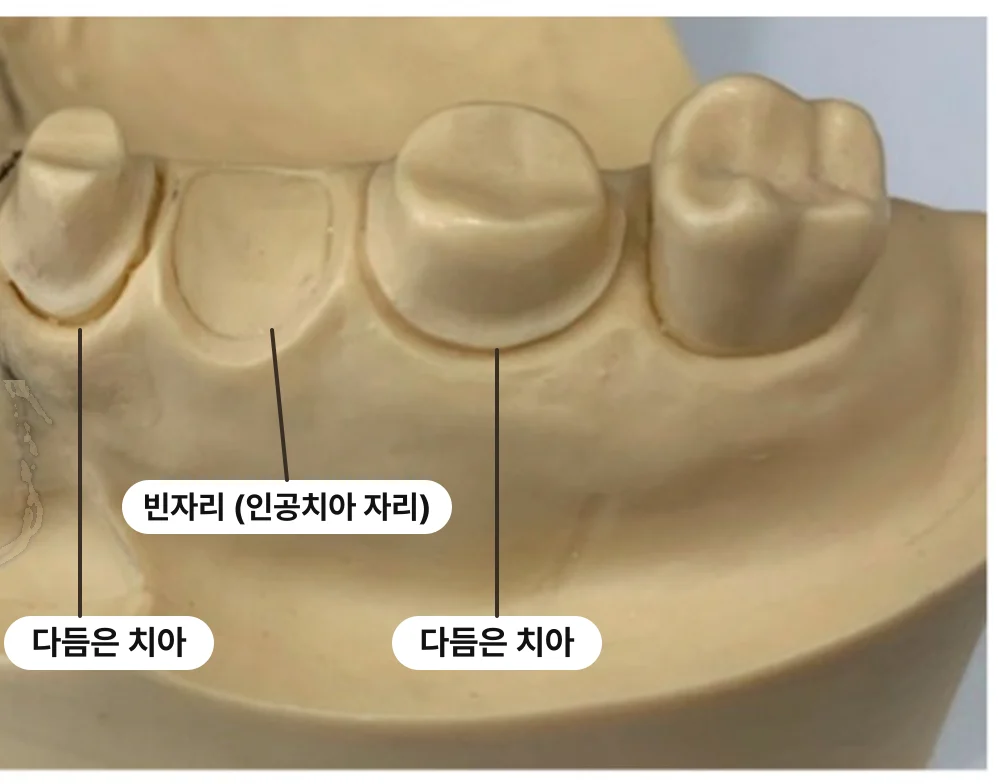
Photo cited from an external paper · not a case from our clinicA tooth model in which the teeth on either side of the gap have been trimmed by the thickness of a crown in order to make a bridge. The artificial tooth spans the central gap, and crowns are placed over the reduced teeth on both sides.Abad-Coronel et al. · Figure 1 · DOI: 10.3390/ma14247791 · CC BY 4.0 · cropped, pencil marks removed, Korean labels added
The burden of trimming also remains on the nerve. In a study that followed teeth whose nerve was alive, the proportion with a living nerve after 10 years was about 84% for single crowns and about 71% for bridge abutment teeth.[3] On the other hand, the absence of surgery and the short treatment time are clear advantages.
There are different types of bridges
| Type | Structure | When it is used |
|---|
| Conventional bridge (Korean) | Crowns on the teeth on both sides + an artificial tooth in the middle | The most common form |
| Cantilever bridge | Uses a tooth on one side only as the abutment | In limited cases, when there is no abutment at the back. Force concentrates on the abutment tooth |
| Resin-bonded bridge (Maryland bridge) (Korean) | Thin wings bonded to the inner surface of the neighboring teeth | Roughly a single front tooth, where chewing forces are low. Less tooth reduction, but it can come off |
| Implant-supported bridge | Uses two or more implants as abutments | A site where several teeth are missing. Natural teeth are left untouched |
A toothbrush cannot reach under the artificial tooth, so you need to clean there by passing thick floss or an interdental brush underneath.
When is a partial denture the right method?
It fits when several teeth are missing or the missing teeth are scattered in different places, and when the rearmost molar is missing so that a bridge has no abutment at the back. It is put in and taken out by hooking clasps (clasp (Korean)) onto the remaining teeth, so there is no surgery, and the amount of tooth trimming is small — about enough for the rest seats.
A partial denture (Korean) consists of a thin metal framework, clasps and rests that wrap around the remaining teeth, and artificial teeth arranged on a gum-colored base. The metal framework distributes chewing forces across several teeth and the gums.
In return, it feels like a foreign object, force is placed on the teeth the clasps hook onto, and it has to be taken out and cleaned after meals. If decay or gum disease develops in a tooth that holds a clasp, the whole denture becomes loose, so those teeth are cared for thoroughly, including flossing. At first, you need a period to get used to the feel of the clasps and to learn the direction for removing and inserting it. Biting it into place bends the clasps, so insert and remove it by hand, and at night take it out and keep it in water. For a site where a single molar is missing, the appliance is relatively large, so we do not often recommend it. It is also used as an intermediate step when surgery has to be postponed or when the remaining teeth are being monitored.
How do we tell when an implant is the better choice and when it is not?
If the teeth on both sides are healthy and there is enough jawbone, an implant is considered first; the further the situation is from those conditions, the more room there is for other methods.
| Implant | Bridge | Partial denture |
|---|
| What it relies on | Jawbone at the gap | Teeth on both sides | Remaining teeth + gums |
| Neighboring teeth | Left untouched | Reduced by the thickness of a crown | Only slightly, for the rest seats |
| Surgery | Required | None | None |
| Fixation | Fixed | Fixed | Put in and taken out |
| Bone at the missing site | Chewing forces are transmitted, which favors maintenance | Continues to shrink little by little | Shrinks |
| Burden | Surgery; bone graft if bone is insufficient | Nerve and decay of the abutment teeth | Foreign-body feeling; teeth holding the clasps |
Longevity figures alone do not settle which is better. In a systematic review, the proportion estimated to still be in use after 10 years was similar, at about 89%, for both conventional bridges and implant-supported single crowns.[1] On the implant side, about 95% of the posts placed in the bone themselves remained at 10 years, but component problems such as screw loosening arise separately.[2] The difference is only in where the problems occur.
What do we check in the treatment room?
We put three places up on the monitor and look at them together: the teeth on either side of the gap, the jawbone at that site, and the opposing tooth. Many people ask cautiously, “Is an implant really the only way?”, but there is no answer before looking at these three places.
- Teeth on either side of the gap — On panoramic (Korean) and periapical X-rays and intraoral photos, we check for decay, large fillings, and existing crowns (Korean), and whether there is enough bone holding the roots.
- Jawbone at the gap — On 3D CT cross-sections, we measure the height and width of the bone and the distance to the nerve canal in the lower jaw or the maxillary sinus in the upper jaw.
- Opposing tooth — We check whether the tooth on the opposite side has over-erupted toward the gap, and whether there is still enough height for a prosthesis.
The options divide based on what we see. If the teeth on both sides are clean, the balance tips toward an implant, which does not require trimming them; if the teeth on both sides are already crowned or need crowns anyway, the biggest drawback of a bridge disappears. If several teeth are missing or there is no abutment at the very back, we consider a partial denture or implants side by side.
When do we not recommend an implant?
If the conditions that support recovery after surgery or the care that follows are not in place, we postpone the implant or plan with another method.
- Diabetes with uncontrolled blood sugar — Proceeding after blood sugar has stabilized ends up being faster.
- A history of injectable osteoporosis medication or radiation therapy to the jaw area — There is a risk of medication-related osteonecrosis of the jaw (Korean), so consulting the prescribing physician comes first.
- Gum disease that has not settled — Gum treatment comes first.
- Circumstances that make it hard to keep up regular checkups and daily hygiene
- When the jawbone is very deficient and the burden of bone grafting is large — An implant overdenture (Korean), which uses implants as supports, may be more realistic.
- Adolescents whose jawbone is still growing — We wait until growth is complete, and in the meantime preserve the gap with another method.
A patient not wanting surgery is also reason enough, and in that case we plan with a bridge or a partial denture. Whichever method is used, the follow-up checks after treatment are done personally by the director who designed it.
What happens if the gap is simply left alone?
Changes do occur, but not every site is urgent. In a study that analyzed casts of molars that had lost their opposing tooth, over-eruption was observed in 92%, and the average was 1.68mm.[5] Meanwhile, in a study that followed for about 7 years 111 people who did not replace a single missing molar with teeth on both sides, the opposing tooth over-erupted by 1mm or less in 99%, and the gap between the neighboring teeth also decreased by 1mm or less in most cases.[4]
So “doing nothing” is also an option. In particular, when a single rearmost molar is missing, there are reports that chewing function is maintained if enough pairs of opposing molars remain on the left and right.[6] However, if you decide to leave it, it should not simply be left; it should be observation. We keep photos taken at the same angle and compare them at regular checkups.
If you are watching and waiting, use the following as your guide.
- What can be watched: Food getting caught a little more than before
- Signs that need checking: The opposing tooth looks longer or touches the gum at the gap / A neighboring tooth has tilted toward the gap and food gets badly caught / You have been chewing only on the other side and the teeth or jaw on that side have become uncomfortable
How long does treatment take, and how many visits are needed?
A bridge or a partial denture takes a few weeks; an implant takes a few months because of the time the bone needs to bond.
| Method | Approximate duration | Process |
|---|
| Implant | 3~4 months if the bone is in good condition; 5~6 months or more if a bone graft is needed | Diagnosis → placement → bone-bonding period (lower jaw 2~3 months, upper jaw 3~6 months) → connecting the prosthesis |
| Bridge | Around 2~3 weeks | Checking the abutment teeth (root canal treatment or gum treatment first if needed) → trimming the teeth → impression and temporary bridge → try-in and cementing |
| Partial denture | Around 3~4 weeks | Design → trimming the rest seats and taking an impression → trying in the metal framework → arranging the artificial teeth → completion |
A partial denture usually takes 4~5 visits. Why implant treatment time differs from person to person is covered in Why does implant treatment take a different amount of time for each person?.
Treatment fees are listed in the fee list (non-covered fees).
Can I switch to an implant later after having a bridge or denture?
In most cases, yes. However, two things cannot be undone. The neighboring teeth trimmed for a bridge will still need crowns again even if you switch to an implant, and at a site with no tooth the jawbone shrinks over time (Korean), so a bone graft (Korean) may become necessary later. A partial denture barely touches the teeth, so it leaves the most freedom to switch. If surgery feels like too much right now, we can plan in an order that keeps later options open.
Frequently asked questions
Q. Which methods does Korean National Health Insurance cover?
For those aged 65 or older, implants are covered for 2 in a lifetime (Korean) and partial dentures once every 7 years (Korean), with a 30% patient co-payment. Bridges are not covered.
Q. Do I have to decide on a method on the day the tooth is extracted?
No. You can decide while the extraction site heals, and we set a time to look at it again. What to settle together before the extraction is covered in Six things to check before having a tooth extracted.
Q. What happens to a bridge if a problem develops in one of the abutment teeth?
A bridge is connected as a single piece, so if decay develops at the margin of an abutment tooth or an abutment becomes loose from gum disease, the whole bridge often has to be redone. The condition of the abutment teeth in effect determines the lifespan of the bridge, so we check the margins at regular checkups.
Q. I don’t like the clasps of a partial denture showing. Is there a way around it?
There are ways, such as moving the clasps to teeth further back, using tooth-colored clasps, or changing to an attachment type that hides the connecting device inside a crown. Each differs in retention, cost, and the tooth preparation required, so we compare them together at your consultation.
Q. Can I bring X-rays or CT scans taken elsewhere?
Recently taken images help with the assessment. However, the shape of the bone changes quickly in the first few months after an extraction, so if they were taken a long time ago, we take new ones and compare.
Q. Near Bongcheon Station, can a son or daughter join their parent’s consultation?
Yes. At Joy Dental Clinic Bongcheon (Bongcheon Station Exit 1, 5F Jehyeong Bldg.), we explain while looking at the screen together, so it is good for the family members who will share the decision to listen together. On Tuesdays we see patients until 8:30 in the evening.
Limits of the evidence
- The 10-year survival rates of bridges and implants[1][2] are estimates pooled from multiple studies, and because patients and prosthetic conditions differed between studies, they do not predict an individual’s outcome.
- The changes seen when a gap is left[4][5] come from studies of molar sites and do not apply as they are to front teeth or to cases where several teeth are missing.
- The shortened dental arch study[6] is a 1981 cross-sectional survey; it means that chewing function is maintained “within the range of adaptation”, not that there is no change at all.
- The durations for each method are not values measured in studies but general ranges used in practice, and they vary with the condition of the bone and the remaining teeth.
DOCTOR’S NOTE
The criterion I look at when choosing a method is “which one uses up less of the remaining teeth.” The question “Is there nothing other than an implant?” usually means it does not yet make sense to you why it should be an implant, so it is not too late to decide after it does make sense.
— Jeong Jinwoo, Director, Joy Dental Clinic Bongcheon
This post reflects information as of the date of writing and was written to provide general information in compliance with Korea’s Medical Service Act and the Ministry of Health and Welfare’s medical advertising guidelines. Implant surgery may have side effects such as bleeding, swelling, and infection, and bridges and partial dentures may have side effects such as decay of the abutment teeth and strain on the gums. Individual diagnosis and the direction of treatment vary with the condition of your mouth, so please be sure to decide after a thorough consultation with your treating clinician.
We are right next to Exit 1 of Bongcheon Station (Line 2), and directions from Seoul Nat’l Univ. Station, Sillim, Nakseongdae and Sadang are in Getting here.
Joy Dental Clinic Bongcheon
5F Jehyeong Bldg., 1738 Nambusunhwan-ro, Gwanak-gu, Seoul (Bongcheon Station, Exit 1)
Hours: Mon·Wed·Thu·Fri 09:30–18:30 / Tue 09:30–20:30 / Sat 09:30–13:30 (closed Sun & public holidays)
Booking: Naver Booking / Phone 02-877-2867
Related pages: Implant treatment · Denture treatment · Implants: what is good to know before your consultation · Is there an age limit for implants? · I was told I can’t have an implant because there isn’t enough bone
References
- Pjetursson BE, Brägger U, Lang NP, Zwahlen M. Comparison of survival and complication rates of tooth-supported fixed dental prostheses (FDPs) and implant-supported FDPs and single crowns (SCs). Clin Oral Implants Res. 2007;18(Suppl 3):97-113. — [Systematic review] Estimated 10-year survival was similar: 89.2% for conventional bridges and 89.4% for implant-supported single crowns. The types of complications differ.
- Jung RE, Zembic A, Pjetursson BE, Zwahlen M, Thoma DS. Systematic review of the survival rate and the incidence of biological, technical, and aesthetic complications of single crowns on implants reported in longitudinal studies with a mean follow-up of 5 years. Clin Oral Implants Res. 2012;23(Suppl 6):2-21. — [Systematic review] Implant-supported single crowns: 10-year survival of 95.2% for the implant itself and 89.4% for the crown on top. Technical complications reported, including screw loosening in 8.8% at 5 years.
- Cheung GSP, Lai SCN, Ng RPY. Fate of vital pulps beneath a metal-ceramic crown or a bridge retainer. Int Endod J. 2005;38(8):521-530. — [Cohort] When teeth with a living nerve were used as bridge abutments, nerve survival after 10 years was 70.8%; for single crowns it was 84.4%.
- Shugars DA, Bader JD, Phillips SW, White BA, Brantley CF. The consequences of not replacing a missing posterior tooth. J Am Dent Assoc. 2000;131(9):1317-1323. — [Cohort] 111 people who did not replace a single missing molar with teeth on both sides (median 6.9 years): the opposing tooth over-erupted by 1 mm or less in 99%, and the decrease in the gap between the neighboring teeth was also mostly 1 mm or less.
- Craddock HL, Youngson CC, Manogue M, Blance A. Occlusal changes following posterior tooth loss in adults. Part 1: a study of clinical parameters associated with the extent and type of supraeruption in unopposed posterior teeth. J Prosthodont. 2007;16(6):485-494. — [Cross-sectional study] Cast analysis of 100 people with molars that had no opposing tooth: over-eruption was observed in 92%, averaging 1.68 mm (0–3.99 mm). Greater in the upper jaw.
- Käyser AF. Shortened dental arches and oral function. J Oral Rehabil. 1981;8(5):457-462. — [Cross-sectional study] Cross-sectional survey of 118 people with shortened dental arches: when four or more pairs of opposing posterior units remain (preferably symmetrical left and right), chewing function is maintained within the range of adaptation.
- Abad-Coronel C, Carrera E, Mena Córdova N, Fajardo JI, Aliaga P. Comparative Analysis of Fracture Resistance between CAD/CAM Materials for Interim Fixed Prosthesis. Materials (Basel). 2021;14(24):7791. — [Laboratory study] A study of materials for temporary bridges. Source of the photo in this article (Figure 1, CC BY 4.0) — cropped, with Korean labels added.


 한국어
 日本語
 简体中文