💡 Key answer
Root canal treatment is performed under local anesthesia, so many people feel only pressure during treatment. Afterward, a common course is soreness when chewing for 2~3 days that eases over about a week. This happens because the tissues around the root tip are irritated as inflammation inside the tooth is cleared away. If the pain is decreasing each day, we consider it part of recovery; if it eases and then worsens again, or your face starts to swell, have it checked without waiting for your next appointment.
Summary for patients
- Do not eat until the anesthesia wears off.
- Do not chew hard foods on the treated side.
- Take pain medication at the prescribed times and as directed.
- Keep track of how much it hurts each day.
❓ What this article covers
- Can root canal treatment hurt while it is being done?
- How much will it hurt when the anesthesia wears off after the first visit?
- Can the pain get worse while waiting for the next visit?
- How long is pain normal after the final visit?
- Why does the amount of pain differ between people having the same root canal treatment?
- What should I do at home if it hurts?
- What do we check in the treatment room?
- Could the pain be coming from somewhere other than the treated tooth?
- How long does treatment take, and how many visits are needed?
- Please contact us right away in these situations
Can root canal treatment hurt while it is being done?
With the area numb, most people feel pressure or vibration rather than pain. Root canal treatment (Korean) involves opening the space inside the tooth where the nerve was, removing inflamed tissue and disinfecting it. We give local anesthesia (Korean) before starting and check that the area is sufficiently numb before opening the tooth.
Sometimes the anesthesia does not work well
If the nerve is severely inflamed, as in a tooth that throbs enough to wake you at night, the usual amount of anesthetic may not fully numb it. This is because inflamed tissue does not respond as well to anesthetic. We then give more anesthetic or add an injection at another site; if pain remains, we sometimes clear only the most inflamed part that day and continue at the next visit.
If it hurts during treatment, please raise your hand rather than enduring it. When you raise your hand, we stop right away and assess whether more anesthesia is needed.
Parts that can be uncomfortable even without tooth pain
Keeping your mouth open for a long time during treatment can make your jaw ache. We often place a rubber sheet (rubber dam (Korean)) to keep saliva out of the tooth, and the clamp holding it can press on the gum and leave that spot sore for a day or two afterward. Please tell us if you would like to rest your mouth during treatment.
How much will it hurt when the anesthesia wears off after the first visit?
As the anesthesia wears off, the tooth often feels sore or slightly raised, or hurts when you chew, for a day or two. Usually, however, the pain is less than it was before treatment. In a review of pain before, during and after root canal treatment, pain decreased substantially within the first day after treatment, and few people still had pain after a week.[1]
Pain on the first day occurs because cleaning and disinfecting the inside of the tooth irritates the tissues outside the root tip. If inflammation was already present at the root tip, this response may be somewhat stronger.
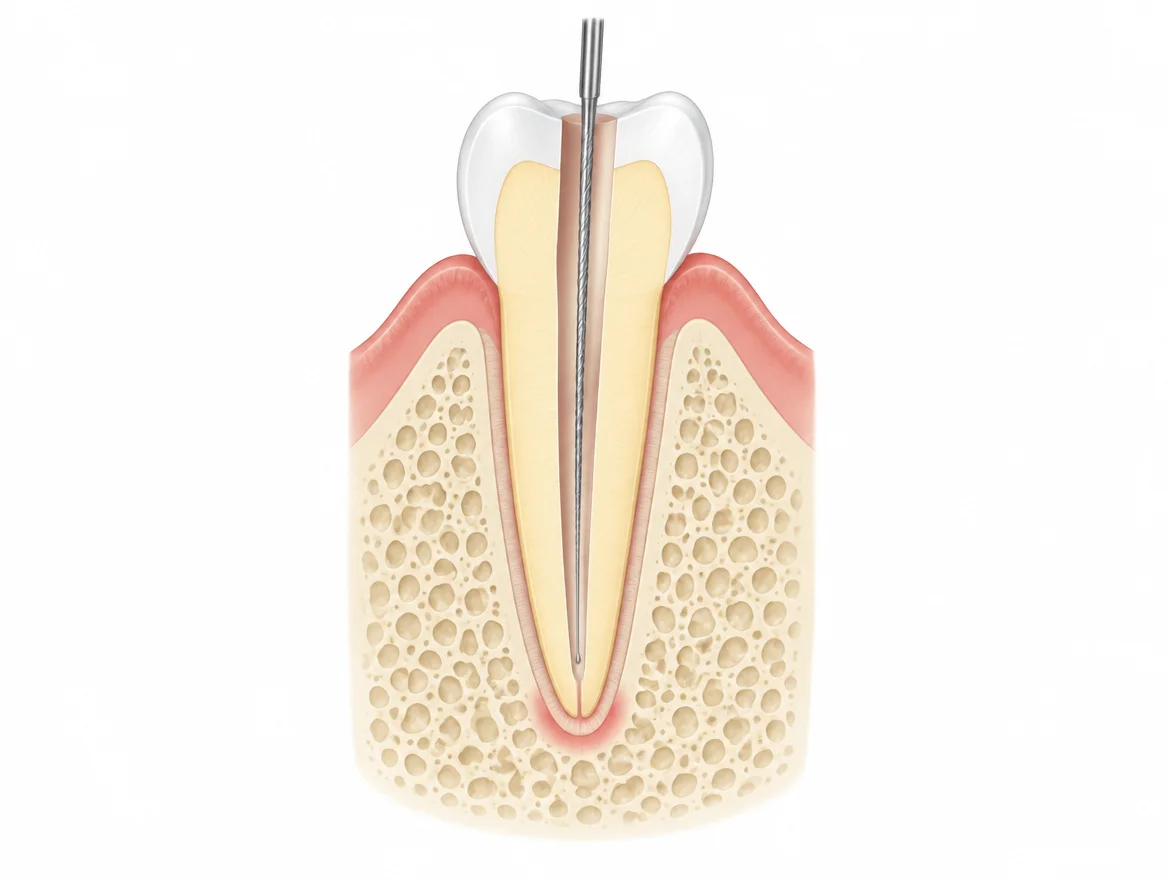
AI-generated explanatory illustrationVertical cross-section of a tooth during root canal treatment — a fine instrument used to clean the inside of the tooth is in the root canal, and the irritated tissues outside the root tip (the ligament and bone around the root) are shown in red. This is where soreness arises on the first day of treatment
If the tooth was very painful before treatment, we sometimes advise taking the first dose of medication before the anesthesia wears off.
Can the pain get worse while waiting for the next visit?
It can, though this is uncommon. A sudden increase in pain with swelling of the gum or face between visits is called an acute exacerbation, or flare-up. It is thought to occur when treatment stimulates the bacteria and inflammation outside the root tip, triggering a sudden response.
A review comparing treatment completed in a single visit with treatment spread over several visits found no clear difference in the frequency of flare-ups.[2] This means that dividing treatment into several visits does not itself increase pain.
Between visits, we place disinfecting medication (intracanal medicament (Korean)) inside the tooth and seal it with a temporary filling (Korean). If the temporary filling is a little higher than the other teeth, that tooth may touch first every time you chew and hurt; this pain eases quickly when the height is adjusted.
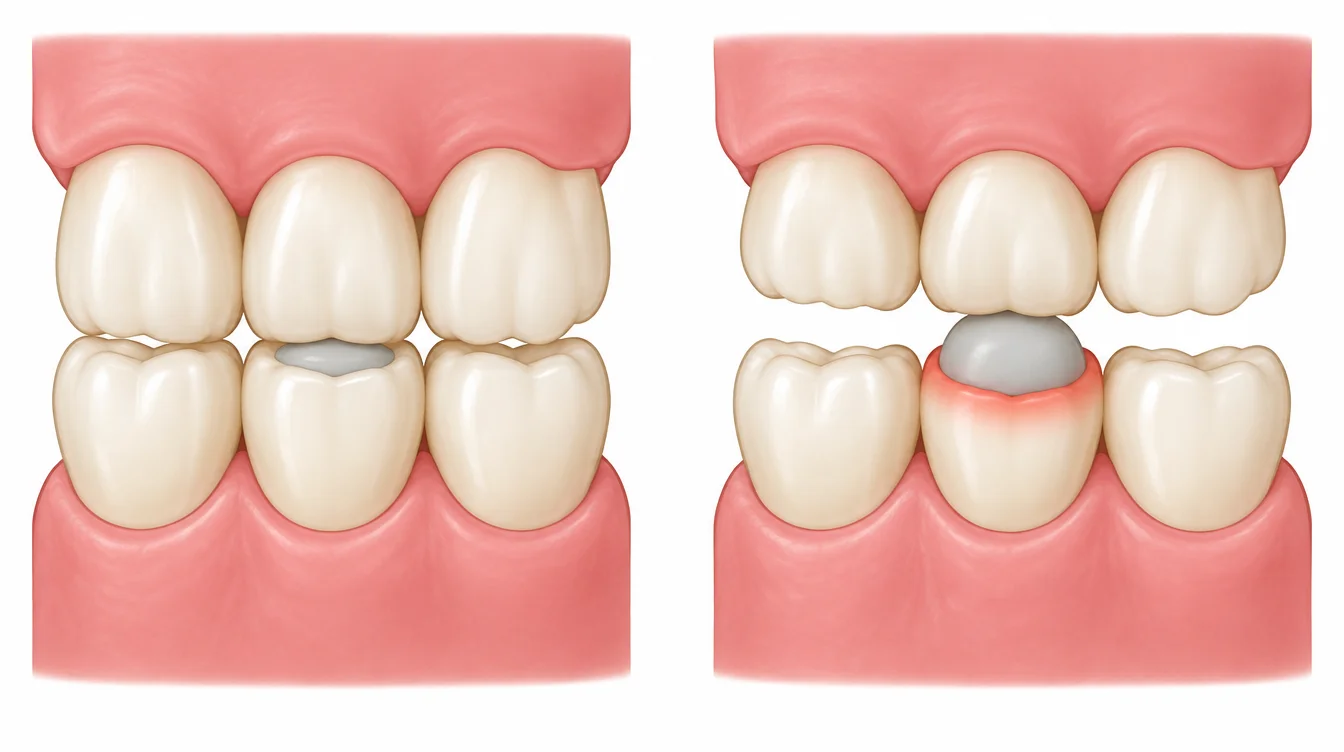
AI-generated explanatory illustrationComparison of temporary filling heights between visits — on the left, the filling is level with the tooth and the upper and lower teeth meet evenly; on the right, the filling is too high, so the upper tooth touches only that tooth first, leaving the neighboring teeth apart (the height difference is exaggerated to make it easier to understand)
How long is pain normal after the final visit?
A dull ache when chewing for a few days after the roots are filled and sealed, gradually easing over 1~2 weeks, is common. This is because filling the canals to the root tips irritates the surrounding area again. Pain at this stage is postoperative pain (Korean) and is usually controlled with the prescribed pain medication.
The tooth may feel slightly different from the others when you tap it with a finger or bite down firmly on that side for a few more weeks. A tooth without its nerve conveys the sensation of chewing only through the tissues around the root, and these tissues take time to settle.
If the same spot still hurts after several months, we do not regard it simply as recovery. Such pain is uncommon but does occur, and its cause may lie outside the tooth, so we examine it again.[5]
| What it feels like | Common reason | What to do |
|---|
| Pain only when chewing | Tissues around the root tip are still sensitive, or the temporary filling or tooth meets too high | Chew on the other side; have the height checked if it continues |
| Throbbing even at rest | An inflammatory response immediately after treatment | Take the prescribed pain medication at the scheduled times |
| Sensitivity to cold or heat | Another tooth with a living nerve, or nerve tissue remaining in the root of the treated tooth | The tooth responsible needs to be identified |
| Gum swelling or pain when pressed | Inflammation at the root tip may be increasing | Contact the clinic and have it examined |
Why does the amount of pain differ between people having the same root canal treatment?
Because the condition of the tooth before treatment differs. Even when the treatment has the same name, the course afterward varies with the condition of the tooth being treated.
Situations in which there may be more pain afterward
- A tooth that was already very painful before treatment — the surrounding tissues are already sensitive, and that state continues for a few more days after treatment.
- A tooth that hurt when chewing or tapping it — this is a sign that inflammation has spread outside the root tip, so the response is stronger when treatment irritates that area.
- A molar with several roots — there are more roots to clean and treatment takes longer, so soreness tends to last longer than with a front tooth.
- Root canal retreatment (Korean) that reopens previously treated roots — removing the old filling material adds another step.
Situations in which it may hurt less than expected
A tooth whose nerve has already died and had no symptoms, or a tooth with a small opening in the gum through which pus drains, often has little pain after treatment. This is because the pressure that had built up inside was already being released.
The examination before treatment shows which situation is closer to yours, so when we start treatment, we explain in advance how much this tooth may hurt.
What should I do at home if it hurts?
The basics are to take your prescribed pain medication at the set intervals and avoid chewing on the treated side. In studies of patients who had pain before treatment, anti-inflammatory pain medicines (of the ibuprofen type) reduced pain after root canal treatment.[3] If you have a sensitive stomach or kidney disease, or take blood-thinning medication, we prescribe a pain medicine with a different ingredient, so please tell us beforehand what you take. The types of pain medication and how to take them are also covered in Dental pain medicines (Korean).
- Taking the medication at the scheduled times, rather than waiting until pain begins, makes pain easier to control.
- Do not take more than the prescribed amount or combine two pain medicines on your own.
- Antibiotics do not help when pain is the only symptom. We prescribe them as needed when swelling spreads or a fever develops.[4]
- Do not apply hot compresses, as they may increase swelling.
What do we check in the treatment room?
Before treatment, we check which tooth hurts and why; during treatment, we measure the root length; if you report pain afterward, we check whether that tooth touches first when you bite.
- Before treatment — we check the response to cold and tapping and look for inflammation at the root tip on a close-up X-ray of the root (a periapical X-ray). From these findings, we explain in advance how much pain there may be afterward.
- During treatment — instruments or medication passing beyond the root tip can increase pain afterward, so we proceed while checking the length with a root-length measuring device (apex locator (Korean)) and X-rays.
- When you report pain after treatment — we ask you to bite on marking paper to see whether the treated tooth or temporary filling touches first; if it is high, we correct it with an occlusal adjustment (Korean). If there is swelling, we check for a collection of pus and, if needed, open the tooth to drain it.
Could the pain be coming from somewhere other than the treated tooth?
Yes. We do not assume that the cause lies only in the treated tooth.
- A neighboring or opposing tooth — tooth pain can be difficult to pinpoint, and sometimes decay or a crack in a neighboring tooth is the actual cause. This is especially so when sensitivity to cold continues.
- Jaw muscles — after keeping your mouth open for a long time, tight jaw muscles may cause aching as far as the area in front of the ear or the temple. This often eases over a few days.
- A tooth treated several years ago that hurts again — the causes differ from pain immediately after the current treatment. This is covered separately in When a tooth with an old root canal hurts again.
How long does treatment take, and how many visits are needed?
Treatment may be completed in one visit or spread over several visits, with the number mainly determined by the number of roots and the degree of inflammation at the root tips. As far as pain is concerned, removing the inflamed nerve tissue at the first visit often greatly reduces the pain that was present before treatment.
The schedule for covering the tooth with composite resin or a crown after root canal treatment is covered in Root canal treatment is finished — what should I do now?. Treatment fees are listed in the fee list (non-covered fees).
- Pain that had been decreasing each day starts to worsen again
- The gum, cheek or area under the jaw starts to swell
- Pain is severe enough to keep you from sleeping despite taking the prescribed pain medication as directed
- The temporary filling falls out or a large part breaks off
- You develop hives or feel short of breath after taking pain medication or antibiotics
Outside clinic hours, if your face swells rapidly, or you have a fever and difficulty swallowing saliva, please go to a nearby emergency department.
Frequently asked questions
Q. When can I eat on the day of treatment?
Wait until the anesthesia wears off. Eating while you are numb makes it easy to bite your cheek or tongue. On the first day, eat soft foods on the untreated side.
Q. Can I go to work or exercise the next day?
Most people can continue their usual daily activities. Please avoid alcohol on the day of treatment, however. It does not mix well with pain medication or antibiotics and may increase the inflammatory response. Strenuous exercise is more comfortable once the throbbing has eased.
Q. Anesthesia did not work well for me before. Will root canal treatment be the same?
Please tell us before treatment if you have had this experience. We can adjust the method, amount and waiting time for the anesthesia from the start. Anxiety can also make it feel as though the anesthesia has not worked fully, so we explain the treatment sequence before beginning.
Q. Why does cold water still feel sensitive after the nerve has been removed?
Often, some nerve tissue remains after the first visit, or the sensitivity actually comes from a neighboring tooth. A tooth whose canals have been fully cleaned and filled does not sense cold, so if sensitivity continues after the final visit, we check again which tooth is responsible.
Q. Can I take pain medication before coming for treatment?
You may take a pain medicine you normally use before coming. Please be sure to tell us what you took and when. The medication can affect the tooth’s response during the pretreatment examination, and we also need to adjust the timing and type of pain medication prescribed afterward accordingly.
Q. What happens if I have to delay my next visit by a long time?
The temporary filling used between visits is not designed to last a long time, so after more than a few weeks it may wear down or develop gaps. If saliva and bacteria enter through these gaps, the disinfected inside of the tooth can become contaminated again, causing pain or requiring a treatment step to be repeated. Please let us know in advance if you need to postpone your visit. We sometimes arrange a short visit to check the temporary filling and reseal it.
Q. A small pimple-like bump has appeared on my gum during root canal treatment.
This may be a drainage path through which pus from inflammation at the root tip escapes through the gum. If it was there before treatment, it often gets smaller as treatment progresses; if it appears during treatment, please be sure to tell us at your next visit. Do not squeeze it with your fingers.
Q. Can I bring my appointment forward if it hurts?
Yes. Contact us, and we will listen to your symptoms and decide whether to bring it forward. Pain caused by a high temporary filling can be reduced in a short visit, and if there is swelling, we address drainage of pus first.
Q. How can I have pain during root canal treatment checked near Bongcheon Station?
If you are receiving treatment at another dental clinic, it is advisable to contact that clinic first, as it has your treatment records. If you cannot reach them or it is urgent, please call Joy Dental Clinic Bongcheon (Bongcheon Station, Exit 1, 5F Jehyeong Bldg.) and tell us which tooth was treated and when.
Limits of the evidence
- The reviews of the course of pain[1][2] pool different treatment methods and pain measurement approaches from several countries, so they cannot predict an individual’s course exactly.
- The studies of anti-inflammatory pain medication[3] involved patients who had pain before treatment, and the types and doses of medication differed between studies.
- Periods such as “a few days” and “1~2 weeks” describe common courses, with substantial variation depending on the extent of inflammation at the root tip and the tooth’s location.
DOCTOR’S NOTE
When someone contacts me about pain after root canal treatment, I first ask, “Is it better or worse than yesterday?” If it is improving, I adjust the bite height and wait; if it is getting worse, I check it again in the treatment room that day. This is because, even with the same amount of pain, I see a decrease as recovery and an increase as growing inflammation.
— Jeong Jinwoo, Director, Joy Dental Clinic Bongcheon
This post reflects information as of the date of writing and was written to provide general information in compliance with Korea’s Medical Service Act and the Ministry of Health and Welfare’s medical advertising guidelines. Root canal treatment may have side effects including postoperative pain, swelling, flare-ups, tooth fracture and instrument fracture, and temporary reduced sensation may occur after anesthesia. Individual diagnosis and the direction of treatment depend on the condition of your mouth, so please be sure to consult fully with your treating clinician before deciding.
We are right next to Exit 1 of Bongcheon Station (Line 2), and directions from Seoul Nat’l Univ. Station, Sillim, Nakseongdae and Sadang are in Getting here.
Joy Dental Clinic Bongcheon
5F Jehyeong Bldg., 1738 Nambusunhwan-ro, Gwanak-gu, Seoul (Bongcheon Station, Exit 1)
Hours: Mon·Wed·Thu·Fri 09:30–18:30 / Tue 09:30–20:30 / Sat 09:30–13:30 (closed Sun & public holidays)
Booking: Naver Booking / Phone 02-877-2867
Related pages: Cavity and root canal treatment guide · When a tooth with an old root canal hurts again · Postoperative pain (Korean) · Intracanal medicament (Korean)
References
- Pak JG, White SN. Pain prevalence and severity before, during, and after root canal treatment: a systematic review. J Endod. 2011;37(4):429-438. — [Systematic review] A review of the frequency and severity of pain before, during and after root canal treatment — pain was most common and most severe before treatment; afterward, it decreased substantially within the first day and was uncommon by one week.
- Sathorn C, Parashos P, Messer H. The prevalence of postoperative pain and flare-up in single- and multiple-visit endodontic treatment: a systematic review. Int Endod J. 2008;41(2):91-99. — [Systematic review] Compared the frequency of postoperative pain and acute exacerbations (flare-ups) after single-visit and multiple-visit root canal treatment — no clear difference was found between the two approaches.
- Smith EA, Marshall JG, Selph SS, Barker DR, Sedgley CM. Nonsteroidal anti-inflammatory drugs for managing postoperative endodontic pain in patients who present with preoperative pain: a systematic review and meta-analysis. J Endod. 2017;43(1):7-15. — [Meta-analysis] In patients who had pain before treatment, nonsteroidal anti-inflammatory drugs (NSAIDs) reduced pain after root canal treatment compared with placebo.
- Lockhart PB, Tampi MP, Abt E, et al. Evidence-based clinical practice guideline on antibiotic use for the urgent management of pulpal- and periapical-related dental pain and intraoral swelling. J Am Dent Assoc. 2019;150(11):906-921. — [Guideline] American Dental Association guideline: treating the cause takes priority for pain arising from the pulp or root tip; antibiotics are used as an adjunct when swelling spreads or systemic symptoms such as fever occur.
- Nixdorf DR, Moana-Filho EJ, Law AS, McGuire LA, Hodges JS, John MT. Frequency of persistent tooth pain after root canal therapy: a systematic review and meta-analysis. J Endod. 2010;36(2):224-230. — [Meta-analysis] Pooled the frequency of pain persisting for 6 months or longer after root canal treatment — uncommon but present, including cases where the cause lies outside the tooth.


 한국어
 日本語
 简体中文