💡 Key answer
A tooth that hurts again after root canal treatment does not always need to be extracted. If inflammation has returned at the root tip, we first check whether the tooth can be kept with root canal retreatment (Korean) or an apicoectomy (Korean). If the root has split vertically or there is too little remaining tooth structure and jawbone, we check whether there is a way to keep the tooth before deciding on extraction. The choice is made after first checking the cause with a close-up X-ray of the root (a periapical X-ray) and tests such as percussion, in which the tooth is tapped lightly.
Summary for patients
- A root canal-treated tooth may not hurt even when there is inflammation.
- Previous X-rays are helpful for comparison.
- If swelling spreads quickly or you develop a fever, seek care right away.
- After retreatment, we still take X-rays at intervals of a few months.
❓ What this article covers
- Why does a root canal-treated tooth hurt again?
- What do we check in the treatment room?
- Can the tooth be treated again if there is inflammation at the root tip?
- When is extraction considered?
- Are there cases where other treatment or monitoring is used instead of root canal retreatment?
- How long does treatment take, and how many visits are needed?
Why does a root canal-treated tooth hurt again?
Common reasons include bacteria re-entering the sealed root canal, bacteria remaining in areas that were difficult to reach during the first treatment, a crack in the root, or a problem with the gums rather than the tooth. Root canal treatment removes inflammation inside the tooth and fills and seals the root canals. If a gap develops in the seal or an area remains unfilled, problems can arise again. Pain returning does not necessarily mean that the first treatment was done incorrectly.
- Leakage at the top of the tooth: If secondary decay (Korean) or a gap develops at the edge of a crown or filling, bacteria can enter the root canal again. In a study examining X-rays of root canal-treated teeth, the condition around the root tip was associated not only with the root filling but also with how well the top of the tooth was sealed.[1]
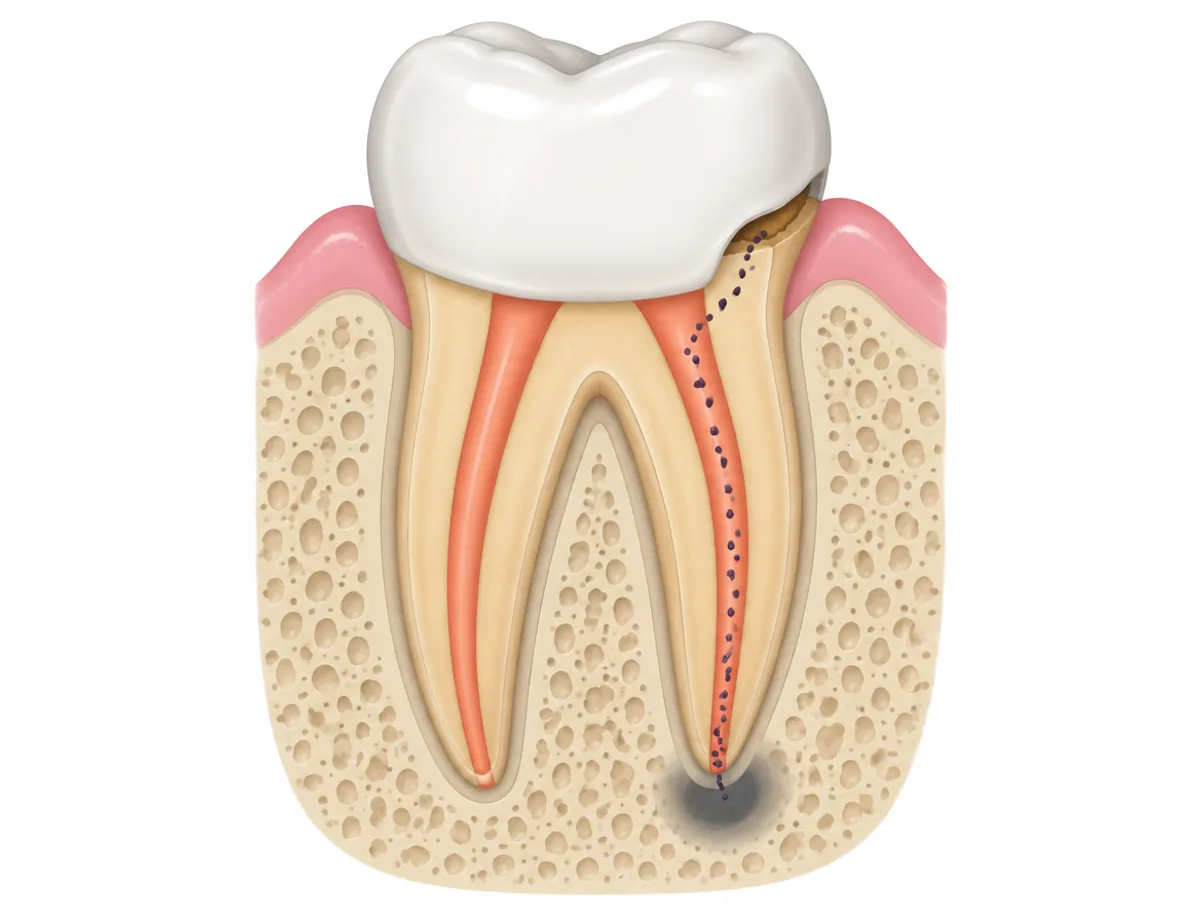
AI-generated explanatory illustrationSecondary decay at the crown margin and inflammation at the root tip
- Areas left untreated during the first treatment: Root canals have many branches and curves. If a canal was not found or part of it was not filled to the end, inflammation may return over time.
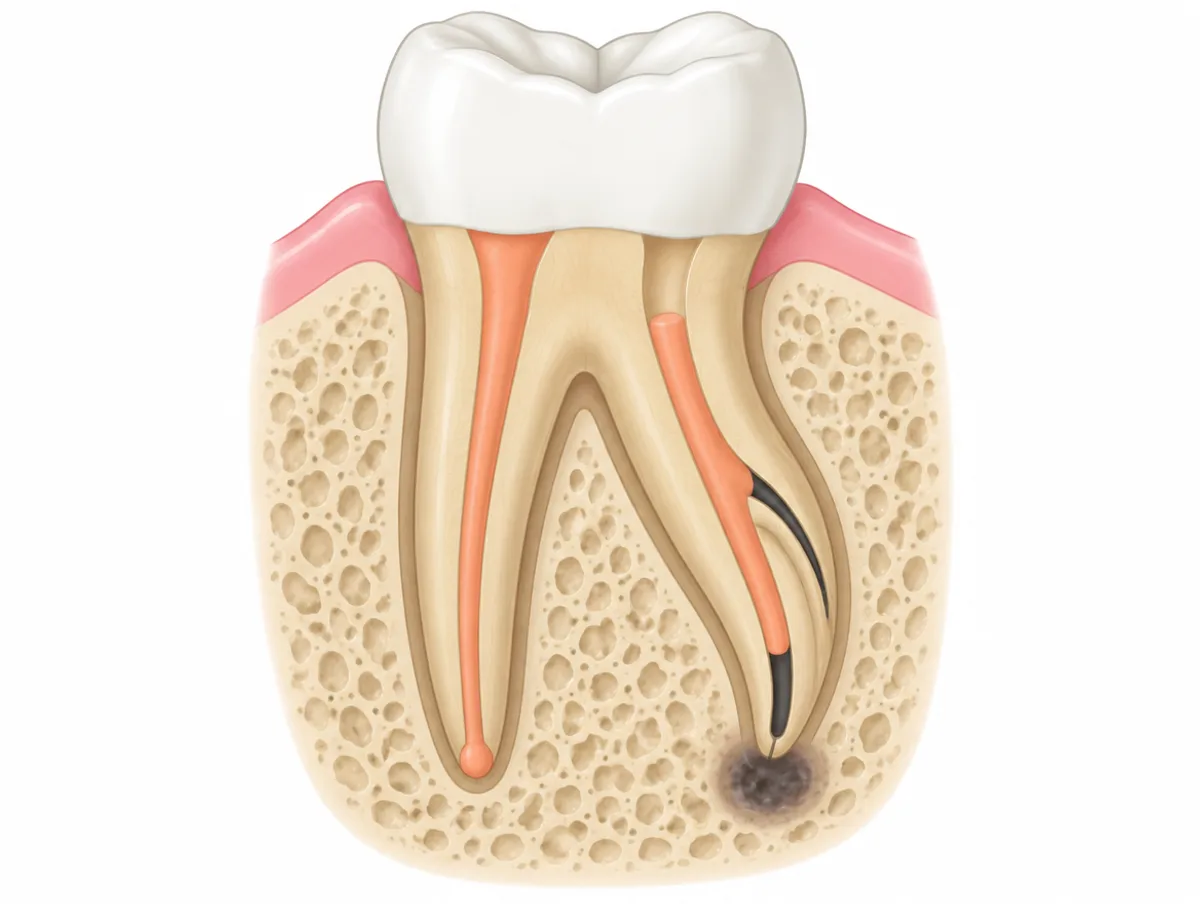
AI-generated explanatory illustrationAn unfilled canal tip and side branches, with inflammation at the root tip
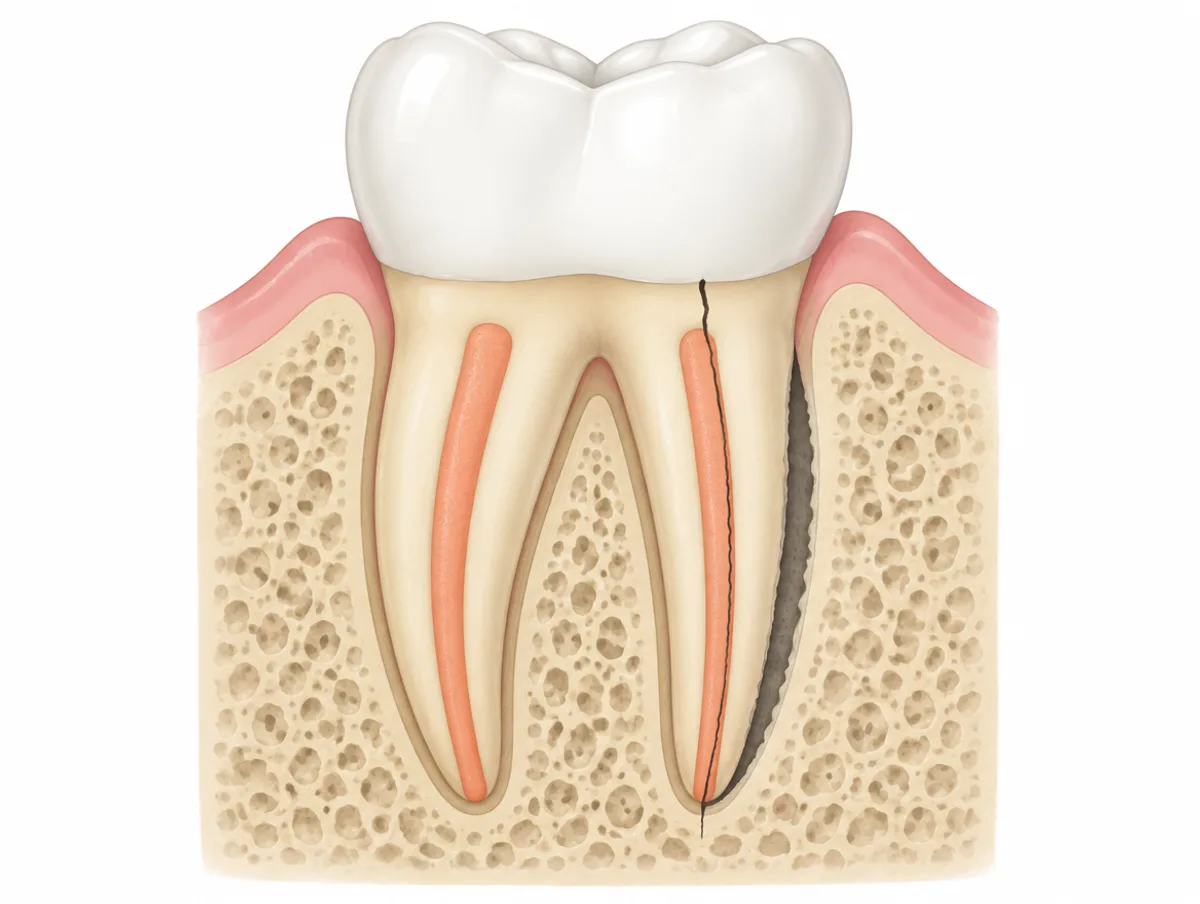
AI-generated explanatory illustrationA vertical root fracture and loss of the adjacent jawbone
- A gum problem rather than a tooth problem: Gum inflammation or a periodontal abscess (Korean) around a root canal-treated tooth can cause similar swelling and pain.
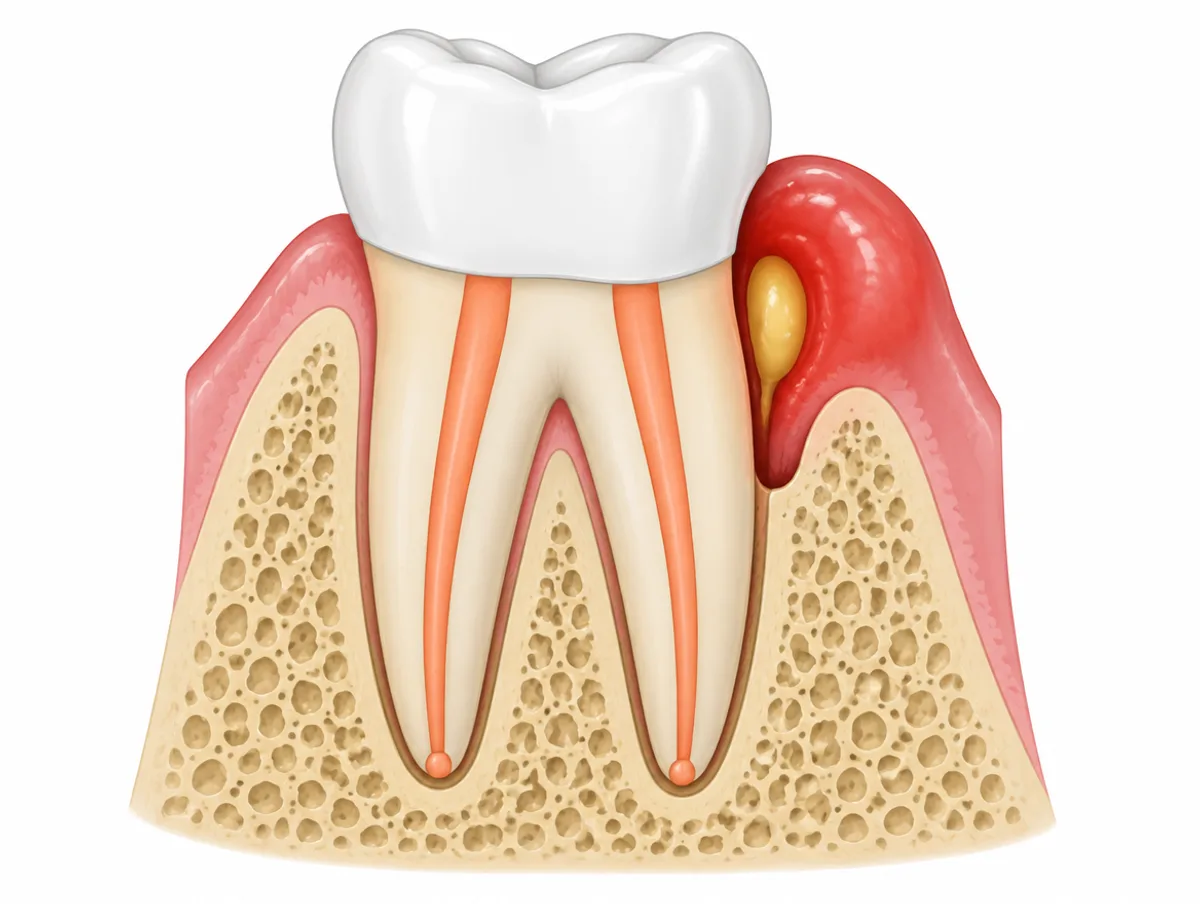
AI-generated explanatory illustrationGum inflammation and a periodontal abscess beside a root canal-treated tooth
What do we check in the treatment room?
We first use a periapical X-ray to look at the root tip and the existing root filling, then add percussion, bite checks and gum pocket depth measurements according to the symptoms. The treatment can differ depending on the cause, even when the pain feels the same, so symptoms alone do not determine whether we treat the tooth again or extract it.
| What we check | Examination | Why we check it |
|---|
| Inflammation at the root tip | Periapical X-ray and, if needed, 3D CT (CBCT) | Whether there is a periapical lesion (Korean) at the root tip and how large it is |
| Existing root filling | Periapical X-ray and, if needed, CT | Whether the root canals are filled to the end and whether a missed canal is suspected |
| Cracks in the tooth | Percussion, bite stick, Q-ray | Cracks on the tooth surface and the area that hurts when biting |
| Vertical root fracture | Periodontal (gum) pocket depth, periapical X-ray and, if needed, CT | Assessed by considering both an isolated narrow, deep pocket and the pattern of bone loss |
| Restoration at the top of the tooth | Intraoral examination, X-ray | Decay or gaps at the crown margin and the presence of a post (post and core (Korean)) |
| Remaining tooth structure and gums | Intraoral examination, periodontal examination, X-ray | Whether enough tooth wall and bone remain to place a new crown |
Why we compare with previous images
It is difficult to tell from a single image whether a lesion at the root tip is growing or healing after the first treatment. If previous X-rays are available, we place images of the same area side by side and compare the size of the dark area.
Why is a vertical fracture difficult to confirm?
A vertical root fracture may not show clearly even on X-ray or CT. Instead, we assess clues such as an isolated narrow, deep gum pocket and a recurring drainage tract (sinus tract) at the same site. If the examinations are still inconclusive, we sometimes open the gum to inspect the root directly.[5]
Can the tooth be treated again if there is inflammation at the root tip?
If enough tooth structure remains and there are no signs of a crack, we first consider treating the tooth again. There are two methods: root canal retreatment, which involves re-entering the tooth to disinfect and fill the root canals, and apicoectomy, which involves opening the gum to remove the inflamed tissue at the root tip and part of the root tip itself.
| Method | What it involves | When it is considered | Points to consider |
|---|
| Root canal retreatment (Korean) | Removing the existing filling material, disinfecting and filling the root canals again; removing the crown and post depending on their condition | When the existing filling is inadequate or a missed canal is suspected, or when the top of the tooth also needs a new restoration | The risk of damage to the tooth during crown and post removal needs to be considered; multiple visits |
| Apicoectomy (Korean) | Opening the gum, removing inflamed tissue at the root tip and part of the root tip, then sealing the end | When the existing crown and post fit well and removing them would be difficult, or when inflammation remains after root canal retreatment | A surgical procedure; sufficient root length is needed |
How do the outcomes of the two methods compare?
Systematic reviews report both root canal retreatment and endodontic surgery as options for keeping teeth. Outcomes were associated with conditions such as the presence and size of a lesion at the root tip before treatment and the condition of the restoration at the top of the tooth.[2][3] In a review comparing the two methods, outcomes tended to favor surgery over shorter follow-up periods and root canal retreatment over longer ones, so the findings differed according to the follow-up period.[3] There is also a study that separately pooled and analyzed outcomes of modern endodontic surgery using a microscope.[4] However, the populations and follow-up periods differ between studies, so we do not apply those figures directly to an individual tooth.
Do the crown and post always need to be removed?
To disinfect the root canals again during retreatment, the crown and post often need to be removed. On the other hand, if the crown and post fit well and the problem is limited to the root tip, we may consider an apicoectomy while leaving the crown in place. This is because forcing out a thick post can further weaken the remaining root.
I personally perform both root canal retreatment and apicoectomy at the clinic, and explain which of the two methods fits this tooth.
When the root has split vertically, or too little tooth structure remains to support a new crown or too little jawbone remains to support the tooth. In the situations below, keeping the tooth may be difficult even with retreatment. We therefore assess the remaining tooth structure and jawbone, and whether removal of the affected root or crown lengthening is possible, before deciding on extraction.
- When the root has split vertically: Bacteria continue to enter through the fracture, so root canal retreatment or apicoectomy often cannot resolve the problem.[5] (For a molar, we may also consider removing only the fractured root.)
- When too little tooth structure remains for a crown: If there is almost no tooth wall above the gum line (ferrule (Korean)), the tooth may fracture easily or the crown may come off even after a new crown is placed.[6]
- When jawbone support has been greatly reduced: If periodontitis has caused substantial loss of the bone supporting the root and the tooth is loose, treating the root tip alone is unlikely to make the tooth last long.
- When decay extends deep below the gum line: If it is difficult to establish a margin for a new crown, we first check whether crown lengthening (Korean) could help, and consider extraction if it would be difficult.
If the tooth is extracted, we also explain whether to replace it with an implant or a bridge (Korean). The checks made before extraction are covered separately in Six things to check before a tooth is extracted.
What I should be frank about
- Inflammation can return even after root canal retreatment or apicoectomy, and extraction would then be considered again.
- After retreatment, we also check whether the edges of the crown or filling fit well, because bacteria can enter again if there is a gap.[1] We also check whether enough tooth wall remains for a new crown.[6]
Are there cases where other treatment or monitoring is used instead of root canal retreatment?
Yes. If the pain comes from the gums or the bite, we treat that cause; if the lesion is healing, we monitor it.
- Gum inflammation alone: If the root tip is fine and there is inflammation in a gum pocket, we start with gum treatment.
- A crown that is too high or a bite that is not aligned: If it hurts only when chewing, checking the height with a bite examination and adjusting it may be all that is needed.
- A neighboring tooth is the cause: The cause may be decay or a crack in a neighboring tooth rather than the root canal-treated tooth, so we check the neighboring teeth as well with a cold test.
- A lesion at the root tip on X-ray without pain: Root canal-treated teeth often do not hurt even when there is inflammation. If comparison with a previous X-ray shows that the lesion is shrinking, we may monitor it without immediate treatment. If it is growing or the top of the tooth needs a new restoration, we consider root canal retreatment.
How long does treatment take, and how many visits are needed?
Root canal retreatment often takes one or two more visits than the first root canal treatment, and several weeks when the final crown is included.
- Root canal retreatment — Crown and post removal, removal of the existing filling material, and repeat disinfection and filling are usually carried out in stages at intervals of 2~3 weeks. There may also be a waiting period for inflammation to settle. We can tell you the exact number of visits after removing the crown and post and checking the condition of the root canals.
- Final crown — It usually takes 1 week from the day the tooth is prepared and scanned to the day the crown is cemented. In the meantime, the tooth is sealed with a temporary filling (Korean) or a temporary crown, and you should not chew hard foods on that side.
- Apicoectomy — The procedure is completed on the day of surgery, and the stitches are removed around 1 week later.
- Checks after treatment — Bone takes time to fill in, so we take X-rays at intervals of a few months to see whether the lesion is shrinking.
Treatment fees are listed in the fee list (non-covered fees).
Frequently asked questions
Q. Is an apicoectomy very painful?
It is performed under local anesthesia. Swelling and bruising may occur for about two days after surgery, and pain can often be managed with prescribed painkillers. We explain the expected side effects and recovery process before you decide on treatment.
Q. There is swelling and pus. Does the tooth need to be extracted right away?
Swelling and pus alone do not determine the need for extraction. We check the cause and extent of inflammation with a periapical X-ray, percussion, gum pocket measurements and other examinations, assess whether drainage is needed, and then decide whether to treat the tooth again or extract it.
Q. Which is better: treating the tooth again or extracting it and getting an implant?
If the conditions allow the tooth to be kept, we first explain how to save your own tooth. However, if conditions such as a vertical fracture or insufficient remaining tooth structure make long-term use difficult, extraction followed by an implant or bridge may be a better option than retreatment.
Q. Doesn’t cutting off the root tip weaken the tooth?
The length removed is a few millimeters at the root tip. If enough root remains, we plan the procedure so that chewing is not greatly affected. If the remaining root would be too short, we explain other options before surgery.
Q. Are root canal retreatment and apicoectomy also covered by health insurance?
Root canal retreatment and apicoectomy are covered by Korean National Health Insurance. However, a new crown and post made after saving the tooth are not covered.
Q. I am near Bongcheon Station. Can you also examine a tooth that had root canal treatment at another clinic?
Yes. At Joy Dental Clinic Bongcheon (Bongcheon Station, Exit 1, 5F Jehyeong Bldg.), we examine the current condition to see whether the tooth meets the conditions for retreatment. The basis for the decision is the current condition of the root tip and the remaining tooth structure, rather than where the first treatment was done.
Limits of the evidence
- The study on the relationship between the restoration at the top of the tooth and the root tip[1] examined X-rays at a single point in time in 1995. It therefore does not prove that restoration quality caused inflammation, and later studies have also reported that root filling quality has a greater influence.
- Reviews of root canal retreatment and endodontic surgery[2][3][4] use different definitions of “success” and follow-up periods across studies, so they do not predict the outcome for an individual tooth.
- The diagnostic clues for vertical fractures[5] and the importance of a ferrule[6] come from reviews of the literature, and many ferrule studies are experiments using extracted teeth.
- The same results do not occur equally in every tooth, and the actual direction of treatment is decided after examination.
DOCTOR’S NOTE
Sometimes a vertical crack in the root becomes visible only after root canal retreatment has begun and the crown and post have been removed. When that happens, I do not press ahead with the original plan. I explain what I can see and then decide on the direction of treatment again.
— Jeong Jinwoo, Director, Joy Dental Clinic Bongcheon
This post reflects information as of the date of writing and was written to provide general information in compliance with Korea’s Medical Service Act and the Ministry of Health and Welfare’s medical advertising guidelines. Root canal retreatment can have side effects such as pain, swelling, tooth fracture and recurrent inflammation, and in rare cases instrument fracture or root perforation may occur. Apicoectomy can have side effects such as bleeding, swelling, pain and infection, and in rare cases altered sensation may occur. Individual diagnosis and the direction of treatment depend on the condition of your mouth, so please be sure to consult fully with your treating clinician before deciding.
We are right next to Exit 1 of Bongcheon Station (Line 2), and directions from Seoul Nat’l Univ. Station, Sillim, Nakseongdae and Sadang are in Getting here.
Joy Dental Clinic Bongcheon
5F Jehyeong Bldg., 1738 Nambusunhwan-ro, Gwanak-gu, Seoul (Bongcheon Station, Exit 1)
Hours: Mon·Wed·Thu·Fri 09:30–18:30 / Tue 09:30–20:30 / Sat 09:30–13:30 (closed Sun & public holidays)
Booking: Naver Booking / Phone 02-877-2867
Related pages: Cavity and root canal treatment guide · Root canal retreatment (Korean) · Apicoectomy (Korean) · My root canal treatment is finished. What should I do now?
References
- Ray HA, Trope M. Periapical status of endodontically treated teeth in relation to the technical quality of the root filling and the coronal restoration. Int Endod J. 1995;28(1):12-18. — [Cross-sectional study] The condition around the root tips of root canal-treated teeth was associated not only with the quality of the root filling but also with the quality of the restoration (seal) at the top of the tooth.
- Ng YL, Mann V, Gulabivala K. Outcome of secondary root canal treatment: a systematic review of the literature. Int Endod J. 2008;41(12):1026-1046. — [Systematic review] A systematic review of root canal retreatment outcomes: the presence or absence of a lesion at the root tip before treatment and the quality of the restoration at the top of the tooth were among the factors reported to be associated with outcomes.
- Torabinejad M, Corr R, Handysides R, Shabahang S. Outcomes of nonsurgical retreatment and endodontic surgery: a systematic review. J Endod. 2009;35(7):930-937. — [Systematic review] A systematic review comparing outcomes of root canal retreatment and endodontic surgery: both methods are options for keeping teeth, and outcome trends differed according to the follow-up period.
- Tsesis I, Rosen E, Taschieri S, Telishevsky Strauss Y, Ceresoli V, Del Fabbro M. Outcomes of surgical endodontic treatment performed by a modern technique: an updated meta-analysis of the literature. J Endod. 2013;39(3):332-339. — [Meta-analysis] A meta-analysis of outcomes of endodontic surgery performed using modern techniques, including microscopy.
- Tamse A. Vertical root fractures in endodontically treated teeth: diagnostic signs and clinical management. Endod Topics. 2006;13(1):84-94. — Vertical root fractures in root canal-treated teeth: narrow, deep gum pockets and recurring sinus tracts are diagnostic clues. If the diagnosis is uncertain, the gum may be opened to inspect the root directly. Treatment is usually extraction or removal of the affected root.
- Juloski J, Radovic I, Goracci C, Vulicevic ZR, Ferrari M. Ferrule effect: a literature review. J Endod. 2012;38(1):11-19. — When a root canal-treated tooth is covered with a restoration, the remaining wall of tooth structure above the gum line (ferrule) is important for resistance to fracture.


 한국어
 日本語
 简体中文