💡 Key answer
What matters for keeping a root canal-treated tooth in use for a long time is how and when it is covered afterward. Root canal treatment removes inflammation inside the tooth, and that tooth is prone to fracture because it has already lost much of its walls. That is why, from the start of root canal treatment, I also decide whether to finish with a composite resin filling or a crown, and proceed to the final restoration without too much delay.
Summary for patients
- Avoid hard and chewy foods on the side with the temporary filling.
- If the temporary filling falls out, have it replaced as soon as possible.
- Schedule the composite resin filling or crown in advance.
- Please tell us if you grind or clench your teeth.
- Even after the tooth is covered, we check the root tip on X-rays at regular checkups.
❓ What this article covers
- Why can a root canal-treated tooth fracture easily?
- What should I be careful about while the temporary filling is in place?
- When should the final restoration be done?
- How do you decide between a composite resin filling and a crown?
- Does sealing the top of the tooth well also affect the root tip?
- What do you check in the treatment room?
- How long does treatment take, and how many visits are needed?
- Are there cases where another option is more suitable than root canal treatment?
Why can a root canal-treated tooth fracture easily?
It is not because the tooth dries out, but because much of its walls have been lost through decay and treatment.
The misconception that “removing the nerve dries out the tooth”
You may have often heard that “removing the nerve makes the tooth dry out and weaken.” However, a study comparing dentin moisture in root canal-treated teeth and vital teeth found no meaningful difference in moisture content.[2]
The actual reason is the loss of walls
It helps to think of a tooth as a box. A small hole in the middle of the lid does not greatly weaken the box, but if the side walls are cut away, it spreads apart easily when pressed from above. In an experiment on extracted premolars, root canal procedures alone reduced tooth stiffness by about 5%, but removing just the middle of the chewing surface reduced it by 20%, and losing the front and back walls (marginal ridges) reduced it by an average of 63%.[1]
Most teeth that need root canal treatment already have deep decay, an old large filling, or a crack (Korean). Once the decay is removed, much of the walls is already missing, and the root canal access opening is added to that. There is also an explanation that without the nerve, the sensation of biting too hard is reduced, so large forces may be applied without you noticing.
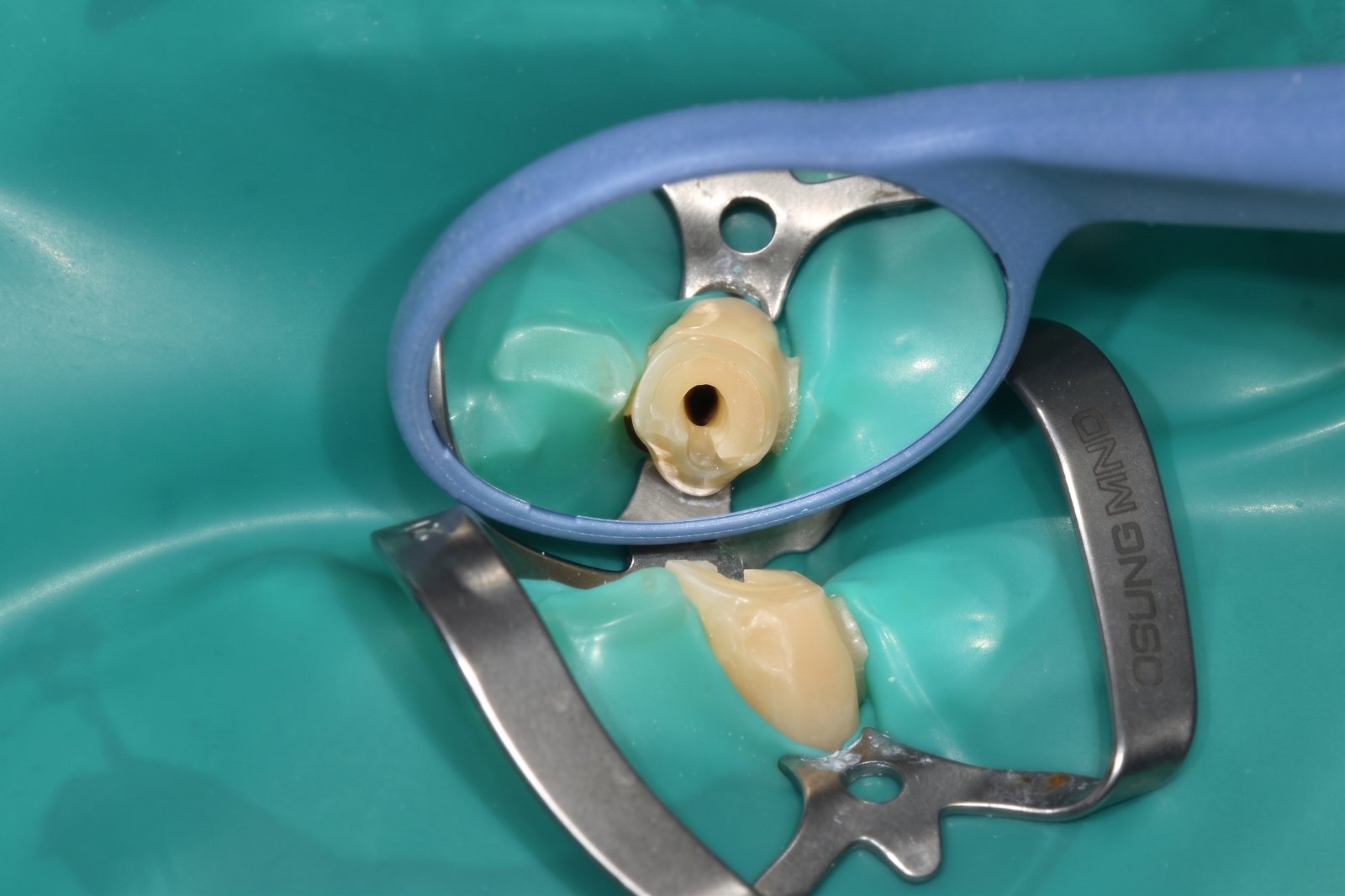
Photo: Root canal treatment with the tooth isolated using a rubber dam (as seen in the mirror). While treating inside the root through the central opening, we also check how thick the walls around the opening remain.
What should I be careful about while the temporary filling is in place?
Avoid chewing hard foods on that side, and have the temporary filling replaced as soon as possible if it falls out. After root canal treatment, the top of the tooth is sealed with a temporary material. This material is not strong and does not hold the walls together, so the tooth is at its weakest during this period.
- Chewing — Do not chew hard or chewy foods such as ice, nuts, hard candy, or squid on that side.
- If the temporary filling falls out — Saliva and bacteria entering through the opening can recontaminate the cleaned and filled root canals. If you cannot come in right away, avoid chewing on that side and rinse gently if food gets caught. You may throw away the piece that fell out.
- Pain — An aching feeling when chewing for a few days after treatment is common as the tissues around the root tip recover (Korean). If it gets progressively worse or your face swells, please contact us right away.
When should the final restoration be done?
There is no fixed deadline, but it is generally better to proceed as soon as possible after root canal treatment. The longer the temporary filling remains, the more the risks of fracture and recontamination accumulate.
In a study that reviewed root canal treatment records for molars and premolars, teeth crowned more than 4 months after treatment had about 3 times the risk of extraction compared with those crowned within 4 months.[4]
An exception is a tooth that had extensive inflammation at the root tip. For these teeth, we first check that symptoms are settling before restoring them. Otherwise, we proceed to the final restoration following root canal treatment.
How do you decide between a composite resin filling and a crown?
We consider five things: the tooth’s position, the remaining walls, the height remaining above the gum line, whether a post is needed, and chewing force.
- The tooth’s position — For molars and premolars, which bear considerable chewing force, we often recommend a crown (Korean) that covers the tooth from above. Front teeth bear less chewing force, so if enough of the walls remain, sealing just the opening with composite resin (Korean) may be sufficient.
- The thickness of the remaining walls — We check whether the front, back, and side walls remain thick enough. If the walls are thin or missing on several sides, composite resin alone has difficulty withstanding chewing force.
- The height of the tooth remaining above the gum line — The crown needs to grip a band of healthy tooth above the gum line to resist forces that split the tooth. This band is called a ferrule (Korean), and a height of about 1.5~2mm is generally considered necessary. If there is not enough height, we first consider crown lengthening (Korean).
- Whether a post is needed — We place a post (Korean) in the root only when too little tooth remains to hold the crown. A post holds the crown in place; it does not strengthen the tooth. Making room for it requires removing more of the root, so we use it only when needed.
- Chewing force — If you grind your teeth (Korean) or clench, we lean toward a crown even if some of the walls remain, and also plan a night guard (Korean).
| Restoration method | Form | Amount of tooth removed | Suitable teeth | Points to consider |
|---|
| Composite resin | Fills only the opening | The least | Front teeth with enough remaining walls | Fracture risk in molars |
| Crown | Covers the whole tooth | Relatively large | Teeth with thin walls or several missing surfaces | Tooth height above the gum line (ferrule) is needed |
| Post + crown | A post inside the root + full coverage | Relatively large + part of the root | Teeth with very little remaining structure | Root fracture risk; use only when needed |
In a study that followed root canal-treated teeth with and without crowns, teeth without crowns were lost at 6 times the rate of those with crowns, even after adjusting for tooth type and extent of decay.[3]
Does sealing the top of the tooth well also affect the root tip?
Yes. Both filling the root canals well and sealing the top well are linked to the health of the root tip. If a gap develops at the top, saliva and bacteria can seep through it and recontaminate the cleaned and filled root canals.
In a study of X-rays of root canal-treated teeth, 91% of teeth with both good root fillings and good coronal restorations had no inflammation at the root tip, compared with 18% of teeth where both were poor.[5] In addition to helping prevent fracture, a crown or composite resin filling acts as a lid that seals the inside of the root off from the outside. This is also why a lost temporary filling should be replaced promptly.
What do you check in the treatment room?
We check at three stages: when treatment begins, before fitting the crown, and at regular checkups after the tooth is covered.
When root canal treatment begins
We use a periapical X-ray to examine the number and shape of the roots and the size of the inflammation at the root tip. After removing decay, we check in your mouth how thick the remaining walls are and how much tooth remains above the gum line. These two factors determine whether we finish with composite resin or a crown. If we suspect a split root, we add CBCT (Korean) and periodontal pocket measurements.
Before fitting the crown
We magnify the margins with an intraoral scanner (TRIOS 6), and before fitting the crown, we check again in your mouth that its margins fit the tooth and that floss passes smoothly.
At regular checkups after the tooth is covered
- Whether the root tip is healing — Inflammation at the root tip (Korean) does not disappear immediately after treatment; it heals as bone fills in over several months to 1 year or longer. We compare with the X-ray taken immediately after treatment to see whether the dark area is shrinking.
- Decay at the margins — A tooth without a nerve does not feel sensitive or painful even if decay develops. Secondary decay (Korean) at the edge of a crown or composite resin filling can often be found only through X-rays and an examination inside the mouth.
- Warning signs — If a pimple-like swelling containing pus appears on the gum, or if you feel a sharp pain only when chewing in a certain direction, we suspect reinfection or a root fracture (Korean).
How long does treatment take, and how many visits are needed?
Root canal treatment and the final restoration together require several visits, and the number depends on the number of roots and the extent of inflammation.
- Root canal treatment — Disinfecting and filling the root canals may be completed in one visit. If there are several roots or extensive inflammation, treatment is usually divided into visits at intervals of 2~3 weeks.
- Final restoration (composite resin) — A composite resin filling that seals the opening is often completed in one visit, either on the day root canal treatment ends or at the next visit.
- Final restoration (crown) — There is one visit to prepare and scan the tooth and another to fit the finished crown, usually 1 week apart.
- Teeth that had extensive inflammation at the root tip — Additional time may be needed to check that symptoms are settling.
Treatment fees are listed in the fee list (non-covered fees).
Are there cases where another option is more suitable than root canal treatment?
Yes. If there will not be enough tooth left to cover and use after treatment, root canal treatment is not our first recommendation. If any of the following applies, we explain root canal treatment alongside other options.
- ✅ The root is split vertically
- ✅ Decay extends deep below the gum line, making it difficult to obtain enough tooth height for a crown to grip
- ✅ Extensive jawbone loss has left the tooth very loose
- ✅ The expected time the tooth can remain in use is short relative to the time and burden of root canal treatment and restoration
Conversely, if the root is sound and the jawbone supports the tooth, we first consider saving it with root canal treatment and restoration, even if it looks badly damaged. If extraction is chosen, the things to check beforehand are covered in Six things to check before having this tooth extracted.
Frequently asked questions
Q. How long can I use a root canal-treated tooth?
There is no fixed lifespan. It depends on the amount of remaining tooth wall, how well the top is covered, the condition of the jawbone, and habits such as grinding. Even with the same treatment, there are large differences between individuals, so continuing to check the root tip and margins at regular checkups after restoration helps keep the tooth in use longer.
Q. What if a root canal-treated tooth hurts again years later?
Often, the root canals have become reinfected or the root has cracked. Depending on the cause, root canal retreatment (Korean) can sometimes save the tooth, but reopening root canals that have already been filled is more difficult than the first treatment. The criteria we use are covered in When a root canal-treated tooth hurts again.
Q. Can a front tooth darken over time after root canal treatment?
This can happen. A previous injury or substances remaining inside the tooth may cause the tooth to darken (Korean) over time. Internal bleaching of a non-vital tooth (Korean) is one way to lighten it from the inside. Details are covered in When a front tooth darkens after root canal treatment.
Q. Once the crown is fitted, can I chew anything I want on that side?
After the final restoration, you can chew as usual. However, it is better to avoid habits such as biting ice or hard shells, as these put strain on natural teeth too.
Q. Near Bongcheon Station, can I have root canal treatment and a crown done at the same clinic?
Yes. At Joy Dental Clinic Bongcheon (Bongcheon Station, Exit 1, 5F Jehyeong Bldg.), we explain the final restoration method and schedule from the start of root canal treatment, and the same director carries out the treatment from the root canal through to the crown.
Limits of the evidence
- The studies on the relationship between tooth walls and stiffness[1] and on moisture[2] were experiments on extracted teeth, so they do not reproduce chewing forces in the mouth exactly.
- The studies on whether a crown was placed[3] and the timing of restoration[4] were retrospective studies of past records. They show an observed trend rather than proving that crowns caused teeth to survive, and 4 months was simply the cutoff used in that study, not a fixed deadline.
- The study on the relationship between the coronal restoration and the root tip[5] was an X-ray study from 1995, and some later studies have found that root filling quality has a greater influence.
- The same results do not apply equally to every tooth, and the actual treatment approach is decided after an examination.
DOCTOR’S NOTE
One of the situations I find most regrettable is when root canal treatment has gone well, but a molar splits vertically while the final restoration is delayed and has to be extracted. No matter how well the inside of the root is treated, we cannot keep the tooth if the structure above it cannot hold up.
— Jeong Jinwoo, Director, Joy Dental Clinic Bongcheon
This post reflects information as of the date of writing and was written to provide general information in compliance with Korea’s Medical Service Act and the Ministry of Health and Welfare’s medical advertising guidelines. Root canal treatment may have side effects such as pain after treatment, tooth fracture, and reinfection. Individual diagnosis and the direction of treatment depend on the condition of your mouth, so please be sure to consult fully with your treating clinician before deciding.
We are right next to Exit 1 of Bongcheon Station (Line 2), and directions from Seoul Nat’l Univ. Station, Sillim, Nakseongdae and Sadang are in Getting here.
Joy Dental Clinic Bongcheon, a dental clinic near Bongcheon Station
Joy Dental Clinic Bongcheon
5F Jehyeong Bldg., 1738 Nambusunhwan-ro, Gwanak-gu, Seoul (Bongcheon Station, Exit 1)
Hours: Mon·Wed·Thu·Fri 09:30–18:30 / Tue 09:30–20:30 / Sat 09:30–13:30 (closed Sun & public holidays)
Booking inquiries: Naver Booking / Phone 02-877-2867
Related pages: Cavity treatment guide · Root canal treatment (Korean) · Crown (Korean) · Ferrule (Korean)
References
- Reeh ES, Messer HH, Douglas WH. Reduction in tooth stiffness as a result of endodontic and restorative procedures. J Endod. 1989;15(11):512-516. — [Experimental study] An experiment on extracted premolars. Root canal procedures alone reduced tooth stiffness by about 5%, an occlusal cavity by 20%, and an MOD cavity involving loss of the front and back walls (marginal ridges) by an average of 63%.
- Papa J, Cain C, Messer HH. Moisture content of vital vs endodontically treated teeth. Endod Dent Traumatol. 1994;10(2):91-93. — [Experimental study] There was no significant difference in dentin moisture content between vital teeth (12.35%) and root canal-treated teeth (12.10%).
- Aquilino SA, Caplan DJ. Relationship between crown placement and the survival of endodontically treated teeth. J Prosthet Dent. 2002;87(3):256-263. — [Cohort study] Even after adjusting for tooth type and extent of decay, teeth without crowns after root canal treatment were lost at 6.0 times the rate of teeth with crowns (a retrospective study of university dental hospital records).
- Pratt I, Aminoshariae A, Montagnese TA, et al. Eight-year retrospective study of the critical time lapse between root canal completion and crown placement: its influence on the survival of endodontically treated teeth. J Endod. 2016;42(11):1598-1603. — [Cohort study] Among root canal-treated posterior teeth, those receiving a crown more than 4 months after treatment had a higher risk of extraction than those crowned within 4 months (hazard ratio 3.38). A single-center retrospective study.
- Ray HA, Trope M. Periapical status of endodontically treated teeth in relation to the technical quality of the root filling and the coronal restoration. Int Endod J. 1995;28(1):12-18. — [Cross-sectional study] The proportion of teeth without inflammation at the root tip was 91.4% when both the root filling and the coronal restoration were good, and 18.1% when both were poor. Some later studies have found that root filling quality has a greater influence.


 한국어
 日本語
 简体中文