💡 Key answer
If sensitivity to cold is brief, settles quickly, and lessens day by day, it falls within the range commonly seen during recovery after gum treatment. Gums may also appear to have receded because swelling from inflammation has settled down. However, if just one tooth keeps getting worse, throbs without a stimulus, or hurts when you chew, we compare it with the first-day records to check for another cause.
Summary for patients
- Compare symptoms every few days to see whether the sensitivity is decreasing.
- Keep brushing the area even if it is sensitive.
- Use toothpaste for sensitive teeth without rinsing it off immediately after applying it.
- If just one tooth keeps getting worse, come in without waiting for the reassessment visit.
- We compare gum recession with the first-day records to check its extent.
❓ What this article covers
- Why do teeth become sensitive after gum treatment?
- Why do the gums look as though they have receded?
- What falls within the normal range?
- What do we suspect if symptoms fall outside the normal range?
- What do we check in the treatment room?
- How can you reduce sensitivity at home?
- Will receded gums come back up?
- How long does treatment take, and how many visits are needed?
Why do teeth become sensitive after gum treatment?
Root surfaces that were covered by tartar and swollen gums become exposed, allowing cold stimuli to travel toward the nerve inside the tooth. The crown of a tooth is covered by hard enamel, but the root surface has only a thin covering and no enamel. The dentin underneath contains many closely packed, tiny tubules leading toward the nerve, so when the root is exposed, cold water or cold air stimulates the nerve through these tubules. This is called dentin hypersensitivity (Korean).
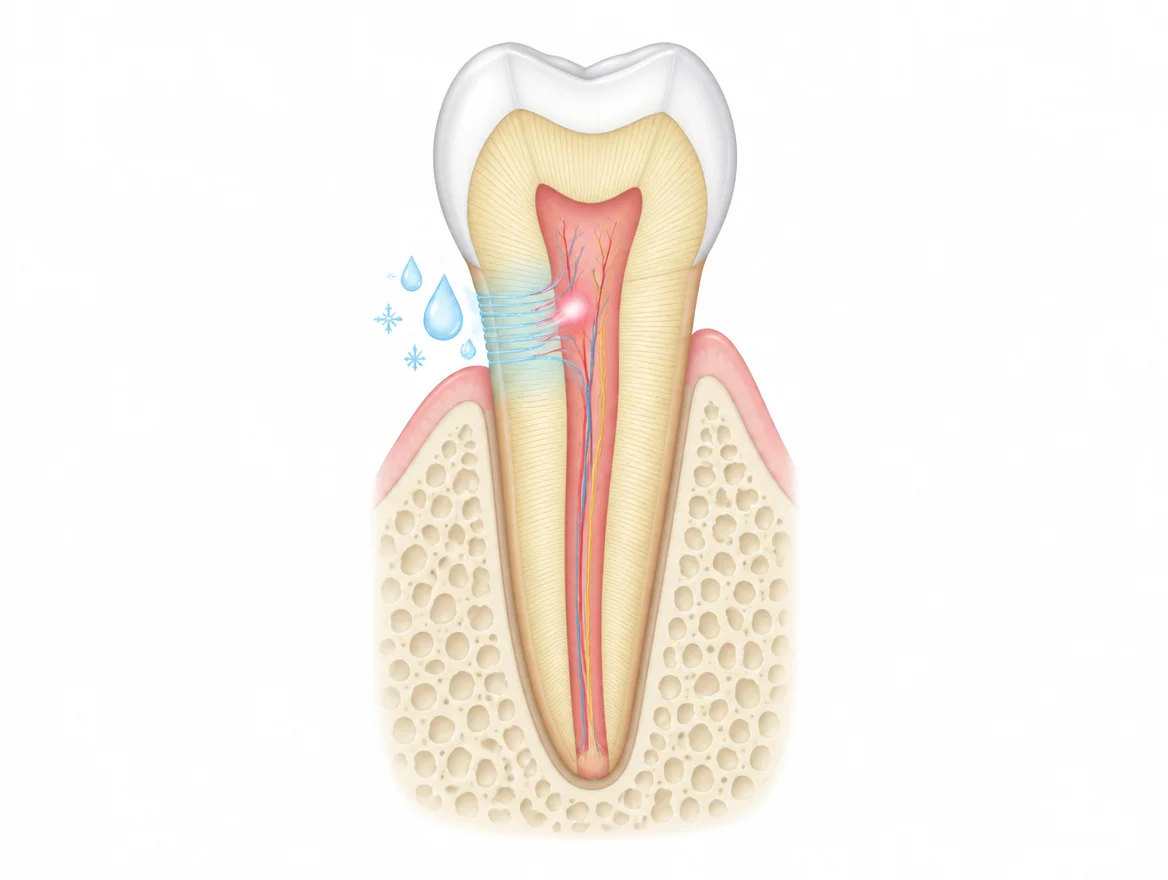
AI-generated explanatory illustrationVertical cross-section of a tooth — a cold stimulus travels from a root exposed by gum recession along tiny tubules in the dentin (dentinal tubules) toward the nerve (pink)
Removing tartar below the gums (root planing (Korean)) removes tartar and inflamed tissue from the root surface, leaving the openings of these tubules exposed immediately after treatment. Sensitivity after gum treatment is common and is usually mild.[1] It is most common immediately after treatment and tends to decrease over the following weeks.[2] This is thought to happen because components of saliva gradually block the tubule openings, while reactions inside the tooth also narrow the tubules. People who were already sensitive to cold before treatment, or who have widely exposed roots, may notice sensitivity more clearly after treatment.
Why do the gums look as though they have receded?
Often, it is because gums that were swollen from inflammation settle down, revealing roots that had been hidden. Gums affected by periodontitis are swollen and soft, covering the teeth above the actual bone level. As the inflammation settles, the gums become firm and recede to match the level of the bone beneath them.
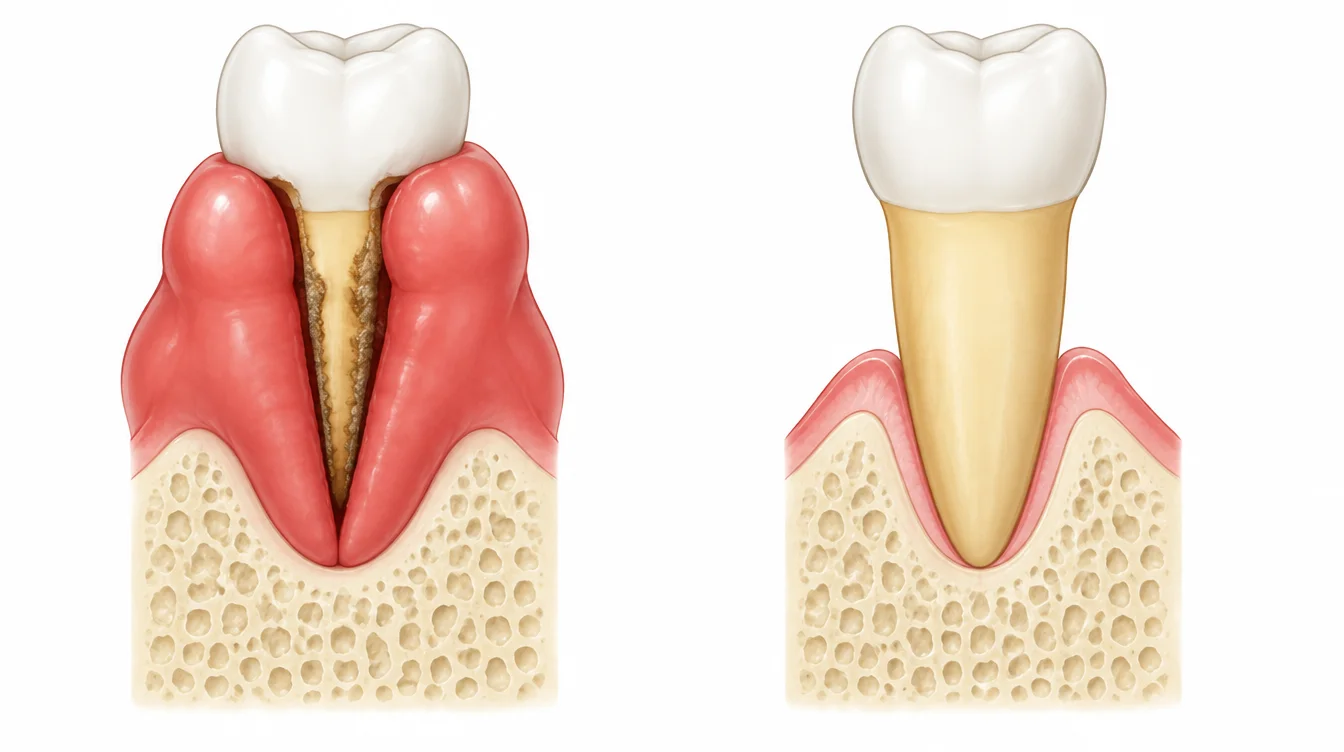
AI-generated explanatory illustrationCross-sections of the same tooth before (left) and after (right) gum treatment — the swollen gums have settled, exposing the root. The bone level is the same in both drawings (the difference in gum level is exaggerated)
Gum treatment reduces pocket depth, and part of this reduction appears as gum recession. Sites where the pockets were deeper initially tend to have greater recession.[3] These changes mainly occur in the first few months after treatment and tend to stabilize afterward.[4]
The teeth may then look longer than before, and reduced gum tissue between the teeth may leave triangular gaps (black triangles (Korean)). Food may get caught between the teeth more easily, or you may feel air escaping between the front teeth when you speak.
The treatment has not cut away the gums; it has revealed the level to which the bone beneath the gums had already receded.
What falls within the normal range?
If the sensitivity is brief and lessens day by day, and gum changes are evenly spread across several treated teeth, we consider this part of recovery. We judge by whether symptoms are decreasing over several days, rather than by symptoms on a single day.
| Considered part of recovery | Reasons to check for another cause |
|---|
| Sensitivity occurs only on contact with cold and settles within a few seconds | Sensitivity or pain lingers after the stimulus is removed |
| Several treated teeth are similarly sensitive | One tooth is much more sensitive than the others |
| Sensitivity lessens day by day | Symptoms worsen over time instead |
| Hot things do not cause discomfort | Heat also causes pain, or the tooth throbs without a stimulus |
| Chewing is comfortable | Chewing or tapping the tooth causes pain |
| The gums appear to have receded evenly | The gum around just one tooth swells or discharges pus |
When comparing symptoms at home, it helps to briefly note the date, which side the sensitive teeth are on, whether cold water, cold air or sweet foods trigger it, and about how many seconds it lasts. Memory alone can make it hard to tell whether things are better than yesterday, and these notes also help us identify the cause in the treatment room.
If you have any symptoms in the right-hand column, please contact us without waiting for the reassessment visit. Even one of these is worth checking. If swelling spreads rapidly or you develop a fever, seek care right away.
What do we suspect if symptoms fall outside the normal range?
A pre-existing problem separate from the gum treatment may be showing up as sensitivity, so we check the possible causes individually. As the gums settle, a problem that was hidden may become visible.
Decay on an exposed root
Root decay hidden below the gums may become visible as the gums recede, or new decay may develop on an exposed root surface. We suspect this if sweet foods also cause sensitivity and the same spot remains sensitive. If decay is confirmed, we remove it and fill the area according to its extent.
Inflammation of the nerve inside the tooth
When deep decay, a crack, or gum inflammation extending to the root tip irritates the nerve inside the tooth, sensitivity turns into pain. Pain often lingers after the cold stimulus is removed, or the tooth throbs on its own at night. We examine the condition of the nerve to decide whether root canal treatment is needed.
Remaining tartar or pus in the gums
Tartar may remain at the bottom of a deep pocket, or the pocket opening may close first after treatment, allowing pus to collect inside. In this case, the gum around just one tooth swells, hurts when pressed, or discharges pus. We clean the area again and use medication as well if needed.
A tooth taking concentrated biting force
If a tooth whose looseness has become apparent as the gums settle makes heavy contact first when you chew, it can feel sensitive and painful. It hurts when chewing or clenching, and this is common in people who grind their teeth. We check the bite, adjust the high spots slightly, and consider a nighttime appliance if needed.
What do we check in the treatment room?
We identify the sensitive teeth one by one to find the cause, and compare the gum level with the measurements recorded on the first day of treatment.
First, we apply cold air or a cold cotton pellet to each tooth to check which teeth are sensitive and how long the sensitivity lasts. We lightly scrape the exposed root surface with a fine instrument to locate the sensitive spot and check for areas softened by decay. If chewing hurts, we gently tap the teeth and ask you to bite on articulating paper to see whether one tooth makes contact before the others.
If only one tooth has symptoms, we measure its gum pocket depth again and check for pus. If pain lingers after the stimulus is removed, we add a test to check whether the nerve inside the tooth is alive and healthy (a pulp vitality test). If we suspect root decay, inflammation at the root tip, or remaining tartar, we take an X-ray.
We do not judge the extent of gum recession solely by how it looks in the mirror. We compare the current gum level with the level entered in the periodontal chart on the first day and explain whether the amount of recession is consistent with the inflammation settling down.
How can you reduce sensitivity at home?
The basics are to use toothpaste for sensitive teeth consistently and keep brushing sensitive areas gently. Brushing a sensitive spot less allows plaque to build up, making gum inflammation return and leaving the exposed root more prone to decay.
After brushing, rub a little toothpaste for sensitive teeth onto the sensitive spot with your finger, and do not rinse it off with water right away. It needs to be used consistently for 1~2 weeks or longer before you feel an effect. Use a soft toothbrush with short, vibrating movements along the gum line, and avoid scrubbing hard from side to side. Until the sensitivity decreases, it is better to use lukewarm water for brushing and drinking.
Do not brush immediately after having a fizzy drink or acidic fruit; rinse with water and wait a little before brushing. This helps reduce toothbrush wear on root surfaces weakened by acid. If the spaces between your teeth have widened, you may need to switch to an interdental brush one size larger. We will help you choose the right size again in the treatment room.
If toothpaste does not reduce the sensitivity, we may apply a desensitizing agent or fluoride to the sensitive spot in the treatment room, or fill it with Bondfill if there is a depression in the sensitive area.
Will receded gums come back up?
Gums that have receded as inflammation settles usually do not return to their original level. The gums follow the level of the bone beneath them, and bone lost to periodontitis usually does not grow back with gum treatment. The gum tissue between teeth may fill in a little over several months after treatment, but the amount is small and varies from person to person.
How we address discomfort from receded gums depends on the type of discomfort. If sensitivity continues, we apply a desensitizing agent to the sensitive spot and fill any hollow areas with Bondfill. If gaps between the front teeth bother you, depending on their size, we consider slightly widening the shape of the teeth with composite resin to reduce the gaps. If food gets caught, we change the interdental brush size, and if it always gets caught in the same spot, we check the contact surfaces.
If just one area keeps receding, we check whether inflammation is progressing again or whether there is another cause, such as brushing habits or the bite. A gum graft (Korean), which moves gum tissue to another site, is considered only under specific conditions after inflammation has stabilized.
How long does treatment take, and how many visits are needed?
Sensitivity and gum changes are usually checked together at the reassessment visit without a separate appointment; extra visits to address the cause are added only when symptoms fall outside the normal range.
Sensitivity is most common during the weeks after tartar is removed from below the gums. If it is decreasing, you manage it at home. At the reassessment 4~8 weeks after the last treatment, we check the sensitive teeth and gum level along with pocket depth.
Applying a desensitizing agent may take just one visit, or it may be applied once or twice more at intervals of a few weeks. If another cause is found, we schedule treatment for it separately, such as decay treatment, root canal treatment, or bite adjustment.
The overall gum treatment schedule and maintenance intervals are covered in How many visits does gum treatment take, and why do I need to keep coming afterward?. Treatment fees are listed in the fee list (non-covered fees).
Frequently asked questions
Q. Can I take a painkiller for the sensitivity?
You may take your usual painkiller according to its instructions. However, if it hurts enough to need a painkiller, or does not settle even with one, there may be a cause other than sensitivity during recovery, so it is better to have it checked.
Q. Can I use any toothpaste for sensitive teeth?
Toothpastes for sensitive teeth fall into two main groups: those with ingredients that make the nerve less responsive to stimuli (such as potassium nitrate), and those with ingredients that block the openings of the tiny tubules in dentin (such as stannous fluoride or arginine). With either type, it is difficult to notice a difference after just one or two uses; you need to use it consistently for a few weeks to find out whether it suits you. If the sensitivity does not decrease after trying it, we examine the sensitive spot directly in the treatment room.
Q. Can my teeth feel sensitive even after scaling alone?
Yes. Areas that were covered by a thick layer of tartar above the gums may feel sensitive for a few days after scaling. This usually lasts a shorter time and is milder than after treatment that reaches below the gums.
Q. Can I postpone my next gum treatment because I dislike the sensitivity?
Postponing it leaves the inflammation in the untreated areas continuing as it is. Please tell us if the sensitivity was severe last time. We can apply a desensitizing agent beforehand or adjust the schedule by treating a smaller area at each visit.
Q. Do receding gums make teeth more likely to loosen?
Gum recession itself does not increase tooth looseness. Looseness depends on how much bone remains, and it often decreases as inflammation settles. Please tell us if you feel that your teeth have become looser after treatment. We will measure again and compare.
Q. Air escapes through the gaps between my front teeth when I speak. Will I get used to it?
In many cases, the tongue adapts over a few weeks and the sensation becomes less noticeable. If it continues to bother you or you are concerned about the appearance, we check the size of the gaps and whether they can be reduced with composite resin.
Q. How can I have sensitivity after gum treatment checked near Bongcheon Station?
You can have it checked at Joy Dental Clinic Bongcheon (Bongcheon Station, Exit 1, 5F Jehyeong Bldg.). If you had gum treatment elsewhere, telling us when and which areas were treated helps us assess the situation.
Limits of the evidence
- The reported frequency of sensitivity after gum treatment[1][2] varies widely because studies use different measurement methods and time points. How long your sensitivity may last is assessed by examining the sensitive spot directly.
- The extent of gum recession[3][4] varies with the initial pocket depth, tooth position and treatment method. Many studies are older, so results with current instruments and methods may differ slightly.
- The effect of toothpaste for sensitive teeth varies with its ingredients and from person to person.
DOCTOR’S NOTE
When someone contacts me after gum treatment saying, “My teeth are sensitive,” I first check whether several teeth are sensitive or just one. If several teeth are similarly sensitive and the sensitivity is decreasing day by day, I monitor them; if just one tooth keeps getting worse, I examine that tooth separately.
— Jeong Jinwoo, Director, Joy Dental Clinic Bongcheon
This post reflects information as of the date of writing and was written to provide general information in compliance with Korea’s Medical Service Act and the Ministry of Health and Welfare’s medical advertising guidelines. Gum treatment may have side effects such as sensitivity, pain, bleeding and gum recession, and receding gums may make the teeth look longer or the spaces between them look wider. Individual diagnosis and the direction of treatment depend on the condition of your mouth, so please be sure to consult fully with your treating clinician before deciding.
We are right next to Exit 1 of Bongcheon Station (Line 2), and directions from Seoul Nat’l Univ. Station, Sillim, Nakseongdae and Sadang are in Getting here.
Joy Dental Clinic Bongcheon
5F Jehyeong Bldg., 1738 Nambusunhwan-ro, Gwanak-gu, Seoul (Bongcheon Station, Exit 1)
Hours: Mon·Wed·Thu·Fri 09:30–18:30 / Tue 09:30–20:30 / Sat 09:30–13:30 (closed Sun & public holidays)
Booking: Naver Booking / Phone 02-877-2867
Related pages: Gum treatment guide · My teeth are sensitive · Dentin hypersensitivity (Korean) · Gum recession (Korean)
References
- von Troil B, Needleman I, Sanz M. A systematic review of the prevalence of root sensitivity following periodontal therapy. J Clin Periodontol. 2002;29(Suppl 3):173-177. — [Systematic review] Root sensitivity after gum treatment is common, usually mild, and tends to lessen over time.
- Lin YH, Gillam DG. The prevalence of root sensitivity following periodontal therapy: a systematic review. Int J Dent. 2012;2012:407023. — [Systematic review] Sensitivity after gum treatment is most common immediately after treatment and tends to lessen over the following weeks. Prevalence varies widely because measurement methods differ between studies.
- Cobb CM. Non-surgical pocket therapy: mechanical. Ann Periodontol. 1996;1(1):443-490. — [Systematic review] After non-surgical gum treatment, pocket depth decreases and the gum level recedes to some extent. Sites with deeper pockets initially tend to show greater gum recession.
- Badersten A, Nilvéus R, Egelberg J. Effect of nonsurgical periodontal therapy. II. Severely advanced periodontitis. J Clin Periodontol. 1984;11(1):63-76. — [Randomized clinical trial] Followed changes in gum level after non-surgical treatment of advanced periodontitis. Gum recession occurred mainly in the first few months after treatment.
- Suvan J, Leira Y, Moreno Sancho FM, et al. Subgingival instrumentation for treatment of periodontitis. A systematic review. J Clin Periodontol. 2020;47(Suppl 22):155-175. — [Systematic review] Summarized the extent of pocket depth reduction after removing tartar below the gums, together with reports of possible side effects such as sensitivity and changes in gum level after treatment.


 한국어
 日本語
 简体中文