💡 Key answer
The number of gum treatment visits varies from person to person depending on the extent of deep gum pockets and the reassessment results. After treatment, maintenance continues, starting at 3-month intervals. Removing tartar below the gums settles inflammation, but bacterial plaque builds up again, and sites where deep pockets remain are difficult to care for with toothbrushing alone. Maintenance means measuring and cleaning those sites again at set intervals to help keep the inflammation that has settled from progressing again.
Summary for patients
- The gum measurements recorded on the first day become the baseline for all later comparisons.
- Treatment below the gums is usually carried out on one half of the mouth at a time.
- After the last treatment, we wait a few weeks before measuring again.
- Maintenance intervals are shortened or lengthened according to the condition of your gums.
- Please continue toothbrushing and using interdental brushes every day, even if your gums bleed.
❓ What this article covers
- What determines the number of gum treatment visits?
- What do we check on the first day at the clinic?
- How do we decide at reassessment whether treatment is complete?
- Why do I need to keep coming back after treatment is finished?
- How is the maintenance interval decided?
- What happens at a maintenance visit?
- When is maintenance alone not enough?
- How long does treatment take, and how many visits are needed?
What determines the number of gum treatment visits?
The main factors are how many teeth have deep gum pockets and where they are spread throughout the mouth. The number of areas requiring separate anesthesia and the reassessment results also affect the number of visits. For gingivitis (Korean), where only the gums are swollen and bleeding, scaling, adjustments to brushing technique, and one follow-up check are often enough. For periodontitis (Korean), where inflammation has reached the jawbone (alveolar bone), removing tartar below the gums and reassessment add more visits.
| Factors that increase the number of visits | Reason |
|---|
| Deep gum pockets spread across multiple areas of the mouth | More areas need anesthesia and treatment |
| Uncontrolled diabetes that worsens gum inflammation | The response to treatment is slower, so additional treatment may be needed after reassessment |
| Smoking | Even if there appears to be less bleeding, healing is slower and deep pockets are more likely to remain |
| Taking blood-thinning medication | We sometimes reduce the area treated at each visit and divide treatment across visits |
| Deep pockets remain at reassessment | We treat those sites again or consider gum surgery |
Studies found no clear difference in effectiveness between treating the whole mouth within 24 hours and dividing treatment into separate areas over multiple visits.[2] We therefore decide how many visits to split treatment into according to the treatment area, general health, and your circumstances. Separate visits can be more comfortable for people who find it hard to lie down for a long time under local anesthesia, or who find eating difficult when both sides are numbed at once. I usually divide the mouth into halves, either upper and lower or left and right.
What do we check on the first day at the clinic?
We measure and record gum pocket depth, bleeding, and looseness for each tooth, and use X-rays to check how much supporting bone remains. This first-day record becomes the baseline for comparison at reassessment and maintenance visits.
Gum pocket depth and bleeding
We gently insert a thin, marked instrument (a probe) between the gum and tooth to measure the depth at several sites around each tooth. A site that bleeds during measurement (bleeding on probing (Korean)) indicates current inflammation. The record of pocket depths and bleeding for each tooth is called a periodontal chart.
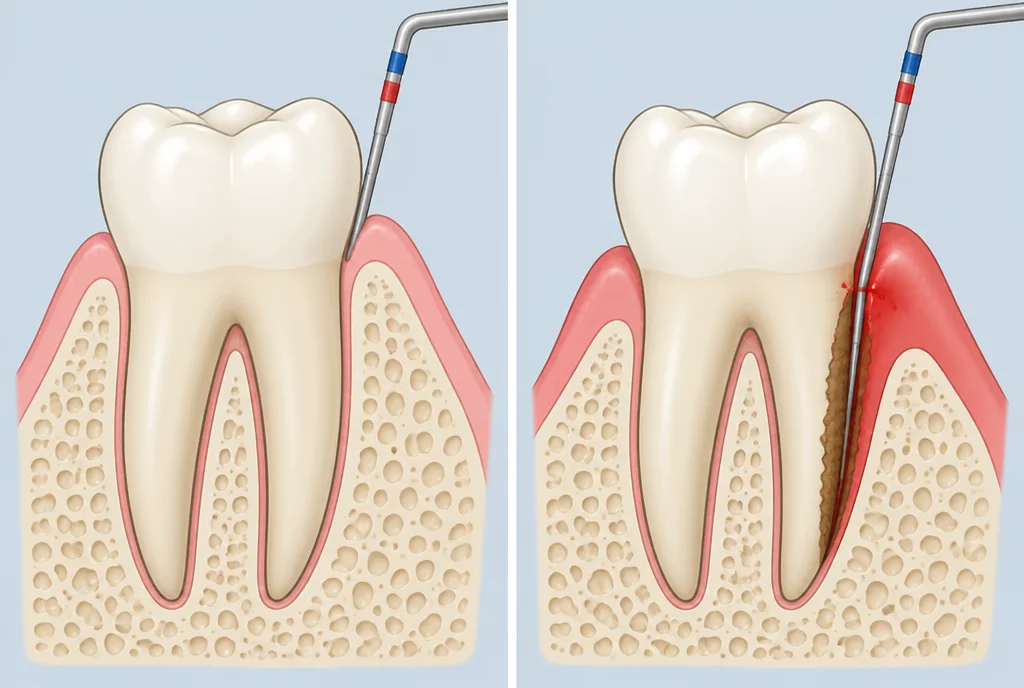
AI-generated explanatory illustrationOn the left, the probe enters only a short distance into healthy gums; on the right, it enters deeply into a gum pocket that has deepened as the supporting bone has been lost due to periodontitis
Tooth looseness and gum level
We push gently on the teeth to record their degree of mobility (Korean) and measure how far the gums have receded from their original position. Recording the gum level as well allows us to tell later whether a lower gum level reflects reduced inflammation or worsening disease.
Bone level on X-rays
We check how far along the root the supporting bone remains, and whether the bone loss is even or forms a deep defect beside just one tooth. We combine these records to determine how far periodontitis has progressed (stage) and the risk of it progressing rapidly (grade).
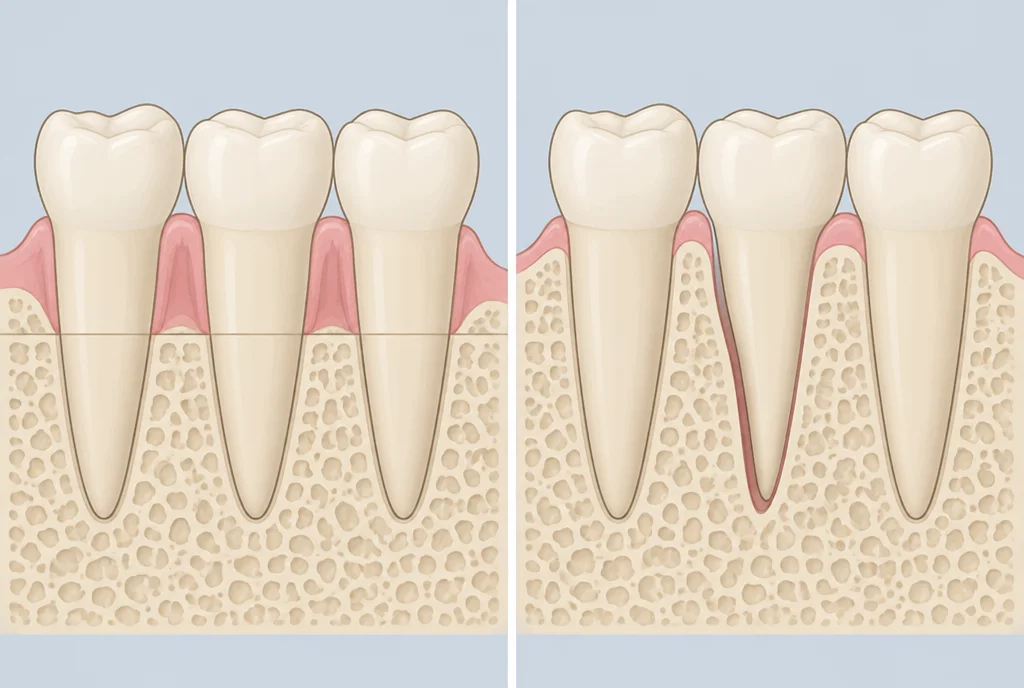
AI-generated explanatory illustrationOn the left, bone loss is even across several teeth; on the right, there is a deep, narrow bone defect beside just one tooth
Rather than simply reading the numbers on the chart to you, we explain which tooth and which side of it has a deep gum pocket.
How do we decide at reassessment whether treatment is complete?
We wait a few weeks after the last removal of tartar below the gums, measure again in the same way as on the first day, and decide based on whether deep pockets and bleeding remain. The gums and underlying tissues take time to heal, so measuring immediately after treatment would show them before healing is complete. Removing tartar below the gums alone generally reduces pocket depth, with greater reductions at sites that were deeper to begin with.[3]
If there is no bleeding on probing and the pockets have become shallow enough to clean at home, we finish the active treatment phase and move on to maintenance. If most sites have improved but a few deep pockets and bleeding remain, we treat just those sites again and remeasure. If deep pockets remain at multiple sites and are too deep for instruments to reach, we consider periodontal flap surgery (Korean), in which the gum is lifted to remove tartar under direct vision.
The European Federation of Periodontology guideline also recommends using these criteria at reassessment to decide the next step.[1]
Around the time of reassessment, the gums may shrink, making the teeth look longer or the spaces between them look wider. This often results from the reduction of gums that were swollen by inflammation, so we compare with the gum levels recorded on the first day to check which process is responsible.
Why do I need to keep coming back after treatment is finished?
Because gum disease can progress again after treatment, and sites that have already become deep are difficult to care for with toothbrushing at home alone. Bacterial plaque builds up again on tooth surfaces that brushing cannot reach, and over time it can extend below the gums and cause inflammation again. Where periodontitis has caused bone loss, the groove around the tooth often remains deeper than normal even after treatment, making these sites prone to renewed inflammation.
An analysis found a higher risk of tooth loss among people who attended maintenance irregularly after periodontal treatment than among those who attended consistently.[4] A long-term observational study also found low levels of tooth loss and alveolar bone loss among adults who received regular professional cleaning and toothbrushing instruction over 30 years.[5]
Most of the supporting bone that has been lost does not grow back with gum treatment. A simple way to think about maintenance is as care aimed at preserving the remaining bone at its current level.
How is the maintenance interval decided?
It is based on reassessment results and factors that worsen gum disease, usually starting at 3 months and lengthening once the condition is stable. The European Federation of Periodontology guideline recommends intervals between 3 months and 12 months according to risk.[1] I also schedule the first maintenance visit 3 months after periodontal treatment is completed.
| When we set a shorter interval | When we can lengthen the interval |
|---|
| Several sites bleed at reassessment | Almost no sites bleed |
| Some deep pockets remain | Pockets have become shallow and stay that way |
| Ongoing smoking or unstable diabetes control | Smoking has stopped or blood sugar is stable |
| Recent tooth loss due to gum disease | No tooth loss during the maintenance period |
| Difficulty using interdental brushes or floss | Consistent cleaning between the teeth at home |
We measure again at each maintenance visit and adjust the interval. If the condition stays stable over consecutive visits, we lengthen the interval; if bleeding increases again, we shorten it.
What happens at a maintenance visit?
We measure gum pockets and bleeding again, compare them with previous records, and clean the tooth surfaces and below the gums according to the findings.
First, we measure pocket depth and bleeding in the same way as before, looking for sites that have deepened or started bleeding. We then remove tartar and bacterial plaque above the gums, and clean below the gums at sites that bleed or have deepened. We sometimes use local anesthesia at those sites.
We also check how you clean your teeth at home. We show you where plaque remains and adjust the interdental brush size or toothbrush angle for those sites. X-rays are taken when needed, considering the gum condition and previous examination results, and we compare bone levels with earlier images. We check the margins of crowned teeth and the gums around implants in the same way.
The director checks these personally at regular checkups every 6 months. At these checkups, we tell you about changes that could affect your teeth and gums before you need to ask.
When is maintenance alone not enough?
If a particular site becomes deeper again or produces pus during maintenance, that site returns to active treatment rather than maintenance. Maintenance is a process for keeping stable gums stable, so it is difficult to manage a site where disease is already progressing again with cleaning alone.
If one or two sites have deepened again, we numb only those areas, remove tartar below the gums again, and reassess. If the same site repeatedly worsens, we look for a separate cause, such as a bone defect between the roots, a tooth taking excessive force when biting, or an ill-fitting restoration margin.
For a tooth where bone loss reaches close to the root tip, we decide whether to keep trying to retain it or to extract it and plan how to restore the site. The process of observing a loose tooth for 3 months is explained in Why we recommend 3 months of gum treatment before extracting a loose tooth.
Conversely, people who only had gingivitis may not need removal of tartar below the gums or maintenance at short intervals. In these cases, we manage the condition with checkups and scaling every 6 months. Scaling intervals are covered in Why do we recommend scaling every 6 months?.
How long does treatment take, and how many visits are needed?
For periodontitis, it usually takes 2~3 months from the first examination to reassessment, followed by maintenance with no set end date. The number of visits increases or decreases according to the factors described above.
- Examination and scaling above the gums: we record a periodontal chart and X-rays, remove tartar above the gums, and adjust your home cleaning technique.
- Removal of tartar below the gums: after local anesthesia, we usually treat one half of the mouth at a time (upper and lower, or left and right), at intervals of 1~2 weeks.
- Reassessment: we wait 4~8 weeks after the last treatment for the gums to heal, then measure again in the same way as on the first day. Continue toothbrushing and using interdental brushes while waiting. If problem sites remain, we treat those sites again or consider gum surgery, which extends the treatment period.
- Maintenance: this usually starts at 3-month intervals and is adjusted according to the condition.
Treatment fees are listed in the fee list (non-covered fees).
Frequently asked questions
Q. Can I return to daily activities right after having tartar removed below the gums?
Most people can return to daily activities that same day. Before the anesthesia wears off, you could bite your cheek or tongue, so please wait until sensation returns before eating. Your gums may feel sore or your teeth may be sensitive to cold for a few days. How long sensitivity usually lasts is covered in Sensitivity after gum treatment.
Q. If I am busy and miss a maintenance visit, do I have to start over?
You do not have to start over. We measure again after the delay, compare with previous records, and treat only the sites that have worsened. However, if the gap has been more than 1 year, the gum condition may have changed considerably, so we may examine as thoroughly as at the first visit.
Q. How long do I need to keep attending maintenance?
There is no set end date. Gums that have had periodontitis can worsen again when care stops, so if the condition stays stable for a long time, we continue while gradually lengthening the interval. If the interval reaches 6 months, you can arrange maintenance on the same day as your regular checkup.
Q. Is maintenance different if I have implants?
We check pocket depth and bleeding around implants as well. If inflammation develops around an implant, bone loss can sometimes be faster than around natural teeth. Even for people with a history of periodontitis, we therefore check at 6-month intervals once the gums are stable, and shorten the interval if bleeding or deep pockets remain. We use an air-polishing device to clean around implants.
Q. How does maintenance differ from regular scaling?
Scaling removes tartar above and at the gum line, while maintenance also includes measuring gum pockets again, comparing them with the previous measurements, and cleaning below the gums where needed. For people who have been treated for periodontitis, remeasuring previously deep sites is important, so scaling alone does not replace maintenance.
Q. Does diabetes change the gum treatment schedule?
If blood sugar control is unstable, healing may be slower and more problem sites may remain at reassessment, so we tend to set shorter maintenance intervals. Knowing your recent HbA1c level helps us plan the schedule. You can continue medical care for diabetes and gum treatment alongside each other.
Q. How can I receive maintenance after gum treatment near Bongcheon Station?
You can receive it at Joy Dental Clinic Bongcheon (Bongcheon Station, Exit 1, 5F Jehyeong Bldg.). At your first visit, we record gum pocket measurements from the outset and use that record to decide the interval.
Limits of the evidence
The studies on the association between maintenance attendance and tooth loss[4][5] are observational, so they cannot rule out the possibility that people who attended consistently were already better at caring for their teeth. Studies directly comparing which interval in months is most appropriate are lacking,[6] so we decide the interval by measuring each person’s condition. The comparison between treatment by area and treatment of the whole mouth within a short period[2] is based on a small number of studies with short follow-up periods.
DOCTOR’S NOTE
When periodontal treatment is complete, I start maintenance at 3-month intervals. After that, I check gum pocket depth, bleeding, and how well the teeth and gums are being cared for to decide whether to lengthen or shorten the interval.
— Jeong Jinwoo, Director, Joy Dental Clinic Bongcheon
This post reflects information as of the date of writing and was written to provide general information in compliance with Korea’s Medical Service Act and the Ministry of Health and Welfare’s medical advertising guidelines. Gum treatment can have side effects such as sensitivity, gum soreness, bleeding, and gum recession (gums moving down so teeth look longer or the spaces between them look wider). Individual diagnosis and the direction of treatment depend on the condition of your mouth, so please be sure to consult fully with your treating clinician before deciding.
We are right next to Exit 1 of Bongcheon Station (Line 2), and directions from Seoul Nat’l Univ. Station, Sillim, Nakseongdae and Sadang are in Getting here.
Joy Dental Clinic Bongcheon
5F Jehyeong Bldg., 1738 Nambusunhwan-ro, Gwanak-gu, Seoul (Bongcheon Station, Exit 1)
Hours: Mon·Wed·Thu·Fri 09:30–18:30 / Tue 09:30–20:30 / Sat 09:30–13:30 (closed Sun & public holidays)
Booking: Naver Booking / Phone 02-877-2867
Related pages: Gum treatment guide · My gums bleed · Periodontal maintenance (Korean) · Root planing (Korean)
References
- Sanz M, Herrera D, Kebschull M, et al. Treatment of stage I–III periodontitis—The EFP S3 level clinical practice guideline. J Clin Periodontol. 2020;47(Suppl 22):4-60. — [Guideline] European Federation of Periodontology clinical practice guideline: risk factor control and oral hygiene → removal of tartar below the gums → reassessment → surgery if needed → maintenance (supportive periodontal care). Recommends maintenance intervals of 3~12 months according to risk.
- Eberhard J, Jepsen S, Jervøe-Storm PM, Needleman I, Worthington HV. Full-mouth treatment modalities (within 24 hours) for chronic periodontitis in adults. Cochrane Database Syst Rev. 2015;(4):CD004622. — [Systematic review] No clear difference in effectiveness between treating the whole mouth within 24 hours and treating separate areas over multiple visits; the approach can be chosen according to the patient's circumstances.
- Suvan J, Leira Y, Moreno Sancho FM, et al. Subgingival instrumentation for treatment of periodontitis. A systematic review. J Clin Periodontol. 2020;47(Suppl 22):155-175. — [Systematic review] Removing tartar below the gums reduces gum pocket depth, with greater reductions in pockets that were deeper at the start.
- Lee CT, Huang HY, Sun TC, Karimbux N. Impact of patient compliance on tooth loss during supportive periodontal therapy: a systematic review and meta-analysis. J Dent Res. 2015;94(6):777-786. — [Meta-analysis] Patients who attended maintenance irregularly after periodontal treatment had a higher risk of tooth loss than those who attended consistently.
- Axelsson P, Nyström B, Lindhe J. The long-term effect of a plaque control program on tooth mortality, caries and periodontal disease in adults. Results after 30 years of maintenance. J Clin Periodontol. 2004;31(9):749-757. — [Cohort study] Adults who received regular professional cleaning and oral hygiene instruction over 30 years had low levels of tooth loss and alveolar bone loss.
- Trombelli L, Franceschetti G, Farina R. Effect of professional mechanical plaque removal performed on a long-term, routine basis in the secondary prevention of periodontitis: a systematic review. J Clin Periodontol. 2015;42(Suppl 16):S221-S236. — [Systematic review] Gum conditions generally remain stable with regular professional cleaning after periodontal treatment, but studies comparing the effects of different intervals are lacking.


 한국어
 日本語
 简体中文