💡 Key answer
If your jaw clicks when you open your mouth but it does not hurt and opens well, in most cases it calls for self-care and monitoring rather than treatment. The most common cause is a disc inside the joint that has slipped slightly forward and returns to position as you open your mouth. Even when this clicking lasts a long time, it usually stays as it is. The basis for judgment is not how loud it is, but whether it comes with pain, limited opening or locking.
Summary for patients
- Eliminating the sound is not the goal of treatment.
- Do not make your jaw click just to check the sound.
- At rest, keep your teeth apart and your lips closed.
- Support your chin with your hand when you yawn.
- Get it checked if it hurts or locks and will not open.
❓ What this article covers
- Why does my jaw click?
- Can I just monitor it if there is only a sound?
- What can I do at home?
- What should I avoid?
- If the sound suddenly stops, does that mean it is better?
- What do we check in the treatment room?
- When should I get it checked instead of watching and waiting?
- How long does treatment take, and how many visits are needed?
Why does my jaw click?
Most often, the sound occurs when the disc inside the joint sits slightly forward at rest and the jawbone moves onto it as you open your mouth.
The jaw joint is just in front of the ear, where the rounded head of the lower jawbone (the condyle) meets the skull. An articular disc (Korean) cushions the two bones. When you open your mouth, the condyle slides forward along this disc.
If the disc sits slightly forward at rest, the condyle moves onto the disc as you open your mouth, making a click, and there is another small sound when you close. This is called disc displacement with reduction, meaning that the displaced disc returns to position. Even under the international diagnostic criteria (DC/TMD), it is often not considered to require separate treatment if there is no pain or locking.[1]
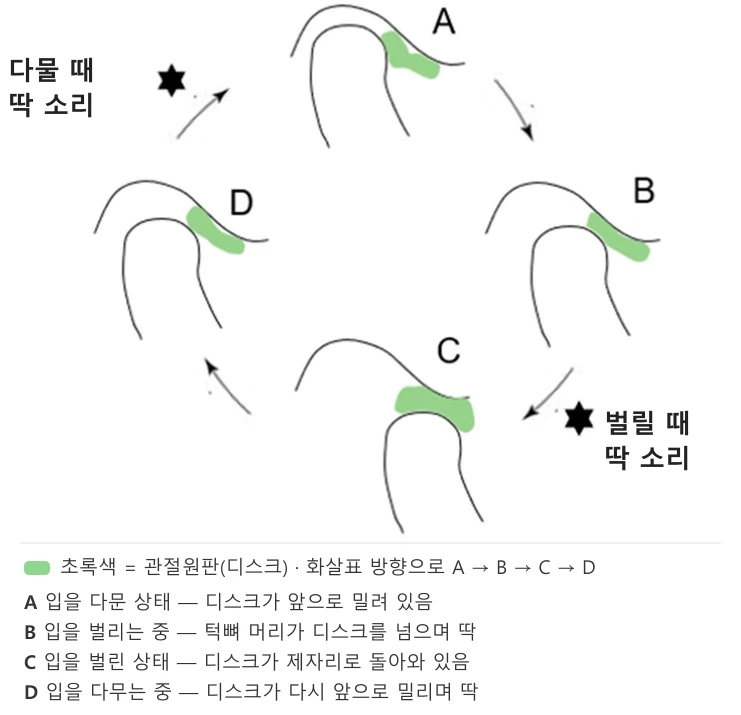
Figure cited from an external paper · Not a case from our clinicThe figure shows the sequence of disc (green) movements when opening and closing the mouth.Poluha et al. · Figure 3 · DOI: 10.1590/1678-7757-2018-0433 · CC BY 4.0 · Korean labels added
Clicking and grating sounds are different
A grating or crunching sound, like stepping on sand, may be the sound of bones rubbing against each other because the disc has worn down or the joint surfaces have become rough. Unlike the clicking common in younger people, it is more frequent from middle age onward or with longstanding symptoms. It may indicate a change in the joint structure, so it is worth having it checked at least once even without pain. The differences between the two sounds are set out in a table in Jaw joint sounds (Korean).
Can I just monitor it if there is only a sound?
In most cases, yes, if there is no pain or locking. Jaw clicking is more common than you might think, and many people live with the sound without pain. In a study that followed people who had jaw clicking in adolescence, clicking rarely progressed to painful jaw locking.[2]
Among all people who seek care for jaw discomfort, pain in the chewing muscles is more common than problems in the joint itself, followed by disc displacement.[4] This means that for many people with jaw discomfort, the issue is more a buildup of strain in the jaw muscles from clenching or grinding than damage to the joint. So even with a clicking jaw, the focus of care is on habits that let the jaw rest, rather than on the sound.
What can I do at home?
Habits that let the jaw rest are the main focus. Most temporomandibular disorders are managed with approaches such as self-care that do not involve grinding down teeth or changing the bite.[3]
Keep your teeth apart and your lips closed
Normally, the upper and lower teeth touch only briefly when chewing and swallowing. If your teeth are touching while you work or drive, separate them slightly and rest the tip of your tongue lightly on the roof of your mouth behind your upper teeth. A small reminder on your monitor or phone can make it easier to notice.
Change the way you eat
When you have pain or frequent clicking, cut food into small pieces to reduce how often you open wide, and alternate sides when chewing rather than using only one side. When yawning, lightly placing your fist under your chin naturally limits how wide you open.
Use compresses and gentle exercises when your jaw feels sore and stiff
Holding a warm towel against the area in front of your ears and your cheek muscles for 10~15 minutes, 2~3 times a day, relaxes muscle tension. For acute pain with swelling and warmth, a brief cold compress may feel more comfortable. Slowly opening and closing while watching in a mirror to keep your jaw from veering to one side can also help; stay within a pain-free range.
Pay attention to sleep and tension as well
When you are short on sleep or remain tense, you spend more time clenching without realizing it. Cut down on caffeine and alcohol before bed, and take time to relax your jaw and shoulders. Detailed steps are covered in Jaw joint self-care (Korean).
What should I avoid?
Start by stopping deliberate jaw movements to check or eliminate the sound.
- Deliberately clicking your jaw to check the sound. Repeated deliberate movements may strain the joint and can easily become a habit.
- Forcing your jaw sideways or twisting it to stop the sound. This only adds strain to the joint.
- Chewing gum for a long time, and hard or chewy foods such as squid, nuts and ice. Also avoid taking large bites out of a whole apple or a thick hamburger.
- Resting your chin on your hand, sleeping face down and chewing on only one side. These concentrate force on one joint.
- Forcing your mouth open with your hands when it suddenly will not open. This can worsen pain and inflammation.
- Having teeth ground down or starting orthodontic or prosthetic treatment solely to eliminate the sound. In general, irreversible approaches such as grinding down teeth are not recommended for sound alone.[3] However, if there is a clear cause, such as a disrupted bite from leaving missing teeth unreplaced for a long time or a restoration that is too high, that cause is examined and treated separately.
If the sound suddenly stops, does that mean it is better?
If your mouth opens as well as before, it may be an improvement, but if the sound disappears and your mouth opens less, it is a sign of the opposite.
The sound disappearing and the jaw getting better are not the same thing. Even if the sound remains, being able to eat and open well without pain means the condition is being managed well. Conversely, if a jaw that used to click suddenly opens less without making a sound and veers to one side as it opens, the disc may be stuck in front and unable to return (disc displacement without reduction). This can become harder to release over time, so avoid forcing it open with your hands and have it checked promptly. Until your visit, use warm compresses and move it slowly only within a pain-free range. Recovery time varies with the cause and condition.
What do we check in the treatment room?
We listen to your history, measure how wide you can open, and press on the joint and muscles to distinguish where the pain comes from.
- History — We ask when the sound started, which side it comes from and what it sounds like, whether there is pain or a history of locking, whether you grind or clench your teeth or rest your chin on your hand, whether there has been an impact injury, and whether you have any other joint conditions.
- Mouth opening — We use a ruler to measure the distance between the upper and lower front teeth. Around 40mm is generally normal; if it has decreased to 35mm or less, we consider it limited. We also check whether the jaw moves straight down as it opens and when the sound occurs.
- Examination by pressing — We press on the joint in front of the ear and the chewing muscles in the cheeks and temples to see where your usual pain is reproduced.[1]
- Signs of grinding — We look for worn, polished areas on the teeth and tooth marks on the inside of the cheeks or the edges of the tongue.
- Imaging — If needed, we examine the shape of the joint bones on a panoramic X-ray or 3D CT. The disc itself does not show on CT, so we refer for MRI when needed, such as with repeated locking.
If there is also pain or locking, we consider a stabilization splint (Korean) or physical therapy (Korean). The care process is covered in Jaw joint treatment guide and My jaw clicks or does not open easily.
When should I get it checked instead of watching and waiting?
If the sound is accompanied by even one of pain, locking or limited opening, it may have progressed beyond sound alone. If you cannot fit three fingers stacked vertically between your upper and lower front teeth, we consider your mouth opening reduced.
| Symptom | Possible condition | What to do |
|---|
| Clicking only, without pain or limited opening | Disc displacement with reduction | Monitor and manage at home |
| Sound + morning soreness and stiffness or a temple headache | Muscle strain from clenching or grinding | Adjust habits; get checked if it continues after 2~4 weeks |
| Sound + joint pain when chewing or opening | Joint strain or inflammation | A check is recommended |
| Occasional locking that releases | The disc is starting to have difficulty returning to position | A check is recommended |
| Sudden inability to open, with deviation to one side | Possible disc displacement without reduction | Do not force it open; get checked promptly |
| A sand-like grating sound + pain | Possible changes in the joint surfaces | Imaging is recommended |
| A changed bite after an impact | Possible injury such as a fracture | Get checked the same day |
If you have been told that you grind your teeth while sleeping or often have a stiff jaw in the morning, we also assess grinding separately from the sound. Morning symptoms are covered separately in Is it hard to open your mouth when you wake up?.
How long does treatment take, and how many visits are needed?
A jaw that only clicks has no treatment period as such; when there is also pain, we assess it in stages over several weeks to several months.
- First visit — The history, measurements and any necessary imaging take about 20~30 minutes.
- Muscle pain — This often improves within 4~8 weeks with self-care, physical therapy and an appliance.
- Joint problems or longstanding symptoms — These may take several months. If there is still no response, we consider joint injections (Korean) or referral to a hospital specializing in oral medicine or oral and maxillofacial surgery.
- Stabilization splint — Taking the impression and fitting the splint are done on separate days. After you start wearing it, adjustments are made every 2~4 weeks. After 4~8 weeks, we measure mouth opening and pain again and revise the plan. It may feel foreign and increase saliva at first, but most people get used to it within 1~2 weeks. Long-term use without adjustment can change the bite, so we check the fit regularly.
Examinations, X-rays, physical therapy and prescribed medication are covered by Korean National Health Insurance. Stabilization splints are covered when conditions such as a diagnosis of a temporomandibular disorder are met. Treatment fees are listed in the fee list (non-covered fees).
Frequently asked questions
Q. Both sides click. Is that okay?
Sounds on both sides do not by themselves mean greater risk. In the treatment room, we also look for differences between the sides, such as whether only one side hurts or which way the jaw veers when opening.
Q. Will a stabilization splint stop the sound?
The main purpose of a splint is to reduce strain on the muscles and joints to ease pain, rather than to eliminate the sound completely. Sounds caused by a changed disc position often remain even with a splint, and if there is only sound without pain, a splint is often unnecessary.
Q. Can I use a mouthguard sold online?
We do not recommend it. Ready-made products that you soften in boiling water and bite into cannot be adjusted to make the upper and lower teeth meet evenly. If they do not fit, they may actually make the muscles work harder.
Q. Will Botox injections in the jaw stop the sound?
Botox injected into the chewing muscles is an additional way to ease pain by temporarily reducing muscle force. It does not change the disc position and is not a treatment to eliminate the sound. Repeated injections can also have side effects such as muscle atrophy, so habit management and a splint come first.
Q. Can I have jaw joint treatment near Bongcheon Station after work?
Joy Dental Clinic Bongcheon (Bongcheon Station, Exit 1, 5F Jehyeong Bldg.) is open until 8:30 p.m. on Tuesdays. The first visit takes about 20~30 minutes, so please allow enough time.
Limits of the evidence
- The study suggesting that clicking rarely leads to locking[2] followed adolescents, so its findings do not apply directly to adults or longstanding clicking.
- Studies of how common each type is[4] collected patients seeking care, so the proportions may differ from those in the general population.
- The emphasis on self-care and conservative treatment[3] comes from a clinical review, and the size of the benefit from each approach varies greatly between individuals.
- The recovery times are general ranges used in practice, not values measured in research.
DOCTOR’S NOTE
The first thing I do for someone who comes in with jaw clicking is measure their mouth opening with a ruler. Even if the sound is loud, if the mouth opens well and there is no pain, we monitor it and work together on habits that let the jaw rest. If pain or locking has begun, regardless of how loud the sound is, I first press on the joint in front of the ear and the muscles to distinguish where the pain is coming from.
— Jeong Jinwoo, Director, Joy Dental Clinic Bongcheon
This post reflects information as of the date of writing and was written to provide general information in compliance with Korea’s Medical Service Act and the Ministry of Health and Welfare’s medical advertising guidelines. Jaw joint treatment may have side effects such as pain, discomfort, bite changes and discomfort while adapting to an appliance. Individual diagnosis and the direction of treatment depend on the condition of your mouth, so please be sure to consult fully with your treating clinician before deciding.
We are right next to Exit 1 of Bongcheon Station (Line 2), and directions from Seoul Nat’l Univ. Station, Sillim, Nakseongdae and Sadang are in Getting here.
Joy Dental Clinic Bongcheon
5F Jehyeong Bldg., 1738 Nambusunhwan-ro, Gwanak-gu, Seoul (Bongcheon Station, Exit 1)
Hours: Mon·Wed·Thu·Fri 09:30–18:30 / Tue 09:30–20:30 / Sat 09:30–13:30 (closed Sun & public holidays)
Inquiries: Naver Booking / Phone 02-877-2867
Related pages: Jaw joint treatment guide · My jaw clicks · Jaw joint sounds (Korean) · Teeth grinding (Korean)
References
- Schiffman E, Ohrbach R, Truelove E, et al. Diagnostic Criteria for Temporomandibular Disorders (DC/TMD) for Clinical and Research Applications. J Oral Facial Pain Headache. 2014;28(1):6-27. — [Guideline] International diagnostic criteria for temporomandibular disorders. Distinguishes disc displacement by sounds, locking and limited mouth opening.
- Könönen M, Waltimo A, Nyström M. Does clicking in adolescence lead to painful temporomandibular joint locking? Lancet. 1996;347(9008):1080-1081. — [Cohort] A follow-up study of jaw clicking in adolescence. Clicking rarely progressed to painful locking.
- Durham J, Newton-John TR, Zakrzewska JM. Temporomandibular disorders. BMJ. 2015;350:h1154. — Clinical review: most temporomandibular disorders are managed with self-care and conservative treatment; irreversible treatment requires caution.
- Manfredini D, Guarda-Nardini L, Winocur E, et al. Research diagnostic criteria for temporomandibular disorders: a systematic review of axis I epidemiologic findings. Oral Surg Oral Med Oral Pathol Oral Radiol Endod. 2011;112(4):453-462. — [Systematic review] Muscle-related diagnoses and disc displacement are the most common types among patients with temporomandibular disorders.
- Poluha RL, Canales GDLT, Costa YM, Grossmann E, Bonjardim LR, Conti PCR. Temporomandibular joint disc displacement with reduction: a review of mechanisms and clinical presentation. J Appl Oral Sci. 2019;27:e20180433. — Review of the mechanisms and clinical presentation of disc displacement with reduction. Source of the illustration in the article (Figure 3, CC BY 4.0) — used with Korean labels added.


 한국어
 日本語
 简体中文