💡 Key answer
A wedge-shaped notch at the neck of a tooth where it meets the gum is called cervical abrasion (Korean). It often develops through a combination of brushing friction, abfraction caused by chewing forces concentrating at the tooth neck, and erosion from acidic foods. Before placing a filling, we therefore check the shape and depth of the notch, wear on the chewing surfaces and the bite, gum condition, and whether decay is present. If it is shallow and not sensitive, we adjust habits and check for changes at regular checkups. If sensitivity persists, or the notch deepens and becomes difficult to keep clean, we consider treatment to reduce sensitivity or a filling with a material called Bondfill, depending on the examination findings. If the causes remain after filling, the tooth may develop a notch again or the filling may fall out, so the habits contributing to the problem also need to be managed.
Many people who notice a notch at the neck of a tooth near the gum line assume it comes from brushing too hard. Brushing is one cause, but forces concentrated at the tooth neck during chewing and acidic foods often act together, and the contribution of each cause may differ from tooth to tooth even in the same mouth.[1] If we fill only the notch and leave the causes unaddressed, the filling may fall out or nearby teeth may develop notches again. That is why I first check the shape of the notch, the chewing surfaces, the bite, and the gums before placing a filling.
Terms explained
- Cervical area (Korean) (the neck of the tooth): the area at the gum line where the crown and root meet
- Noncarious cervical lesion: a notch at the tooth neck caused by something other than decay. Cervical abrasion is a typical example
- Abrasion (Korean): tooth wear caused by friction, such as brushing
- Abfraction: repeated chewing forces cause the tooth to flex slightly, gradually breaking away tissue at the tooth neck where stress is concentrated[1][3]
- Erosion (Korean) (acid erosion): dissolution of the tooth surface by acidic foods, drinks, or stomach acid
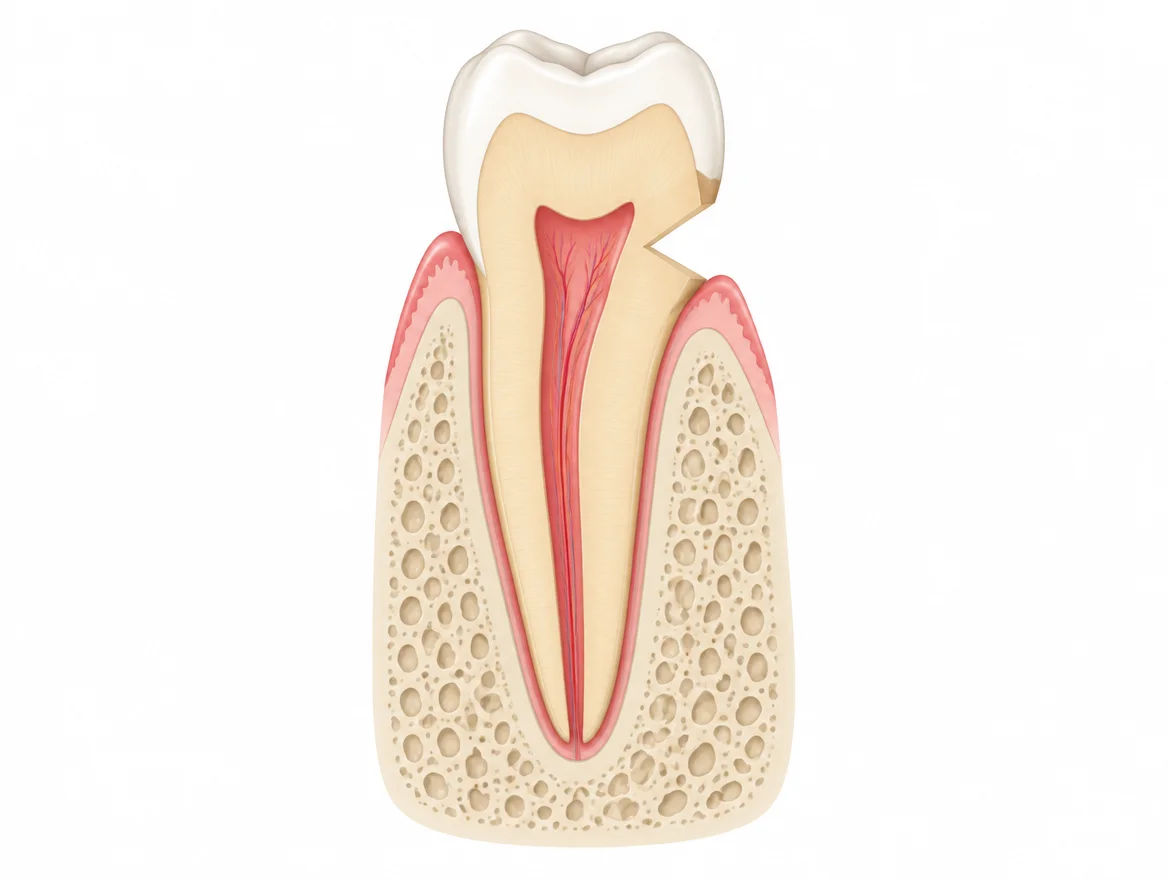
AI-generated explanatory illustrationCross-section of cervical abrasion: a wedge-shaped notch at the neck of a tooth just above the gum line
Is a notch at the tooth neck caused by incorrect brushing?
Often, brushing is not the only issue. Reviews describe cervical lesions as often resulting from the combined action of friction (brushing), chewing forces (abfraction), and chemical erosion (acid).[1][3]
| Related factor | Details |
|---|
| Brushing | Scrubbing hard from side to side with stiff bristles; highly abrasive toothpaste |
| Chewing forces | Teeth grinding (Korean), clenching, or an occlusion (Korean) (bite) in which certain teeth contact first — forces concentrate at the tooth neck, causing abfraction |
| Acid | Frequently drinking carbonated beverages, fruit juice, or vinegar drinks; acid reflux |
| Gum recession | When the gums recede and expose the root surface, which has no enamel, the same irritation can cause wear more readily |
These factors often act together even on a single tooth. For example, if chewing forces cause tiny cracks at the tooth neck, brushing and acid can wear that area more easily.[1] Changing brushing alone or simply filling the notch may therefore not stop it from deepening. We look at tooth condition and daily habits together to identify contributing factors and habits that can be changed.
Can the shape of the notch tell us the cause?
The shape helps us estimate the cause, but we do not draw a conclusion from shape alone. In the treatment room, we look at the following two points.
- Shape: A deep wedge with angular edges is often described in relation to abfraction from chewing forces, while a rounded, smooth, saucer-shaped depression is often described in relation to acid erosion.[1][3]
- Distribution: Whether similar notches appear across several teeth where the toothbrush presses hard, or a deep notch occurs in only one or two teeth that receive heavy forces when biting
Because several factors often overlap at the same site, we do not distinguish the causes by shape and distribution alone. We also check brushing technique, acidic food intake, wear on the chewing surfaces, and the bite.
What else do we check at the dental clinic?
We examine the whole mouth as well as the notch itself.
- Depth and surface of the notch: We use an instrument to check whether the surface is hard or has soft areas like decay. If decay is suspected, we assess its extent with Q-ray or a periapical X-ray.
- Sensitivity: We use cold testing, applying cold air or another cold stimulus, to check which tooth is sensitive and how sensitive it is.
- Chewing surfaces and bite: Flat wear or chipped edges on the chewing surfaces may suggest grinding or clenching. We use articulating paper to check which teeth contact first and where they meet.
- Gums: We check how far the gums have receded and whether gum disease is present. Cervical lesions often occur together with cervical dentin hypersensitivity (Korean) and gum recession (Korean).[2]
- Daily habits: We ask about your toothbrush and toothpaste, brushing technique, and how often you drink acidic beverages.
After explaining the findings, we discuss whether to monitor the area or fill it. At the next checkup, we examine the depth and surface condition again to look for changes.
Are there times when you monitor without filling right away?
Yes. If the notch is shallow, not sensitive, and easy to clean of plaque, we may adjust contributing habits and check for changes at regular checkups. Depending on the condition, we consider monitoring, treatment to reduce sensitivity, or a filling.[3]
| Condition | Approach |
|---|
| Shallow, not sensitive, and easy to clean of plaque | Monitoring — adjust brushing and habits, and compare depth at checkups |
| Sensitive to cold water, but the notch is shallow | Apply a desensitizing agent or fluoride first and monitor the response |
| Sensitivity persists, or a checkup confirms that the notch has deepened | Consider a Bondfill filling |
| Plaque remains in the notch and is difficult to remove | Adjust the cleaning technique and consider a filling if needed |
| Decay is also present | Decide on treatment according to the depth and progression of decay |
| The notch extends deep toward the nerve and the tooth is weakened | Check the nerve and assess the extent of treatment separately |
The table summarizes general criteria. Actual decisions depend on the examination findings.
During monitoring, we also manage brushing technique, acidic drink intake, and clenching habits.
- Use a soft-bristled toothbrush and the Bass technique (Korean): place the bristles at an angle to the gum line, make short vibrating movements, then sweep toward the tooth. Avoid long, forceful side-to-side scrubbing.
- Cut down on frequent acidic drinks, and rinse your mouth with water after drinking them.
- If clenching or grinding is suspected, check whether your upper and lower teeth touch during the day. If you have been told that you grind your teeth at night, please mention it at your visit.
If chewing forces are suspected as a cause, we assess the amount of tooth wear or chipping and any jaw muscle symptoms to decide whether a splint (Korean) (an appliance) is needed. A notch at the tooth neck alone does not mean you need an appliance.
When is a filling the appropriate choice?
We consider a filling if discomfort continues after treatment to reduce sensitivity and adjustments to cleaning, or if the notch deepens and becomes difficult to clean.[3] We also consider a filling if you are concerned about its appearance on a visible tooth, such as a front tooth.
At Joy Dental Clinic Bongcheon, we fill cervical areas with a material called Bondfill. Filling a notch may help reduce sensitivity and create a shape that is easier to clean, but it does not remove the cause. If chewing forces continue to concentrate there or brushing habits remain unchanged, notches may develop again at the edges of the filling or on nearby teeth. We therefore check the restoration margins and surrounding teeth at subsequent checkups even after filling.
If decay is also present, if deep decay has inflamed the nerve, or if the tooth is substantially weakened, a filling alone may not be enough. In these situations, as with decay on the root near the gum line, we assess the nerve and the amount of remaining tooth structure separately to decide on treatment.
What I want to be clear about
- A filling at the tooth neck can fall out. Several conditions affect retention, including the tooth surface available for bonding, difficulty keeping out saliva and moisture near the gum line, and chewing forces concentrated at the tooth neck. Reports also show differences in loss rates depending on the bonding method.[3][4]
- If the causes remain, notches may develop again around the restoration or on other teeth.
- Sensitivity may remain for a while after filling, and the amount of improvement varies from person to person.
How long does treatment take, and how many visits are needed?
A Bondfill filling is usually completed in a single visit. For teeth being monitored, we compare the depth again at regular checkups. If decay or a nerve problem is also present, treatment takes longer.
- Desensitizing agent or fluoride application — We apply it on the day of the visit and may reapply it at a checkup if the effect wears off.
- A Bondfill filling — If there are only a few notches, treatment is usually completed in 1 visit. If several teeth are involved, we may divide treatment across visits.
- When inflammation has reached the nerve — If root canal treatment is needed, we decide on the schedule and whether the tooth needs to be covered afterward based on its condition and symptoms.
- Monitoring — We compare depth and sensitivity at regular checkups. Please let us know if sensitivity develops or worsens, even before your next scheduled checkup.
Treatment fees are listed in the fee list (non-covered fees).
Frequently asked questions (FAQ)
Q. Can I leave a notch alone if it is not sensitive?
If it is shallow, not sensitive, and easy to clean of plaque, we may monitor it without filling right away. However, we need to check at visits whether it has deepened in the meantime, and it is advisable to start changing contributing habits now.
Q. My filling fell out. Can it just be filled again?
While assessing whether it can be filled again, we examine the tooth surface available for bonding, any remaining filling material, and whether decay is present. We also check the bite to see whether chewing forces concentrate at the neck of that tooth.
Q. Will toothpaste for sensitive teeth help?
It may help reduce sensitivity, but it does not fill the notch. If sensitivity continues despite using toothpaste for sensitive teeth, we recommend having it checked.
Q. Will an electric toothbrush make the notch worse?
An electric toothbrush can also put stress on the tooth if you press hard or use it with highly abrasive toothpaste. Use soft bristles and hold the brush lightly against the teeth.
Q. Are receding gums and a notch in the tooth the same thing?
No. Gum recession means that the gum has moved down, while cervical abrasion means that the tooth itself has developed a notch. They often occur together,[2] so we check both.
Q. I was told that my chewing surfaces are worn too. Could they be related?
They may be related. Worn chewing surfaces can indicate heavy forces from grinding or clenching, and these forces are one cause of notches at the tooth neck (abfraction).[1][3] However, brushing and acid erosion often act together as well, so we check them too.
Q. How is a notch in a tooth different from decay?
Cervical abrasion often has a hard, smooth surface, while decay is often soft and discolored. However, if plaque remains in a notch, decay can develop there too, so we distinguish them through examination.
Related article: Decay on the root near the gum line
Limits of the evidence
- The explanation that several factors act together[1][3] comes from reviews of existing research and cannot tell us how much each factor contributed to a particular notch in one person.
- The finding that these lesions occur together with sensitivity and gum recession[2] comes from a cross-sectional study conducted at one point in time, so it cannot establish which came first.
DOCTOR’S NOTE
On the day I fill the neck of a tooth, I also ask about the toothbrush you use, the direction you brush, and whether you keep your upper and lower teeth together during the day. A filling fills the notch, while the habits that caused it need to start changing that same day.
— Jeong Jinwoo, Director, Joy Dental Clinic Bongcheon
This post reflects information as of the date of writing and was written to provide general information in compliance with Korea’s Medical Service Act and the Ministry of Health and Welfare’s medical advertising guidelines. Filling the cervical area may have side effects such as sensitivity, discoloration, loss of the filling, or gaps at its edges. Individual diagnosis and the direction of treatment depend on the condition of your mouth, so please be sure to consult fully with your treating clinician before deciding.
We are right next to Exit 1 of Bongcheon Station (Line 2), and directions from Seoul Nat’l Univ. Station, Sillim, Nakseongdae and Sadang are in Getting here.
Joy Dental Clinic Bongcheon
5F Jehyeong Bldg., 1738 Nambusunhwan-ro, Gwanak-gu, Seoul (Bongcheon Station, Exit 1)
Hours: Mon·Wed·Thu·Fri 09:30–18:30 / Tue 09:30–20:30 / Sat 09:30–13:30 (closed Sun & public holidays)
Booking: Naver Booking / Phone 02-877-2867
Related pages: Tooth decay treatment guide · Cervical abrasion (Korean) · Sensitive teeth (Korean)
References
- Grippo JO, Simring M, Coleman TA. Abfraction, abrasion, biocorrosion, and the enigma of noncarious cervical lesions: a 20-year perspective. J Esthet Restor Dent. 2012;24(1):10-23. — A review describing noncarious cervical lesions as multifactorial lesions caused by the combined action of friction (abrasion), stress (abfraction), and chemical erosion.
- Teixeira DNR, Zeola LF, Machado AC, et al. Relationship between noncarious cervical lesions, cervical dentin hypersensitivity, gingival recession, and associated risk factors: A cross-sectional study. J Dent. 2018;76:93-97. — A cross-sectional study finding that cervical lesions, cervical dentin hypersensitivity, and gum recession often occur together and are associated with several risk factors, including age.
- Goodacre CJ, Eugene Roberts W, Munoz CA. Noncarious cervical lesions: Morphology and progression, prevalence, etiology, pathophysiology, and clinical guidelines for restoration. J Prosthodont. 2023;32(2):e1-e18. — A review of the shape, progression, and causes (including stress) of cervical lesions and the criteria for considering a filling, including sensitivity, plaque control, weakened tooth structure, and appearance.
- Peumans M, De Munck J, Mine A, Van Meerbeek B. Clinical effectiveness of contemporary adhesives for the restoration of non-carious cervical lesions. A systematic review. Dent Mater. 2014;30(10):1089-1103. — A systematic review of the clinical retention of restorations placed in cervical lesions: the rate at which restorations fell out differed by bonding method.


 한국어
 日本語
 简体中文