💡 Key answer
The choice between floss and an interdental brush depends on the size of the gaps between your teeth, rather than on whether one tool is better or worse. In gaps where an interdental brush fits without force, it removes plaque more effectively,[2][3] while floss is used for narrow gaps that do not accommodate a brush, especially between the front teeth.[4] Gap sizes differ from site to site even in one person’s mouth, so a combination of floss and interdental brushes in several sizes is often used.
Summary for patients
- Look in a mirror to see whether there are gaps beneath the gums between your teeth.
- Start by trying the thinnest interdental brush.
- Clean once a day, before brushing your teeth at bedtime.
- Replace an interdental brush if its bristles are flattened or its wire is bent.
- If the same spot bleeds for more than 2 weeks, it needs to be checked.
❓ What this article covers
- Why do I need to clean between my teeth separately?
- How do floss and interdental brushes differ?
- Which tool fits the gaps between my teeth?
- How do I use floss and interdental brushes?
- What do we check in the treatment room?
- What should I do if my gums bleed or the floss breaks?
- Are there situations where ordinary floss and interdental brushes are difficult to use?
Why do I need to clean between my teeth separately?
Because a toothbrush can barely clean the sides where neighboring teeth touch, and these are common starting points for gum disease and tooth decay. Teeth are shaped like rounded columns, so a toothbrush cleans the front, back and chewing surfaces, but its bristles cannot reach just below the points where teeth meet. Cleaning between the teeth separately is called interdental cleaning, and its purpose is to remove plaque (Korean) from these side surfaces and the gum line below them.
When plaque builds up beneath the gums between the teeth, it causes gingivitis (Korean), and if this persists, it can progress to periodontitis (Korean), in which the jawbone is lost. Decay on the sides between teeth is not visible from the outside and is sometimes only found after it has progressed considerably. Overlapping teeth and areas around bridges and implants also tend to retain plaque. Taken together, studies report a tendency toward less gum inflammation when floss or interdental brushes are added to toothbrushing compared with toothbrushing alone,[1] and interdental cleaning is recommended as a basic part of gum care.[4]
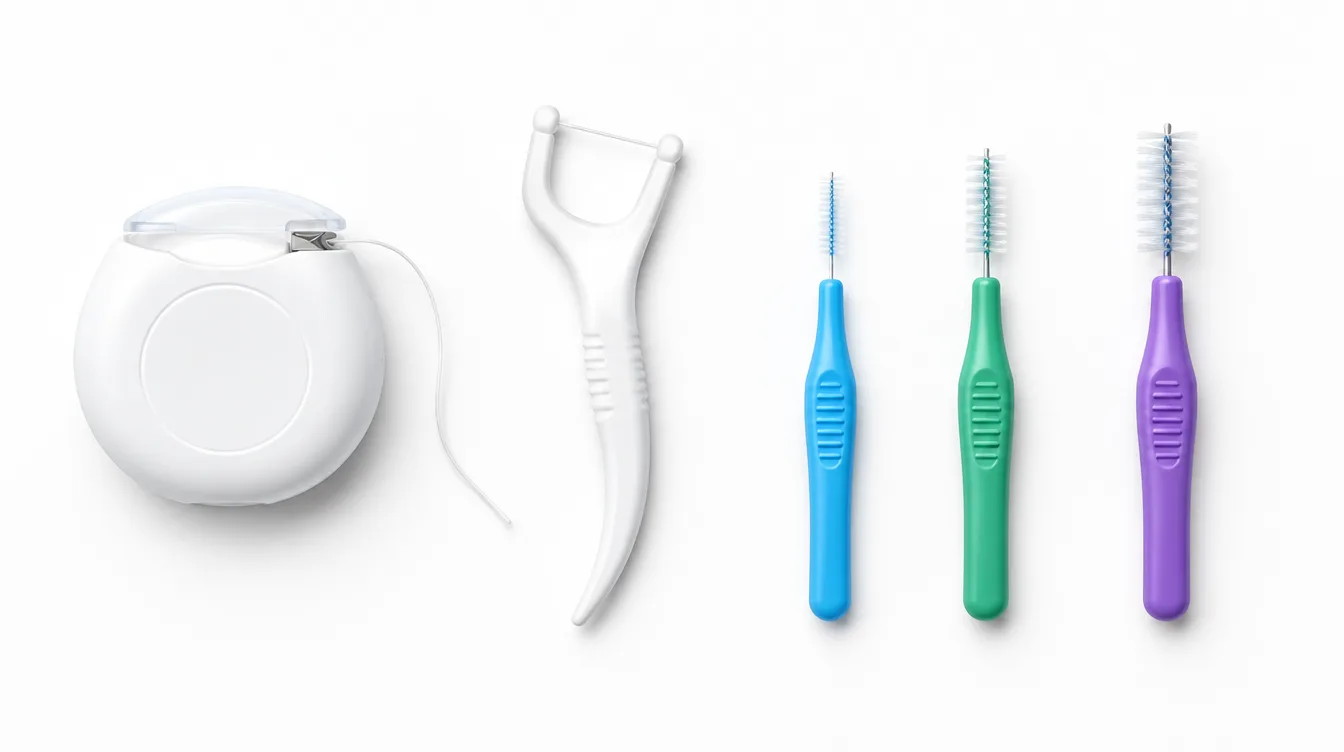
AI-generated explanatory illustrationA roll of floss, a Y-shaped floss holder and interdental brushes in different sizes
How do floss and interdental brushes differ?
Floss cleans by sweeping a thin thread against the side of a tooth, while an interdental brush moves back and forth through an open gap to clean even the concave root surfaces. Floss (Korean) can pass through the contact point between teeth even in narrow spaces. An interdental brush (Korean) is a small cylindrical brush with bristles around a thin wire core, available in different thicknesses to suit different gap sizes.
| Item | Floss | Interdental brush |
|---|
| Suitable gaps | Narrow gaps where teeth touch tightly | Areas with a visible triangular gap between teeth |
| Common sites | Front teeth, teeth with healthy gums and no open gaps | Between molars, areas of gum recession, around bridges and implants |
| Plaque removal | Used in narrow gaps that do not accommodate an interdental brush | More effective than floss where it fits[2][3] |
| Learning to use it | Requires hand skills; molars are difficult | Relatively easy; choosing the size is key |
| Common mistake | Pressing down hard and cutting the gum | Forcing in a brush that is too thick and injuring the gum |
| Replacement | Use a fresh section each time | Replace if the bristles flatten or the wire bends |
Floss also comes in several forms. A roll of floss that you wind around your fingers is the basic type, and waxed floss slides easily into narrow gaps. Y-shaped and F-shaped floss holders are easy to use with one hand and suit molars or people just starting out. Wide, flat dental tape is useful for people whose floss often breaks. Choosing a product you can use every day matters more than the material or shape.
Try an interdental brush to see whether it fits without force.
1. Look at the gums between your teeth in a mirror.
If the gum completely fills the triangular space between your teeth and no gap is visible, start with floss. If you can see a small triangular gap below the gum, try an interdental brush.
2. Start by trying the thinnest interdental brush.
The right size slides in without force but is not loose, and you should feel the bristles lightly touch the sides of your teeth as you move it back and forth. Forcing a brush into a gap where it does not fit can injure the gum and may even widen the gap.
3. Different sites may need different sizes.
Match the tool to the actual gap size rather than the tooth’s position. For example, it is common to use two or three tools in the same mouth: floss between the front teeth, a thin interdental brush between the premolars and a slightly thicker one between the molars.
A gap large enough for an interdental brush does not automatically mean gum disease. A gradual lowering of the gums between the teeth is a common change with age, and some sites, such as those around bridges and implants, have gaps to begin with. Clean each gap with a tool that fits its size. The height of the gum that fills the space between teeth (the interdental papilla (Korean)) depends on the height of the bone beneath it, and it recedes along with the bone when bone levels fall because of gum disease or age. Once the gum has receded, restoring it fully is difficult, so care after a gap forms focuses on keeping that site clean.
How do I use floss and interdental brushes?
Wrap floss around the side of the tooth in a C-shape and sweep it upward, and insert an interdental brush straight along the gap and move it back and forth.
Floss
- Cut off about 40cm, wind it around the middle fingers of both hands, and leave only 2~3cm between your thumbs and index fingers.
- Gently move it from side to side in a sawing motion to pass through the contact point between the teeth. Do not snap it down from above in one motion.
- Wrap the floss around the side of one tooth in a C-shape, and sweep from just below the gum line toward the chewing surface 2~3 times.
- In the same gap, wrap it in a C-shape around the side of the other tooth and clean in the same way.
- Move to a clean section of floss before going to the next gap. With a floss holder, rinse the floss with water after cleaning each gap before moving on.
Simply inserting and removing floss may remove food, but it leaves the bacterial film on the tooth surface. What matters is wrapping it against the surface and sweeping as described in step 3.
Interdental brush
- Looking in a mirror, insert it slowly into the gap near the gum. Follow the direction of the gap so the wire tip does not poke the gum or scratch the tooth. A brush with an L-shaped handle is convenient for molars.
- Move it gently back and forth 2~3 times. Do not rotate or twist it.
- If possible, insert it once from the outside and once from the inside (the tongue or palate side) to clean.
- After use, rinse it under running water and leave it to dry.
Order and frequency: Cleaning between your teeth once a day, before brushing at bedtime, allows toothbrushing to remove the plaque loosened from between the teeth and makes it easier for fluoride in toothpaste to reach these surfaces.
It is advisable to avoid repeatedly poking between your teeth with a toothpick, as this can press on the gums and widen the gaps. Do not skip a spot for days just because it bleeds, either.
What do we check in the treatment room?
At sites that keep bleeding or catch the floss, we check gum pocket depth, tartar, decay and restoration margins to decide whether home cleaning is enough.
- Gum pockets and bleeding — We measure the depth of the gum pockets between teeth and check whether they bleed during measurement. At 3mm or less, the gums may be healthy or have gingivitis; if several sites measure 4mm or more, we suspect periodontitis. If the pockets are deep, home cleaning tools cannot reach inside them, and tartar removal beneath the gums may be needed.
- Tartar — Hardened tartar cannot be removed with floss or an interdental brush, and bleeding recurs at that site.
- Decay and restoration margins — If floss catches or frays at only one site, there may be decay on the side between teeth or an open margin around a filling or crown. These areas are difficult to see directly, so we check them with an X-ray.
- Sites with remaining bacterial film — During a checkup, shining blue light with Q-ray makes bacterial film appear red, allowing us to identify frequently missed sites between teeth in photos.
- Changes in gaps — If an interdental brush now fits loosely in a gap that previously only accommodated floss, we compare with earlier records to see whether the gums have receded.
The stages and number of visits for gum treatment are covered in our gum treatment guide and brushing and care when your gums bleed.
What should I do if my gums bleed or the floss breaks?
A little bleeding during the first 1~2 weeks is common, but if the same spot bleeds for more than 2 weeks or floss breaks at the same spot, have it checked at a dental clinic.
| Situation | Possible cause | What to do |
|---|
| A little bleeding during the first 1~2 weeks | Gum inflammation from accumulated plaque | Keep using the tool gently; bleeding usually decreases |
| Bleeding at the same spot for more than 2 weeks | Possible tartar beneath the gums or periodontitis | Have your gums checked at a dental clinic |
| Floss breaks at the same spot | Decay, a gap at a restoration margin or tartar | A dental check is recommended |
| Food gets stuck at the same spot every time | An open contact between teeth or decay | A dental check is recommended |
It is also a good idea to have your gums checked if an interdental brush smells after you insert and remove it, or if your gums are swollen and hurt when pressed. If bleeding does not decrease, switching to a thicker brush or scrubbing harder may only cause more gum injury. Reasons why food keeps getting stuck at the same spot are covered separately in When food keeps getting stuck between your molars.
Are there situations where ordinary floss and interdental brushes are difficult to use?
Yes. If you have connected restorations or orthodontic appliances, ordinary floss cannot pass through, so other tools are needed.
- Bridges — Floss cannot be inserted from above beneath connected artificial teeth. Pass bridge floss with a stiff end (Super Floss) or floss using a threader through from the side, or use an interdental brush if the gap is large enough.
- Orthodontic appliances — Floss cannot pass beneath the wire in the usual way, so a floss threader or an interdental brush for orthodontic appliances is used.
- Difficulty using your hands — Floss holders or interdental brushes with long handles are easier to use.
- Already hardened tartar or deep gum pockets — No home cleaning tool can resolve these. After scaling or tartar removal beneath the gums, continue with home care.
Frequently asked questions
Q. Can I use an oral irrigator (Waterpik) instead?
An oral irrigator helps rinse food out from between teeth and is convenient around bridges and orthodontic appliances. However, it has limited ability to scrub away plaque attached to tooth surfaces, so we recommend using it together with floss or interdental brushes when possible.
Q. Can I use an interdental brush around implants too?
Yes. Plaque control around implants is even more important than around natural teeth, and interdental brushes that fit the gaps are commonly used. If you are concerned about the metal core touching the implant surface, choose a product with a coated core.
Q. Does flossing widen the gaps between teeth?
Correct use does not widen the gaps. If a gap is wide enough for floss to slide in without resistance, an interdental brush may be more suitable there.
Q. Do I need to put toothpaste on an interdental brush?
It is not essential. People concerned about decay because their gums have receded and their roots are exposed sometimes use a small amount of fluoride toothpaste on it.
Q. The necks of my teeth feel sensitive after I use an interdental brush.
If the wire core repeatedly scratches the neck of a tooth, it can cause sensitivity or wear. Check that you are inserting it along the gap without the wire touching the neck of the tooth, and that the brush is not too thick. If sensitivity continues, it is a good idea to have it examined.
Q. Does cleaning between teeth also reduce bad breath?
Food and plaque left between teeth are among the causes of bad breath, so it helps. You also need to clean the coating on the back of your tongue, and if the odor remains, have your gums and teeth checked for gum disease or decay. More details are covered in When bad breath remains after brushing.
Q. How can I have my interdental brush size checked near Bongcheon Station?
At Joy Dental Clinic Bongcheon (Bongcheon Station, Exit 1, 5F Jehyeong Bldg.), you can have it checked during scaling or a checkup.
Limits of the evidence
- The Cochrane review[1] that pooled the effects of adding interdental cleaning to toothbrushing found low-certainty evidence, and evidence on preventing tooth decay is even more limited.
- The findings that interdental brushes perform better than floss[2][3] assessed plaque and gum inflammation measures in gaps that accommodate a brush. They are not comparisons of the two tools in narrow gaps.
- The recommendation to choose a tool according to gap size[4] is based on expert consensus, and the tool and size suitable for each person need to be checked directly at each site.
DOCTOR’S NOTE
Having the tools fitted once in the treatment room is more helpful than reading about how to clean between your teeth. During scaling or gum treatment, I try floss and interdental brushes at each site to find whether floss or a particular brush size fits. At the next checkup, I look again at how the gums at those sites have changed.
— Jeong Jinwoo, Director, Joy Dental Clinic Bongcheon
This post reflects information as of the date of writing and was written to provide general information in compliance with Korea’s Medical Service Act and the Ministry of Health and Welfare’s medical advertising guidelines. Using floss or interdental brushes can have side effects such as gum injury, bleeding and gum recession. Individual diagnosis and the direction of treatment depend on the condition of your mouth, so please be sure to consult fully with your treating clinician before deciding.
We are right next to Exit 1 of Bongcheon Station (Line 2), and directions from Seoul Nat’l Univ. Station, Sillim, Nakseongdae and Sadang are in Getting here.
Joy Dental Clinic Bongcheon
5F Jehyeong Bldg., 1738 Nambusunhwan-ro, Gwanak-gu, Seoul (Bongcheon Station, Exit 1)
Hours: Mon·Wed·Thu·Fri 09:30–18:30 / Tue 09:30–20:30 / Sat 09:30–13:30 (closed Sun & public holidays)
Inquiries: Naver Booking / Phone 02-877-2867
Related pages: Gum treatment guide · My gums are bleeding · Floss (Korean) · Interdental brushes (Korean)
References
- Worthington HV, MacDonald L, Poklepovic Pericic T, et al. Home use of interdental cleaning devices, in addition to toothbrushing, for preventing and controlling periodontal diseases and dental caries. Cochrane Database Syst Rev. 2019;4(4):CD012018. — [Systematic review] Cochrane review: adding floss or interdental brushes to toothbrushing may reduce gum inflammation compared with toothbrushing alone (low-certainty evidence).
- Slot DE, Dörfer CE, Van der Weijden GA. The efficacy of interdental brushes on plaque and parameters of periodontal inflammation: a systematic review. Int J Dent Hyg. 2008;6(4):253-264. — [Systematic review] In gaps that accommodate an interdental brush, interdental brushes removed plaque more effectively than floss.
- Sälzer S, Slot DE, Van der Weijden FA, Dörfer CE. Efficacy of inter-dental mechanical plaque control in managing gingivitis – a meta-review. J Clin Periodontol. 2015;42(Suppl 16):S92-S105. — [Systematic review] Meta-review: interdental brushes are the most effective tool for removing interdental plaque. Floss is recommended for narrow gaps that do not accommodate an interdental brush.
- Chapple ILC, Van der Weijden F, Doerfer C, et al. Primary prevention of periodontitis: managing gingivitis. J Clin Periodontol. 2015;42(Suppl 16):S71-S76. — [Guideline] European Federation of Periodontology workshop consensus: for interdental cleaning, prioritize an interdental brush that fits the gap, and use floss where a brush does not fit.


 한국어
 日本語
 简体中文