💡 Key answer
Bad breath that remains after brushing often comes from the back of the tongue and between the teeth, where a toothbrush does not reach well. Bacteria produce odor compounds in the coating at the back of the tongue and in food debris and plaque left between the teeth. If bad breath remains despite consistently adding tongue cleaning and floss or interdental brushes to your brushing routine, have a dentist check your gums, tooth decay and restorations. If gum bleeding recurs or you have swelling or pain, have an examination regardless of how long you have been following this care routine.
Summary for patients
- Clean your tongue once a day with gentle strokes from back to front.
- Clean between your teeth with floss or interdental brushes at least once a day.
- If your mouth often feels dry, sip small amounts of water frequently.
- If you wear dentures, take them out and clean them every day.
❓ What this article covers
- What causes bad breath?
- How does morning-only breath differ from bad breath that remains after brushing?
- How should I clean my tongue?
- Should I use floss or interdental brushes between my teeth?
- Does a frequently dry mouth make bad breath worse?
- What do we check in the treatment room?
- What should we suspect if bad breath continues despite thorough cleaning and dental treatment?
What causes bad breath?
Most cases are caused by odorous gases produced when bacteria in the mouth break down food debris. When bacteria break down food debris or cells shed inside the mouth, they produce sulfur-containing gases (volatile sulfur compounds), and these gases are mainly what we notice as bad breath. These bacteria gather in large numbers in the tongue coating (Korean) (the white film on the tongue) at the back of the tongue and inside gum pockets. Plaque (Korean) (the sticky bacterial film on teeth) left between the teeth is another cause.
Many people think bad breath comes from a stomach problem. However, 80~90% of the causes of bad breath are known to be inside the mouth, while odor coming up from the stomach is relatively uncommon. That is why we start by examining the mouth. People often become used to their own breath and do not notice it well, only learning about it from a family member. The overall causes are covered in the glossary entry on halitosis (Korean).
How does morning-only breath differ from bad breath that remains after brushing?
Saliva decreases during sleep, so you may have bad breath in the morning. If it remains after brushing, we start with the places the toothbrush has not reached. This is because bacteria are not washed away as well when saliva decreases. If the odor lessens after brushing and drinking water and you have no other symptoms, you can continue your usual care. If the odor remains after brushing or continues during the day, the places to check depend on its pattern, as shown below.
| Pattern of bad breath | Where to check | How to care for it |
|---|
| Only in the morning, lessens after brushing | No particular site (caused by less saliva during sleep) | Keep brushing as usual |
| Remains even immediately after brushing | Coating at the back of the tongue, between the teeth | Tongue cleaning and floss or interdental brushes |
| Food frequently gets stuck around a particular tooth | Food debris and plaque between the teeth | Floss or interdental brushes |
| Mouth often feels dry and the odor worsens as the afternoon progresses | Dry mouth (Korean) | Drink water frequently |
| Odor is a concern while wearing dentures | Bacterial film on the dentures, gums in contact with the dentures | Take dentures out to clean them; see a dentist if they are uncomfortable |
How should I clean my tongue?
Place a tongue cleaner or a soft toothbrush toward the back of your tongue, and gently sweep it forward without pressing hard. Make a habit of cleaning your tongue when you brush your teeth. You can use either a tongue cleaner or a soft toothbrush. Studies comparing several ways of managing bad breath, including tongue cleaning, have not established which tool is better.[1]
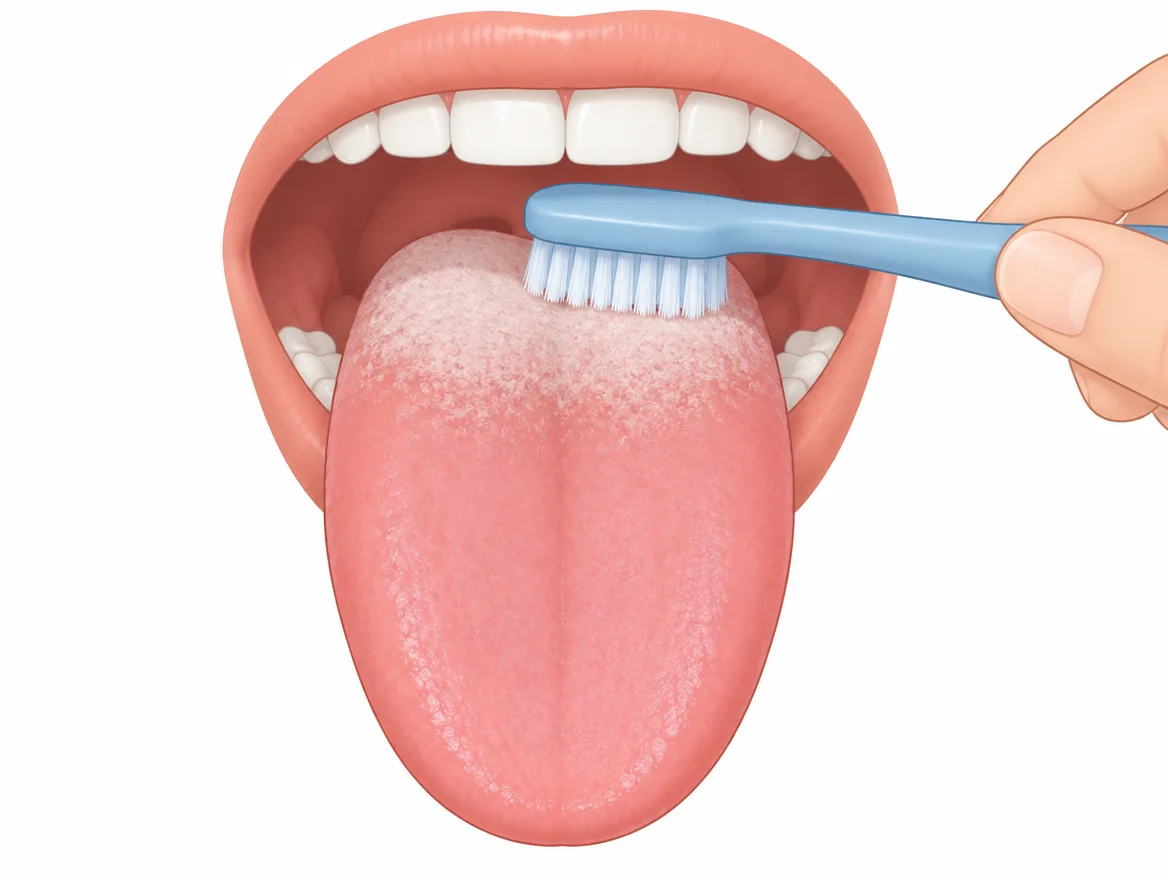
AI-generated explanatory illustrationThe tongue extended with a soft toothbrush placed on the coating toward the back
- Stick your tongue forward and place a tongue cleaner or a soft toothbrush toward the back of it.
- Pull it gently from back to front in a sweeping motion. Do not repeatedly scrub the same spot hard.
- Repeat a few times, rinsing the tool with water as you go.
- Clean your tongue gently once a day.[2]
(That is what the research findings indicate, but I clean mine three times a day.)
If you gag, start at the middle of the tongue and gradually work farther back. Some people gag less when they breathe out while cleaning. Everyone has some tongue coating, and a visible white film does not always mean there is a problem. Scraping hard irritates the tongue surface, so even if some white coating remains, do not try to remove it all at once. If there is a sore area on your tongue or a white patch that does not wipe off and persists, have it examined.
Should I use floss or interdental brushes between my teeth?
Floss suits narrow spaces between teeth, while interdental brushes suit visible gaps where the gums have receded. Around bridges and implants, choose tools according to the space and the shape of the restoration. Clean between your teeth with floss or interdental brushes at least once a day.[2]
Simply putting floss (Korean) between your teeth and pulling it out may remove food, but leaves bacterial film on the sides of the teeth. Wrap the floss in a C shape against the side of one tooth and sweep it upward from just below the gum line, then clean the tooth on the opposite side of the same gap in the same way. Choose an interdental brush (Korean) that goes in without force while its bristles touch the sides of the teeth. Since the spaces differ from site to site, many people use two or three different sizes. Cleaning between the teeth before brushing at bedtime lets you brush away the loosened plaque afterward and helps the fluoride in toothpaste reach between the teeth. How to choose is explained in detail in Floss or interdental brushes: which suits the spaces between my teeth?.
You may notice bleeding when you first start cleaning. Continue gently without scrubbing hard. If food gets stuck in the same spot every time and there is an odor, the gap between the teeth may have widened or there may be decay; see When food keeps getting stuck between the molars.
Does a frequently dry mouth make bad breath worse?
Yes. When saliva decreases, bacteria and food debris are not washed away as well, making bad breath more likely to worsen. Saliva washes away food, neutralizes acids produced by bacteria and protects the lining of the mouth. If the odor worsens as the afternoon progresses or you wake up at night looking for water, we first consider dry mouth.
The most common cause of dry mouth is medication. Many medicines, including antihistamines, antidepressants, diuretics and some blood pressure medicines, can cause dry mouth, and it is more common when several medicines are taken together. Mouth breathing or snoring habits, as well as caffeine, alcohol and tobacco, also dry the mouth. More people experience dry mouth as they get older, but the increase in medications is often a greater cause than age itself.
- Sip small amounts of water frequently instead of drinking a lot at once.
- Sugar-free gum or xylitol candy helps stimulate saliva.
- Use a humidifier if the room is dry.
- If a medicine seems to be the cause, consult the prescribing doctor and do not stop it on your own.
Persistent dry mouth can cause not only bad breath but also multiple cavities at the necks of teeth and on exposed root surfaces within a short time. For people in this situation, we set slightly shorter intervals between checkups. Details are covered in Dry mouth (Korean).
What do we check in the treatment room?
After asking when and how the odor occurs, we check gum pockets, decay and restorations, and the condition of the tongue and saliva. This is a process of looking for causes in places that a toothbrush or mouthwash cannot reach.
Gum pockets and bleeding
We measure the depth of the gum pockets around each tooth and check for bleeding during measurement. A depth of 3mm or less indicates health or inflammation limited to the gums; if several sites measure 4mm or more, we suspect periodontitis (Korean), in which inflammation has spread to the jawbone (alveolar bone). We also use X-rays to check how much bone remains. Bacteria inside gum pockets cannot be cleaned away at home, so if periodontitis is the cause, they need to be removed through scaling and removal of tartar below the gums for the odor to decrease.
Tartar
Tartar (Korean) attached above and along the gum line can also cause bad breath. Tartar is plaque hardened with minerals in saliva; its rough surface makes it easier for bacteria to attach, and it cannot be removed with a toothbrush. The inner surfaces of the lower front teeth and the outer surfaces of the upper molars are close to the openings of salivary glands, so tartar forms particularly easily there. Hardened tartar is removed through scaling, which is covered by Korean National Health Insurance once a year for people aged 19 or older.
Decay and restoration margins
Long-standing cavities, restorations with gaps, and the area under the gum covering a partially erupted wisdom tooth are places where food can become trapped and cause odor. The sides of teeth facing each other are hard to see directly, so we check them with X-rays. Inflammation under the gum covering a wisdom tooth (pericoronitis (Korean)) tends to swell again when you are tired or have a cold, so if the rearmost gum is swollen and there is an odor, we check that site first.
Sites with remaining bacterial film, the tongue and saliva
During a checkup, shining blue light with Q-ray makes bacterial film appear red, allowing us to see in photos the areas that brushing often misses. We also ask about the thickness of the coating at the back of your tongue, dry mouth and the medications you take.
| Identified cause | What we do at the dental clinic |
|---|
| Gum inflammation or periodontitis | Scaling and removal of tartar below the gums (Gum treatment guide) |
| Decay or restorations with gaps | Treat decay; adjust or remake the restoration |
| Inflamed gums around a wisdom tooth | Clean and disinfect; consider extraction if needed |
| Dry mouth | Identify medications that may be causing it; adjust fluoride use and checkup intervals |
| Dentures | Explain cleaning methods and check the fit |
What should we suspect if bad breath continues despite thorough cleaning and dental treatment?
If bad breath remains even after causes inside the mouth have been checked and the necessary treatment completed, causes outside the mouth also need to be considered. In this situation, assessment by the relevant medical specialty is more appropriate than further dental treatment.
- Nose and throat — An ear, nose and throat specialist checks for sinusitis, postnasal drip and tonsil stones.
- Stomach and esophagus — Gastroesophageal reflux can be a cause, but accounts for only a small proportion of bad breath cases.
- Systemic conditions — Diabetes can sometimes cause an acetone-like odor, and liver or kidney disease or certain medicines may also be responsible.
Odor during fasting or a diet that greatly reduces food intake is temporary. If the odor is unusual or different from normal, or remains unchanged after thorough cleaning of the tongue and between the teeth and dental treatment, please have causes outside the mouth checked.
Frequently asked questions
Q. Will mouthwash get rid of bad breath?
Mouthwash may help reduce odor temporarily, but it does not clean away food debris and plaque left on the tongue and between the teeth. Mouthwash containing alcohol can make the mouth drier, so an alcohol-free product is a better choice if your mouth often feels dry.
Q. How can I check my own breath?
Smelling the floss after using it or asking a close family member may give you an idea, but these are not accurate ways of checking. If you remain concerned despite care, have a dentist check the condition of your mouth and the cause.
Q. I wear dentures and notice an odor.
Bacterial film also forms on denture surfaces, so it is advisable to take them out and clean them every day, and leave them out at night. Cleaning methods are covered in Denture care (Korean). If your dentures are loose and food often gets trapped, or the gums in contact with them hurt, have the fit checked.
Q. Does smoking make bad breath worse?
In addition to the smell of tobacco itself, smoking dries the mouth and increases odor. Habitual mouth breathing also dries the mouth and has the same effect.
Q. My tongue looks black and hairy.
This may be black hairy tongue (Korean), which occurs when the projections on the tongue surface become elongated and stained. Causes include inadequate tongue cleaning, smoking, coffee or black tea, dry mouth and some antibiotics; it is not a dangerous condition. With regular cleaning of the back of the tongue and reduction of the causes, it usually improves within a few weeks. If the color or shape changes suddenly or there is pain, have it examined.
Q. How can I have the cause of bad breath checked near Bongcheon Station?
You can have an examination at Joy Dental Clinic Bongcheon (Bongcheon Station, Exit 1, 5F Jehyeong Bldg.). It helps us assess the cause if you tell us whether the odor occurs mainly in the morning or throughout the day, and whether you take any medications.
Limits of the evidence
- In the systematic review[1] comparing ways to manage bad breath such as tongue cleaning, mouthwash and toothpaste, the certainty of the evidence was generally low, making it difficult to say which tool or product is better.
- The recommended frequencies of once a day for tongue cleaning and at least once a day for cleaning between the teeth follow daily care guidance from public health organizations[2][3], rather than studies directly comparing frequencies.
- The proportions of different causes of bad breath vary between surveys, and the cause in an individual needs to be checked through an examination.
- The odor you notice yourself may differ from what others notice.
DOCTOR’S NOTE
People who come in for bad breath often worry about how strong it is, but I first look for where it comes from. I measure gum pocket depths and use X-rays to examine the areas between teeth that are hard to see directly. If I find a cause that cannot be cleaned away at home, such as tartar below the gums, I treat that site first. If I cannot find a cause inside the mouth, I explain that other areas, such as the nose or throat, need to be checked.
— Jeong Jinwoo, Director, Joy Dental Clinic Bongcheon
This post reflects information as of the date of writing and was written to provide general information in compliance with Korea’s Medical Service Act and the Ministry of Health and Welfare’s medical advertising guidelines. Tongue cleaning and the use of floss or interdental brushes may have side effects such as irritation of the tongue surface, gagging, gum bleeding and gum injuries. Individual diagnosis and the direction of treatment depend on the condition of your mouth, so please be sure to consult fully with your treating clinician before deciding.
We are right next to Exit 1 of Bongcheon Station (Line 2), and directions from Seoul Nat’l Univ. Station, Sillim, Nakseongdae and Sadang are in Getting here.
Joy Dental Clinic Bongcheon
5F Jehyeong Bldg., 1738 Nambusunhwan-ro, Gwanak-gu, Seoul (Bongcheon Station, Exit 1)
Hours: Mon·Wed·Thu·Fri 09:30–18:30 / Tue 09:30–20:30 / Sat 09:30–13:30 (closed Sun & public holidays)
Booking: Naver Booking / Phone 02-877-2867
Related pages: Gum treatment guide · Tongue cleaning (Korean) · Halitosis (Korean) · Why are we advised to have scaling every 6 months?
References
- Kumbargere Nagraj S, Eachempati P, Uma E, et al. Interventions for managing halitosis. Cochrane Database Syst Rev. 2019;12:CD012213. — [Systematic review] A systematic review comparing ways to manage bad breath (tongue cleaning, mouthwash, toothpaste, etc.): several methods showed results tending toward less odor, but the level of evidence was generally low.
- NHS. Bad breath. — Daily care for bad breath: clean the tongue along with brushing, clean between the teeth with floss or interdental brushes, avoid dry mouth, and clean dentures. See a dentist if bad breath continues despite care.
- American Dental Association, MouthHealthy. Bad Breath (Halitosis). — Causes of bad breath and daily care: brushing and interdental cleaning, causes related to dry mouth, denture cleaning, and dental assessment of persistent bad breath.


 한국어
 日本語
 简体中文