💡 Key answer
If food gets stuck in the same place every time, it is often necessary to find out why it gets stuck there, rather than stopping at removing it. The contact between teeth may have opened, decay may have developed on the side of a tooth, the contact of a filled or crowned tooth may have weakened, an opposing tooth may be pushing food in, or gum recession may have left a space below. There may be more than one cause, so we check the contact with floss and add X-rays, a bite examination and a gum examination according to your symptoms and the clinical findings to identify the cause.
Summary for patients
- Remove the food with floss or a suitable interdental brush instead of a toothpick.
- Before your visit, check whether floss slips straight through or catches.
- It helps if you tell us when it happens and which foods get stuck.
- Try to remember whether that tooth has been filled or crowned before.
- Keep cleaning that site with an interdental brush even after treatment.
❓ What this article covers
- From which direction does food get stuck?
- What do we suspect if floss slips straight through?
- What do we suspect if floss catches or breaks?
- Why does food get stuck every time you chew even when the contact is normal?
- Why does food remain in the lower space between teeth even after brushing?
- What do we check in the treatment room?
- Are there cases where we can monitor without treatment?
- How long does treatment take, and how many visits are needed?
From which direction does food get stuck?
Food can be pushed down between teeth from above as you chew, or enter from the side and remain in the lower space left by receding gums. Both can happen together.[4] Although both are described as food getting “stuck,” different directions mean different causes and treatments, so we begin with this distinction.
- Food pushed in from above (vertical): As you chew, food pushes past the place where the teeth touch (the contact point) and becomes wedged between them. Tough foods such as meat tend to get stuck, and you may feel pressure until the food is removed.
- Food remaining in the space near the gums (horizontal): Food enters from the side and stays in a space created by recession of the gums between teeth.
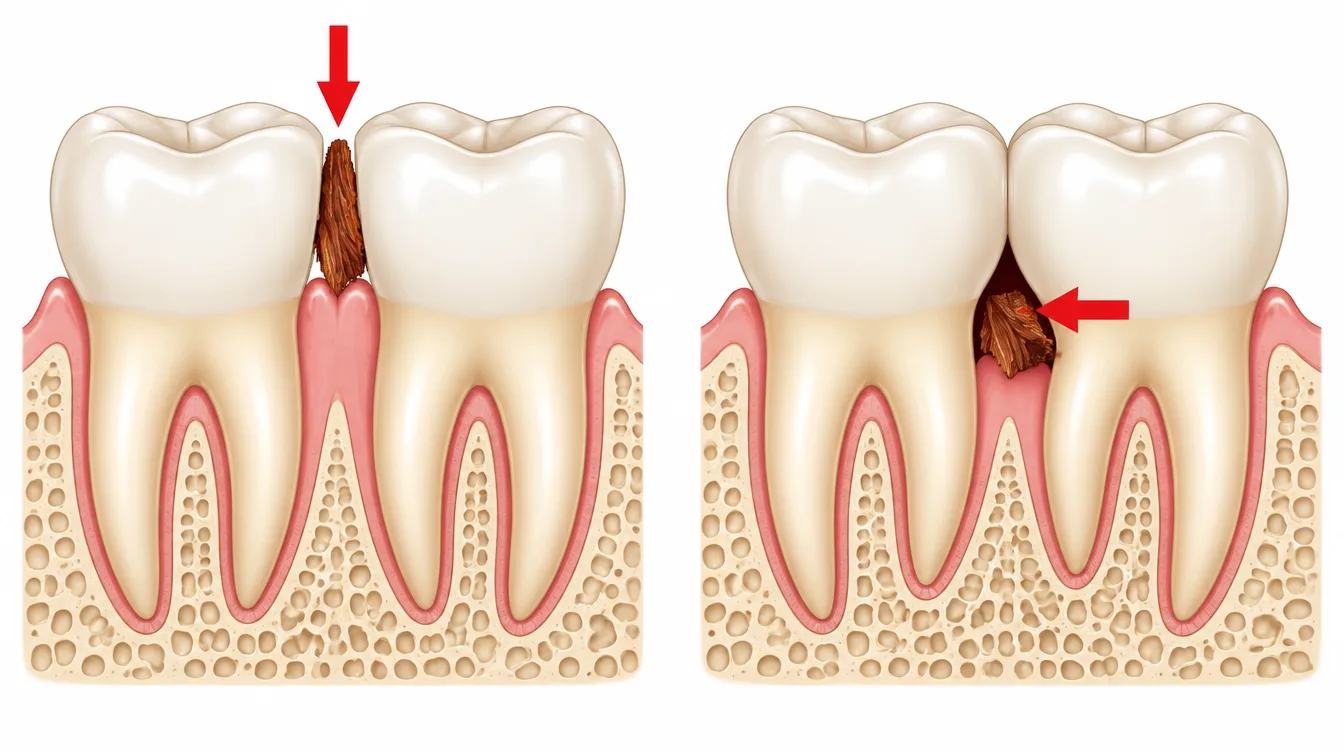
AI-generated explanatory illustrationLeft: food pushed in from above; right: food remaining in the space near the gums
Food being pushed in from above often requires correcting the contact, decay, restoration or bite to reduce it. For food that stays in the space near the gums, we check for gum inflammation and whether the site can be cleaned before deciding on gum treatment or a care method.[4] The review that describes this classification divides the causes into loss of contact, occlusal interference, abnormal tooth position, abnormal tooth shape and periodontal destruction. In the treatment room, we start narrowing down the cause by asking whether floss slips straight through, catches, or whether food gets stuck only when you chew.
What do we suspect if floss slips straight through?
We first check whether the contact between the teeth has opened. If the contact is maintained, floss briefly meets resistance and then passes through with a “snap.” Without this resistance, we consider the contact open; research also defines an open contact as one through which “floss passes without resistance.”[1] However, this feeling alone does not tell us whether there is decay or what condition the gums are in.
- A tooth has gradually tilted or moved toward a space left unfilled after a neighboring tooth was extracted.
- Gum disease has reduced the jawbone (alveolar bone), and the tooth is loose (Korean).
- The side surface (Korean) of an old filling or restoration has worn down.
In a study of 104 adults who had an open contact on only one side, the periodontal pocket (Korean) (gum pocket) on the open side was on average 0.27mm deeper than on the opposite, closed side, and the level at which the gum attached to the tooth was 0.48mm lower.[1] The differences were small but statistically significant, and there was also a weak tendency for gum pockets to be slightly deeper on the side where food got stuck more often. However, this study alone does not establish that the open gap caused gum disease.
What do we suspect if floss catches or breaks?
We check for decay on the side of a tooth or a rough margin on a filled or crowned tooth. If floss frays or breaks at the same place, it means that somewhere on the surface at that site is not smooth.
Decay on the side of a tooth
Decay (Korean) on the side of a tooth between teeth is barely visible from the outside. When a cavity forms on the side, the area of contact becomes smaller, allowing food in; the trapped food can in turn worsen the decay. If decay is confirmed, we treat it and rebuild the contact surface.
An inlay (Korean) or crown (Korean) is made with a surface that touches the neighboring tooth, but a gap can form if the contact was weak from the start, wears down or breaks over time, or the neighboring tooth moves. If the restoration’s margin (Korean) protrudes near the gum (an overhanging margin), food and plaque can catch there and become difficult to remove. If a gap develops at the margin, secondary decay (Korean) may develop underneath.
A 1990 study of posterior amalgam restorations in 100 patients treated by final-year dental students found overhanging margins in 62% of restorations on surfaces between teeth, with more periodontal pockets deeper than 3mm next to overhanging margins.[3]
An opposing tooth may be pushing food into the gap, or the contact may open only during chewing.[4]
When the opposing tooth acts like a wedge
When the upper and lower teeth meet, the pointed part (cusp (Korean)) of the opposing tooth (Korean) can fit like a wedge between the teeth where food gets stuck and push food into the gap. If the opposing tooth was extracted long ago, we also check whether the tooth left without a biting partner has gradually moved down or up (over-eruption (Korean)), changing the bite.
Sometimes teeth touch at rest, but chewing force pushes a tooth slightly aside and creates a gap. In this case, the floss test may appear normal, so which food you are chewing and on which side when food gets stuck become important clues.
If the cause is the bite, we consider occlusal adjustment (Korean), which involves slightly reshaping the pointed part of the opposing tooth. At the same time, we assess whether treatment to restore the contact between teeth is also needed.
Why does food remain in the lower space between teeth even after brushing?
It is often because the gums that used to fill the space between the teeth have receded, leaving a triangular space below the contact point. When the gum between teeth (the interdental papilla (Korean)) becomes lower (gum recession (Korean)), the space it used to fill is left empty (a black triangle (Korean)), allowing food to enter from the side and remain there.
This space may be the result of bone loss between teeth due to gum disease, so we look not only at the space but also at the condition of the gum and bone below it. A study of 40 young adults also found significant associations between the type of contact between teeth and food impaction, and between food impaction and periodontal pocket depth.[2] This is why we consider both the irritation from trapped food pressing on the gums and the inflammation caused by retained food and plaque.[4]
What do we check in the treatment room?
We start with a floss test and add X-rays, articulating paper and a gum examination as needed. We do not perform every test in the same order for everyone; we select them according to the direction in which food gets stuck and your symptoms.
- Floss test — We check how tight the contact is and compare it with the same site on the opposite side. If there is a restoration, we also check its contact and where floss catches.
- X-rays — Because the side surfaces between teeth are hard to see, we use periapical X-rays to check for decay on these surfaces and examine restoration margins, and use panoramic X-rays (Korean) and periapical X-rays to see how much bone has been lost between teeth.
- Articulating paper — You bite on thin paper that marks where the teeth touch, so we can check which part of the opposing tooth meets the gap.
- Gum examination — We measure periodontal pocket depths and check for bleeding during measurement.
| Cause | How we check | Next step |
|---|
| Open contact between teeth | Floss test, comparison with the opposite side | Treatment to rebuild the contact surface (filling, inlay, crown, etc.), checking why the tooth moved |
| Decay on the side of a tooth | Clinical examination, X-rays (periapical images) | Treating decay and restoring the contact surface |
| Problem with a restoration’s contact or margin | Floss test, X-rays, instruments | Adjusting or remaking the restoration |
| Opposing tooth pushing food in | Articulating paper | Occlusal adjustment, combined with restoration of the contact if needed |
| Space left by receding gums | Periodontal pocket examination, X-rays | Gum treatment if gum disease is present; additional treatment or interdental brush care for the remaining space, depending on its shape and whether it can be cleaned |
Are there cases where we can monitor without treatment?
Yes. If there is no decay or gum inflammation, the contact is only slightly weak, and food is easily removed with floss or an interdental brush, we sometimes monitor the site with ongoing care. We decide whether treatment is needed by considering whether decay or gum inflammation is present, how much tooth would need to be removed, and whether the site can be cleaned.
- When a sound tooth would need to be reduced — Covering a tooth without decay with a restoration to create a contact may offer little benefit relative to the amount of tooth that needs to be removed.
- The lower space near the gums — For a space that remains after gum disease has stabilized, we usually first explain how to clean it with an interdental brush (Korean) of the right size.
- When tooth position itself is the cause — For a gap caused by a tilted or rotated tooth, we may also consider correcting the position rather than filling the gap with a restoration.[4]
Do not put off an examination if you notice these signs
- The gum where food gets stuck is swollen or hurts when pressed, or there is bleeding or pus
- The tooth where food gets stuck is sensitive to cold or hurts when you chew
- Floss repeatedly breaks at the same place
How long does treatment take, and how many visits are needed?
Depending on the cause, treatment may be completed in a day or take several weeks to several months.
- Rebuilding the contact surface with composite resin — A small area can be filled with composite resin (Korean) on the same day, usually in 1 visit.
- Making or replacing an inlay or crown — Around 2 visits are needed: one to prepare and scan the tooth, and another to cement the finished restoration. For a crown, it usually takes 1 week from the scan to cementation.
- Occlusal adjustment — We check the bite and gradually reshape the spots that contact too high.
- Gum treatment — Tartar below the gums is usually removed in 2~4 sections of the mouth, at intervals of 1~2 weeks, and pocket depths are measured again after 4~8 weeks to check for improvement. The detailed steps are covered in our gum treatment guide.
Treatment fees are listed in our fee list (non-covered fees).
Frequently asked questions
Q. Can I remove the food with a toothpick?
Please do not force a toothpick between your teeth. Remove the food gently with floss or an interdental brush that fits the size of the gap.
Q. Will daily flossing make gaps between my teeth?
Floss pushes the teeth apart only briefly as it passes through the contact point, so flossing correctly is not considered a cause of gaps. More often, people discover an existing gap when they start using floss.
Q. Doesn’t everyone get food stuck between their teeth as they get older?
As the gums gradually recede with age, more sites may trap food. However, if food gets stuck particularly often in one place, there is often a local cause involving the contact, decay or a restoration.
Q. Food gets stuck even though I only recently had a crown fitted.
Even a newly fitted restoration may have been made with a weak contact, or the opposing tooth may be pushing food into the gap. If it was fitted recently, we recheck the contact and bite to decide whether to adjust or remake the restoration.
Q. Are the causes the same when food gets stuck next to an implant?
Some are the same, and some are different. An implant is directly attached to the bone and does not move, while the neighboring natural tooth moves slightly, so the contact between them can open over time. The space around an implant crown is assessed separately according to its position and the shape of the restoration. After checking why food gets stuck and whether the site can be cleaned, we decide on restoration adjustments or a care method.
Q. Can’t you just fill the gap between teeth with something like composite resin?
If food is being pressed in from above and decay also needs treatment, we may rebuild the contact surface. However, filling the lower space left by receding gums can block the path for an interdental brush and make gum care difficult, so we decide after checking the cause.
Q. How can I have the cause of trapped food checked near Bongcheon Station?
You can have an examination at Joy Dental Clinic Bongcheon (Bongcheon Station, Exit 1, 5F Jehyeong Bldg.). Telling us where food gets stuck, which food you are chewing and on which side when it happens helps us check the cause more quickly.
Limits of the evidence
- In the study of open contacts and periodontal pockets,[1] the differences were small, at 0.3~0.5mm. Because this was a cross-sectional study with measurements at one point in time, it does not prove that open contacts caused gum disease.
- The association between food impaction and pocket depth[2] comes from a 1980 study of 40 young adults, making it difficult to apply directly to older people or those with advanced gum disease.
- The 62% prevalence of overhanging margins[3] comes from a 1990 study of amalgam restorations placed in student care, so this rate cannot be applied directly to today’s inlays and crowns. We refer only to the point that restoration margins can affect the gums.
- The vertical/horizontal classification and division of causes[4] come from a review of existing studies; the actual cause is determined after examination.
DOCTOR’S NOTE
I do not decide on treatment simply because food gets stuck; I first examine why it happens. If the cause needs to be corrected, I recommend treatment and explain why. If there is no reason to treat it now, I tell you so.
— Jeong Jinwoo, Director, Joy Dental Clinic Bongcheon
This post reflects information as of the date of writing and was written to provide general information in compliance with Korea’s Medical Service Act and the Ministry of Health and Welfare’s medical advertising guidelines. Treatment for decay, restoration adjustments, occlusal adjustment and gum treatment can have side effects such as sensitivity, pain, swelling and bleeding. Individual diagnosis and the direction of treatment depend on the condition of your mouth, so please be sure to consult fully with your treating clinician before deciding.
We are right next to Exit 1 of Bongcheon Station (Line 2), and directions from Seoul Nat’l Univ. Station, Sillim, Nakseongdae and Sadang are in Getting here.
Joy Dental Clinic Bongcheon
5F Jehyeong Bldg., 1738 Nambusunhwan-ro, Gwanak-gu, Seoul (Bongcheon Station, Exit 1)
Hours: Mon·Wed·Thu·Fri 09:30–18:30 / Tue 09:30–20:30 / Sat 09:30–13:30 (closed Sun & public holidays)
Booking: Naver Booking / Phone 02-877-2867
Related pages: Tooth decay treatment guide · Gum treatment guide · Interdental brush (Korean) · Occlusal adjustment (Korean)
References
- Jernberg GR, Bakdash MB, Keenan KM. Relationship between proximal tooth open contacts and periodontal disease. J Periodontol. 1983;54(9):529-533. — [Cross-sectional study] In 104 adults with an open contact on only one side (floss passed without resistance), the open contact was compared with the closed contact on the opposite side: periodontal pocket depth (0.27mm) and attachment loss (0.48mm) were statistically significantly greater on the open-contact side, but the differences were small. Side-to-side differences in the tendency for food impaction were also weakly associated with pocket depth and attachment level.
- Hancock EB, Mayo CV, Schwab RR, Wirthlin MR. Influence of interdental contacts on periodontal status. J Periodontol. 1980;51(8):445-449. — [Cross-sectional study] Examination of 40 young adults: significant associations between contact type and food impaction, and between food impaction and periodontal pocket depth. Supports the clinical observation that food impaction contributes to gum disease.
- Pack AR, Coxhead LJ, McDonald BW. The prevalence of overhanging margins in posterior amalgam restorations and periodontal consequences. J Clin Periodontol. 1990;17(3):145-152. — [Cross-sectional study] Examination of posterior amalgam restorations: overhanging margins were found in 62% of restorations on surfaces between teeth, and periodontal pockets deeper than 3mm were more common next to overhanging margins.
- Ma W, Zhou J, Ma B. Classification and treatment of food impaction. Front Dent Med. 2025;6:1614381. — Review of the classification and treatment of food impaction (CC BY 4.0): divides the causes into loss of contact, occlusal interference, abnormal tooth position, abnormal tooth shape and periodontal destruction; classifies the direction as vertical (pressed in from above) or horizontal (remaining in a space left by receding gums). Also classifies cases where contact is normal at rest but opens only during chewing (dynamic).


 한국어
 日本語
 简体中文