💡 Key answer
There is no upper age limit for implants — no age “from which it can no longer be done.” What decides whether it is possible is the amount and density of the jawbone, whether systemic conditions such as diabetes and osteoporosis are under control, and whether you can keep up regular checkups and hygiene care after the procedure. At Joy Dental Clinic Bongcheon, we look at these three points through a detailed 3D CT diagnosis and a review of the medications you take before judging whether it is possible, and it is not rare for people over eighty to have implants.
Summary for patients
- With diabetes, we proceed after blood sugar has stabilized.
- Do not stop osteoporosis medication or blood thinners on your own.
- Write down the names of your medications and when you started them, and bring the note with you.
- If your hands are not fully comfortable to use, please come with a family member or caregiver.
- If bone is severely lacking, we also look at an implant denture.
❓ What this article covers
- Do implants last less long when you are older?
- I have diabetes. Can I get an implant?
- I take osteoporosis medication. Is it risky to get an implant?
- Can I not have surgery if I take blood thinners?
- What do you check in the treatment room?
- At an advanced age, which is right: an implant, a denture, or a bridge?
- When is another option better than an implant?
- How long does treatment take, and how many visits are there?
Do implants last less long when you are older?
The figures reported for older groups are slightly lower, but the difference is not large enough to say that it cannot be done because of age alone.
10-year survival rates seen in studies
In an analysis that pooled studies with follow-up of 10 years or more, the 10-year implant survival rate was about 96%, and 91.5% when looking only at the group aged 65 or older.[4] The survival rate is “the proportion still remaining in the mouth,” so it does not mean there were no problems during that time. Older groups include more people with systemic conditions or limited hand movement, so this study alone cannot tell whether the difference is due to age itself.
Bone is affected more by the time since the tooth was lost than by age
With an implant, an artificial root is placed in the bone and then goes through osseointegration (Korean), in which it bonds firmly with that bone. So the first question is whether there is bone of sufficient height and width at the site. When a tooth has been missing for a long time, the bone at that site gradually becomes thinner, and this is influenced more by “how much time has passed since the tooth was lost” than by age. Options for when bone is lacking are covered separately in I was told I can’t get an implant because there is no bone.
If anything, the age criterion is at the lower end
For adolescents whose jawbone is still growing, implants are postponed until growth is complete. This is because an implant is bonded to the bone and does not move, so its height can fall out of line with the neighboring teeth while the jaw is growing.
I have diabetes. Can I get an implant?
If blood sugar is being managed stably, it is possible in many cases.
Taken together, studies comparing patients with and without diabetes did not find a clear difference in implant failure rates.[5] However, if blood sugar is not controlled, wound healing slows and the risk of infection rises, so osseointegration may not go well, and the bone around the implant may decrease more. The Korean Diabetes Association recommends HbA1c below 8% when elective surgery is scheduled.[2]
At Joy Dental Clinic Bongcheon, if you have diabetes, we
- check your recent HbA1c level and how your blood sugar is usually managed,
- consult your physician if necessary to set the timing of the procedure,
- schedule infection control and visit intervals before and after the procedure a little more closely, and
- set regular checkup intervals shorter than the usual interval even after the prosthesis is connected.
If your levels are unstable at the moment, stabilizing blood sugar first and then proceeding, rather than forcing the placement, often turns out to be the faster route in the end. On the day of treatment, please eat and take your medication as usual before you come, so that low blood sugar during treatment can be avoided.
I take osteoporosis medication. Is it risky to get an implant?
Having osteoporosis does not by itself rule it out; the judgment differs depending on the type of drug, the duration, and how it is given.
Some osteoporosis drugs (such as the bisphosphonate class) can, in rare cases, affect the healing response of the jawbone.[3] This is called medication-related osteonecrosis of the jaw, MRONJ (Korean).
| Situation | Approach |
|---|
| Oral medication taken for a relatively short time | Regarded as relatively low risk |
| Oral medication taken for a long time | The risk rises somewhat, so we plan more cautiously |
| Injections given for osteoporosis | We take more care than with oral medication |
| High-dose intravenous injections | We consult the prescribing medical team first |
What matters is that you do not stop the medication on your own. A drug holiday is something to be decided in consultation with the prescribing doctor, and the dental clinic adjusts the timing of the procedure based on that outcome. If you have not yet started osteoporosis medication, it is safer to take care of any teeth that need to be extracted or any necessary oral surgery first.[3]
Can I not have surgery if I take blood thinners?
For one or two implants, we mostly proceed while you keep taking the medication as it is.
Blood thinners (Korean) such as aspirin, warfarin and the newer oral anticoagulants are often taken because of heart or blood vessel disease. The risk of stroke or heart attack that can arise when the medication is stopped is more serious than bleeding at the surgical site, so it is not stopped arbitrarily because of dental surgery. Bleeding is controlled with local measures such as gauze pressure and sutures. When the bone graft is large or several implants are placed at once, we check the opinion of the prescribing doctor and, if necessary, proceed in stages.
What do you check in the treatment room?
We check along three lines: the CT images, the medications you take, and whether you will be able to clean your teeth on your own going forward.
What we look at on the CT images
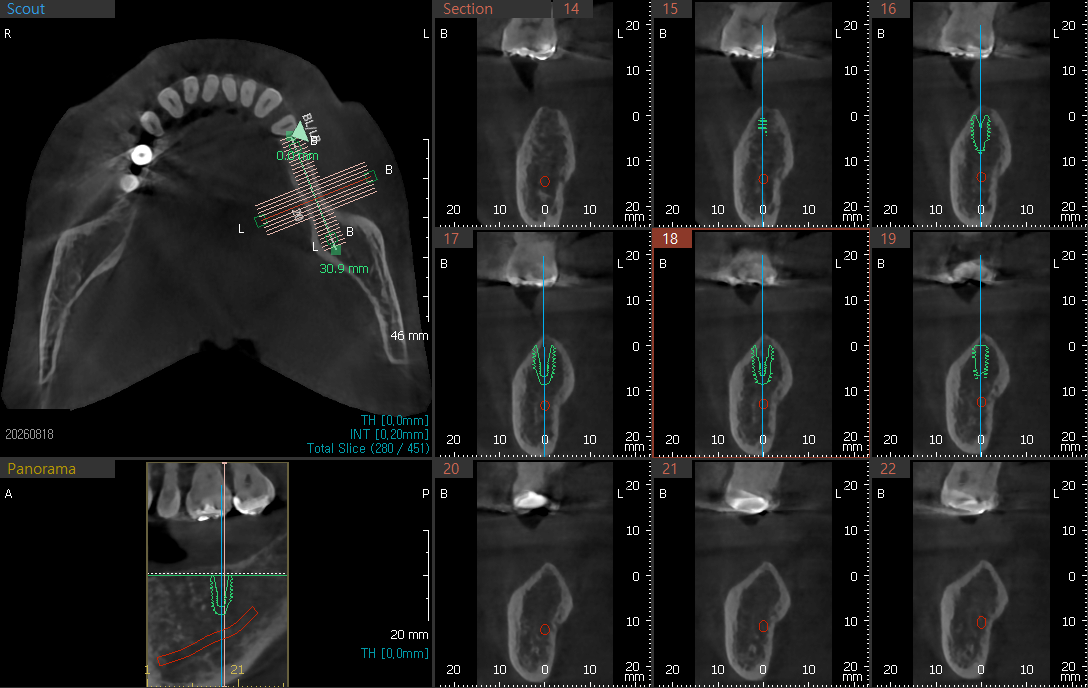
On 3D CT cross-sections, we measure the height, width and density of the bone at the site, the distance to the inferior alveolar nerve canal (Korean) in the lower jaw, and the distance to the maxillary sinus for upper molars. A single panoramic X-ray is a flat image, so it cannot show the thickness of the bone.
Medications and chronic conditions
We check for blood pressure, diabetes and heart disease, osteoporosis medication and blood thinners, and also ask whether you have ever had radiation therapy to the head or neck. If you are unsure of the drug names, you can bring a photo of the medication bag or the prescription, or a family member or caregiver can tell us on your behalf.
Whether you can keep up the care
An implant is a treatment that is maintained afterwards by regular checkups and daily hygiene care. When care lapses, peri-implantitis (Korean) sometimes progresses faster than gum disease around natural teeth. So we also ask about hand movement for holding a toothbrush and an interdental brush, whether you can visit regularly, and whether there is a family member or caregiver who can help.
At an advanced age, which is right: an implant, a denture, or a bridge?
The answer differs depending on the number of missing teeth, the remaining natural teeth, bone conditions, general health, and the circumstances for care.
| Item compared | Implant | Partial/complete denture | Bridge |
|---|
| Grinding down of neighboring natural teeth | None | None (a partial denture is supported by clasps) | The teeth on both sides must be ground down |
| Chewing force | Relatively close to natural teeth | Relatively weak, and an adjustment period is needed | Relatively stable |
| When bone is lacking | A bone graft may be needed | Can be made even with little bone | The condition of the remaining teeth is key |
| Treatment period | Generally 3~6 months (longer with a bone graft) | Around 2~4 weeks | Around 2~3 weeks |
| Burden on the body | Involves a surgical step | No surgery | No surgery |
| How it is cared for | Toothbrush and floss as with natural teeth + regular checkups | Remove and clean; check the condition of the gums | Floss is hard to pass through, so separate tools are needed |
Between “an implant or a denture,” there is also the approach of placing 2~4 implants and fixing a denture on top of them (implant-supported denture, overdenture (Korean)). In the lower jaw, 2 at the front is the standard, and in the upper jaw the bone is softer and wider, so 4 or more are usually needed. Compared with a full set of implants, fewer are placed and the surgical burden is smaller, and because it can be removed and cleaned, care is easy even when hand function has declined — which is meaningful at an advanced age. In return, the rubber rings fitted inside the denture are consumable parts and are usually replaced every 1~2 years, and when the jawbone changes, the inside of the denture is refitted.
When is another option better than an implant?
When the burden on the body or the difficulty of care is greater than the benefit gained from surgery. If any of the following applies, we recommend considering other treatments first.
- ✅ When the jawbone is severely lacking, but a large bone graft is burdensome because of your general condition — Rather than extensive graft surgery, an implant-supported denture that uses the remaining bone puts less strain on the body.
- ✅ When diabetes has been uncontrolled for a long time or you have recently been receiving osteoporosis injections, or when daily hygiene care and regular visits are difficult because of cognitive decline or similar reasons — We postpone the timing until the condition stabilizes, or give priority to a denture, which involves no surgery and can be removed and cleaned.
- ✅ When the remaining natural teeth alone can support a denture stably — If the situation does not require adding surgery, we suggest that direction first.
- ✅ When there are natural teeth that can be saved but would have to be extracted for implants — We give priority to preserving natural teeth. We first check whether they can be maintained with root canal treatment or gum treatment.
How long does treatment take, and how many visits are there?
The period is determined by the condition of the bone rather than by age, and time for coordinating systemic conditions may be added at the front.
- Osseointegration period — Generally 2~3 months for the lower jaw and 3~6 months for the upper jaw. Overall, we expect 3~4 months without a bone graft, and 5~6 months or more if a bone graft is needed.
- Coordination before starting — If there are things to be settled before surgery, such as stabilizing blood sugar or checking the prescribing doctor’s opinion, the start is delayed by that much.
- Visits — You come in this order: consultation and CT, surgery, suture removal, checks during the osseointegration period, impression taking, and connection of the prosthesis. While waiting for osseointegration, you come in for a check about once every month or two.
Why the period differs at each stage is covered in Implants: why does the treatment period differ from person to person?. Treatment fees are listed in the fee list (non-covered fees).
Frequently asked questions
Q. How long does the procedure take, and does it hurt a lot?
If one implant is placed without a bone graft, the placement itself usually takes around 30~60 minutes under local anesthesia. We begin after confirming that the anesthesia has taken effect, so there is normally no sharp pain during the procedure; swelling and discomfort afterwards vary from person to person, and we explain this at the consultation.
Q. I am elderly. Isn’t anesthesia risky?
Implant placement is done under local anesthesia, and Joy Dental Clinic Bongcheon does not perform sedation. If you have high blood pressure, diabetes or heart disease, we check your medication and how well the condition is controlled at the consultation, and proceed in cooperation with your physician if necessary.
Q. Are implants covered by health insurance?
If you are aged 65 or older and partially edentulous with at least one natural tooth remaining, Korean National Health Insurance covers up to 2 implants per person per lifetime, with a patient co-payment rate of 30%.[1] At present you are not eligible if you have no teeth at all, but from January 2027 coverage will also apply, up to 2 per lifetime, to complete edentulism with no teeth at all in the upper or lower jaw (if you previously received a complete denture under Korean National Health Insurance, from 7 years after the date you received it).[6] However, for an implant denture (overdenture), in which implants hold the denture, it has been reported that both the implants and the denture will remain not covered even after the expansion.[6] Additional surgery such as bone grafting is not included in coverage. Before starting, there is a procedure in which the dental clinic registers the eligible patient and the tooth sites with the National Health Insurance Service.
Q. What happens if an implant fails?
If initial osseointegration does not occur, the implant is usually removed and the cause identified, and placement can be attempted again once the bone has healed. In the long term, managing peri-implantitis is the key to maintenance, so it is important to keep to your regular checkup intervals.
Q. I have a CT taken elsewhere some time ago. May I bring it?
Yes. CT files taken elsewhere can also be opened and viewed at our clinic. However, the shape of the bone changes quickly in the first few months after a tooth is extracted, so if it was taken a long time ago, we take a new one and compare.
Q. When my parent has an implant consultation near Bongcheon Station, may I, as their child, go in with them?
Yes. At Joy Dental Clinic Bongcheon (Bongcheon Station Exit 1, 5F Jehyeong Bldg.), a family member or caregiver can look at the CT images together and hear the explanation, and may also tell us about medications and chronic conditions on the patient’s behalf.
Limits of the evidence
- The 10-year survival rate[4] is a value for study participants whose maintenance continued, and the figure for those aged 65 or older is also an average pooled from several studies, so it does not tell us the outcome for each individual.
- The relationship between diabetes and failure rates[5] comes from studies that mostly involved patients whose blood sugar was managed, so it cannot be applied as it is to uncontrolled diabetes.
- HbA1c below 8%[2] is a recommendation for elective surgery in general, not a criterion specific to implants.
- The risk categories for osteoporosis drugs are rough tendencies, and even with the same drug the judgment differs depending on coexisting chronic conditions and duration. The periods in the comparison table are also general ranges.
DOCTOR’S NOTE
In consultations with elderly patients, I always check whether they can manage their oral hygiene on their own. The placement takes one day, but the care has to be done every day, so I decide on the design with the care in mind as well.
— Jeong Jinwoo, Director, Joy Dental Clinic Bongcheon
This post reflects information as of the date of writing and was written to provide general information in compliance with Korea’s Medical Service Act and the Ministry of Health and Welfare’s medical advertising guidelines. Implant surgery may involve side effects such as bleeding, swelling, pain and infection, and in rare cases nerve damage or failure of osseointegration may occur. Individual diagnosis and treatment direction vary depending on the condition of your mouth, so please be sure to decide after sufficient consultation with the medical team in charge of your care.
We are right next to Exit 1 of Bongcheon Station (Line 2), and directions from Seoul Nat’l Univ. Station, Sillim, Nakseongdae and Sadang are in Getting here.
Joy Dental Clinic Bongcheon
5F Jehyeong Bldg., 1738 Nambusunhwan-ro, Gwanak-gu, Seoul (near Bongcheon Station)
Hours: Mon·Wed·Thu·Fri 09:30–18:30 / Tue 09:30–20:30 / Sat 09:30–13:30 (closed Sun & public holidays)
Booking: Naver Booking / Phone 02-877-2867
References
- 국민건강보험공단. 치과임플란트 급여안내 — For partially edentulous patients aged 65 or older (completely edentulous patients excluded); 2 implants per person per lifetime; patient co-payment rate of 30% for Korean National Health Insurance subscribers.
- 대한당뇨병학회. 2023 당뇨병 진료지침. — [Guideline] For patients scheduled for elective surgery, recommends HbA1c below 8% and perioperative blood glucose of 100~180 mg/dL to reduce surgery-related complications.
- MSD 매뉴얼 일반인용. 약물 관련 턱 골괴사증(MRONJ). — Can occur after tooth extraction, implant placement and similar procedures in people who have taken or been given antiresorptive drugs such as bisphosphonates; high-dose intravenous administration carries relatively higher risk; recommends having any necessary oral surgery done before starting antiresorptive drugs.
- Howe MS, Keys W, Richards D. Long-term (10-year) dental implant survival: A systematic review and sensitivity meta-analysis. J Dent. 2019;84:9-21. — [Meta-analysis] 10-year implant survival rate of 96.4% (95% CI 95.2~97.5); 91.5% in the group aged 65 or older. These values reflect the maintenance conditions of the study participants.
- Moraschini V, Barboza ES, Peixoto GA. The impact of diabetes on dental implant failure: a systematic review and meta-analysis. Int J Oral Maxillofac Surg. 2016;45(10):1237-1245. — [Meta-analysis] No significant difference in implant failure rates between diabetic and non-diabetic patients. Uncontrolled diabetes should be considered separately, and marginal bone loss may be greater.
- 치과신문. 65세 이상 완전 무치악 임플란트 급여 적용. 2026.9.10. — News report on the decision of the 15th Health Insurance Policy Deliberation Committee (2026.9.8). From January 1, 2027, people aged 65 or older with no teeth at all in the upper or lower jaw will also be supported for 2 implants; if they have received a complete denture under Korean National Health Insurance, from 7 years after receiving it; for overdentures, both the implants and the denture are not covered. As of the article date, the official notice had not yet been revised.


 한국어
 日本語
 简体中文