💡 Key answer
A diagnosis of peri-implantitis does not automatically mean that the implant has to come out. We check whether the implant is loose or fractured and whether the remaining bone can support it. If it is loose or fractured, we consider removal; if it can be kept, we start by treating the inflammation and checking the response. If bone loss continues after treatment, we reassess the decision then.
Summary for patients
- Lost bone does not come back on its own.
- Please do not put off scheduled checkups even if you have no pain.
- If your implant was placed elsewhere, please bring your X-ray and CT files.
- If you smoke or have diabetes, quitting smoking and managing blood sugar are part of the care as well.
❓ What this article covers
- What exactly does “peri-implantitis” mean?
- Why does peri-implantitis develop?
- What do we check in the treatment room?
- When can we try treating the inflammation first without removing the implant?
- If it feels loose, how do we tell a screw problem from a problem with the implant itself?
- When is removal the better option?
- How long does treatment take, and how many visits are needed?
- What do we check after treatment, and which symptoms mean you should come in before your scheduled checkup?
What exactly does “peri-implantitis” mean?
It means that inflammation in the gums around an implant has spread down to the bone, and the bone supporting the implant is being lost. The stage in which inflammation is confined to the gums and the bone is unchanged is called peri-implant mucositis, and the two stages require different treatment.[1]
Terms explained
- Peri-implant mucositis (Korean): Inflammation is confined to the gums, without bone loss. Removing the bacterial biofilm (plaque) and correcting the cleaning technique can reverse it.[1]
- Peri-implantitis (Korean): Inflammation is accompanied by loss of supporting bone (the bone that holds the implant). Lost bone does not return on its own, so the goal of treatment is to stop progression.[1]
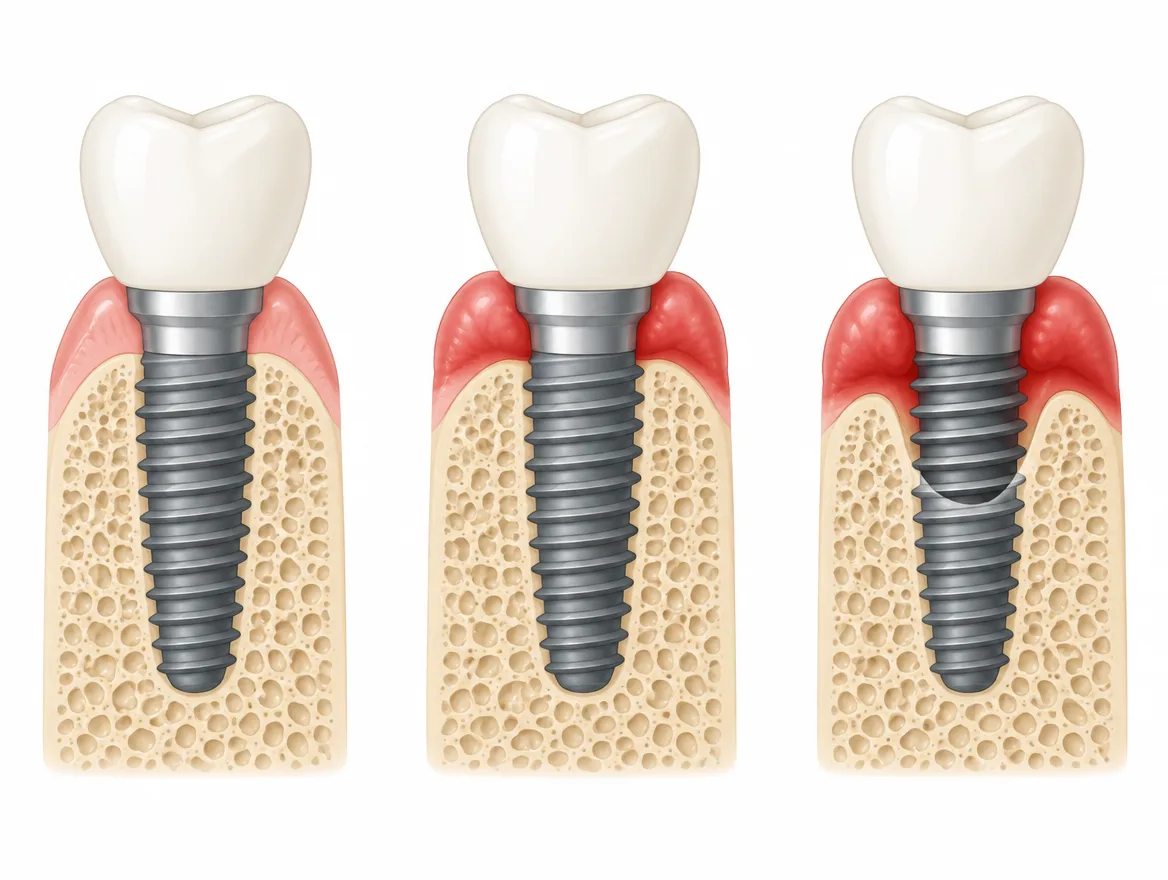
AI-generated explanatory illustrationFrom left: a healthy state, peri-implant mucositis with swollen gums only, and peri-implantitis with a hollow in the bone around the neck
Implants do not develop cavities, but they can develop gum disease. Natural teeth have a periodontal ligament (Korean) between the root and the bone, and gum fibers attach to the root, limiting the downward spread of bacteria to some extent. Implants lack this structure, so once inflammation starts, it tends to spread toward the bone more quickly.[4] They also lack nerves like those in natural teeth, so pain is often not obvious. Sometimes the only sign is bleeding during cleaning, and the problem is discovered only after considerable bone has been lost.
Why does peri-implantitis develop?
The cause is bacterial biofilm, just as with gum disease around natural teeth, and it is more likely to develop when several conditions favor biofilm buildup.
The 2017 World Workshop review found a strong association between peri-implantitis and a history of periodontitis, inadequate biofilm control, and lack of regular maintenance.[4] The European Federation of Periodontology clinical practice guideline also recommends quitting smoking and managing blood sugar in patients with diabetes to support health around implants.[3]
Conditions inside the mouth also play a role.
- A prosthesis shape that is difficult to clean — If the underside of the prosthesis covers a broad area and leaves places a toothbrush or interdental brush cannot reach, biofilm remains.
- Cement left below the gum line — With a cement-retained prosthesis, cement remaining below the gum line can cause inflammation.
When these causes are present, addressing them alongside the inflammation is needed to help reduce recurrence.[3][4] If your diabetes is not well controlled or you smoke, we also discuss blood sugar management and quitting smoking.
What do we check in the treatment room?
We do not decide from a single image: we compare previous records, examine the gum pockets, and check for movement and fractures together.
- Comparing previous and current images — If an X-ray from the day the prosthesis was fitted or a previous checkup is available, we compare it with today’s image to see how far the bone around the fixture (Korean) (the screw placed in the bone) has receded and whether it has receded further since the last visit. The comparison is explained in Bone around an implant should be compared with previous X-rays.
- Probing examination — We use a thin instrument to measure the depth of the periodontal pockets (Korean) (gum pockets) around the implant and check for bleeding on probing (Korean) or pus. The diagnostic criteria also identify peri-implantitis when bleeding or pus, bone loss after initial healing, and deeper pockets than before occur together.[2]
- Checking for movement — We check whether the prosthesis moves and, if so, whether the screw has loosened or the implant itself is moving. We take both a close-up X-ray of the root area (a periapical X-ray) and a panoramic X-ray and, if necessary, use a device that measures implant stability (an ISQ meter).
- Checking for fractures of the prosthesis or implant — We check whether the prosthesis, the screw or, rarely, the fixture itself has fractured.
We also look at the pattern of bone loss. Whether there is a hollow around the implant or a broad reduction in bone height affects the subsequent treatment approach.[5]
When can we try treating the inflammation first without removing the implant?
If the implant is neither loose nor fractured, and we judge that it can be kept based on the remaining bone and the conditions for ongoing care, we start by treating the inflammation even if some bone has been lost. The European Federation of Periodontology clinical practice guideline also recommends starting with non-surgical treatment and then reassessing.[3]
Non-surgical treatment
Without opening the gums, we use instruments to remove biofilm and tartar around the implant and review how you clean around the implant neck at home.[3] At the mucositis stage, this treatment and care often allow the inflammation to subside.[1] Even at the peri-implantitis stage, where bone has been lost, we go through this step first and then reassess changes in bleeding, pus and pocket depth.[3]
If inflammation remains at reassessment
If bleeding, pus and deep pockets remain after non-surgical treatment, the guideline presents surgical treatment in which the gums are opened to clean the implant surface. Whether to add a bone graft (Korean) depends on the remaining bone and the shape of the defect.[3] Even with bone grafting, there is no guarantee that all the lost bone will return. In a study that followed patients receiving regular maintenance after surgical treatment for 5 years, 63% still met the treatment success criteria at 5 years, while some had recurrent inflammation or lost their implants.[6]
At this stage, I do not perform surgical treatment for peri-implantitis; I recommend removing the implant with persistent inflammation and placing a new one afterward.
If it feels loose, how do we tell a screw problem from a problem with the implant itself?
If only the prosthesis moves, a screw problem is likely; if the prosthesis and fixture move together, the bond between the implant and bone has broken down. If the screw is loose, the implant remains attached to the bone, and retightening or replacing the screw often resolves the problem. If the fixture itself moves, the bond with the bone (osseointegration (Korean)) has broken down, which is beyond what treating the inflammation can reverse.
| What to check | Loose screw | Movement of the implant itself |
|---|
| Part that moves | Only the prosthesis (crown) moves | The prosthesis and fixture move together |
| X-ray | Check the screw connection and whether surrounding bone has been lost | Check whether bone has been lost around the fixture and how much |
| Response | Retighten or replace the screw and check causes such as the bite | Consider removal |
What we look for when an implant feels loose is covered in What do we check when an implant feels loose?.
When is removal the better option?
When trying to keep it would instead harm the surrounding bone and neighboring teeth.
- When the implant itself is loose — An implant that has lost osseointegration will not reattach through treatment of the inflammation.
- When the fixture is fractured — Treating only the inflammation while leaving the fractured part in place is difficult, so we check the fracture location and the condition of the remaining parts to determine the extent of removal.
- When bone loss does not stop after treatment — If bleeding or pus remains despite treatment of the inflammation, or each checkup image shows further bone loss, we consider removal to protect the remaining bone.
- When we judge that the remaining bone cannot adequately support the implant — We assess the extent of bone loss and the implant’s stability, together with its distance from the nerve canal in the lower jaw, the maxillary sinus in the upper jaw and the roots of neighboring teeth.
- When ongoing care is difficult and inflammation persists — If cleaning is difficult, we first check whether care can be made possible with cleaning aids, help from family, or adjustments to the shape of the prosthesis. If inflammation persists despite this, we reassess whether the implant can be kept.[3]
After removal, we wait for the inflammation to subside and the bone to heal, then first consider placing another implant. Depending on the bone condition and the remaining teeth at that time, we may also consider a bridge (Korean) or a partial denture (Korean). Depending on how much bone remains, a bone graft may be needed first.
How long does treatment take, and how many visits are needed?
Peri-implantitis is not finished with a single treatment, and care continues afterward.
- Non-surgical treatment — After removing biofilm and tartar and reviewing the cleaning technique, we allow time for the gums to heal, then ask you to return to reassess bleeding, pus and pocket depth.
- Removal and placement of a new implant — If inflammation remains at reassessment, we recommend removal. We determine when to place a new implant after checking that the inflammation has subsided and the bone has healed, so having another implant means going through the steps of initial implant treatment again. The duration of each stage is covered in Implants: why does the duration differ from person to person?.
The interval between checkups after treatment is set according to bone changes and the condition of the gums. Treatment fees are listed in the fee list (non-covered fees).
What do we check after treatment, and which symptoms mean you should come in before your scheduled checkup?
At each checkup, we compare X-rays taken in the same way and probing results with previous records. We check whether bone loss has stopped progressing, whether there is no bleeding or pus, and whether the pockets have become shallower.[3] During checkups, we clean around the implant with an air-polishing device (Korean), which sprays fine powder with water to avoid scratching the surface.
When to come in without waiting for your scheduled checkup
- Pus comes out when you press the gum, or there is an odor from the site
- Bleeding occurs every time you clean, or the gums become swollen and painful again
- The prosthesis feels loose or seems to rotate
- Chewing hurts, or chewing on that side feels uncomfortable
- The gums have receded, exposing more of the implant’s metal part
Frequently asked questions
Q. I was told I have bone loss, but there is no pain or movement. Can I leave it alone?
Having no pain does not mean treatment is unnecessary. Bone loss in peri-implantitis has been reported to accelerate over time.[4] If the implant is not loose, it may be possible to try treatment to keep it, so please first have images compared and a probing examination to check whether it is progressing.
Q. Won’t antibiotics alone cure it?
Antibiotics alone cannot remove biofilm attached to the implant surface. The basis of treatment is removing biofilm with instruments. The European Federation of Periodontology clinical practice guideline does not recommend routinely adding oral antibiotics to peri-implantitis treatment; whether to prescribe them is decided according to the patient’s condition.[3]
Q. Does treating peri-implantitis mean I need a new prosthesis?
Not necessarily. If the prosthesis shape makes cleaning difficult or cement remains below the gum line, the prosthesis may be removed or reshaped. If these causes are absent, treatment may be carried out with the existing prosthesis in place.
Q. How should I clean around my implant at home?
A toothbrush alone does not clean well around the implant neck, so an interdental brush (Korean) or special floss suited to the shape of the prosthesis is used as well. At checkups, we confirm which size fits and whether any areas are being missed.
Q. I am near Bongcheon Station. Can you also check an implant placed at another dental clinic?
This is possible in some cases. At Joy Dental Clinic Bongcheon (Bongcheon Station, Exit 1, 5F Jehyeong Bldg.), we check the implant’s condition and product information before explaining the scope of checkups and treatment we can provide. Please bring X-ray or CT files or product information from the clinic where it was placed, if available. Without previous records, today’s images and probing results become the new baseline. The diagnostic criteria also call for assessing bone level together with probing results when previous records are unavailable.[2]
Limits of the evidence
- The 5-year follow-up study[6] was small, involving 24 patients (36 implants), and included only patients who received regular maintenance after surgical treatment.
- The study of bone loss patterns[5] classified their shape using CT; it did not directly compare treatment outcomes for different shapes.
- The diagnostic criteria[2] are shared criteria used in research and clinical care, and the numerical thresholds used when previous records are unavailable are reference values to help judgment.
- The European Federation of Periodontology guideline[3] provides recommendations based on multiple studies, and the surgical approach varies with the shape of the defect and individual conditions.
DOCTOR’S NOTE
For patients who have completed peri-implantitis treatment, I start by explaining that lost bone does not return on its own. The goal of treatment is to prevent further bone loss. If the bone is unchanged on the next checkup image, we continue using the current implant. If it is still being lost, we discuss then whether to treat further or whether removal would be better.
— Jeong Jinwoo, Director, Joy Dental Clinic Bongcheon
This post reflects information as of the date of writing and was written to provide general information in compliance with Korea’s Medical Service Act and the Ministry of Health and Welfare’s medical advertising guidelines. Treatment of peri-implantitis may have side effects such as gum recession, sensitivity, pain, swelling, exposure or failure of bone graft material, recurrent inflammation and implant removal after treatment; in rare cases, nerve damage or maxillary sinus problems may occur. Individual diagnosis and the direction of treatment depend on the condition of your mouth, so please be sure to consult fully with your treating clinician before deciding.
We are right next to Exit 1 of Bongcheon Station (Line 2), and directions from Seoul Nat’l Univ. Station, Sillim, Nakseongdae and Sadang are in Getting here.
Joy Dental Clinic Bongcheon
5F Jehyeong Bldg., 1738 Nambusunhwan-ro, Gwanak-gu, Seoul (Bongcheon Station, Exit 1)
Hours: Mon·Wed·Thu·Fri 09:30–18:30 / Tue 09:30–20:30 / Sat 09:30–13:30 (closed Sun & public holidays)
Booking: Naver Booking / Phone 02-877-2867
Related pages: Implant treatment guide · Implant maintenance (Korean) · Peri-implantitis (Korean)
References
- Berglundh T, Armitage G, Araujo MG, et al. Peri-implant diseases and conditions: Consensus report of workgroup 4 of the 2017 World Workshop on the Classification of Periodontal and Peri-Implant Diseases and Conditions. J Periodontol. 2018;89(S1):S313-S318. — [Guideline] Consensus report: peri-implant mucositis is plaque-related gum inflammation without bone loss and can be reversed by removing the cause. Peri-implantitis is inflammation accompanied by progressive loss of supporting bone. Recommends recording baseline radiographs and probing depths after completion of the prosthesis.
- Renvert S, Persson GR, Pirih FQ, Camargo PM. Peri-implant health, peri-implant mucositis, and peri-implantitis: Case definitions and diagnostic considerations. J Clin Periodontol. 2018;45(S20):S278-S285. — Case definitions: peri-implantitis is identified when bleeding or pus on probing, radiographic bone loss after initial healing, and increased probing depth compared with previous records occur together. Without previous records, bleeding or pus on probing, a probing depth of 6mm or more, and a radiographic bone level at least 3mm below the most coronal portion of the intraosseous part of the implant are assessed together.
- Herrera D, Berglundh T, Schwarz F, et al. Prevention and treatment of peri-implant diseases — The EFP S3 level clinical practice guideline. J Clin Periodontol. 2023;50(S26):4-76. — [Guideline] European Federation of Periodontology clinical practice guideline: peri-implantitis treatment starts with risk factor management and non-surgical biofilm removal; surgical treatment is considered if the condition has not resolved at reassessment. Surgery is based on opening the gums to clean the implant surface, with regenerative (bone grafting) or resective procedures added according to the shape of the defect. Recommends regular maintenance after treatment.
- Schwarz F, Derks J, Monje A, Wang HL. Peri-implantitis. J Clin Periodontol. 2018;45(S20):S246-S266. — 2017 World Workshop review: peri-implantitis is strongly associated with a history of periodontitis, poor plaque control and lack of regular maintenance. It tends to progress faster than periodontitis around natural teeth. Bone loss without signs of inflammation is uncommon.
- Monje A, Pons R, Insua A, Nart J, Wang HL, Schwarz F. Morphology and severity of peri-implantitis bone defects. Clin Implant Dent Relat Res. 2019;21(4):635-643. — [Cross-sectional study] Classified 158 peri-implantitis bone defects using CT: an intrabony component (a hollow extending into the bone) was common, and bone loss was greater on the cheek side. Provides background on how defect shape affects the feasibility of regenerative treatment and the choice of treatment.
- Heitz-Mayfield LJA, Salvi GE, Mombelli A, et al. Supportive peri-implant therapy following anti-infective surgical peri-implantitis treatment: 5-year survival and success. Clin Oral Implants Res. 2018;29(1):1-6. — [Cohort] Followed 24 patients (36 implants) who received regular maintenance after surgical treatment of peri-implantitis for 5 years: implant survival was 100% at 1 year after treatment; at 5 years, 63% of patients still met the treatment success criteria, while some had recurrence or lost implants.


 한국어
 日本語
 简体中文