💡 Key answer
The small space between an implant crown and the gum is usually not an accidental gap, but a passage left for an interdental brush to remove plaque that clings to the implant neck like buildup on a sink. Filling this space removes access for an interdental brush and may increase the risk of peri-implantitis. At Joy Dental Clinic Bongcheon, instead of closing the gap, we first identify why food gets caught, restore any lost contact with the neighboring tooth, and select cleaning tools for the space that needs cleaning.
Summary for patients
- We first use floss together to identify where food gets caught.
- Clean once a day with an interdental brush of the right thickness.
- Avoid toothpicks, as they may widen the gap.
- Remember the interdental brush thickness selected on the day your crown was fitted.
- If floss slips straight through, please tell us at your checkup.
❓ What this article covers
- Why does food get caught so easily between implants?
- Why is that gap a “breathing hole”?
- What happens if the space is closed or left open?
- Does trapped food mean something is wrong with the implant?
- What do we check in the treatment room?
- What do we do instead of closing the gap?
- Are there times when narrowing the space is appropriate?
- How long does treatment take, and how many visits are there?
Why does food get caught so easily between implants?
Because implants are shaped differently from natural teeth and, unlike neighboring teeth, do not move. If food starts getting caught after an implant in a place where it did not when you had a natural tooth, the reason is usually one of two things.
First, implants are shaped differently from natural teeth. A natural tooth’s width changes smoothly from root to crown, and the gum fills the space between teeth in a triangular shape. An implant consists of a narrow post placed in the bone with a crown the size of the original tooth on top, leaving a small space near the gum where the post widens into the crown. In addition, the gum is lower where a tooth has been extracted, so this space tends to look wider than it did with a natural tooth.
Second, an implant does not move, but the neighboring tooth can. Thanks to the periodontal ligament (Korean) surrounding their roots, natural teeth gradually change position over time and move very slightly each time you chew. Implants are directly bonded to bone and do not have this movement. It is therefore not unusual for the initially snug contact between an implant crown and its neighboring tooth to loosen after a few years. A meta-analysis pooling 10 studies found contact loss between implant-supported prostheses and adjacent teeth in 41%, and it was more common at the front contact at 47%.[3] A study in Korea with 7 years of follow-up also reported an increase over time.[4]
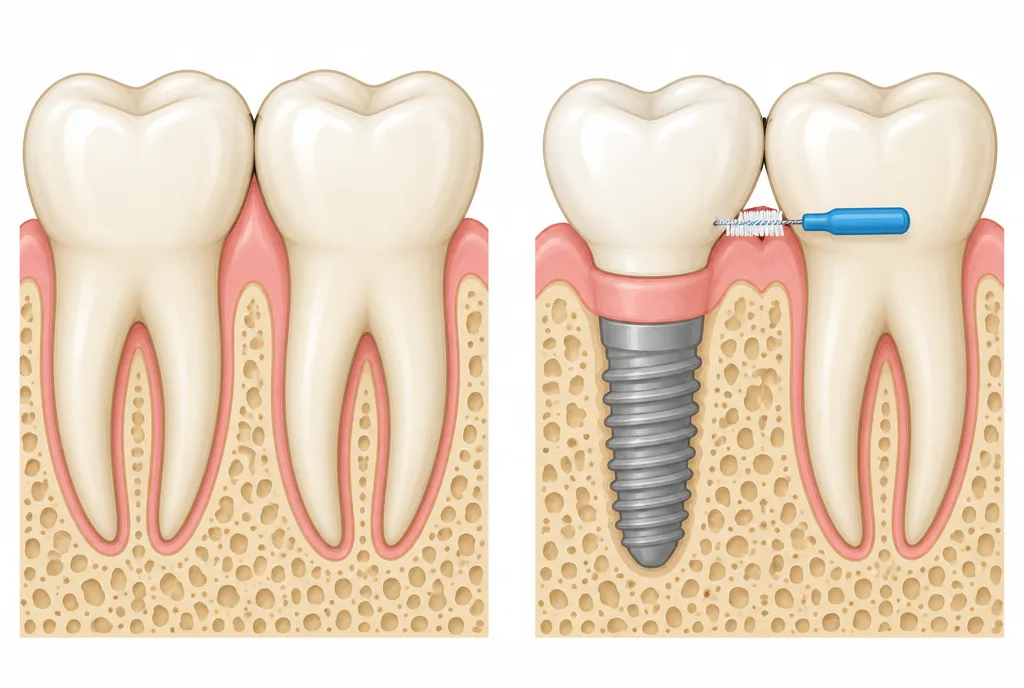
AI-generated explanatory illustrationNatural tooth–implant on the left, implant–natural tooth on the right
There is an important distinction here. Food pushed in from above and food left below are different problems. Food pressed through the contact gap with the neighboring tooth while chewing is a “lost contact problem,” while food remaining in the space near the gum beneath the crown is a “cleaning space problem.” For the former, we need to assess whether to restore the contact; for the latter, we need to find a solution while preserving cleaning access.
Why is that gap a “breathing hole”?
Because it is the passage that lets cleaning tools such as an interdental brush reach the implant neck. Implants have no tooth nerve. Changes that you would notice through sensitivity or pain in a natural tooth can easily go unnoticed longer in an implant. So what really deserves attention with an implant is not so much the trapped food as the plaque left behind.
Plaque (Korean) is like buildup on a sink. A thin layer forms each day, hardens into tartar if left for a long time, and quietly starts damaging the gum beneath it.[5] The hardest place to remove plaque from an implant is the neck where the crown meets the gum. Toothbrush bristles cannot reach this area, so you need to insert an interdental brush (Korean) through the space beneath it to clean. This is why I call the space a “breathing hole.” I mean a passage for cleaning tools, not a hole for air to pass through.
Filling that space with the crown may reduce trapped food, but it also removes the route for cleaning away plaque. In a study examining implants in 23 patients who came for peri-implantitis treatment, about half (48%) of the implants with peri-implantitis had prosthesis designs that did not allow access for cleaning tools, while peri-implantitis was uncommon in designs that could be cleaned (4%).[1] Another study analyzing 168 implants used for an average of 10.9 years found peri-implantitis in 31.3% of bone-level implants with crowns flaring at an angle greater than 30° near the gum (15.1% at 30° or less), and in 37.8% when this was combined with a convex contour.[2] This is also why the European Federation of Periodontology recommends designing implant prostheses so that “patients can clean them themselves, they can be examined, and professionals can clean them.”[5]
What happens if the space is closed or left open?
Closing it means less food gets caught at first, but plaque becomes trapped below the gum; leaving it open means food may get caught, but you can clean it away every day.
| Item | Crown that fills the space | Crown that leaves cleaning space |
|---|
| Trapped food | Feels reduced at first | Can get caught but can be removed with an interdental brush |
| Plaque | Trapped below the gum, accumulates, and is difficult to clean | Can be removed with an interdental brush once a day |
| Gum condition | Not visible from outside and difficult to examine | Can be checked with a probe at checkups |
| Risk of peri-implantitis | May increase[1][2] | Care aims to lower it[5][6] |
| When problems are detected | Detection tends to be delayed | There is a chance to detect problems at the gum inflammation stage |
The European Federation of Periodontology’s clinical practice guideline also recommends regular maintenance tailored to risk for implant patients and regards prosthesis designs that are difficult to clean as something to correct.[6]
Does trapped food mean something is wrong with the implant?
Often, it does not. The adjacent natural tooth moves little by little while the implant does not, so contact can open up after a few years.[3][4] Here are common misconceptions we hear in the treatment room alongside what actually happens.
| Common misconception | What we see in the treatment room |
|---|
| Food getting caught means the implant is faulty | This is a structural change caused by the neighboring natural tooth moving while the implant stays still, and commonly occurs over time. We need to examine the contact and gum to determine whether something is wrong. |
| I can just remove it with a toothpick | Repeated toothpick use can press on the gum and widen the space, while leaving plaque behind. An interdental brush of the right thickness at the same site can clean away both food and plaque. |
| Closing the hole will keep it clean | Less food may get caught, but without access for an interdental brush, plaque below the gum becomes difficult to clean. |
| The bigger the space, the worse it is | The right size is one that lets an interdental brush fit without being loose. A space too narrow for a tool to enter is more of a problem. |
| It does not hurt, so it is fine | Implants have no tooth nerve, so problems can easily be felt only later. Having no pain does not mean it is healthy. |
What do we check in the treatment room?
We use floss to check contact with the neighboring tooth, a probe to check the gum below the crown, and an interdental brush inserted into the space to check its size.
- Contact — We pass floss between the implant and the neighboring tooth to check whether contact has loosened. The first step is to distinguish food pressed in from above while chewing from food remaining in the space below.
- Gum — We gently measure around the implant with a probe to check for bleeding, pus, or deeper pockets. The space must be left open to allow this examination.
- Size and shape of the space — We select the right interdental brush thickness by trying it in the space, and also check whether the shape traps food so that it cannot come out.
- Bone — If the gum shows signs of inflammation, we compare the bone height around the implant on a periapical X-ray with earlier images.
On the day the crown is fitted, we select the right interdental brush thickness for the site and explain why we leave the space open rather than close it. Knowing this in advance helps you understand why food might get caught later. What we look at during checkups is covered in What we look at in regular implant checkups.
What do we do instead of closing the gap?
Depending on why food gets caught, we restore lost contact or adjust the crown’s shape, and select cleaning tools to reduce discomfort.
“Doctor, please close this hole. Food gets caught every time I eat, and I cannot live without toothpicks.” This is something I often hear from people with implants. But I do not close the gap on the spot. It is not because I do not understand the discomfort. It is because filling that hole could let a quieter, bigger problem start there than the inconvenience you have now.
- We restore lost contact with the neighboring tooth. Depending on how much it has opened and the gum condition, we slightly build up the contact surface on the neighboring tooth, add to the contact area of the implant crown, or remake the crown if the gap is large. At Joy Dental Clinic Bongcheon, we use both screw-retained and cement-retained crowns, and tailor the adjustment to the retention method: unscrewing a screw-retained crown to adjust it, or building up the contact area inside the mouth for a cement-retained crown.
- We leave the lower space open and select cleaning tools. Use an interdental brush of the right thickness once a day, adding a water flosser (Korean) as an aid if needed. There is no need to be alarmed because an interdental brush fits through. That space is there for cleaning.
- We can adjust the shape of the space. If its shape traps food so that it cannot come out, we adjust the curve of the crown’s side so food can leave rather than stay there. However, we do not narrow it so much that an interdental brush cannot enter.
In my experience, when we work through these steps, it is rare that the problem can only be solved by “closing the hole.” Many people experience less discomfort just by restoring the contact and selecting the right tools. However, even after being restored, contact can open up again over time,[4] so we recheck the resistance felt with floss at every implant checkup.
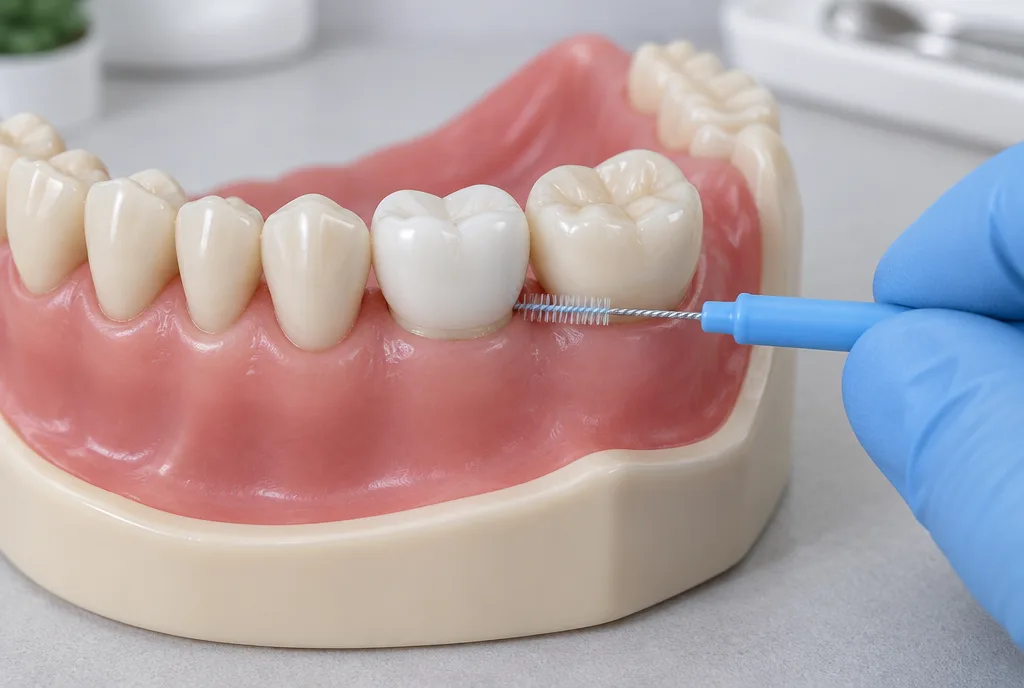
AI-generated explanatory illustrationCleaning a dental model by inserting an interdental brush into the space ("breathing hole") beneath the implant crown
Are there times when narrowing the space is appropriate?
Yes. But even then, the criterion is “can an interdental brush enter?”
- Where the space looks dark when you smile, such as around front teeth, we compromise by improving the contour near the gum (Korean) while preserving a minimal passage for an interdental brush.
- Where the gum is unusually low and the space excessively large, we redesign the crown shape.
The aim is not to eliminate the space, but to find a size that allows cleaning without retaining food.
How long does treatment take, and how many visits are there?
Restoring contact or adjusting the shape can be completed relatively quickly, while remaking a crown usually takes 1 week from impression to fitting, or 2 weeks if longer.
- Restoring contact and adjusting the shape — We decide whether to build up the existing crown or make a new one based on its retention method (screw or cement) and how much the contact has opened.
- When remaking a crown — From the day the impression is taken to the day it is fitted, it usually takes 1 week, or 2 weeks if longer.
- Follow-up checks — The standard is a first check 3 months after fitting the prosthesis, then every 6 months, checking the contact and gum each time.
Treatment fees are listed in the fee list (non-covered fees).
Frequently asked questions
Q. Can I use a water flosser (Waterpik) instead?
It helps rinse away food, but an interdental brush is more effective at rubbing off plaque attached to the implant neck. We recommend using a water flosser as an aid and continuing with an interdental brush once a day.
Q. Floss keeps breaking or catching at that spot.
The crown margin may be rough, tartar may have built up, or there may be decay in the neighboring tooth. Please do not leave it unattended; tell us at your checkup so we can identify the cause.
Q. It bleeds when I insert an interdental brush. Can I keep using it?
It is better to clean carefully without avoiding the area, but do not scrub hard. Bleeding often signals that plaque remains there and the gum is inflamed. If bleeding continues after 1~2 weeks of cleaning, it could be peri-implant mucositis and needs to be checked.
Q. What is the difference between screw-retained and cement-retained crowns?
A screw-retained crown can be easily removed by undoing the screw, while a cement-retained crown has a smooth surface without an access hole but usually needs to be cut off for removal. With cement-retained crowns, we also check for cement left below the gum. The differences are covered in Screw-retained vs cement-retained (Korean).
Q. I am near Bongcheon Station. Do you also check food getting caught between implants placed at another clinic?
Yes. At Joy Dental Clinic Bongcheon (Bongcheon Station Exit 1, 5F Jehyeong Bldg.), we check the contact and gum condition. For implants placed elsewhere, the adjustment method differs depending on the retention method and product, so please bring your implant product card or treatment records if you have them.
Limits of the evidence
- The relationship between cleaning access and peri-implantitis[1] comes from an analysis of 23 patients referred for peri-implantitis treatment, so it cannot be interpreted as a general incidence rate.
- The study on crown contour and peri-implantitis[2] analyzed radiographs at a single point in time, showing an association between contour and disease rather than proving causation, and differences were found only in bone-level implants. Neither study directly measured outcomes after filling the space.
- The rates of contact loss[3][4] come from studies with differing participants and observation periods, so they do not predict whether contact will open up around your implant.
- The table comparing closed and open spaces reflects general trends in the literature and clinical practice; actual risk varies with gum condition, history of gum disease, smoking status, and other factors.
DOCTOR’S NOTE
Patients cannot see for themselves what is happening under a crown. So to me, completing implant treatment means leaving that area accessible for cleaning and viewing, and having the person who designed it keep checking it.
— Jeong Jinwoo, Director, Joy Dental Clinic Bongcheon
This post reflects information as of the date of writing and was written to provide general information in compliance with Korea’s Medical Service Act and the Ministry of Health and Welfare’s medical advertising guidelines. Implant prostheses may involve side effects such as food getting caught, gum inflammation and pain. Individual diagnosis and treatment direction vary depending on the condition of your mouth, so please be sure to decide after sufficient consultation with the medical team in charge of your care.
We are right next to Exit 1 of Bongcheon Station (Line 2), and directions from Seoul Nat’l Univ. Station, Sillim, Nakseongdae and Sadang are in Getting here.
Joy Dental Clinic Bongcheon
5F Jehyeong Bldg., 1738 Nambusunhwan-ro, Gwanak-gu, Seoul (Bongcheon Station, Exit 1)
Hours: Mon·Wed·Thu·Fri 09:30–18:30 / Tue 09:30–20:30 / Sat 09:30–13:30 (closed Sun & public holidays)
Booking: Naver Booking / Phone 02-877-2867
Related pages: Implant treatment · Implant maintenance (Korean) · Peri-implantitis (Korean) · Interdental brush (Korean)
References
- Serino G, Ström C. Peri-implantitis in partially edentulous patients: association with inadequate plaque control. Clin Oral Implants Res. 2009;20(2):169-174. — [Cross-sectional study] Analysis of 23 partially edentulous patients referred for peri-implantitis treatment: 48% of implants with peri-implantitis had prosthesis designs inaccessible to cleaning tools, while only 4% of those with accessible designs had peri-implantitis (positive predictive value 65%, negative predictive value 82%). This referred patient sample cannot be interpreted as a general incidence rate. Cleanable prosthesis designs and patient education were proposed as key to prevention.
- Katafuchi M, Weinstein BF, Leroux BG, Chen YW, Daubert DM. Restoration contour is a risk indicator for peri-implantitis: A cross-sectional radiographic analysis. J Clin Periodontol. 2018;45(2):225-232. — [Cross-sectional study] Cross-sectional radiographic analysis of 168 implants (mean time in use 10.9 years): in bone-level implants, peri-implantitis was present in 31.3% when the restoration emergence angle exceeded 30° (15.1% at 30° or less), rising to 37.8% when combined with a convex contour. No difference in tissue-level implants. The study examined the association between contour and disease.
- Bento VAA, Gomes JML, Lemos CAA, et al. Prevalence of proximal contact loss between implant-supported prostheses and adjacent natural teeth: A systematic review and meta-analysis. J Prosthet Dent. 2023;129(3):404-412. — [Meta-analysis] Meta-analysis of 10 studies: the rate of contact loss between implant-supported prostheses and adjacent natural teeth was 41% (confidence interval 30~53%), more common at the front (mesial) contact at 47%.
- Pang NS, Suh CS, Kim KD, Park W, Jung BY. Prevalence of proximal contact loss between implant-supported fixed prostheses and adjacent natural teeth and its associated factors: a 7-year prospective study. Clin Oral Implants Res. 2017;28(12):1501-1508. — [Cohort] A 7-year prospective study in Korea: contact loss between implant-supported prostheses and adjacent teeth increased over time and occurred more often at the front contact.
- Jepsen S, Berglundh T, Genco R, et al. Primary prevention of peri-implantitis: managing peri-implant mucositis. J Clin Periodontol. 2015;42(Suppl 16):S152-S157. — [Guideline] European Federation of Periodontology consensus: plaque causes peri-implant mucositis, and implant positioning and prosthesis design should allow patients to clean on their own, probing examinations, and professional cleaning.
- Herrera D, Berglundh T, Schwarz F, et al. Prevention and treatment of peri-implant diseases — The EFP S3 level clinical practice guideline. J Clin Periodontol. 2023;50(S26):4-76. — [Guideline] European Federation of Periodontology clinical practice guideline: recommends regular maintenance tailored to risk for implant patients. Prosthesis designs that are difficult to clean should be corrected.


 한국어
 日本語
 简体中文