💡 Key answer
There are cases where a dental implant (Korean) can be placed on the day a tooth is extracted, but this is not possible at every site. Before extraction, we plan by assessing inflammation at the site, the remaining bone walls and whether stability can be achieved during placement on CT and X-rays, then check the site again after extraction before deciding. Immediate placement does not mean you can chew from that day; time for the bone to bond is still needed. If the conditions are not suitable, we wait for the bone to heal or graft bone first, then decide when to place the implant.
Summary for patients
- Ask for an explanation on the CT screen of why we would place the implant right away or wait.
- The plan for that day may change depending on the condition after extraction.
- Tell us about your medications, and do not stop them on your own.
- Do not chew on the implant side until the bone has bonded.
- For front teeth, discuss ways to temporarily cover the gap while waiting.
❓ What this article covers
- Do “placing it on the day of extraction” and “chewing from that day” mean the same thing?
- How do we decide whether immediate placement is possible?
- When do we place an implant on the day of extraction?
- What differs between front and back teeth in immediate placement?
- When do we wait?
- Can the plan change after extraction even if I was told beforehand that immediate placement was possible?
- What do we check in the treatment room?
- How long does treatment take, and how many visits are needed?
Do “placing it on the day of extraction” and “chewing from that day” mean the same thing?
They mean different things. Placing the implant root (fixture (Korean)) in the extraction socket on the same day is called immediate implant placement (Korean). Connecting a temporary tooth immediately after placement so that it does not touch the opposing tooth is called immediate restoration; allowing that tooth to meet the opposing tooth and bear force is separately called immediate loading (Korean). Having a temporary tooth attached does not mean you can immediately chew freely. Terms such as “one-day implant” cover different things at different clinics, so during consultation it is helpful to ask separately “when will the implant be placed?” and “when will the tooth be attached?”
Even if the implant is placed on the day of extraction, the same period of osseointegration (Korean), during which the implant bonds with the bone, is still needed. The advantage of immediate placement is therefore not “being able to chew immediately,” but that combining extraction and placement may reduce the number of operations and the overall duration. Additional procedures such as bone grafting change this accordingly. Even when I place an implant on the day of extraction, I do not attach a tooth to it that day. How we manage the gap while the bone bonds depends on the site and its condition, so I discuss this before surgery.
We decide by looking at five things — inflammation at the extraction site, the remaining bone walls, primary stability, the extraction method and general health. Before extraction, we assess the site with 3D CT (Korean), X-rays and an oral examination, and also check medications, systemic conditions and smoking. Some of these five items are checked again by looking directly at the site after extraction.
| What we check | How we check | When we consider immediate placement | When we consider waiting |
|---|
| Inflammation at the extraction site | Size of the periapical lesion (Korean) on X-ray and CT, gum swelling and pus | No inflammation, or chronic inflammation that can be thoroughly removed during extraction[6] | Pus accumulation, or swelling and pain from acute inflammation |
| Remaining bone walls | Thickness and height of the outer (buccal) wall on CT cross-sections | The outer wall is intact and has some thickness[1] | The outer wall has been resorbed or breaks during extraction |
| Whether stability can be achieved during placement | Amount of bone remaining below and on the inner side of the root tip on CT | The implant can engage firmly in the bone below and on the inner side of the root tip | Insufficient bone to support the implant, making primary stability difficult to achieve |
| How the tooth can be extracted | Number and shape of roots, and how firmly they are fused to the bone | Regardless of the number of roots, the tooth can be removed without breaking the bone walls, and primary stability can be achieved afterward | Teeth with widely spreading roots or roots fused to the bone, where substantial bone damage is expected during extraction |
| General health and habits | Medications, diabetes, smoking and teeth grinding | No major factors that delay healing | With uncontrolled diabetes, heavy smoking, osteoporosis injections or medication, and similar factors, discuss the surgical plan itself first (do not stop medication on your own) |
When all five factors above favor immediate placement. I perform placement on the day of extraction for both front and back teeth. After extracting the tooth and removing inflamed tissue from the socket, I place the implant into bone on the inner side of and below the root-shaped socket to achieve stability. After placement, I check how firmly the implant is held using measurements such as ISQ, and the gap between the implant and the socket walls is often filled with bone graft material.
The outer bone wall needs particular attention during immediate placement. After extraction, jawbone loss is greatest at the outer wall[2][4], and placing an implant immediately cannot prevent this resorption.[3] We therefore decide the placement position by considering both the position of the final prosthesis and the outer bone wall, and often graft the gap between the implant and the outer wall.[1] Although studies have pooled survival rates for implants placed on the day of extraction[5], in visible areas such as the front teeth we also need to consider visible gum recession, so survival rates alone do not determine the decision.[1]
For front teeth, the gum line is more challenging; for back teeth, it is the bone needed for stability.
Front teeth
The outer bone wall at a front tooth site is often naturally thin. If this wall shrinks, the gum can recede with it, and the crown margin may become visible later. If your gum line shows when you smile, we therefore examine the thickness of the outer wall particularly carefully on CT. If the outer gum is thin, we also plan a procedure to thicken it when needed.
Back teeth
Back teeth often have two or three diverging roots, leaving a large, irregularly shaped socket after extraction. We therefore check whether primary stability can be achieved in the bone between the roots and below their tips, in a position that suits the future prosthesis. The nerve canal is close to the lower back teeth, and the maxillary sinus is close to the upper back teeth, so we also assess the length of bone available below the root tips.
When do we wait?
If inflammation is severe, the outer wall has been resorbed, or primary stability looks difficult to achieve, we wait rather than place the implant that day. Waiting in this situation does not mean “it cannot be done,” but “placing it after the bone heals or after grafting bone first.” There are roughly three ways of waiting.
| Approach | Timing of placement | When we consider it | Points to consider |
|---|
| Placement after gum healing | 4–8 weeks after extraction | Gum inflammation needs to settle first, or a site where thicker gum tissue is desired[1] | Bone has not filled in sufficiently, so grafting is often done at placement |
| Placement after partial bone healing | 3–4 months or more after extraction, depending on bone healing[1] | Extensive inflammation or a large socket left by multiple diverging roots | Bone width may decrease while waiting, increasing the need for bone grafting[4] |
| Grafting on the day of extraction and waiting (socket preservation (Korean)) | 3–4 months or more after extraction, decided after checking healing at the grafted site | A thin or broken outer wall where substantial shrinkage is expected if left alone | Reduces the amount of shrinkage but does not prevent it completely[7] |
Methods used at sites where substantial bone has already been lost are covered in I was told I cannot have implants because there is not enough bone.
Yes. Even if the outer wall appears present on CT, it may break during extraction, or extraction may reveal that inflammation at the root tip has resorbed more bone than the CT showed. In that situation, we postpone same-day placement and decide whether to wait for healing first or graft bone, according to the inflammation and bone condition. Before surgery, I therefore explain that “if the conditions turn out to be different after extraction, we may not place the implant that day,” along with the alternatives, and explain the changed plan and its reasons again after surgery.
What do we check in the treatment room?
Before extraction, we check distances on CT cross-sections; on the day of placement, stability; and while waiting, how much bone has filled in.
On CT cross-sections, we also look at how much bone remains below the root tip. In the lower jaw, we check the distance between the tip of the planned implant and the nerve canal (Korean), and I plan around a margin of about 2mm. In the upper jaw, we check the height of bone remaining below the maxillary sinus (Korean). If needed, we measure distances directly on the screen and explain them in mm. If the margin is insufficient, we decide the timing by considering the placement position, implant length and need for bone grafting together.
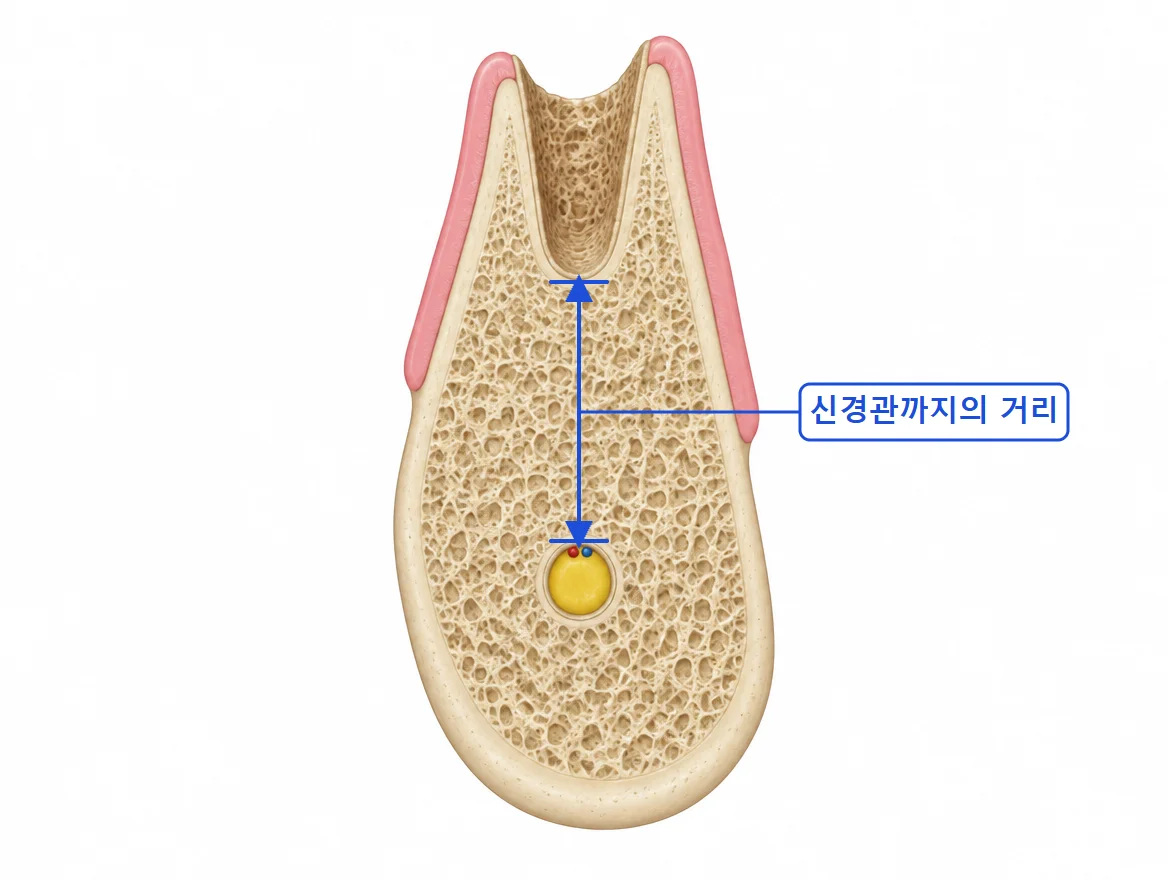
AI-generated explanatory illustrationLower jaw cross-section immediately after extraction: nerve-filled canal and distance from the socket floor to the nerve canal (the 2mm margin in the text is measured from the tip of the planned implant)
While waiting and after placement
If we decide to wait, we check how the extraction site is healing, then use an X-ray or CT before placement to see how much bone has filled in and decide the placement date. Whether placement is immediate or delayed, regular checkups after placement include comparing bone height with previous images.
How long does treatment take, and how many visits are needed?
Immediate placement removes the waiting period after extraction; waiting adds that period and one more operation.
- Immediate placement — Extraction and placement are done in one operation, followed by the osseointegration period (generally 2~3 months for the lower jaw and 3~6 months for the upper jaw), then the prosthetic work.
- Placement after waiting — After the waiting period in the table above (4–8 weeks or 3–4 months or more), a separate placement operation is performed, followed by the same osseointegration period.
- With bone grafting — The osseointegration period may be 1~2 months longer.
- Visits — You come for extraction (and placement), stitch removal, checkups during osseointegration, impression taking and attachment of the prosthesis, in that order. While waiting for osseointegration, you come for checkups about once every one or two months.
What happens on surgery day is covered in Implant surgery day: what actually happens, and how long does it take?, and the duration of each stage in Implants: why does the duration differ from person to person?. Treatment fees are listed in the fee list (non-covered fees).
Frequently asked questions
Q. Does placing an implant immediately after extraction cause more pain or swelling?
Because extraction and placement are combined in one operation, the extent of surgery that day may be greater. Swelling and pain usually start to decrease within a few days, and the course after surgery is covered in Swelling and pain: how many days is normal?.
Q. Is the gap just left empty while waiting?
For visible sites such as front teeth, we discuss ways to cover the gap temporarily. Back tooth sites are often left empty while you wait and chew on the opposite side. Which method fits depends on the site and your bite.
Q. May I bring a CT taken at another dental clinic?
Yes. We can open external CT files at our clinic, so we assess those images first and take another scan only if needed.
Q. If several teeth need extracting, are implants placed immediately at all sites on the same day?
We assess each site separately. Even if teeth are extracted on the same day, some sites may receive implants immediately if the conditions are suitable, while others with extensive inflammation or weak bone walls are left to heal. What to decide together before extraction is covered in Six things to check before having this tooth extracted.
Q. Can I have everything from extraction to the implant prosthesis done in one place near Bongcheon Station?
Yes. At Joy Dental Clinic Bongcheon (Bongcheon Station, Exit 1, 5F Jehyeong Bldg.), the lead director personally performs extraction, placement, attachment of the prosthesis and subsequent regular checkups.
Limits of the evidence
- There is insufficient evidence to conclude that immediate, early or delayed placement is better at every site.[8] The criteria in this article are also applied after checking the condition of the site.
- The evidence that immediate placement does not prevent outer bone resorption[3] and that the outer wall loses the most bone[2] comes from animal experiments, so the same magnitude of change cannot be assumed in humans.
- Survival rates for implants placed on the day of extraction[5] come from selected cases, and aesthetic outcomes such as gum recession need to be assessed separately.
- Evidence for immediate placement at inflamed sites[6] involves few studies and patients and mainly addresses chronic inflammation, making it difficult to apply directly to sites with acute inflammation.
- The durations in the tables and text are typical time frames and vary with the site and general health.
DOCTOR’S NOTE
Placement on the day of extraction can reduce the number of operations, but proceeding despite unsuitable conditions increases the risk of early failure or gum recession at the front teeth. I therefore choose the timing based on supporting long-term use of the implant rather than on the number of operations.
— Jeong Jinwoo, Director, Joy Dental Clinic Bongcheon
This post reflects information as of the date of writing and was written to provide general information in compliance with Korea’s Medical Service Act and the Ministry of Health and Welfare’s medical advertising guidelines. Extraction and implant surgery may have side effects such as bleeding, swelling, pain, infection, failure to achieve primary stability and gum recession; in rare cases, nerve injury, maxillary sinus perforation or failure of osseointegration may occur. Individual diagnosis and the direction of treatment depend on the condition of your mouth, so please be sure to consult fully with your treating clinician before deciding.
We are right next to Exit 1 of Bongcheon Station (Line 2), and directions from Seoul Nat’l Univ. Station, Sillim, Nakseongdae and Sadang are in Getting here.
Joy Dental Clinic Bongcheon
5F Jehyeong Bldg., 1738 Nambusunhwan-ro, Gwanak-gu, Seoul (Bongcheon Station, Exit 1)
Hours: Mon·Wed·Thu·Fri 09:30–18:30 / Tue 09:30–20:30 / Sat 09:30–13:30 (closed Sun & public holidays)
Booking: Naver Booking / Phone 02-877-2867
Related pages: Implant treatment guide · Immediate implant placement (Korean) · Socket preservation (Korean)
References
- Buser D, Chappuis V, Belser UC, Chen S. Implant placement post extraction in esthetic single tooth sites: when immediate, when early, when late? Periodontol 2000. 2017;73(1):84-102. — Divides implant placement after extraction into immediate (on the day of extraction), early (after gum healing or partial bone healing) and delayed (after bone healing), and outlines criteria for choosing the timing according to the condition of the outer bone wall, gum thickness and other factors.
- Araújo MG, Lindhe J. Dimensional ridge alterations following tooth extraction. An experimental study in the dog. J Clin Periodontol. 2005;32(2):212-218. — [Experimental study] An experimental study showing that after extraction, jawbone loses height and width, particularly at the outer (buccal) wall.
- Araújo MG, Sukekava F, Wennström JL, Lindhe J. Ridge alterations following implant placement in fresh extraction sockets: an experimental study in the dog. J Clin Periodontol. 2005;32(6):645-652. — [Experimental study] An experimental study showing that placing an implant immediately in an extraction socket did not prevent resorption of the outer bone wall — evidence that immediate placement cannot be considered to preserve bone.
- Tan WL, Wong TL, Wong MC, Lang NP. A systematic review of post-extractional alveolar hard and soft tissue dimensional changes in humans. Clin Oral Implants Res. 2012;23 Suppl 5:1-21. — [Systematic review] A systematic review showing that in humans, jawbone width decreases more than height during the 6 months after extraction.
- Lang NP, Pun L, Lau KY, Li KY, Wong MC. A systematic review on survival and success rates of implants placed immediately into fresh extraction sockets after at least 1 year. Clin Oral Implants Res. 2012;23 Suppl 5:39-66. — [Systematic review] A systematic review pooling survival rates over at least 1 year for implants placed on the day of extraction in selected cases. Reported survival rates were high, but aesthetic problems such as gum recession need to be assessed separately.
- Waasdorp JA, Evian CI, Mandracchia M. Immediate placement of implants into infected sites: a systematic review of the literature. J Periodontol. 2010;81(6):801-808. — [Systematic review] A review mainly addressing immediate placement at sites with chronic periapical infection. It collected reports that placement was possible after thorough removal of inflamed tissue, but the small number of studies and patients and unclear classification of infection make it difficult to apply the results directly to sites with acute inflammation.
- Avila-Ortiz G, Chambrone L, Vignoletti F. Effect of alveolar ridge preservation interventions following tooth extraction: A systematic review and meta-analysis. J Clin Periodontol. 2019;46 Suppl 21:195-223. — [Meta-analysis] A meta-analysis showing that socket preservation (filling the extraction site with bone graft material) reduces the amount of bone loss but does not prevent it completely.
- Esposito M, Grusovin MG, Polyzos IP, Felice P, Worthington HV. Interventions for replacing missing teeth: dental implants in fresh extraction sockets (immediate, immediate-delayed and delayed implants). Cochrane Database Syst Rev. 2010;(9):CD005968. — [Systematic review] A Cochrane review finding insufficient evidence to conclude that immediate, early or delayed placement is better — the timing should be chosen to suit the condition of the site.


 한국어
 日本語
 简体中文