💡 Key answer
Back teeth break after root canal treatment more because of the tooth walls lost to decay and previous restorations (remaining tooth structure) than because of root canal treatment itself. A restoration such as a crown covers the outside but does not support a hollow tooth from within. At Joy Dental Clinic Bongcheon, before placing a restoration (crown, overlay or onlay) on a root canal treated back tooth with thin walls, we build up and support the inside with a composite containing short glass fibers. The glass fiber material is designed so that a spreading crack meets a fiber and stops.
3-line summary
- It is the loss of tooth structure that weakens a root canal treated tooth. When the front and back walls are also lost (an MOD cavity), the tooth’s ability to withstand force drops considerably.
- For back teeth with thin walls, we support the inside with glass fiber composite before placing the restoration.
- If there is a vertical root fracture or almost no ferrule (tooth structure for the crown to encircle and grip), this material alone is not enough.
❓ What this article covers
- What is a glass fiber composite core?
- Why do root canal treated teeth break?
- Why use glass fiber composite?
- How is the core made?
- When a glass fiber core alone is not enough
- How much does it cost?
- Frequently asked questions
What is a glass fiber composite core?
Among the materials used to build up the inside of a tooth after root canal treatment and create a foundation (core (Korean)) beneath a restoration, this is a composite mixed with short glass fibers. We fill the space inside the thinned walls with this material to take the place of dentin, finish the outside with conventional composite, and then place a restoration such as a crown (Korean), overlay or onlay.
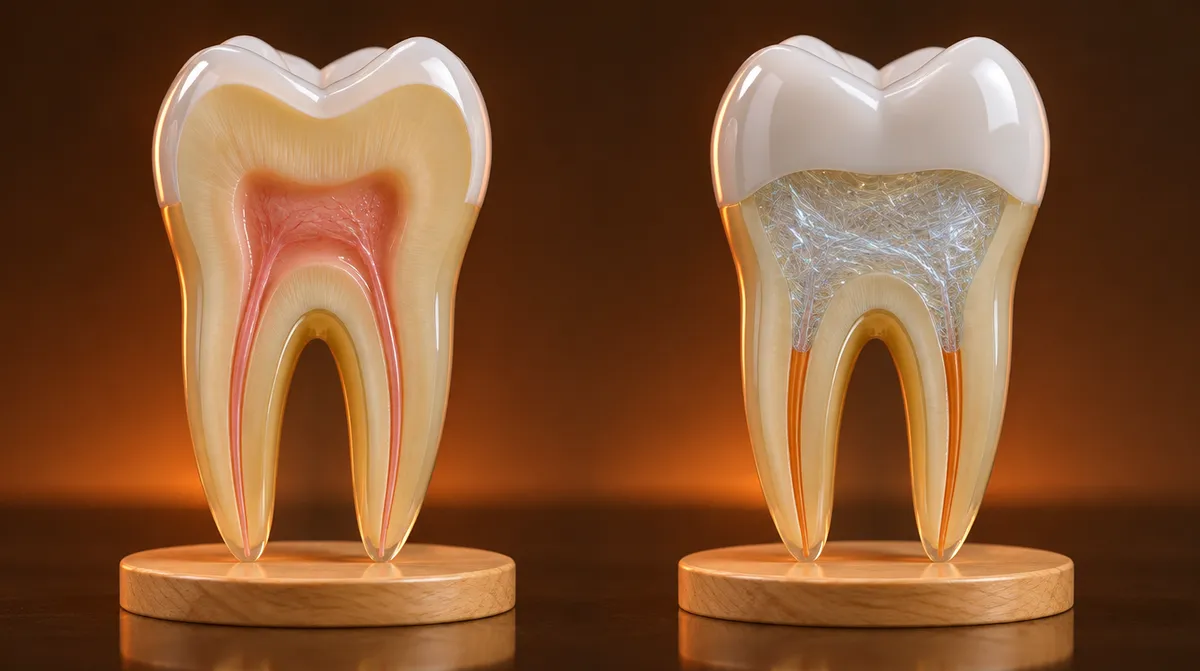
AI-generated illustrationThe natural tooth on the left has enamel on the outside and dentin within. In the treated tooth on the right, a restoration such as a crown takes the place of enamel, and a glass fiber reinforced core takes the place of dentin. This is not a photograph of an actual tooth cross-section.
This is different from a post (Korean) placed in the root canal (the channel inside the root). A post uses the root canal space, while a glass fiber composite core provides support within the coronal part (the head of the tooth).
✅ Teeth we use it for
- Molars and premolars with thin walls after root canal treatment
- Teeth in which even the cheek-side and tongue-side walls have been reduced while removing decay or old restorations
- Teeth that have lost the chewing surface as well as the front and back walls (an MOD cavity)
⚠️ Teeth that cannot be managed with this alone
- Teeth with a vertical root fracture
- Teeth with almost no ferrule (sound tooth structure for the crown to encircle and grip) remaining
- Teeth with thick walls remaining (treated with a conventional composite core)
Why do root canal treated teeth break?
It is the increasing extent of tooth structure removed, more than the root canal procedure itself, that greatly weakens a tooth. In an experiment measuring how well the cusps of extracted premolars resisted bending under force (stiffness), root canal procedures reduced stiffness by about 5%. Preparing an occlusal cavity reduced it by about 20%, and an MOD cavity including the mesial and distal marginal ridges reduced it by about 63%.[1] This did not measure the probability of fracture, but it means that the more walls a tooth loses, the more it bends under chewing forces.
| Extent of tooth preparation | Reduction in stiffness (laboratory) |
|---|
| Root canal procedures | About 5% |
| Occlusal cavity | About 20% |
| MOD cavity (including mesial and distal marginal ridges) | About 63% |
Back teeth that have gone through decay treatment and replacement restorations before reaching root canal treatment have often lost walls in this way. If a restoration alone is placed over a hollow tooth, the thin walls may bend with every bite and develop microcracks. If a crack progresses from beneath the restoration toward the root, replacing the restoration may no longer be enough, and the tooth may become difficult to save.
For a crown to last, a band of sound tooth structure needs to remain above the crown margin. This is called a ferrule (Korean), and a height of about 1.5~2mm is commonly used as a guide.[5][6] The core supports the inside of this band.
Why use glass fiber composite?
Once a crack forms in conventional composite, it can spread readily through the material, while a composite with short glass fibers oriented in different directions is designed so that the crack meets a fiber and stops. We use this material for three reasons.
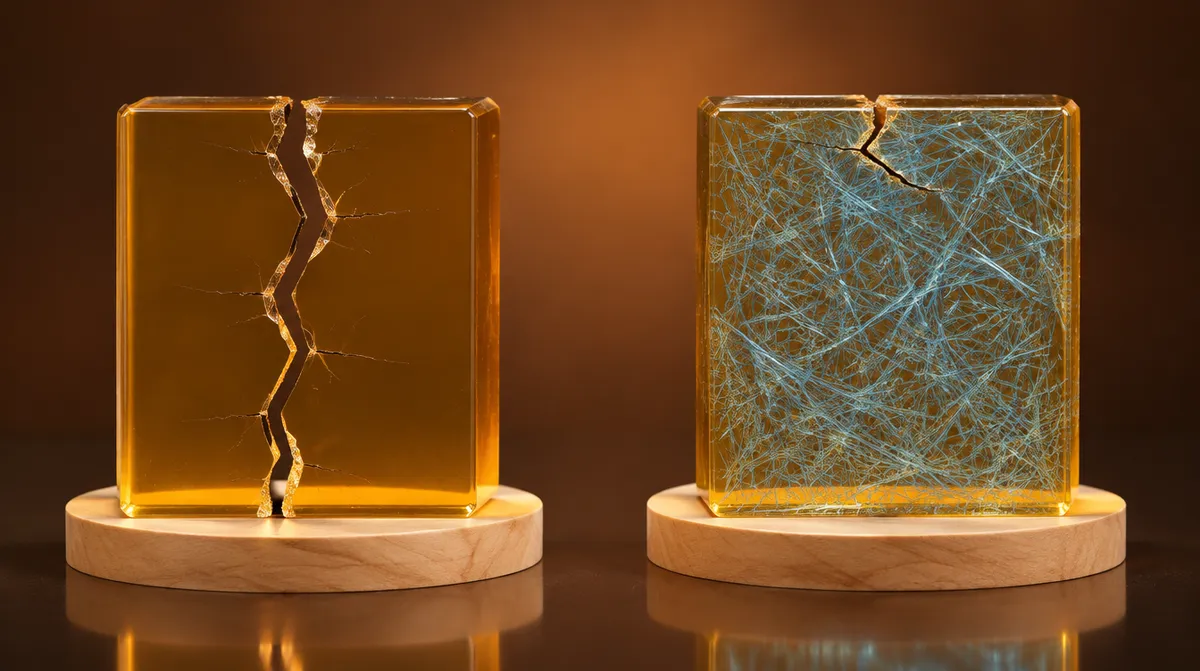
AI-generated illustrationComposite without fibers on the left and composite containing glass fibers on the right. This illustration shows the design principle; it is not a photograph of actual material cross-sections.
- Resistance to cracks. In an experiment during the development of this material, a composite core containing short glass fibers had about 2 times the resistance to crack propagation (fracture toughness) of a composite core without fibers (2.6 versus 1.3 MPa·m½).[2]
- How it breaks. In the same experiment, crowns with this material as the underlying layer showed different fracture patterns depending on the fracture toughness of that layer.[2] Its design to limit crack propagation in the underlying layer is why we choose this material for the space inside thinned walls.
- Filling even narrow, deep areas inside. Because the material is flowable, it is easy to fill narrow, deep corners inside thinned walls. For teeth that need a post because little tooth structure remains, we place the post and then fill around it with this material to provide support.
| Category | Conventional composite core | Glass fiber composite core |
|---|
| Inside the material | Small particles only, without fibers | Short glass fibers oriented in different directions |
| When a crack forms | Can spread readily through the material | Designed to stop the crack when it meets a fiber |
| Role | Core beneath a restoration | Core beneath a restoration + support inside thin walls |
| Teeth treated at Joy Dental Clinic Bongcheon | Teeth with thick walls remaining | Root canal treated back teeth with thin walls |
These values compare experimental materials with and without fibers within the same study.[2] They do not represent all conventional composites on the market.
Resistance to crack propagation (fracture toughness)
Conventional composite core
Glass fiber composite core
Unit: MPa·m½ · Bar endpoint = 3.0 · Laboratory measurements within the same study
Resistance to bending until fracture (flexural strength)
Conventional composite core
Glass fiber composite core
Unit: MPa · Bar endpoint = 200 · Laboratory measurements within the same study
How is the core made?
We do this on the day we take the impression, so you do not need an extra visit for the core.
- Checking the root canal treatment with an X-ray. We check symptoms, the root canal filling and any periapical lesion (a shadow at the root tip) to see whether we can proceed right away.
- Isolation and bonding. A core cannot hold up if the bond is weak, so we isolate the tooth with a rubber dam or a similar method before bonding.
- Building up the core with glass fiber composite. We support the inside of the thinned walls with glass fiber composite and finish the outside with conventional composite.
- Tooth preparation and impression-taking. We shape the supporting tooth to fit the restoration and take a digital impression, then place a temporary tooth until the restoration arrives.
- Bonding the restoration and regular checkups. The director who planned the restoration checks the bite and bonds it. At subsequent checkups, we also examine it with X-rays.
When a glass fiber core alone is not enough
- Teeth with a vertical root fracture. Filling the inside does not join the fracture line back together. We discuss extraction and the options afterward together.
- Teeth with an inadequate ferrule. If about 1.5~2mm of sound tooth structure does not remain above the crown margin, we assess whether it can be exposed through crown lengthening (Korean) (adjusting the gum level) or by moving the tooth upward with orthodontic extrusion. If there is not enough tooth structure to retain the core, we also consider a post.[4][6]
- Teeth whose root canal treatment is not yet complete. If pain on biting or swelling persists, identifying the cause comes before the core.
- People who grind their teeth (bruxism). Both the core and restoration are subjected to heavy forces, so we may also recommend an appliance for bruxism (Korean).
- People who have had an allergic reaction to resin materials. Please let us know before treatment.
Once a core is placed, it is difficult to reverse the procedure, so we check the points above before proceeding.
How much does it cost?
A glass fiber composite core costs KRW 200,000 per tooth and is not covered by Korean National Health Insurance. The restoration is charged separately, and root canal treatment itself is covered by Korean National Health Insurance. The costs of crowns, overlays and onlays are listed in the fee list (non-covered fees). (As of November 2026)
Ask at your consultation if any of these apply
- You have a back tooth that has had or is undergoing root canal treatment
- That tooth has had a large restoration (composite, amalgam or inlay) for some time
- You have felt an ache or a sharp twinge in that tooth when chewing
- A tooth with a crown has broken or been extracted in the past
- You have been told that you clench or grind your teeth
Frequently asked questions
Q. Does every root canal treated tooth need a glass fiber core?
No. We use it for root canal treated teeth with thin walls. If thick walls remain, we use a conventional composite core.
Q. Are a glass fiber post and a glass fiber composite core the same thing?
No. A post is a pillar placed in the root canal, while a glass fiber composite core is a material used to build up the inside of the coronal part of the tooth. For teeth that need a post, we use both together.
Q. Can everything from the core to the restoration be finished in one day?
The core is made on the day we take the impression. The restoration is made at a dental laboratory, so you return once more for bonding.
Q. Can a glass fiber core also break or come loose?
This is an approach intended to reduce the chance of fracture, not to prevent fracture altogether. Results vary with the amount of remaining tooth structure, teeth grinding and chewing habits, and we check promptly if a restoration is suspected to have come loose or developed a crack.
Q. Should a tooth with an old metal post also be changed to glass fiber?
If you are using it without problems, we leave it in place. This is because removing it may damage the root. When a new restoration is needed, we assess its condition and discuss it with you.
Q. How can I consult about a glass fiber core and a restoration together near Bongcheon Station?
At Joy Dental Clinic Bongcheon (Bongcheon Station, Exit 1, 5F Jehyeong Bldg.), we check the root canal treatment with an X-ray and explain the costs and schedule from the core through to the restoration together. If you had root canal treatment elsewhere, bringing the X-rays taken then can help.
Limits of the evidence
- The stiffness reduction figures[1] come from an experiment on extracted premolars and do not directly represent the probability of a tooth breaking in a person’s mouth.
- The fracture toughness and flexural strength figures[2] were measured using experimental materials during development and may differ from the values for commercial products.
- Most research on glass fiber reinforced cores consists of laboratory studies, and there are still few clinical studies with long-term follow-up of patients.[3]
DOCTOR’S NOTE
Before placing a crown or overlay on a back tooth after root canal treatment, I first look at the remaining tooth structure. A restoration only covers the outside, so a tooth with thinned inner walls needs support from within to last. If the walls are thin, I fill the inside with glass fiber composite before placing the restoration, and I continue to examine that tooth myself at checkups after bonding.
— Jeong Jinwoo, Director, Joy Dental Clinic Bongcheon
This post reflects information as of the date of writing and was written to provide general information in compliance with Korea’s Medical Service Act and the Ministry of Health and Welfare’s medical advertising guidelines. Treatment results may vary from person to person depending on tooth condition and lifestyle habits.
We are right next to Exit 1 of Bongcheon Station (Line 2), and directions from Seoul Nat’l Univ. Station, Sillim, Nakseongdae and Sadang are in Getting here.
Joy Dental Clinic Bongcheon
5F Jehyeong Bldg., 1738 Nambusunhwan-ro, Gwanak-gu, Seoul (Bongcheon Station, Exit 1)
Hours: Mon·Wed·Thu·Fri 09:30–18:30 / Tue 09:30–20:30 / Sat 09:30–13:30 (closed Sun & public holidays)
Booking: Naver Booking / Phone 02-877-2867
Further reading: Cavity and root canal treatment guide · Aftercare following root canal treatment · A cracked tooth: crown now or watch? · Treatment case of a premolar fractured while eating (Korean)
References
- Reeh ES, Messer HH, Douglas WH. Reduction in tooth stiffness as a result of endodontic and restorative procedures. J Endod. 1989;15(11):512-516. — [Experimental study] A study measuring how well the cusps resisted bending (stiffness) as extracted premolars underwent root canal treatment and cavity preparation in sequence. Root canal procedures reduced stiffness by about 5%, an occlusal cavity by about 20%, and an MOD cavity including the front and back marginal ridges by about 63%. This study did not measure the force needed to cause fracture or the probability of fracture.
- Lassila L, Keulemans F, Säilynoja E, Vallittu PK, Garoushi S. Mechanical properties and fracture behavior of flowable fiber reinforced composite restorations. Dent Mater. 2018;34(4):598-606. — [Experimental study] A study measuring the properties of an experimental composite core material containing short glass fibers. The material containing 50wt% fibers had higher fracture toughness, 2.6 versus 1.3 MPa·m½, and flexural strength, 175.5 versus 123 MPa, than the material without fibers, and the fracture toughness of the underlying material changed how the crown fractured. The study used experimental materials, not commercial products.
- Garoushi S, Gargoum A, Vallittu PK, Lassila L. Short fiber-reinforced composite restorations: A review of the current literature. J Investig Clin Dent. 2018;9(3):e12330. — [Literature review] A review of 70 papers related to glass fiber reinforced cores. A common finding was that placing this material beneath conventional composite improved load-bearing capacity and fracture patterns, but most studies were laboratory studies and only 4 were clinical reports.
- Mannocci F, Bhuva B, Roig M, Zarow M, Bitter K. European Society of Endodontology position statement: the restoration of root filled teeth. Int Endod J. 2021;54(11):1974-1981. — [Guideline] The European Society of Endodontology's position statement on restoration after root canal treatment. It states that restorations should be selected according to the amount of remaining tooth structure, that root dentin should not be removed unnecessarily for a post, and that a post cannot compensate for an inadequate ferrule.
- Al-Dabbagh RA, et al. Effect of a circumferential ferrule on the survival and success of endodontically treated teeth restored with fiber posts: A systematic review and meta-analysis. J Prosthet Dent. 2024;132(6):1251-1259. — [Meta-analysis] An analysis pooling the effects of the band of tooth structure encircled by a crown (ferrule) on survival and success in root canal treated teeth restored with glass fiber posts.
- Gavriil D, Kakka A, Myers P, O'Connor CJ. Pre-endodontic restoration of structurally compromised teeth: current concepts. Br Dent J. 2021;231(6):343-349. — [Review] An article outlining methods and the sequence of decisions for restoring severely broken-down teeth before root canal treatment. It covers ferrule height criteria and ways to expose tooth structure by adjusting the gum level or through orthodontic extrusion.


 한국어
 日本語
 简体中文