💡 Key answer
No. A sinus lift is a procedure considered when the remaining bone height at an upper molar site is insufficient. If there is enough bone, we place the implant without a lift. If there is a small shortage, we consider gently raising the lining through the implant opening or using a short implant; if there is a large shortage, we make a window in the side to lift a wider area. We decide by measuring the remaining bone height and width on CT cross sections and considering the shape of the sinus floor, the condition of its lining, and the restoration plan together.
Summary for patients
- A CT scan is needed to determine whether you need a sinus lift.
- Please tell us if you have been treated for sinusitis or rhinitis.
- Bring the names of your medications, and do not stop taking them on your own.
- If you have an existing CT scan, please bring the files.
❓ What this article covers
- Does everyone need a sinus lift for an upper molar implant?
- What do we check on CT in the clinic?
- How do the options differ according to remaining bone height?
- When can a short implant or a change in position be used instead of a sinus lift?
- If you have a nasal or sinus problem, does anything need to come before the implant?
- If the sinus lining tears during surgery, does the implant fail?
- How long does treatment take, and how many visits are needed?
Does everyone need a sinus lift for an upper molar implant?
No. If the remaining bone can adequately accommodate the implant, we place it without a sinus lift. Sinus lifts come up often in upper molar implant consultations because of the anatomy of this area.
The maxillary sinus (Korean) is an air-filled space inside the cheekbone, just above the roots of the upper molars. It connects to the nose through a small opening and has a thin membrane lining its floor. After an upper molar is lost, the jawbone often shrinks from below while the sinus floor moves downward from above, leaving a thinner layer of bone between them. A study analyzing CT scans of 128 people with missing upper back teeth found a remaining bone height of 4mm or less at about half of the first and second molar sites.[4]
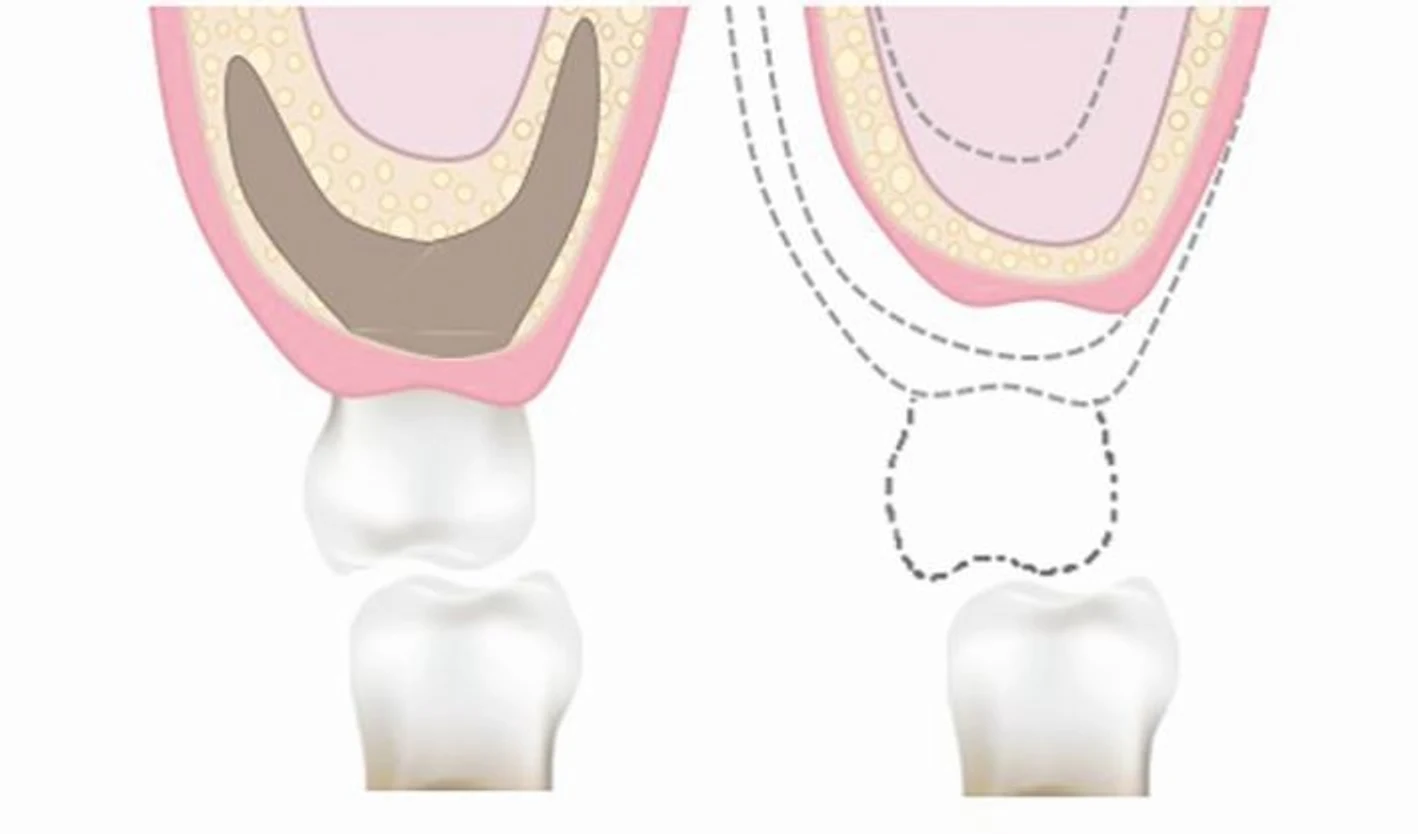
Figure from an external publication · Not a case from our clinicSchematic cross sections with an upper molar present (left) and after extraction (right). When the tooth is lost, the jawbone shrinks from below (the dotted lines show the original outlines of the jawbone and tooth), while the floor of the maxillary sinus (the pink space) moves downward from above, thinning the bone between them. The tooth below is the opposing lower molar.[6]King & Schofield · Figure 1 · DOI: 10.1038/s41415-023-6391-7 · CC BY 4.0 · Enlarged only
It is not a procedure to remove the sinus
Some people arrive thinking the procedure “blocks” or “fills in” the sinus, but that is not an accurate description. A sinus lift (Korean) raises the membrane on the sinus floor without tearing it, then fills the space between the membrane and the bone with bone graft material (Korean). The sinus remains above it, and the aim is for bone to fill the newly created space over time. How much bone forms and when it forms vary with the person and the extent of grafting.
To decide whether a lift is needed, we first check how many mm of bone remain at the site, then consider the bone width, sinus condition, implant length and restoration plan together. Even in the same person, an upper molar site on the right may not need a lift while one on the left does.
What do we check on CT in the clinic?
On CT cross sections, we check the remaining bone height and width, the shape of the sinus floor, the thickness of the sinus lining, and whether there is inflammation. A panoramic X-ray is a flat image that can give an approximate idea of height, but CT (Korean) cross sections are needed to check whether the floor slopes, whether there are partitions, and how thick the lining is.
| What we check | Why we check it |
|---|
| Remaining bone height | How many mm there are from the top of the jawbone to the sinus floor — the first criterion for whether a lift is needed |
| Remaining bone width | Thickness between the cheek and palate sides — even with enough height, insufficient width may require another type of graft |
| Shape of the sinus floor | Whether it is flat, sloping or concave — whether the shape allows the lining to be raised readily through the implant opening |
| Partitions (septa) | Thin bony walls rising from the sinus floor — places where the lining can tear more easily |
| Lining thickness and inflammation | Thickened lining, cysts or accumulated secretions — an ear, nose and throat consultation may need to come before surgery |
| Passage to the nose | Whether the sinus opening is clear |
We measure the remaining bone height directly on the cross section and tell you the measurement in mm, then compare it with the planned implant fixture (Korean) length (the screw-shaped artificial root placed in the bone) to check how many mm are lacking. This difference helps determine whether a lift is needed and, if so, how far to raise the lining.
If you have a CT scan taken elsewhere, please bring the files. We can open them at the clinic. However, if a tooth has been extracted since then or a long time has passed, another scan may be needed.
How do the options differ according to remaining bone height?
If there is ample remaining bone, we first consider placement without a lift; for a small shortage, raising the lining through the implant opening; and for a large shortage, making a window in the side. There is no exact mm cutoff for each method because implant length and diameter, the shape of the floor, and bone hardness also matter.
| CT findings | Option considered | Timing of placement |
|---|
| Enough height and width for the planned implant | Placement without a sinus lift | Same as a standard implant |
| A small shortage | Transcrestal approach (gently raising the lining through the implant opening) or a short implant | Usually the same day |
| A large shortage | Lateral approach (Korean) (making a small window in the bone beside the gum and lifting a wider area of lining) | The same day or several months later, depending on the remaining bone |
| The burden of grafting outweighs the benefit | A prosthesis other than an implant | — |
This is a general summary; the actual choice depends on CT findings, the condition of your mouth, and your general health.
When the transcrestal approach is suitable
We prepare the implant opening to just below the sinus floor, then gently push the floor bone upward through that opening, raising the lining along with it. Because the gum does not need to be opened widely, swelling tends to be less. Reports found outcomes easier to predict when the remaining bone height was at least 5mm and the floor was relatively flat.[2] An analysis pooling implants placed using this method reported a 3-year survival rate of 92.8%.[2]
When the lateral approach is suitable
We consider this approach when the remaining bone is too thin to achieve enough elevation through the implant opening alone, or when a sloping floor and partitions mean the lining needs to be raised under direct vision. Opening the gum and making a window in the side wall can cause more swelling and bruising. A review of 48 studies of the lateral approach reported a 3-year survival rate of 90.1%, and 98.3% when rough-surfaced implants and a barrier membrane covering the window were used.[3]
The two methods are used for different bone conditions and surgical circumstances, so these survival figures alone cannot tell us which is better.
If the remaining bone can hold the implant firmly from the outset, we place it on the day of the sinus lift. Otherwise, we place it separately after the grafted bone has healed.
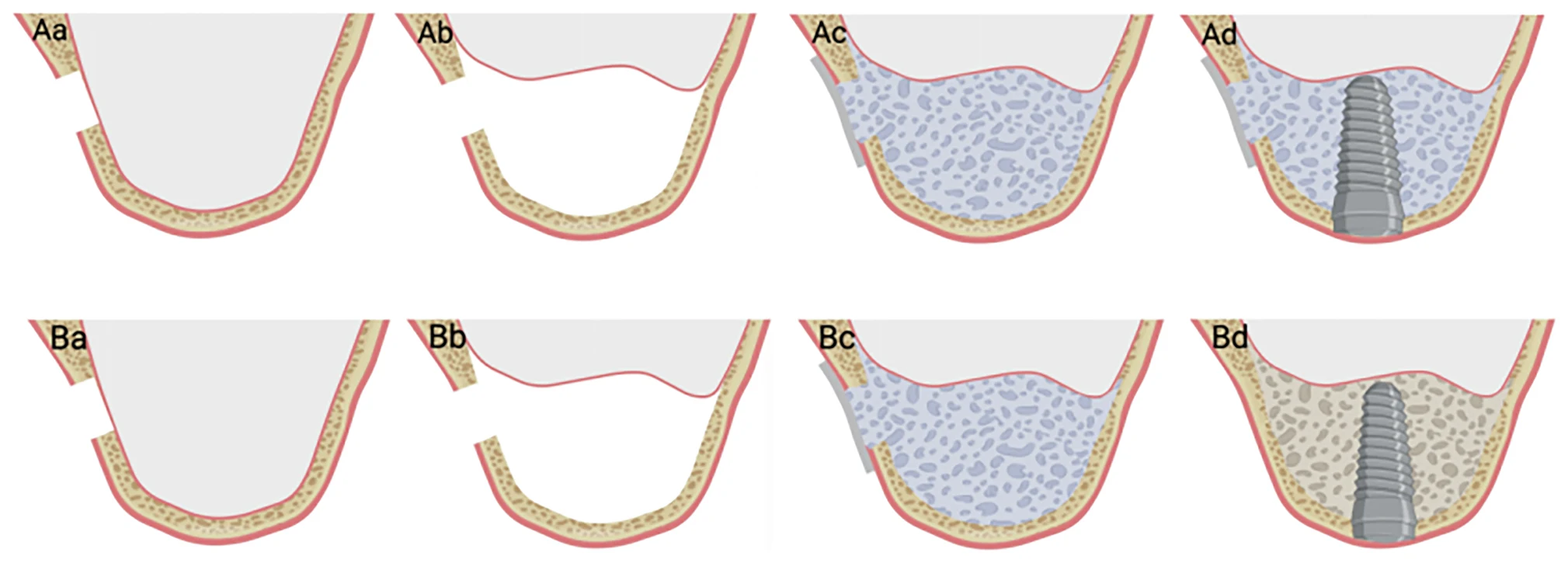
Figure from an external publication · Not a case from our clinicA schematic cross section of the sinus showing the steps of a lateral approach sinus lift. A small window is made in the bone beside the gum (a), the sinus floor lining is lifted without tearing it (b), and the space between the lining and bone is filled with bone graft material (blue granules), with a barrier membrane covering the window (c). The top row (A) shows same-day placement when the remaining bone can hold the implant, while the bottom row (B) shows placement after waiting several months for the grafted bone to heal (d).[7]Liu et al. · Figure 3 · DOI: 10.1038/s41405-025-00380-2 · CC BY 4.0 · Margins cropped only
When can a short implant or a change in position be used instead of a sinus lift?
If some bone remains and chewing forces and the restoration design allow it, a short implant or a change in position or angle may reduce the extent of a sinus lift or sometimes avoid it.
Short implants
A short implant (Korean) uses a shorter implant to suit the remaining bone height. Its diameter is chosen according to the remaining bone width and chewing forces. A Cochrane review of randomized clinical trials comparing short implants (5~8.5mm) with sinus lifts at remaining bone heights of 4~9mm found insufficient evidence to judge which had a lower failure rate up to 1 year after restoration. Surgical site complications were more frequent with sinus lifts.[1]
However, because the root is shorter relative to the crown, we decide carefully if you grind your teeth heavily or habitually clench. We may also consider a design connecting it to a neighboring implant to share the load.
Adjusting position or angle
Even if the bone directly below the sinus is thin, nearby areas with more bone may allow us to shift the placement position slightly or angle the implant to reduce the extent of the lift. We decide whether this is possible by considering the bone shape on CT together with the planned crown position. If the implant is too far out of line with the crown, concentrating chewing forces on one side or leaving too little space for cleaning, we consider another method.
When an option other than an implant is suitable
- When the neighboring teeth on both sides already have extensive crowns, so connecting them with a bridge (Korean) would involve relatively little additional burden
- When several upper molars are missing and a partial denture could replace them together
- When additional surgeries and a longer treatment period would place a major burden on your health or daily life
In these cases, we compare other options when planning. A comparison of the three methods is available in Are there alternatives to implants?.
If you have a nasal or sinus problem, does anything need to come before the implant?
Yes. If the sinus is inflamed or its opening is blocked, we arrange the sinus lift after an ear, nose and throat specialist has first brought it under control. Lifting an inflamed lining can worsen inflammation after surgery or lead to infection of the graft material.
A thickened sinus lining on CT is more common than you might expect. In the CT study mentioned earlier, 60.6% of patients had a lining thicker than 2mm. When it was thicker than 5mm, especially with a polyp-like shape, the proportion with a blocked sinus opening was higher, and the researchers suggested that an ear, nose and throat consultation before a sinus lift may help in these cases.[4] Slight thickening alone does not rule out surgery, so we assess thickness, shape and symptoms together.
What to tell us at your consultation
- Any history of treatment for sinusitis or rhinitis, or nasal surgery
- Whether one side of your nose is always blocked or you often have yellow nasal discharge
- Any nasal sprays or rhinitis medications you use daily
- Your medications — especially blood thinners and osteoporosis medicines: do not stop them on your own, and tell us their names
- Whether you have diabetes and your recent readings, and whether you smoke
This information affects the surgery date, medications before and after surgery, and any care needed with other specialists.
If the sinus lining tears during surgery, does the implant fail?
A tear in the lining does not necessarily mean the implant will fail. However, depending on the size of the tear, we may stop surgery that day or change the plan. A meta-analysis pooling 12 studies and 1,652 sinus lifts found membrane perforation in about 1 in 4 procedures (23.5%); when appropriately managed, the difference in implant survival between sites with and without perforation was not statistically significant.[5] A thin membrane or partitions increase the risk of tearing, so the CT checks described earlier are also useful here.[5]
- A small hole: We often cover it with a resorbable membrane and continue grafting and implant placement.
- A large hole: Graft material could leak into the sinus, so we may stop grafting that day and plan again several months later, after the lining has healed.
If this happens during surgery, we explain afterward what we did and any extra precautions you need to take at home. Nasal symptoms after surgery, such as nosebleeds or congestion, and which symptoms can be monitored are covered separately in Nosebleeds or congestion after a sinus lift: what is within the expected range, and how do we check?.
How long does treatment take, and how many visits are needed?
Placement without a sinus lift follows the standard implant schedule. With a sinus lift, the time depends on whether the implant is placed the same day or separately after building up bone first. An upper jaw implant generally takes 3~6 months to bond to the bone (osseointegration (Korean)).
- Examination and consultation: We check the remaining bone and sinus condition on CT and decide on the method. If an ear, nose and throat consultation is needed, we set the surgery date after reviewing the findings.
- Surgery: This is performed under local anesthesia. During surgery, we explain which stage we are at, and we tell you beforehand to raise your hand if you want us to pause. We recommend returning the next day for cleaning and dressing of the site.
- Stitch removal and healing check: We check both the surgical site and any nasal symptoms.
- Bone healing period: With same-day placement, the grafted bone heals while the implant bonds to the bone. We decide when to fit the restoration based on initial stability, the extent of the graft and healing. If bone is built up first, we wait several months before placing the implant separately. There are checkup visits during the waiting period.
- Restoration: We take an impression and attach the crown. On the day it is attached, we take a close-up X-ray of the root area (a periapical X-ray) as a baseline for comparison at future checkups.
- Regular checkups: The usual schedule is a first checkup 3 months after attaching the restoration, followed by checkups every 6 months.
The additional time for each method is summarized in a table in I was told I cannot have implants because there is not enough bone. Are there really no options?. Treatment fees are listed in the fee list (non-covered fees).
Frequently asked questions (FAQ)
Q. Will a sinus lift interfere with breathing through my nose?
A sinus lift uses only part of the space at the sinus floor; it does not operate on the nasal breathing passage itself. After surgery, swelling of the lining may make the operated side of the nose feel congested. Please contact us if the blockage worsens instead of easing. Symptoms that can be monitored are described in our article on nasal symptoms after a sinus lift.
Q. My tooth was removed a long time ago. Does waiting longer make a sinus lift more likely?
It may. After an upper molar is extracted, the jawbone often shrinks and the sinus floor moves downward, so the remaining bone becomes thinner over time. However, the rate varies from person to person, and we cannot be certain until we measure the current condition on CT. If you have an upper molar that will be extracted, we can also consider a bone preservation procedure on the day of extraction.
Q. Is the transcrestal approach always better than the lateral approach?
No. The transcrestal approach involves a smaller opening but has limits on how far the lining can be raised. The lateral approach causes more swelling but allows elevation under direct vision where bone is very limited. A review of randomized clinical trials also found no evidence that any one method reduced implant failure.[1] We decide on the method according to the remaining bone and the shape of the floor.
Q. Is a sinus lift very painful?
Surgery is performed under local anesthesia. If you feel sensitivity or pain during surgery, we can give more anesthetic, so please raise your hand rather than putting up with it. Pain and swelling after surgery can often be managed with the prescribed medication, and the lateral approach may cause more swelling and bruising than the transcrestal approach.
Q. What should I prepare for an upper molar implant consultation near Bongcheon Station?
Please bring any existing CT files. Providing your medication list and history of treatment for sinusitis or rhinitis in advance also helps us check whether you need a sinus lift and whether an ear, nose and throat consultation should come first.
Limits of the evidence
- The review comparing short implants with sinus lifts[1] focused on outcomes up to 1 year after restoration and had few participants, so long-term outcomes are difficult to judge from these data alone.
- The survival figures[2][3] mainly pool observational studies without control groups, so results may vary with surgical methods and patient conditions.
- The CT study[4] analyzed patients from one region at one point in time, so the proportions for lining thickness and remaining bone height may not be the same in other populations.
- In the membrane perforation meta-analysis[5], incidence varied widely across studies, from 3.6~41.8%, so the average cannot be applied directly to one person’s surgical risk.
DOCTOR’S NOTE
When planning an upper molar implant, I measure the remaining bone height on CT cross sections to check whether a sinus lift is needed.
If the sinus lining is thick or the opening appears blocked and there are nasal symptoms, an ear, nose and throat consultation should come before surgery.
— Jeong Jinwoo, Director, Joy Dental Clinic Bongcheon
This post reflects information as of the date of writing and was written to provide general information in compliance with Korea’s Medical Service Act and the Ministry of Health and Welfare’s medical advertising guidelines. Sinus lifts and implant surgery may have side effects such as bleeding, nosebleeds, swelling, bruising, pain, infection, perforation of the sinus lining, and leakage of graft material; in rare cases, sinusitis or failure of osseointegration may occur. Individual diagnosis and the direction of treatment depend on the condition of your mouth, so please be sure to consult fully with your treating clinician before deciding.
We are right next to Exit 1 of Bongcheon Station (Line 2), and directions from Seoul Nat’l Univ. Station, Sillim, Nakseongdae and Sadang are in Getting here.
Joy Dental Clinic Bongcheon
5F Jehyeong Bldg., 1738 Nambusunhwan-ro, Gwanak-gu, Seoul (Bongcheon Station, Exit 1)
Hours: Mon·Wed·Thu·Fri 09:30–18:30 / Tue 09:30–20:30 / Sat 09:30–13:30 (closed Sun & public holidays)
Booking: Naver Booking / Phone 02-877-2867
Related pages: Implant guide · Sinus lift (Korean) · Lateral sinus lift (Korean) · Short implants (Korean)
References
- Esposito M, Felice P, Worthington HV. Interventions for replacing missing teeth: augmentation procedures of the maxillary sinus. Cochrane Database Syst Rev. 2014;(5):CD008397. — [Systematic review] A Cochrane review of 18 randomized clinical trials (650 participants). In 4 trials (102 participants) comparing short implants (5~8.5mm) with sinus lifts at remaining bone heights of 4~9mm, the evidence was insufficient to determine differences in implant or prosthesis failure 1 year after restoration, and surgical site complications were more frequent with sinus lifts. Studies comparing sinus lift techniques also found no evidence that any one technique reduced failure.
- Pjetursson BE, Lang NP. Sinus floor elevation utilizing the transalveolar approach. Periodontol 2000. 2014;66(1):59-71. — A review of sinus lifts using the transcrestal approach (through the implant opening). A review covering 4,388 implants reported a 3-year survival rate of 92.8%; at the patient level, about 1 in 10 experienced implant loss over 3 years. Membrane perforation occurred in 3.8% and postoperative infection in 0.8%. Outcomes were most predictable when the remaining bone height was at least 5mm and the sinus floor was relatively flat.
- Pjetursson BE, Tan WC, Zwahlen M, Lang NP. A systematic review of the success of sinus floor elevation and survival of implants inserted in combination with sinus floor elevation. J Clin Periodontol. 2008;35(Suppl 8):216-240. — [Systematic review] 48 studies of lateral approach sinus lifts, covering 12,020 implants: the 3-year implant survival rate was 90.1%, and 98.3% when rough-surfaced implants and a barrier membrane over the window were used.
- Shanbhag S, Karnik P, Shirke P, Shanbhag V. Cone-beam computed tomographic analysis of sinus membrane thickness, ostium patency, and residual ridge heights in the posterior maxilla: implications for sinus floor elevation. Clin Oral Implants Res. 2014;25(6):755-760. — [Cross-sectional study] CBCT analysis of 128 people with missing upper back teeth (199 sinuses). About half of the first and second molar sites had a remaining bone height of 4mm or less, and 60.6% of patients had a sinus lining thicker than 2mm. When the lining was thicker than 5mm, especially with a polyp-like shape, the proportion with a blocked sinus opening was higher; the authors suggested that an ear, nose and throat consultation before a sinus lift may be helpful in these cases.
- Al-Dajani M. Incidence, risk factors, and complications of Schneiderian membrane perforation in sinus lift surgery: a meta-analysis. Implant Dent. 2016;25(3):409-415. — [Meta-analysis] 12 studies, with 388 membrane perforations in 1,652 sinus lifts (weighted incidence 23.5%, range across studies 3.6~41.8%). A thin membrane or bony partitions (septa) inside the sinus increased the risk. The difference in implant survival between sites with and without perforation was not significant.
- King EM, Schofield J. Restoratively driven planning for implants in the posterior maxilla - Part 1: alveolar bone healing, bone assessment and clinical classifications. Br Dent J. 2023;235(8):585-592. — [Review] The schematic showing how the remaining bone becomes thinner through alveolar bone resorption and sinus expansion after upper molar extraction (Figure 1) is reproduced under the CC BY 4.0 license. The article reviews bone healing, bone assessment and classifications for implant planning in the posterior upper jaw.
- Liu H, Liu H, Jiang Q. External sinus lift with simultaneous implant placement for severely atrophic maxilla: optimization of staged surgical approaches. BDJ Open. 2025;11:87. — [Retrospective study] The schematic showing the lateral approach sinus lift sequence and comparing same-day with delayed placement (Figure 3) is reproduced under the CC BY 4.0 license. The study compared changes in bone height and width with simultaneous and staged placement in severely atrophic upper jaws.


 한국어
 日本語
 简体中文