💡 Key answer
A restoration on a front tooth does not always need to be remade just because it looks a different color. The solution depends on whether the surface of the restoration is stained, its margin near the gum is exposed, the neighboring natural teeth have changed color, or the restoration itself did not match from the start or has changed color during use. That is why we first check where the color difference comes from before deciding whether to remake it.
Summary for patients
- Surface stains may improve with cleaning and polishing.
- For a dark line near the gum, we first check for a gap or decay.
- Whitening does not lighten restorations as much as natural teeth.
- If neighboring teeth have been whitened, we compare after their color has settled.
- If the color has changed along the margin, have it checked even if it does not hurt.
Hello. I am Jeong Jinwoo, Director of Joy Dental Clinic Bongcheon. I first check the restoration and the tooth underneath with an intraoral examination and a periapical X-ray, explain why the color looks different, and then discuss treatment options.
Terms explained
Why does only the restored front tooth look a different color?
There are four broad causes, depending on where the color has changed. Tooth color comes from both the color inside the tooth and stains on its surface, and natural teeth generally become gradually darker and yellower with age.[1] Natural teeth and restorations change color in different ways, and restorations can also develop stains or changes in the color of the material, so we first need to identify which area has changed.
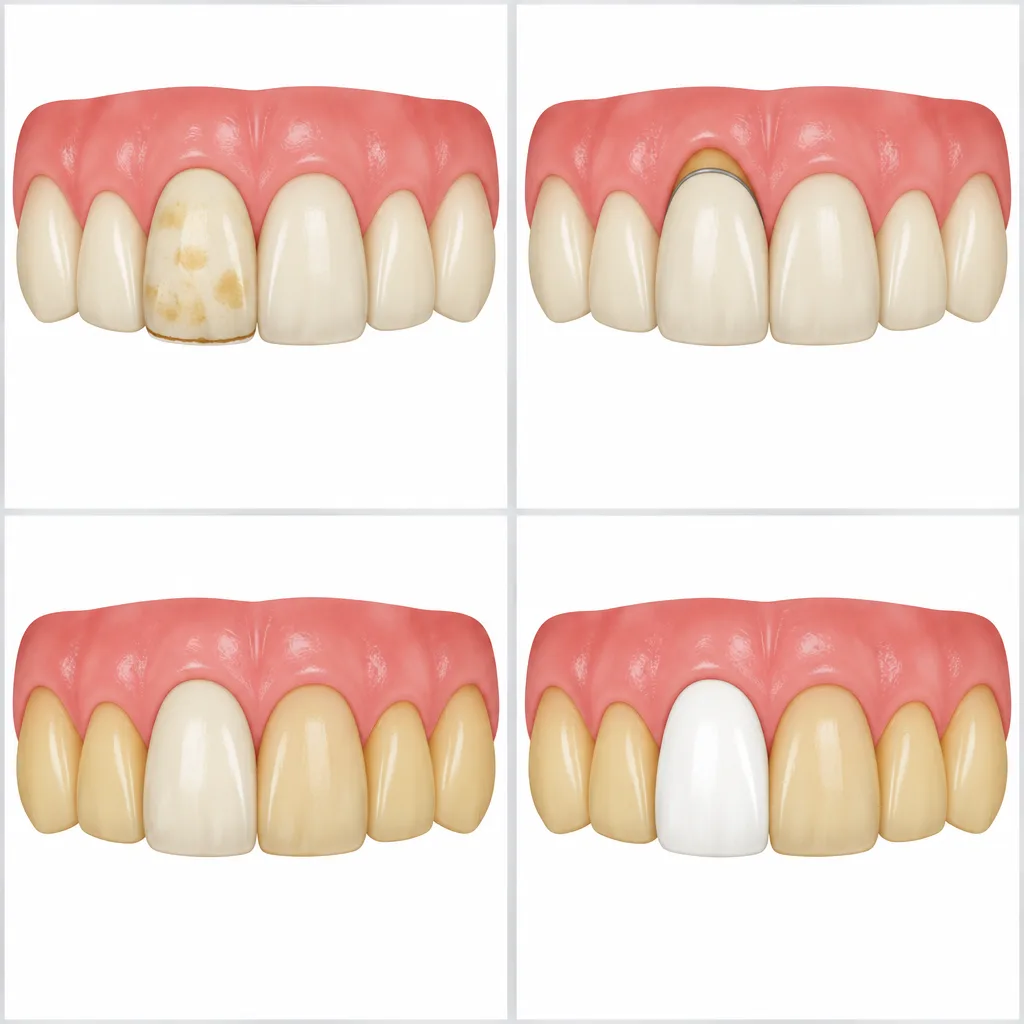
AI-generated explanatory illustrationFrom the top left: surface staining, the margin near the gum, changes in neighboring natural teeth, and the color of the restoration itself
| Cause | Area of change | Main appearance | Response |
|---|
| Surface staining | Surface and margin of the restoration | Yellow or brown patches, staining in a line along the margin | Scaling (Korean) and polishing |
| Margin near the gum | Between the edge of the restoration and the gum | A gray or black line along the gumline, or the root becoming visible as the gum recedes | Check the gum condition and the margin (Korean) (edge of the restoration) |
| Changes in neighboring natural teeth | Teeth next to the restoration | The restoration stays the same, but neighboring teeth become yellower or lighter | If they have darkened, consider whether stain removal or whitening (Korean) is needed; if whitening has lightened them, compare after the color stabilizes |
| Color of the restoration itself | The whole restoration | Brightness or translucency differs from neighboring teeth from the start, or the material changes color during use | Consider remaking it |
To decide whether to remake it, we check whether the color difference appears only in photos or under certain lighting or is also visible in everyday life, how much it bothers you, and the condition of the restoration and tooth.
If there are surface stains, can the restoration be kept without remaking it?
In some cases, it does not need to be remade. If stains from coffee, tea or tobacco are on the surface of the restoration, cleaning and polishing suited to the material may improve them. If the staining is deep or the surface has defects, a partial repair or remaking the restoration may be necessary. For staining along the boundary between the restoration and the tooth, we first check whether a gap or decay is also present.
What do you check if there is a dark line near the gum?
We first check where the line comes from. There are three main causes.
- The margin of a restoration containing metal shows through: With a PFM crown (Korean) that has a metal framework inside, the metal color at the margin may show through as a gray line if the gum is thin or has receded.
- There is gum recession (Korean) (the gum has moved down): If the tooth root becomes exposed between the restoration margin and the gum, it often looks like a band because the root is darker and yellower than the restoration.
- A gap or decay has developed at the margin: If a gap forms at the edge of the restoration or secondary decay (Korean) develops underneath, the margin may become dark. This is a matter of tooth health rather than color, so we check it with a periapical X-ray and an intraoral examination.
For the first two causes, whether the line is visible when you smile matters. If it is hidden by the lip and there is no gum inflammation or gap, we can monitor it. For the third cause, the extent and progression need to be checked regardless of the color. We also look into the cause of any gum inflammation to decide whether monitoring, a partial repair, gum treatment or remaking the restoration is needed.
What if the neighboring teeth have changed color?
We check why the neighboring natural teeth have changed color and, if necessary, compare again after stain removal or whitening. Because natural teeth darken or become stained over time, a restoration matched a few years ago may now look relatively bright.[1]
Conversely, a restoration can look dark because only the neighboring teeth have been whitened. Crowns, veneers and composite resin do not become lighter to the same extent as natural teeth with whitening.[3] So if you want all your front teeth to be lighter, whitening comes first, and we decide whether to rematch the restoration after the color stabilizes.
When a natural tooth that has had root canal treatment becomes darker, the causes and treatment differ. This is covered separately in When a front tooth gradually darkens after root canal treatment.
When do you remake a restoration whose own color does not match?
If the brightness or translucency of the restoration itself still differs clearly from the neighboring teeth after checking for staining, gum problems and changes in neighboring teeth, we consider remaking it. Removing the existing restoration during this process may require additional shaping of the tooth, so we do not decide immediately based on color alone.
When we consider remaking the restoration
- When there is a gap at the restoration margin or decay underneath
- When the restoration is broken or cracked and the extent of the damage and the condition of the material make a partial repair difficult
- When gum inflammation around the restoration persists because of its shape or margin
- When the color difference remains visible in everyday life after surface stains have been removed and the color of neighboring natural teeth has been checked
- When you have finished whitening the neighboring teeth and want the restoration to match their new color
Conversely, there is no need to rush into remaking it if cleaning and polishing restore the color, or if an examination finds no gap, decay, fracture or inflammation and the line near the gum is not visible when you smile or the difference appears only under certain lighting or in photos. In these cases, you can decide by weighing how much it bothers you in everyday life against the amount of tooth reduction involved in remaking it.
If you decide to have it remade, we also discuss the material. I mainly use zirconia (Korean) for crowns, and I use e.max (lithium disilicate) crowns (Korean) only for front teeth, not for molars. If you are concerned about metal color showing through near the gum, we consider a metal-free material. I explain in advance that even a new restoration may develop a color difference from neighboring teeth over time.
Frequently asked questions (FAQ)
Q. How much more of the tooth needs to be reduced if the restoration is remade?
We check the condition with an intraoral examination and a periapical X-ray before removal, but the actual extent may depend on the decay visible after the restoration is removed and the condition of the remaining tooth.
Q. My front tooth with composite bonding has turned yellow. Do I need a crown instead?
Not necessarily. In some cases, the color of composite resin can be improved by polishing the surface or adding new resin to part of it. We first check the extent of discoloration, the condition of the resin bond, whether there is decay or a fracture, and the condition of the remaining tooth to decide whether a resin repair is possible. If a veneer or crown is needed, we explain the extent of tooth reduction and the advantages and disadvantages.
Q. I have had the restoration for a long time, but nothing bothers me except the color. Should I still have it checked?
Gaps at restoration margins and decay underneath often do not hurt in the early stages. If the color has changed along the margin, we recommend having it checked even if you have no discomfort. The lifespan of restorations is covered in Restoration lifespan (Korean).
Related articles: When a front tooth gradually darkens after root canal treatment · Front tooth veneers: how much tooth is removed? · Aesthetic restoration treatment guide
This post reflects information as of the date of writing and was written to provide general information in compliance with Korea’s Medical Service Act and the Ministry of Health and Welfare’s medical advertising guidelines. Remaking a restoration may involve tooth reduction and side effects such as sensitivity, gum irritation, the restoration coming off or fracturing, tooth damage during removal of the existing restoration, and inflammation of the dental pulp. Whitening may cause side effects such as sensitivity and gum irritation. Individual diagnosis and the direction of treatment depend on the condition of your mouth, so please be sure to consult fully with your treating clinician before deciding.
We are right next to Exit 1 of Bongcheon Station (Line 2), and directions from Seoul Nat’l Univ. Station, Sillim, Nakseongdae and Sadang are in Getting here.
Joy Dental Clinic Bongcheon
5F Jehyeong Bldg., 1738 Nambusunhwan-ro, Gwanak-gu, Seoul (Bongcheon Station, Exit 1)
Hours: Mon·Wed·Thu·Fri 09:30–18:30 / Tue 09:30–20:30 / Sat 09:30–13:30 (closed Sun & public holidays)
Booking: Naver Booking / Phone 02-877-2867
Related pages: Aesthetic restoration treatment guide · Shade guide (Korean) · Gum recession (Korean)
References
- Joiner A. Tooth colour: a review of the literature. J Dent. 2004;32 Suppl 1:3-12. — Review of the literature on tooth color: tooth color consists of internal color and surface staining. Teeth generally become darker and yellower with age, and food, smoking and other factors cause surface staining.
- Paravina RD, Ghinea R, Herrera LJ, et al. Color difference thresholds in dentistry. J Esthet Restor Dent. 2015;27 Suppl 1:S1-9. — Color difference thresholds in dentistry: the study distinguished between a difference that can be seen (perceptibility threshold) and one that is acceptable (acceptability threshold).
- Attin T, Hannig C, Wiegand A, Attin R. Effect of bleaching on restorative materials and restorations—a systematic review. Dent Mater. 2004;20(9):852-861. — Systematic review of the effects of bleaching agents on restorative materials: bleaching does not lighten restorations such as composite resin and ceramics in the same way as natural teeth.
- Choi JW, Lee MJ, Oh SH, Kim KM. Changes in the physical properties and color stability of aesthetic restorative materials caused by various beverages. Dent Mater J. 2019;38(1):33-40. — Comparison of the color stability of aesthetic restorative materials immersed in various beverages: color changes differed depending on the beverage and the material.


 한국어
 日本語
 简体中文