💡 Key answer
A front tooth that darkens after root canal treatment often has discoloration from pigments inside the tooth, so we first consider nonvital tooth bleaching (Korean), which places a bleaching agent inside the tooth, rather than whitening applied to the outside. Whether bleaching is enough or the tooth needs covering depends on whether the previous root canal treatment is still sound, how much tooth remains and what color it has become. It may not become as light as you want, or it may darken again a few years later, so before removing tooth structure, we first check whether bleaching is suitable for the tooth.
Summary for patients
- Before bleaching, we check the previous root canal treatment with an X-ray.
- Nonvital tooth bleaching involves several visits to replace the bleaching agent.
- If you feel discomfort during bleaching, please contact us without waiting for your appointment.
- If you want all your front teeth whitened, please tell us at the consultation first.
- After bleaching, we continue to check the color and the neck of the tooth at regular checkups.
❓ What this article covers
- Why does a front tooth darken after root canal treatment?
- What are the options, and how do they differ?
- What do we check in the treatment room?
- How is nonvital tooth bleaching done?
- Can the lightened color darken again?
- What is the order if I want all my front teeth to be lighter?
- When is covering the tooth more suitable than bleaching?
- How long does treatment take, and how many visits are needed?
Why does a front tooth darken after root canal treatment?
It is mainly because pigments seep into the dentin inside the tooth. Blood components and tissue left behind as the pulp becomes damaged, along with pigments from materials placed inside the root, seep along the fine tubules in dentin, making the tooth look gray or brown from the outside. In a study analyzing 255 teeth that underwent nonvital tooth bleaching, trauma (an impact) was the most common cause of discoloration at 58.8%, followed by previous dental treatment and pulp necrosis.[1]
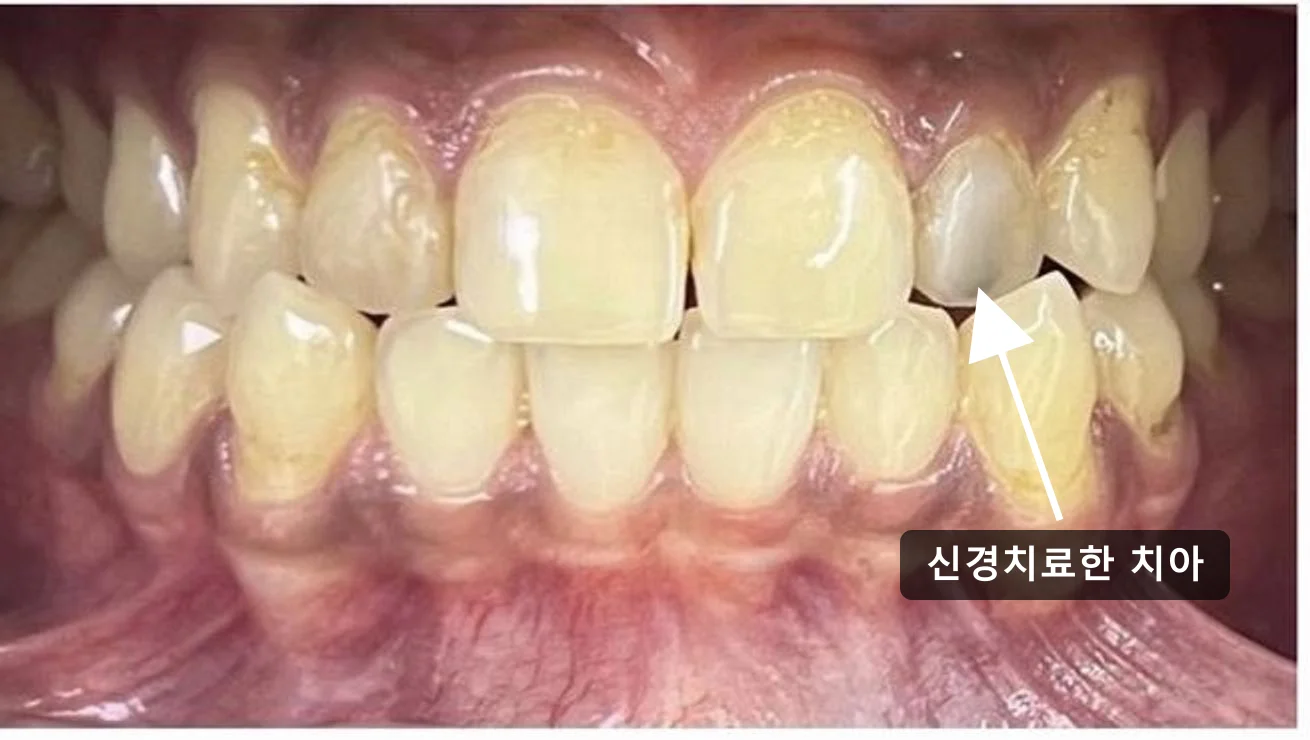
Photograph cited from an external paper · Not a case from our clinicOnly the upper lateral incisor that has had root canal treatment has darkened to gray. Actual decisions are based on the patient's own X-ray and examination results.Aljanahi et al. · Br Dent J 2025 · Fig. 1(b) · DOI: 10.1038/s41415-025-8386-z · CC BY 4.0 · Cropped to the right-hand photograph only, with Korean labels added
Surface stains from coffee and tobacco can be removed by scaling and polishing, but discoloration arising inside the tooth cannot. Depending on its cause and extent, in-office whitening (Korean) or home whitening (Korean) applied to the outside alone may not lighten it as much as you want.[3] The types of discoloration are covered separately in Tooth discoloration (Korean).
What are the options, and how do they differ?
There is nonvital tooth bleaching, which lightens the tooth from within, and there are ways to mask the color by covering it with materials such as composite resin, a veneer or a crown. The actual amount of tooth structure removed depends on the existing restoration and the condition of the remaining tooth.
| Method | What it does | Tooth structure removed | When it fits | Points to consider |
|---|
| Nonvital tooth bleaching (Korean) (internal bleaching) | A small opening is made at the back of the tooth; bleaching agent is placed inside and replaced to match the color | Uses the existing root canal access opening (the existing resin may need to be removed or adjusted) | Internal discoloration with an adequate root filling and sufficient tooth walls — response varies with the color and cause | May darken again; rarely, cervical resorption |
| Composite resin (Korean) (direct restoration) | Tooth-colored material is added to the front surface to mask the color | None or little | Mild discoloration or a small color correction after bleaching | Discoloration and wear over time; dark colors are difficult to mask |
| Veneer (Korean) | A thin layer is removed from the front surface and a ceramic shell is bonded on | Mainly the front surface; the extent varies with discoloration and shape | Sufficient tooth walls remain and you also want to change the shape or size | Dark discoloration may show through; removed tooth structure cannot be restored to its original state |
| Crown (Korean) | Covers the whole tooth; a post and core (Korean) is placed if needed | All around the tooth — usually the most of the four methods | Little tooth structure remains, or there is a large resin filling or a broken area | Removed tooth structure cannot be restored to its original state |
There are reports that preparing a front tooth for a crown removes about 63~72% of the tooth above the gum line, while veneers involve 1/4 to 1/2 of that amount (Aesthetic restoration treatment guide). The amount removed for a veneer is covered in Front-tooth veneers: how much tooth structure is removed?.
What do we check in the treatment room?
First, we use an X-ray to see whether the previous root canal treatment is still sound, check how much tooth remains, and then record the current color using a tooth shade guide. A mirror alone cannot tell us why the color has darkened or how much tooth structure remains.
Is the previous root canal treatment still sound?
We check this before the color. A periapical X-ray shows whether there is a periapical lesion (Korean) (a lesion around the root tip) and whether the root canal is adequately filled all the way to the end. Nonvital tooth bleaching is performed after confirming an adequate root filling and placing a sealing barrier over it.[3] If a lesion is visible at the root tip, we check when the previous root canal treatment (Korean) was done, the symptoms and changes on X-rays to decide first whether further treatment is needed; the color comes after that.
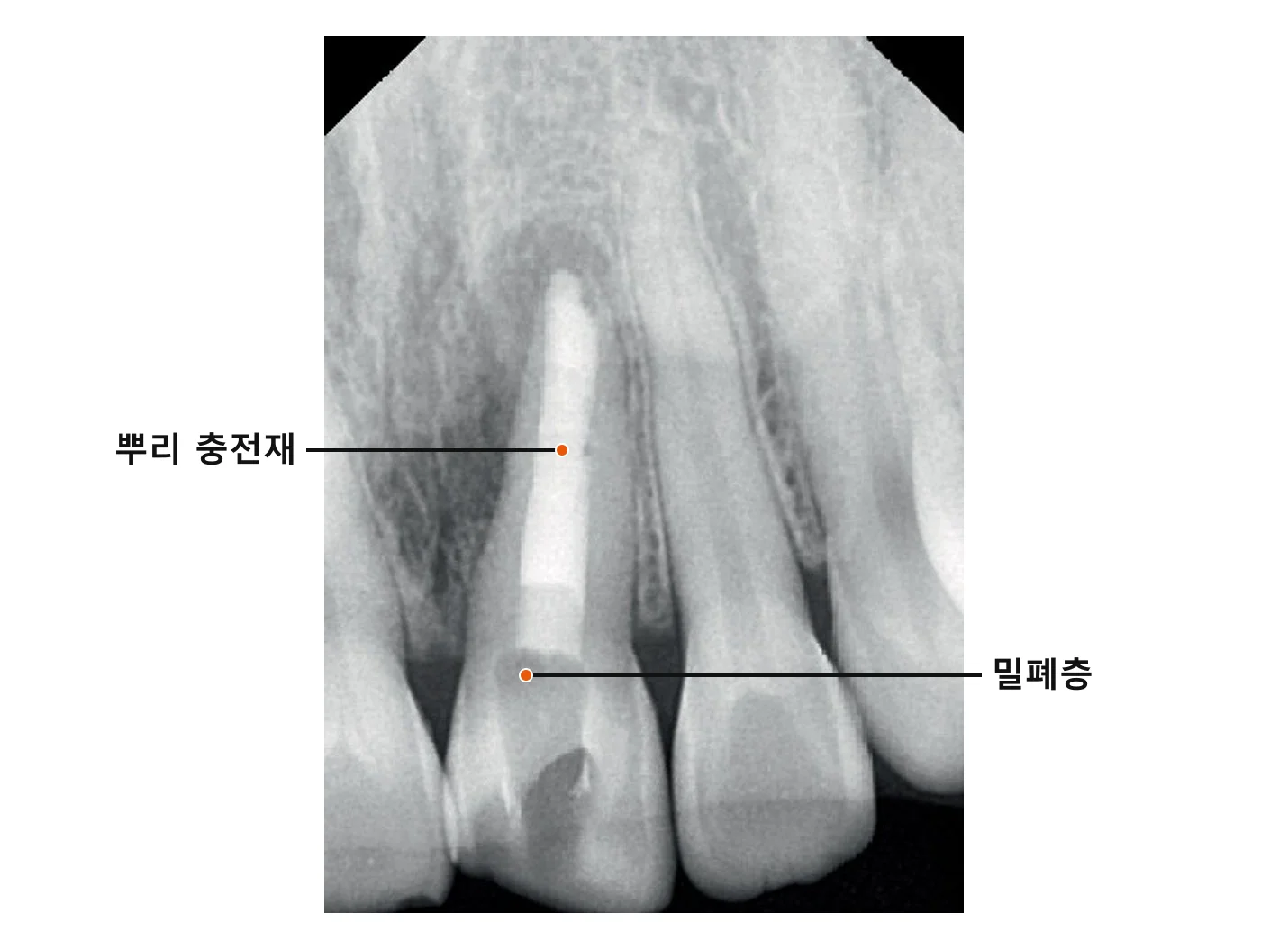
Photograph cited from an external paper · Not a case from our clinicX-ray before nonvital tooth bleaching — a sealing barrier covers the root filling. The bleaching agent is placed above this barrier, inside the crown of the tooth.Bhojwani et al. · Case Rep Dent 2025 · Figure 6 · DOI: 10.1155/crid/5318875 · CC BY 4.0 · Enlarged, with Korean labels added
If just one front tooth has darkened without ever having root canal treatment, the pulp may have died (Korean) after an impact in the past. It needs to be checked even if it does not hurt.
How much tooth structure remains?
Even if bleaching lightens the color, the weakness of the tooth remains. With an X-ray and an examination inside the mouth, we check whether there is a large resin filling apart from the root canal access opening on the back of the front tooth, a broken area or a post, and we also check for discomfort when tapping the tooth.
What shade is the dark color?
We record the color before treatment with this shade guide and compare the response during bleaching using the same guide. In the study, gray or light yellow discoloration lightened with relatively fewer applications, while dark yellow and black discoloration needed more replacements of the bleaching agent.[1] Discoloration caused by metal materials such as amalgam does not respond well to bleaching.[3]
How is nonvital tooth bleaching done?
We open the access at the back, place a sealing barrier over the root filling, then leave a bleaching agent inside the crown of the tooth for a few days, repeating this process until the color matches.
- We remove the existing resin at the back and take out a small amount of root filling to below the level of the neck of the tooth.
- We place a sealing barrier (base) over it to keep the bleaching agent from leaking toward the root.
- We put bleaching agent inside the crown of the tooth and temporarily seal the opening.
- At the next visit, we compare the color with the shade guide and replace the bleaching agent if more lightening is needed.
- Once the color matches, we remove the bleaching agent and seal the opening with a permanent material.
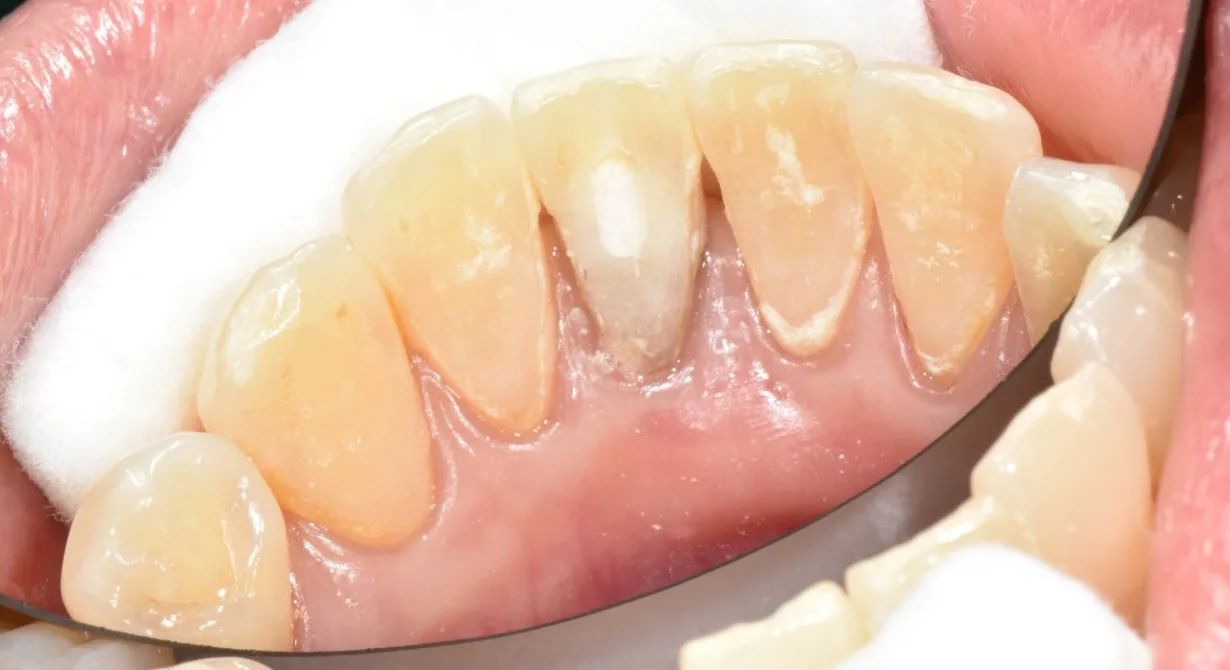
Treatment at Joy Dental Clinic BongcheonBack of a lower front tooth during nonvital tooth bleaching — bleaching agent placed in the opening (mirror photograph)
Why a sealing barrier is placed
Cervical resorption (loss of the hard tissue at the neck of the tooth as it breaks down) has been reported in rare cases. In a study following 204 bleached root-filled teeth for 1~19 years, it was observed in 4 teeth (1.96%); all four had a history of trauma and had been treated with 30% hydrogen peroxide and heat together, without a sealing barrier over the root filling.[2] This is why a sealing barrier is placed over the filling in current nonvital tooth bleaching.[3]
Can the lightened color darken again?
It can darken again.[3] That is why carefully sealing the back opening after bleaching is important. The analysis of 255 teeth mentioned earlier reported that the lightened color was maintained relatively well in teeth whose openings were sealed with glass ionomer cement and composite resin (a tooth-colored material).[1]
What we should be frank about
- We cannot promise in advance how many shades lighter nonvital tooth bleaching will make the tooth. If the desired color is not achieved in one application, we replace the bleaching agent according to the response over several visits.
- The lightened color may darken again a few years later, at which point we consider bleaching again or covering the tooth.
- Composite resin, veneers and crowns are not permanent either. If discoloration, wear or detachment occurs, we check the condition to decide whether to repair or replace them.
What is the order if I want all my front teeth to be lighter?
We first whiten all the teeth (Korean), then match the color of the one dark tooth after the color has stabilized. Nonvital tooth bleaching aims to bring the color of one darkened tooth closer to its neighbors, not to make it whiter than the neighboring teeth.
Composite resin, veneers and crowns do not change color with whitening. So if a tooth is covered first and the other teeth are whitened later, only the covered tooth may look relatively dark. This is why we choose the color of the covering restoration after the color of the neighboring teeth has been settled.
When is covering the tooth more suitable than bleaching?
When little tooth structure remains, the discoloration is caused by metal, or you want to change the shape as well as the color.
- When much of the tooth has been removed or broken: The tooth walls remaining above the gum line for a crown to encircle (the ferrule (Korean)) are important for resistance to fracture. We check the amount and shape of these walls and explain the option of covering the tooth with a crown.[4]
- When a metal post or metal material is present: The color of the post may show through, limiting what bleaching alone can do, so we also consider covering the tooth.
- When you also want to change the shape, size or gaps: We discuss which of composite resin, a veneer or a crown fits, according to the extent of breakage, the amount of tooth structure remaining and the shape you want.
Conversely, if there are no problems at the root tip or with the root filling, enough tooth wall remains apart from the back opening, and the internal discoloration is not caused by metal, we first consider nonvital tooth bleaching before treatment that removes tooth structure.
How long does treatment take, and how many visits are needed?
Nonvital tooth bleaching involves several visits while the bleaching agent is replaced a number of times; covering the tooth takes from the same day to 1~3 weeks, depending on the method.
- Nonvital tooth bleaching — The number of visits needed varies with the cause of discoloration and the response to treatment.[1]
- Composite resin — It is bonded directly and finished on the same day.
- Veneer — Planning, tooth preparation, a temporary tooth, fabrication, and try-in and bonding usually take 2~3 visits over 1~3 weeks.
- Crown — It usually takes 1 week from tooth preparation and scanning to bonding; more time is added if a post or root canal retreatment is needed.
Treatment fees are listed in the fee list (non-covered fees).
Frequently asked questions
Q. Does nonvital tooth bleaching cause sensitivity or pain?
Bleaching agent can irritate the gums if it touches them, so the opening through which it is placed is sealed to prevent leakage. Sensitivity is uncommon because the tooth has had root canal treatment, but swelling or discomfort in the gums during bleaching needs to be checked.
Q. Isn’t bleaching a waste if I eventually need a veneer or crown?
If bleaching lightens the internal color, it can sometimes reduce the difficulty of masking a dark color with a covering restoration later. However, not every tooth needs bleaching first, so you can decide after reviewing the expected benefits and limitations.
Q. My root canal treatment was a long time ago. Can I still have bleaching?
The passage of a long time alone does not rule it out. However, the root tip or the root filling may have changed in the meantime, so we first check the current condition with a periapical X-ray.
Q. Can I bite into food with that front tooth during bleaching?
While the bleaching agent is inside and the opening is temporarily sealed, it is better to avoid biting into hard or tough food with that front tooth. If the temporary filling comes out, the bleaching agent may leak, so please contact us right away.
Q. Can I have nonvital tooth bleaching near Bongcheon Station?
Joy Dental Clinic Bongcheon (Bongcheon Station, Exit 1, 5F Jehyeong Bldg.) provides nonvital tooth bleaching in the clinic. After checking your tooth, we explain the expected schedule of visits.
Limits of the evidence
- The causes of discoloration and responses by color[1] come from a retrospective analysis of 255 teeth treated at one institution, so they are difficult to apply directly to other bleaching methods or patient populations.
- The 1.96% rate of cervical resorption[2] is the result of an older method using 30% hydrogen peroxide and heat together without a sealing barrier; this figure cannot be applied directly to current bleaching methods.
- The nonvital tooth bleaching procedure and the possibility of darkening again[3], and the importance of the ferrule[4], are described in literature reviews; many ferrule studies are experiments using extracted teeth.
- How many shades lighter the tooth becomes and how long the color lasts vary greatly between individuals, and the actual treatment direction is decided after examination.
DOCTOR’S NOTE
If a tooth is weak and needs covering, I do not recommend bleaching based on color alone. Whether the approach is bleaching or covering the tooth, I first examine the root canal treatment and the remaining tooth structure, then explain which method fits this tooth.
— Jeong Jinwoo, Director, Joy Dental Clinic Bongcheon
This post reflects information as of the date of writing and was written to provide general information in compliance with Korea’s Medical Service Act and the Ministry of Health and Welfare’s medical advertising guidelines. Nonvital tooth bleaching may have side effects such as gum irritation and darkening again, and in rare cases resorption at the neck of the tooth (cervical resorption) can occur. Veneers and crowns require tooth structure to be removed, and this cannot be reversed; composite resin, veneers and crowns may have side effects such as sensitivity, discoloration, detachment and fracture. Individual diagnosis and the direction of treatment depend on the condition of your mouth, so please be sure to consult fully with your treating clinician before deciding.
We are right next to Exit 1 of Bongcheon Station (Line 2), and directions from Seoul Nat’l Univ. Station, Sillim, Nakseongdae and Sadang are in Getting here.
Joy Dental Clinic Bongcheon
5F Jehyeong Bldg., 1738 Nambusunhwan-ro, Gwanak-gu, Seoul (Bongcheon Station, Exit 1)
Hours: Mon·Wed·Thu·Fri 09:30–18:30 / Tue 09:30–20:30 / Sat 09:30–13:30 (closed Sun & public holidays)
Booking: Naver Booking / Phone 02-877-2867
Related pages: Whitening treatment guide · Aesthetic restoration treatment guide · Nonvital tooth bleaching (Korean) · Tooth discoloration (Korean) · Root canal treatment is finished. What should I do now?
References
- Abbott P, Heah SY. Internal bleaching of teeth: an analysis of 255 teeth. Aust Dent J. 2009;54(4):326-333. — [Cohort] Analysis of 255 teeth treated with nonvital tooth bleaching: trauma was the most common cause of discoloration (58.8%), and dark yellow and black discoloration required more applications of bleaching agent than gray and light yellow discoloration. Teeth restored with glass ionomer cement and composite resin had good color stability, and no external resorption was observed.
- Heithersay GS, Dahlstrom SW, Marin PD. Incidence of invasive cervical resorption in bleached root-filled teeth. Aust Dent J. 1994;39(2):82-87. — [Cohort] Follow-up of 204 bleached root-filled teeth for 1~19 years: cervical resorption in 4 teeth (1.96%). All had a history of trauma and had been treated with 30% hydrogen peroxide and heat together, without a sealing barrier over the root filling.
- Plotino G, Buono L, Grande NM, Pameijer CH, Somma F. Nonvital tooth bleaching: a review of the literature and clinical procedures. J Endod. 2008;34(4):394-407. — Literature review of nonvital tooth bleaching: the root filling must be checked before starting and a sealing barrier placed over it. The color may darken again, and discoloration caused by metal restorations does not respond well to bleaching.
- Juloski J, Radovic I, Goracci C, Vulicevic ZR, Ferrari M. Ferrule effect: a literature review. J Endod. 2012;38(1):11-19. — Literature review: when covering a root canal-treated tooth with a restoration, the tooth walls remaining above the gum line (ferrule) are important for resistance to fracture.
- Aljanahi M, Alhussin A, Elbishari H. Challenges faced when masking a single discoloured tooth - Part 1: aetiology and non-invasive management. Br Dent J. 2025;238(12):919-924. — Review of the causes of single-tooth discoloration and non-invasive management, including bleaching. Source of the photograph in the article (Fig. 1(b), CC BY 4.0) — cropped and used with Korean labels added.
- Bhojwani P, Ikhar A, Patel A, Chandak M, Sedani S. Revitalizing the Dull: A Classic Approach to Nonvital Tooth Bleaching. Case Rep Dent. 2025;2025:5318875. — Case report of nonvital tooth bleaching of an upper front tooth after root canal treatment. A glass ionomer sealing barrier was placed over the root filling before the bleaching agent was inserted. Source of the X-ray in the article (Figure 6, CC BY 4.0) — enlarged and used with Korean labels added.


 한국어
 日本語
 简体中文