💡 Key answer
People who have had gum disease (periodontitis) can also have implants. Before placement, we check pocket depth, bleeding and bone height to decide on timing, and after placement we check every 6 months once the gums are stable. Studies have continued to report more peri-implantitis and bone loss in people with a history of periodontitis than in people whose gums were healthy.[1] This does not mean implants are not possible. In a study following implants for 10 years, 90% or more of the implants remained in both groups with a history of periodontitis, and less peri-implantitis was observed in a group receiving regular maintenance.[2][3]
Summary for patients
- Before placement, we measure periodontal pocket (gum pocket) depth and bone height.
- We also check the gums around the remaining teeth.
- We recommend stopping smoking before and after surgery.
- If you have diabetes, please tell us your recent blood glucose levels.
- Please keep your checkup appointments after placement.
❓ What this article covers
- Are implants more likely to fail in people who have had gum disease?
- What do we check in the treatment room before placement?
- Do we save loose teeth, or extract them and place implants immediately?
- What changes if you smoke or have diabetes?
- Are there cases where implants are postponed or other methods are considered first?
- How long does treatment take, and how many visits are needed?
- How often should you have checkups after placement?
Are implants more likely to fail in people who have had gum disease?
Many studies report more peri-implantitis and bone loss than in people whose gums were healthy. A systematic review of implant outcomes in people treated for periodontitis found the same pattern, with those who had severe periodontitis tending to have higher implant loss rates.[1]
Periodontitis and peri-implantitis are both inflammatory diseases associated with bacterial biofilm. In periodontitis, biofilm that builds up between the teeth and gums causes inflammation inside the gums and loss of the bone underneath. The same can happen when biofilm builds up around an implant; this is called peri-implantitis (Korean). In mouths that have had periodontitis, conditions that favor this inflammation often remain, and if the remaining teeth have deep periodontal pockets (gum pockets), bacteria can move toward the implants.
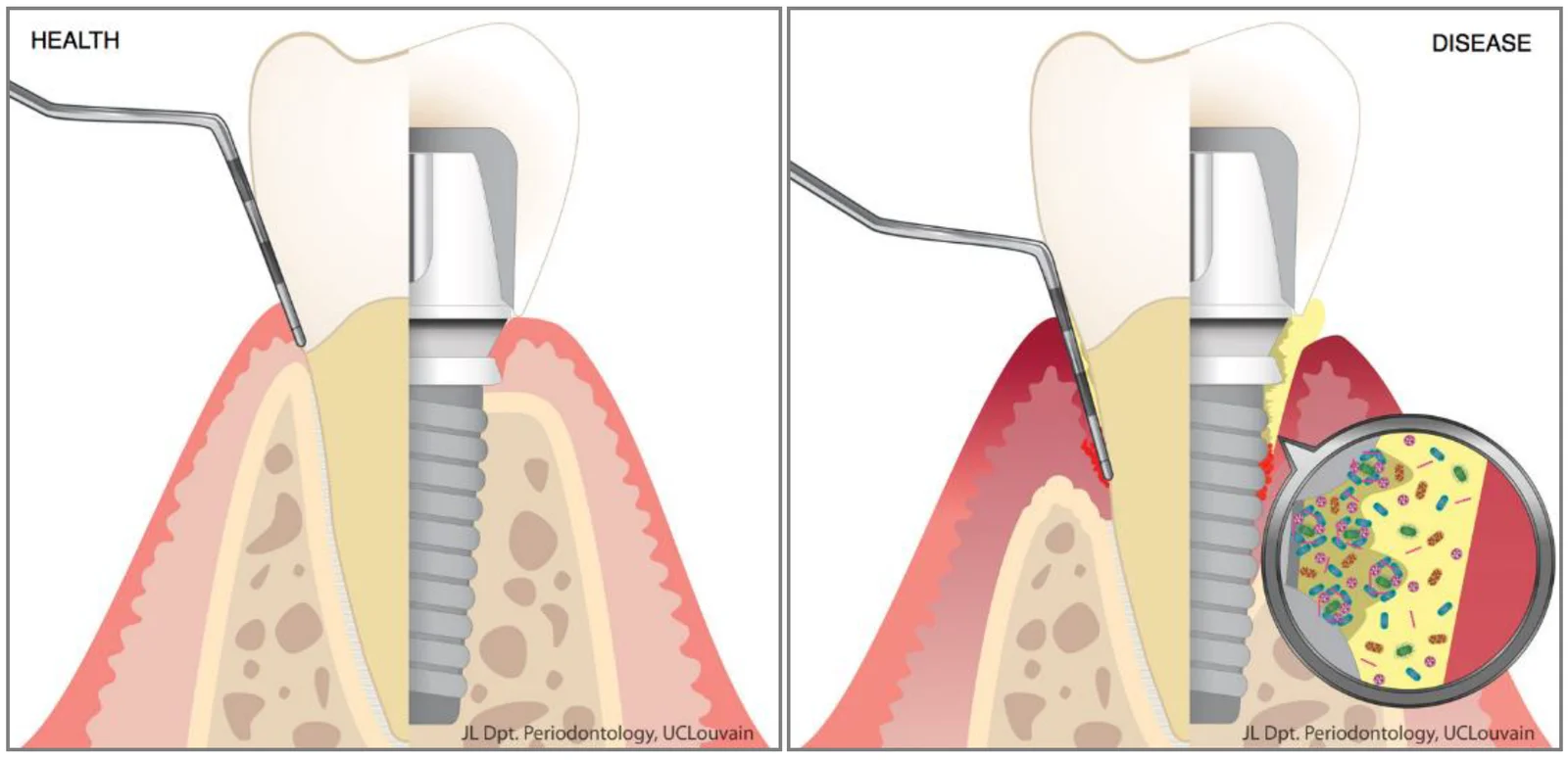
Figure cited from an external paper · Not a case from our clinicThe left illustration shows health, and the right shows inflammation. The left half of each illustration is a natural tooth and the right half is an implant, showing bacterial biofilm (yellow) on the tooth and implant surfaces, deeper gum pockets and a lower bone level underneath.Lasserre et al. · Figure 1 · DOI: 10.3390/ma11101802 · CC BY 4.0 · Used without modification (resized only)
This does not mean the outcome is predetermined. In a study that divided 112 people who received implants into three groups according to their history of periodontitis and followed them for 10 years, the proportions of implants remaining after 10 years were 96.6% in those with healthy gums, 92.8% in those with moderate periodontitis and 90% in those with severe periodontitis.[2] The figures were lower in those with periodontitis, but 90% or more remained, and more implant loss was observed in periodontitis patients who did not consistently receive regular periodontal maintenance.[2]
A review prepared for the international classification workshop also identified a history of periodontitis, poor plaque control and lack of regular maintenance as risk factors for peri-implantitis.[5] Of these, a history of periodontitis cannot be changed, but the other two can be changed through care.
What do we check in the treatment room before placement?
We check whether inflammation remains in the gums and how much the bone level has dropped because of gum disease. We check the gums around all the remaining teeth, as well as the site where the implant will be placed.
| What we check | How we check it | What we decide |
|---|
| Pocket depth and bleeding | Periodontal pocket examination (Korean) using a thin instrument to measure the depth around each tooth, and bleeding on probing (Korean) | Sites needing gum treatment, timing of placement |
| Bone height around the remaining teeth | Panoramic X-ray, periapical X-ray | Which teeth to save and which to extract |
| Tooth mobility | Clinical examination | Whether the tooth can be saved and when to extract it |
| Bone width and height at the placement site | Measurements in mm on CT (Korean) cross-sectional images | Implant size, whether a bone graft is needed |
| Home care | Checking where biofilm remains | Guidance on using a toothbrush and interdental brushes |
Where bone levels have dropped because of periodontitis, the bone available for implant placement is often reduced too, so we separately measure bone width and height and the distances to the nerve canal and maxillary sinus on CT. If you have a CT scan from another dental clinic, please bring it. We can open the files at our clinic.
We also check the medications you take, whether you smoke or have diabetes, and your recent HbA1c (a measure of average blood glucose over the past 2~3 months). Smoking and blood glucose control are factors that affect gum disease and implant outcomes.
We decide on placement timing by considering the pocket depth, bleeding, plaque control and bone height found during the examination together. How treatment proceeds when some sites need gum treatment (root planing (Korean)) is covered in Why is gum treatment split across several visits?.
We first judge whether a tooth can be saved with gum treatment, and recommend extraction as the first option for teeth that are difficult to keep. We do not extract a tooth immediately just because it is loose. Some teeth become less mobile after periodontitis treatment.
When we consider saving a tooth
We consider saving a tooth if the bone still supports the root sufficiently, or if the mobility is caused by inflammation and may decrease after gum treatment. We also consider whether retaining the tooth helps the overall prosthetic plan.
The process of observing a loose tooth for a few months after gum treatment is covered in Loose teeth: why we recommend 3 months of gum treatment before extraction.
We recommend extracting teeth with bone loss extending close to the root tip and substantial movement even with a finger, and teeth with recurring pus and inflammation that does not settle after gum treatment. The same applies if keeping the tooth could lead to loss of bone around neighboring teeth or at a future implant site.
It is possible if the conditions are right. At sites where gum disease has caused substantial bone loss, we assess the bone available to stabilize the implant and the state of inflammation before deciding on timing. Studies of immediate placement at previously inflamed sites reported high survival rates when the extraction sites were thoroughly debrided and disinfected.[10] At sites with substantial bone loss, immediate placement may leave too little bone for the implant to engage firmly. The conditions for placement on the day of extraction are covered separately in Can an implant be placed on the day a tooth is extracted?.
What changes if you smoke or have diabetes?
Both affect gum disease and implant outcomes, so we make a plan to manage them alongside the implant plan.
| Factor | Research findings | What we do in the treatment room |
|---|
| Smoking | Implant-level failure rates pooled across studies: 6.35% in smokers and 3.18% in nonsmokers[8]. Also associated with loss before restoration[7] | Recommend stopping smoking before and after surgery, and consider it when setting checkup intervals |
| Diabetes | Diabetes or hyperglycemia is associated with an approximately 50% higher risk of peri-implantitis[9] | Check recent blood glucose levels; if not controlled, decide on timing after consulting your physician |
These are patterns observed in studies, not a prediction of an individual’s outcome.
If you smoke, gum bleeding may be less apparent even when inflammation is present, so we look at pocket depth and X-ray findings as well as bleeding. In many cases, diabetes does not prevent implant placement if blood glucose is well controlled. Do not stop diabetes medication or insulin on your own.
Are there cases where implants are postponed or other methods are considered first?
Yes. Depending on the condition of the remaining teeth and your general health, a different sequence or method may be appropriate instead of implants.
If plaque control at home is still difficult, we may postpone placement until you are comfortable using a toothbrush and interdental brushes.
If several remaining teeth are also loose and more extractions are likely in the future, we make an overall plan before placing implants one by one. In this situation, we also compare partial dentures (Korean) and bridges.
If blood glucose is not controlled or surgery needs to be postponed because of your general health, we discuss ways to fill the missing-tooth site temporarily in the meantime.
Options other than implants are compared in Is there no other way besides an implant?.
How long does treatment take, and how many visits are needed?
The overall schedule depends on whether teeth need to be extracted and whether bone grafting is needed. The stages are as follows.
| Stage | Typical time needed | Criteria for moving to the next stage |
|---|
| Examination and planning | Depends on the condition of the gums and bone | Check pocket depth, bleeding, plaque control and bone height |
| Waiting after extraction (if a tooth is extracted) | 4–8 weeks for gum healing alone; 3–4 months or more for bone healing | Inflammation and gum healing, bone available to stabilize the implant |
| Placement and osseointegration (Korean) | 2~3 months for the lower jaw, 3~6 months for the upper jaw (1~2 months more with bone grafting) | Implant is firmly anchored |
| Restoration | Several visits from taking an impression to attaching the restoration | Check the bite and gum condition |
These are typical time frames and vary with bone condition and the response of the gums.
Implants are placed under local anesthesia, and we recommend returning the next day for disinfection (dressing). Treatment fees are listed in the fee list (non-covered fees).
How often should you have checkups after placement?
The standard checkup is 3 months after the restoration is attached, then every 6 months. People with a history of periodontitis also have checkups every 6 months once their gums are stable. Until then, we check more frequently. A history of periodontitis makes inflammation around implants more likely, so it needs to be detected and treated early. Peri-implantitis can progress without pain, making it difficult to judge by pain alone. The European Federation of Periodontology guideline also recommends regular maintenance tailored to individual risk after placement.[6]
At the stage where inflammation affects only the gums around an implant (peri-implant mucositis (Korean)), it can often be reversed with cleaning and care. In a study that re-examined 80 people at this stage after 5 years, 18.0% of those receiving regular maintenance and 43.9% of those without it had progressed to peri-implantitis.[3] An analysis of maintenance studies also found that a history of periodontitis and maintenance intervals were associated with peri-implantitis.[4]
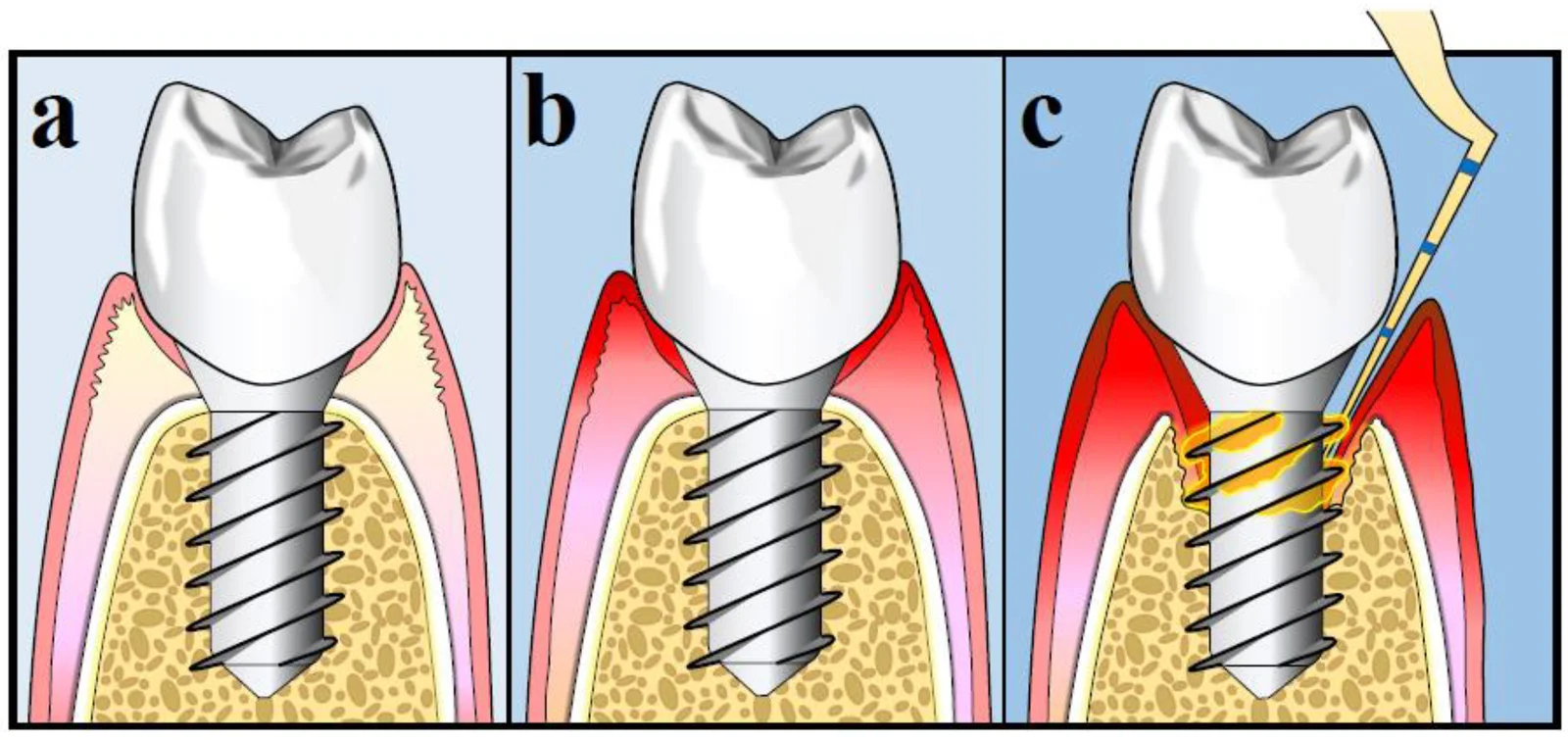
Figure cited from an external paper · Not a case from our clinica shows health around the implant; b shows peri-implant mucositis, with inflammation limited to the gums and unchanged bone; c shows peri-implantitis, with inflammation extending to the bone and a lower bone level around the implant.Kormas et al. · Figure 1 · DOI: 10.3390/antibiotics9110835 · CC BY 4.0 · Used without modification (resized only)
At checkups, we examine pocket depth, bleeding and pus around the implant, bone height compared with the periapical X-ray taken on the day the restoration was attached, screw loosening and the bite, and we clean around the implant with an air-polishing device. What we look at during checkups is covered in What do we look at in regular checkups after an implant?.
Please contact us even before your scheduled checkup
- If the gums around the implant bleed or discharge pus
- If the gums swell or hurt when pressed
- If the implant or the restoration on top feels loose
- If food keeps getting trapped around the implant and there is an odor
What we do when peri-implantitis has already developed is covered in I have peri-implantitis: does the implant have to be removed?.
Frequently asked questions (FAQ)
Q. I had gum treatment before. Do I need it again?
If the pockets are not deep and there is no bleeding when measured now, you may not need treatment again. Even if you had treatment before, inflammation may have returned if maintenance stopped for several years, so we measure again before placement to decide.
Q. Can I have implants if my gums are thin or have receded?
In many cases, yes. However, if there is too little firm gum tissue around an implant, brushing may be painful and biofilm may remain more easily, so we sometimes consider a gum graft as well. Where bone is lacking, we also plan a bone graft (Korean).
Q. Should I use interdental brushes around implants too?
Yes. A toothbrush alone does not clean well between an implant and the neighboring tooth or around the implant. We choose interdental brushes that fit the gaps and point out again at checkups where biofilm remains.
Q. What do I do about the missing-tooth site until the implant is placed?
For visible sites such as the front teeth, we discuss ways to fill the space temporarily. If one or two molars are missing, you may leave the space as it is, but leaving it empty for a long time can allow neighboring teeth to tilt or opposing teeth to move into the gap, so we plan placement without delaying too long.
Q. What should I prepare for an implant consultation near Bongcheon Station?
Please bring any records of previous gum treatment or CT scans and X-rays taken at another dental clinic. It also helps the consultation if you tell us which medications you take, whether you smoke and, if you have diabetes, your recent blood glucose levels.
Limits of the evidence
- The studies on a history of periodontitis and implant outcomes[1] differed in design and diagnostic criteria, so their figures could not be pooled. They point in the same direction of higher risk, but it is difficult to say how many times higher.
- The 10-year follow-up study[2] and the maintenance study[3] each examined relatively small groups of patients in a single country and institution, making it difficult to apply the findings directly to patients in different circumstances.
- Most smoking and diabetes studies[8][9] were observational, so they do not prove causation, and other factors may be involved.
- There are few studies directly comparing which interval in months is most appropriate for checkups,[4] so we decide the interval after checking each person’s gum condition.
DOCTOR’S NOTE
For people who have had gum disease, I decide on the surgery date after checking their current pocket depth, bleeding and bone height. After placement, I continue checking the gums around the remaining teeth and the areas around the implants using the same criteria.
— Jeong Jinwoo, Director, Joy Dental Clinic Bongcheon
This post reflects information as of the date of writing and was written to provide general information in compliance with Korea’s Medical Service Act and the Ministry of Health and Welfare’s medical advertising guidelines. Gum treatment can have side effects such as sensitivity, gum recession and bleeding, and implant surgery can have side effects such as bleeding, swelling, pain, infection and peri-implantitis; in rare cases, nerve damage or failure of osseointegration may occur. Individual diagnosis and the direction of treatment depend on the condition of your mouth, so please be sure to consult fully with your treating clinician before deciding.
We are right next to Exit 1 of Bongcheon Station (Line 2), and directions from Seoul Nat’l Univ. Station, Sillim, Nakseongdae and Sadang are in Getting here.
Joy Dental Clinic Bongcheon
5F Jehyeong Bldg., 1738 Nambusunhwan-ro, Gwanak-gu, Seoul (Bongcheon Station, Exit 1)
Hours: Mon·Wed·Thu·Fri 09:30–18:30 / Tue 09:30–20:30 / Sat 09:30–13:30 (closed Sun & public holidays)
Booking: Naver Booking / Phone 02-877-2867
Related pages: Implant treatment guide · Periodontitis (Korean) · Peri-implantitis (Korean) · Periodontal maintenance (Korean)
References
- Sousa V, Mardas N, Farias B, Petrie A, Needleman I, Spratt D, Donos N. A systematic review of implant outcomes in treated periodontitis patients. Clin Oral Implants Res. 2016;27(7):787-844. — [Systematic review] 27 longitudinal studies comparing implant outcomes in people treated for periodontitis and people with healthy gums. Those with a history of periodontitis had more peri-implantitis and bone loss and lower success and survival rates; those with a history of severe periodontitis tended to have higher implant loss rates. Differences in study designs and definitions prevented a meta-analysis.
- Roccuzzo M, De Angelis N, Bonino L, Aglietta M. Ten-year results of a three-arm prospective cohort study on implants in periodontally compromised patients. Part 1: implant loss and radiographic bone loss. Clin Oral Implants Res. 2010;21(5):490-496. — [Cohort] 112 people who received implants after completing gum treatment were divided into three groups—periodontally healthy, moderate periodontitis and severe periodontitis—and followed for 10 years. The 10-year survival rates were 96.6%·92.8%·90%, and the proportions of sites with bone loss of 3mm or more were 4.7%·11.2%·15.1%. Failures were more frequent among periodontitis patients who did not continue regular periodontal maintenance throughout follow-up.
- Costa FO, Takenaka-Martinez S, Cota LOM, Ferreira SD, Silva GLM, Costa JE. Peri-implant disease in subjects with and without preventive maintenance: a 5-year follow-up. J Clin Periodontol. 2012;39(2):173-181. — [Cohort] 80 people with peri-implant mucositis were re-examined after 5 years. Peri-implantitis developed in 18.0% of the group receiving regular maintenance and 43.9% of the group without it. Gum pocket depth and the presence of periodontitis were also associated with risk.
- Monje A, Aranda L, Diaz KT, Alarcón MA, Bagramian RA, Wang HL, Catena A. Impact of maintenance therapy for the prevention of peri-implant diseases: a systematic review and meta-analysis. J Dent Res. 2016;95(4):372-379. — [Meta-analysis] 13 clinical studies. A history of periodontitis was associated with peri-implant mucositis and peri-implantitis, and the interval between regular maintenance visits also affected peri-implantitis occurrence. Regular maintenance at least every 5~6 months was suggested, with the interval tailored to risk.
- Schwarz F, Derks J, Monje A, Wang HL. Peri-implantitis. J Clin Periodontol. 2018;45 Suppl 20:S246-S266. — [Review] A paper summarizing the definition, progression and risk factors of peri-implantitis for the 2017 World Workshop on the Classification of Periodontal and Peri-Implant Diseases. A history of chronic periodontitis, poor plaque control and lack of regular maintenance were identified as risk factors for peri-implantitis.
- Herrera D, Berglundh T, Schwarz F, Chapple I, Jepsen S, Sculean A, et al. Prevention and treatment of peri-implant diseases—The EFP S3 level clinical practice guideline. J Clin Periodontol. 2023;50 Suppl 26:4-76. — [Guideline] European Federation of Periodontology clinical practice guideline for the prevention and treatment of peri-implant diseases. Recommends risk factor management and regular maintenance tailored to individual risk after implant placement.
- Derks J, Håkansson J, Wennström JL, Tomasi C, Larsson M, Berglundh T. Effectiveness of implant therapy analyzed in a Swedish population: early and late implant loss. J Dent Res. 2015;94(3 Suppl):44S-51S. — [Cohort] Review of treatment records of 2,765 randomly selected people in Sweden (11,311 implants), with 596 examined after 9 years. Implant loss before restoration was associated with smoking, a history of gum disease and other factors.
- Chrcanovic BR, Albrektsson T, Wennerberg A. Smoking and dental implants: A systematic review and meta-analysis. J Dent. 2015;43(5):487-498. — [Meta-analysis] 107 studies. Of 19,836 implants placed in smokers, 6.35% failed, compared with 3.18% of 60,464 implants in nonsmokers. Smoking was associated with failure, postoperative infection and bone loss. Other uncontrolled factors mean the findings need cautious interpretation.
- Monje A, Catena A, Borgnakke WS. Association between diabetes mellitus/hyperglycaemia and peri-implant diseases: Systematic review and meta-analysis. J Clin Periodontol. 2017;44(6):636-648. — [Meta-analysis] 12 studies (7 in the quantitative analysis). Diabetes or hyperglycemia was associated with an approximately 50% higher risk of peri-implantitis (independently of smoking). No association with peri-implant mucositis was confirmed.
- Chrcanovic BR, Martins MD, Wennerberg A. Immediate placement of implants into infected sites: a systematic review. Clin Implant Dent Relat Res. 2015;17 Suppl 1:e1-e16. — [Systematic review] Studies of implants placed on the day of extraction at sites with periodontal or root-tip inflammation. Survival rates were high when the sites were thoroughly debrided and disinfected, but more long-term randomized studies are needed, and infection classifications differed between studies.
- Lasserre JF, Brecx MC, Toma S. Oral microbes, biofilms and their role in periodontal and peri-implant diseases. Materials (Basel). 2018;11(10):1802. — [Review] A paper summarizing the role of oral biofilms in periodontal and peri-implant diseases. Source of an illustration in this article (Figure 1, CC BY 4.0)—the figure comparing tissues around teeth and implants in health and inflammation is used without modification.
- Kormas I, Pedercini C, Pedercini A, Raptopoulos M, Alassy H, Wolff LF. Peri-implant diseases: diagnosis, clinical, histological, microbiological characteristics and treatment strategies. A narrative review. Antibiotics (Basel). 2020;9(11):835. — [Review] A paper summarizing the diagnosis, clinical, histological and microbiological characteristics, and treatment strategies for peri-implant diseases. Source of an illustration in this article (Figure 1, CC BY 4.0)—the figure comparing peri-implant health, mucositis and peri-implantitis is used without modification.


 한국어
 日本語
 简体中文