💡 Key answer
Gum treatment takes several visits because treatment below the gums may be divided into sections, and the gums are measured again afterward to decide the next step. Several weeks after the tartar below the gums has been removed, gum pocket depth and bleeding are measured again in the same way as at the start. Sites where both depth and bleeding have stabilized move on to maintenance, while further treatment or surgery is considered for sites that remain deep or continue to bleed.
Summary for patients
- On the first day, we measure gum pocket depth and examine the bone on X-rays.
- Treatment below the gums may be divided into sections under local anesthesia.
- Please also attend the visit a few weeks later when we measure again.
- The new measurements determine whether further treatment is needed.
- Even after treatment is finished, checkups at set intervals are needed.
❓ What this article covers
- What do we check at the first visit?
- How does scaling differ from treatment below the gums?
- Why is treatment below the gums divided into sections?
- When do we measure again after treatment, and what do we compare?
- If deep sites remain at reassessment, is surgery necessary?
- How often should I visit after treatment is finished?
- Are there cases that do not follow this sequence?
- How long does treatment take, and how many visits are needed?
Terms explained
- Periodontal pocket (Korean) (gum pocket): a gap between the tooth and gum that has deepened because of inflammation. Its depth is measured with a probe
- Bleeding on probing (Korean): bleeding when gum pocket depth is measured. It is an indicator used to assess whether inflammation remains
- Root planing (Korean) (removal of tartar below the gums): treatment that scrapes off tartar attached to the root surface below the gums and smooths the surface
- Periodontal maintenance (Korean): care after gum treatment in which the gums are measured again and tartar is removed at set intervals
What do we check at the first visit?
We check gum pocket depth and bleeding, and use X-rays to see how much jawbone (alveolar bone) remains. These records become the baseline for comparing treatment results later.
We measure gum pocket depth by gently inserting a thin, marked instrument (a probe) between the gum and tooth. We measure several sites on the outer and inner sides of each tooth, and also record which sites bleed during measurement. Gum disease often progresses below the gums beyond the swelling visible on the surface, so these measurements tell us how deep the pockets are around each tooth.
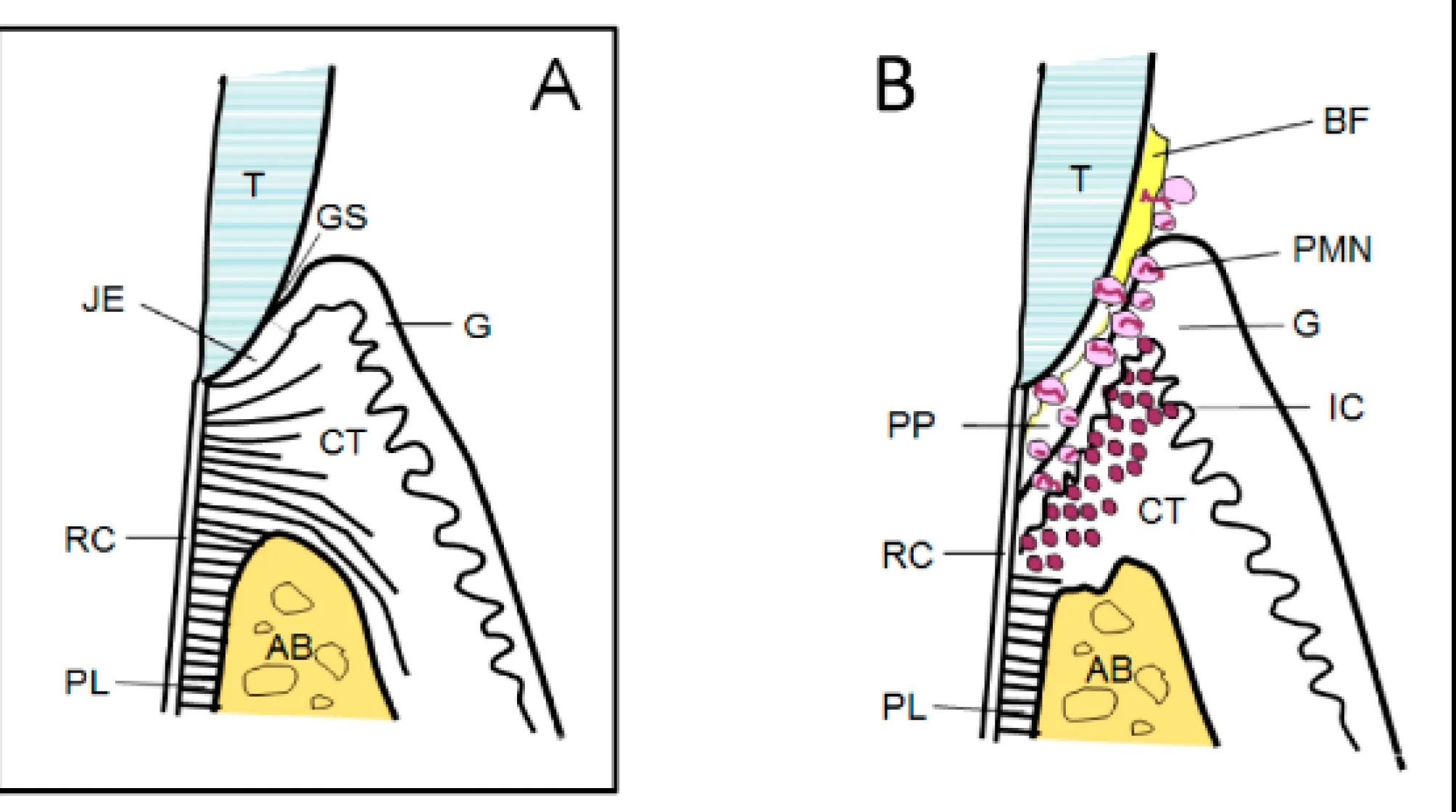
Figure from an external paper · Not a case from our clinicThe left panel (A) shows healthy gums, with a shallow groove between the tooth and gum and jawbone extending close to the neck of the tooth. The right panel (B) shows periodontitis: bacterial biofilm (yellow) is attached to the tooth surface, a deep pocket has formed between the tooth and gum, inflammatory cells have gathered, and the jawbone level has dropped. At the first visit, the probe measures the depth of this pocket, and the X-ray shows the height of this bone. The English labels in the figure indicate the tooth (T), gum (G), bacterial biofilm (BF), gum pocket (PP), jawbone (AB), periodontal ligament (PL), root surface (RC), connective tissue (CT), inflammatory cells (IC·PMN), gingival sulcus (GS), and junctional epithelium (JE).[6]Könönen et al. · Figure 1 · DOI: 10.3390/jcm8081135 · CC BY 4.0 · Cropped to panels (A)(B) only
For X-rays, a panoramic X-ray (Korean) shows bone levels throughout the mouth, and teeth that appear to have substantial bone loss are checked again with a periapical X-ray, which gives a close-up view of the roots. We check how far down the root the bone level has dropped and whether there is a deep defect on just one side (bone loss pattern (Korean)).
We also check the following.
- Whether teeth are loose and whether bone loss extends between the roots of molars (furcation involvement (Korean))
- The location and amount of tartar, and whether plaque accumulates around the edges of restorations
- Smoking, systemic conditions such as diabetes (Korean), and medications you take
Smoking and blood sugar control affect how well the gums recover after treatment. Please tell us at your visit whether you smoke and whether you have systemic conditions such as diabetes. If you take blood-thinning medication, please tell us its name and do not stop it on your own.
How does scaling differ from treatment below the gums?
Scaling removes tartar above and along the gum line, while treatment below the gums also removes tartar from the root surfaces deep beneath the gums.
If inflammation is limited to the gums and the bone level has not dropped, as in gingivitis (Korean), scaling (Korean) and adjustments to brushing technique often help. However, when gum pockets have deepened because of periodontitis (Korean), removing tartar above the gums alone is not enough; tartar and plaque on the root surfaces below the gums must also be removed.[1] In this case, we perform root planing under local anesthesia, inserting instruments below the gums to scrape tartar from the root surfaces. We may also perform periodontal curettage (Korean) to remove severely inflamed tissue inside the gums.
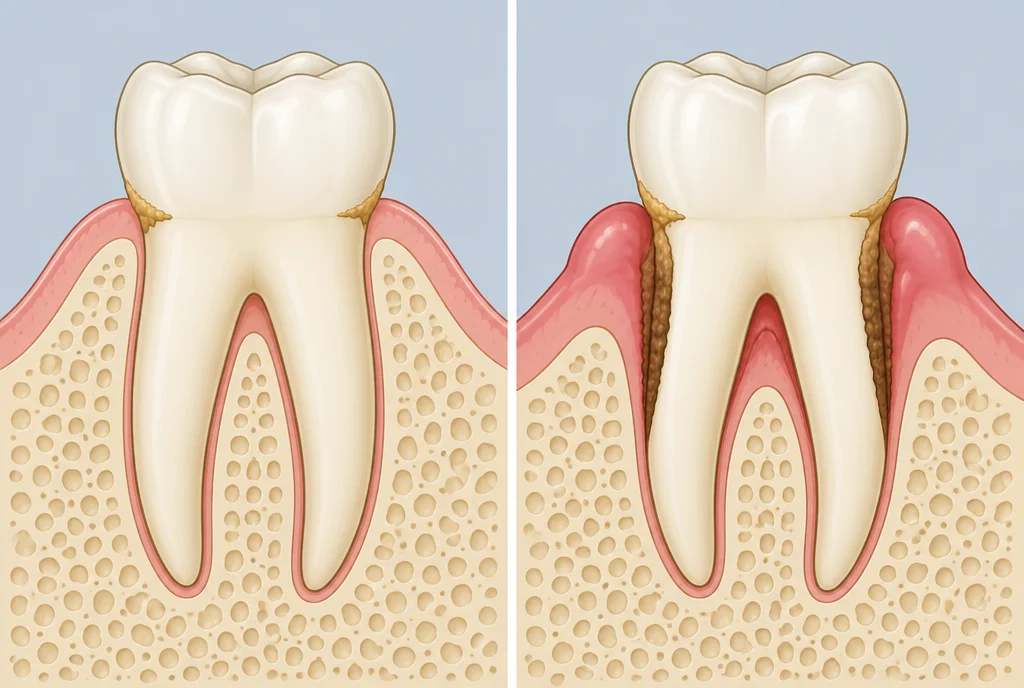
AI-generated explanatory illustrationThe left panel shows tartar attached only to the tooth surface above the gum line, the area cleaned by scaling. The right panel shows swollen gums, a deeper pocket, tartar extending onto the root surface below the gums, and a lowered bone level, the area cleaned by treatment below the gums under local anesthesia
| Category | Scaling | Treatment below the gums (root planing and periodontal curettage) |
|---|
| Indications | Gingivitis; the first stage of periodontitis treatment | Periodontitis with deepened gum pockets |
| Area treated | Tartar above and along the gum line | Tartar on root surfaces below the gums, inflamed tissue |
| Anesthesia | Usually not used | Local anesthesia |
| Approach | Usually the whole mouth in one visit | Often divided into sections |
This table gives a general distinction; the actual area treated depends on the examination results.
Scaling is often done before treatment below the gums. Removing tartar above the gums reduces some swelling and makes brushing easier, allowing a more accurate view of deep areas during treatment below the gums. During this period, we also explain how to brush along the tooth–gum border and how to use floss or interdental brushes. How well you remove plaque at home affects the treatment result. The European Federation of Periodontology’s clinical practice guideline also places this stage first in treatment.[1]
Why is treatment below the gums divided into sections?
To reduce the area needing anesthesia and the treatment time, making each visit less demanding.
Treatment below the gums takes time because the root surfaces of each tooth are cleaned under local anesthesia. If the areas needing treatment are spread throughout the mouth, treating them all at once means a larger area needs anesthesia and a longer treatment session. For a few days after the anesthesia wears off, your gums may feel sore or chewing may be uncomfortable; dividing treatment into sections allows you to eat on one side.
Reviews of studies comparing treatment of the whole mouth within 24 hours with treatment divided into sections have found no clear difference in effectiveness between the two methods.[4] This does not mean that dividing treatment leads to better healing. We therefore decide how many sections to use based on where deep pockets are concentrated, how comfortably you tolerate anesthesia and treatment time, and a schedule that makes it easy for you to attend. If there are only one or two deep sites, treatment may be completed in one visit.
Between treatment visits, please follow these instructions.
- Keep brushing the treated side as well, using a soft toothbrush along the gum line.
- Avoid hot food until the anesthesia wears off, and take care not to bite your cheek or tongue.
- You may have sensitivity to cold after treatment. It usually decreases over time, but please contact the clinic if sensitivity worsens or pain continues.
When do we measure again after treatment, and what do we compare?
Several weeks after treatment below the gums is completed, we measure pocket depth and bleeding again in the same way as at the start and compare them with the first day’s records. This reassessment is why you need another visit even after treatment is finished.
Immediately after tartar removal, the gums are still healing, so measuring right away does not give accurate results. It takes time for the gums to settle and reattach to the root surfaces, so reevaluation is usually done 4~8 weeks after treatment is completed.[3] At reassessment, we compare the following.
- How much shallower the gum pockets have become around each tooth
- How much the number of sites that bleed on probing has decreased
- Whether previously loose teeth are less mobile
- Where plaque remains
After treatment below the gums, pockets usually become shallower and bleeding decreases. However, the deeper the pockets were initially, the more often deep sites remain after treatment.[2] We therefore measure again to check how much each site has improved.
| Reassessment result | Response |
|---|
| Pockets have become shallower, at 4mm or less, with no bleeding on probing | Move on to maintenance |
| Pockets of 4~5mm remain, with bleeding on probing | Repeat treatment below the gums at those sites and reassess |
| Deep pockets of 6mm or more remain | Consider gum surgery (periodontal flap surgery) |
| Bone level has dropped close to the root tip, with marked tooth mobility | Reassess whether the tooth can be kept; consider extraction and the plan afterward |
This is a general summary; actual decisions depend on the examination results.[1]
It is easy to miss the reassessment visit if nothing hurts, but we need those results to decide the next step. Please attend even if your symptoms have improved.
If deep sites remain at reassessment, is surgery necessary?
If deep pockets remain, we check the tooth and the surrounding gums and bone to decide whether surgery is needed and how far it should extend. If the remaining depth is 4~5mm, repeating treatment below the gums at that site without surgery may be enough in some cases.[1]
If pockets of 6mm or deeper remain after treatment below the gums, we check for bleeding and examine the shape of the roots and bone, then consider periodontal flap surgery (Korean), in which the gums are opened to remove tartar while directly viewing the root surfaces.[1] If there is a deep bone defect on one side, we may also consider a regenerative procedure to fill the defect, but this is not possible for every defect shape.
There is also research on what happens when deep pockets remain. In a study of patients receiving maintenance for an average of 11 years after gum treatment, those with pockets of 6mm or deeper remaining at the end of treatment had a higher risk of renewed gum disease progression and tooth loss.[5] This is why we look separately at the remaining sites during reassessment.
If surgery is being considered, we explain which teeth have pockets remaining, their depth in mm, what surgery would change, and how we would manage the sites without surgery. Please take time to consider whether to have surgery before deciding. If factors affecting healing, such as smoking or blood sugar, are not controlled, we may recommend smoking cessation and blood sugar management before surgery.
How often should I visit after treatment is finished?
At Joy Dental Clinic Bongcheon, we usually arrange maintenance every 3~6 months, adjusting the interval according to reassessment results and risk factors. The European Federation of Periodontology’s clinical practice guideline also recommends tailoring maintenance intervals to each person’s risk within a range of 3~12 months.[1]
Even when gum treatment settles the inflammation, most of the lost bone remains lost, and plaque can easily accumulate again at sites that were deep. At maintenance visits, we remove tartar and, where needed, measure depth and bleeding again to compare with previous records. If a site has become deeper, we treat that site again.
We use shorter intervals in the following cases.
- Several deep pockets or bleeding sites remained at reassessment
- You smoke or your blood sugar is not well controlled
- You have restorations that are hard to reach with a toothbrush or lesions between the roots of molars
Conversely, if depth and bleeding remain stable over several maintenance visits, we may extend the interval. General information about scaling intervals is covered separately in Why are you advised to have scaling every 6 months?.
Are there cases that do not follow this sequence?
Yes. Even if the gums are swollen and painful, gum disease may not be the cause, or another procedure may need to come before gum treatment.
- Repeated swelling around just one tooth: the gums can also swell when the pulp dies and inflammation develops at the root tip, or when a root is cracked. In these cases, we first treat the cause with procedures such as root canal treatment (Korean) or extraction. Repeated swelling at the same site is covered in When a gum boil keeps recurring in the same spot.
- Swelling and pain caused by a buildup of pus: if swelling and pain develop suddenly, as with a periodontal abscess (Korean), we first drain the pus and settle the inflammation, then measure pocket depth after it has settled.
- A tooth whose bone level has dropped close to the root tip: for a tooth judged difficult to keep with gum treatment, we recommend extraction and consider its timing together with the subsequent implant or denture plan. The decision to extract depends on the amount of remaining bone, tooth mobility, and whether inflammation can be controlled.
- Repeated inflammation at one site because of the edge of a restoration: if the edge of a restoration does not fit the gum and plaque accumulates there, we consider adjusting or remaking the restoration along with gum treatment. If left as it is, inflammation is likely to recur at the same site.
- Gum enlargement caused by medication: some blood pressure medications and anticonvulsants can cause the gums to enlarge. In this case, consultation with the prescribing physician may be needed.
Conversely, at the gingivitis stage, treatment often ends with scaling, adjustments to brushing technique, and a follow-up check after a short interval, without treatment below the gums.
How long does treatment take, and how many visits are needed?
Gingivitis often requires 1 scaling visit and a follow-up check, while periodontitis often takes about 2~3 months for treatment below the gums by section and reassessment. If any sites need surgery, the duration is longer.
| Stage | What is done | Usual number of visits and timing |
|---|
| Examination | Record pocket depth and bleeding; take X-rays | First visit |
| Scaling and home care instruction | Remove tartar above the gums; explain brushing and interdental care | Usually 1 visit |
| Treatment below the gums | Root planing and periodontal curettage by section | 1~4 visits depending on the treatment area, at intervals of 1~2 weeks |
| Reassessment | Measure pocket depth and bleeding again and compare with the first day | Several weeks after the last treatment |
| Further treatment | Retreatment of remaining sites or gum surgery | Depending on reassessment results |
| Maintenance | Remeasure pocket depth; remove tartar | Every 3~6 months |
These are general time frames and vary with examination results and the response to treatment.
Treatment fees are listed in the fee list (non-covered fees).
Frequently asked questions (FAQ)
Q. Why can teeth look longer after treatment below the gums?
As gums swollen by inflammation settle, the gum margins move down. This does not mean the treatment has cut away the gums. Gaps between the teeth (black triangles (Korean)) or sensitivity to cold may appear, and sensitivity usually decreases over time.
Q. If I miss one visit along the way, do I have to start over?
Missing one visit does not mean starting again from the beginning. However, if the interval becomes too long, plaque may have built up again in the sections treated earlier. We check those sites and, if needed, treat them again before continuing. Please let us know in advance if attending is difficult.
Q. Will treatment below the gums make loose teeth firm again?
Mobility may decrease when inflammation settles. However, removing tartar below the gums alone is unlikely to restore lost bone to its original height, so teeth with substantial bone loss may remain loose after treatment. If the movement makes chewing uncomfortable, we may consider splinting the tooth to neighboring teeth.
Q. I have not been brushing the treated side because it bleeds. Is that okay?
Please brush the treated side as well. If you do not brush, plaque accumulates again and makes it harder for the gums to heal. Gently brush along the gum line with a soft toothbrush. Bleeding and brushing are explained in detail in Brushing and care when your gums bleed.
Q. Can mouthwash or gum medication replace this treatment?
Mouthwash and medication cannot remove tartar attached to the roots below the gums. If tartar remains, the cause of inflammation remains, so they cannot replace treatment below the gums. Medication is prescribed only as an adjunct when needed.
Q. Do you also measure around implants?
Yes. Gum inflammation can also develop around implants, so at maintenance visits we check depth and bleeding around implants too. Implant checkups are covered in What do we look at in regular checkups after an implant?.
Limits of the evidence
- The mm thresholds in the table of responses to reassessment results are general criteria based on the European Federation of Periodontology’s clinical practice guideline. Even at the same depth, decisions vary with the tooth’s location, bone shape, and general health.[1]
- The relationship between remaining deep pockets and tooth loss comes from a long-term observational study of patients receiving maintenance at one institution; a single deep pocket does not mean that tooth loss will follow.[5]
- Comparisons of treatment by section with full-mouth treatment involve a limited number of studies with different conditions, so they do not tell us which method suits everyone.[4]
- Responses to treatment vary considerably between individuals depending on smoking, diabetes, and home care.
DOCTOR’S NOTE
Gum treatment is demanding for me to perform and painful for the patient receiving it. I still do it because it is one of the most effective ways to preserve teeth.
— Jeong Jinwoo, Director, Joy Dental Clinic Bongcheon
This post reflects information as of the date of writing and was written to provide general information in compliance with Korea’s Medical Service Act and the Ministry of Health and Welfare’s medical advertising guidelines. Gum treatment may have side effects such as sensitivity, pain, bleeding and swelling afterward, as well as gum recession that makes teeth look longer or creates gaps between teeth. Individual diagnosis and the direction of treatment depend on the condition of your mouth, so please be sure to consult fully with your treating clinician before deciding.
We are right next to Exit 1 of Bongcheon Station (Line 2), and directions from Seoul Nat’l Univ. Station, Sillim, Nakseongdae and Sadang are in Getting here.
Joy Dental Clinic Bongcheon
5F Jehyeong Bldg., 1738 Nambusunhwan-ro, Gwanak-gu, Seoul (Bongcheon Station, Exit 1)
Hours: Mon·Wed·Thu·Fri 09:30–18:30 / Tue 09:30–20:30 / Sat 09:30–13:30 (closed Sun & public holidays)
Booking: Naver Booking / Phone 02-877-2867
Related pages: Gum treatment guide · Periodontitis (Korean) · Periodontal maintenance (Korean)
References
- Sanz M, Herrera D, Kebschull M, et al. Treatment of stage I–III periodontitis—The EFP S3 level clinical practice guideline. J Clin Periodontol. 2020;47(Suppl 22):4-60. — [Guideline] Clinical practice guideline from the European Federation of Periodontology. It divides periodontitis treatment into oral hygiene and risk factor control → removal of tartar below the gums → reevaluation → treatment of remaining deep pockets → maintenance, and recommends deciding the next treatment based on reevaluation results at each stage.
- Suvan J, Leira Y, Moreno Sancho FM, Graziani F, Derks J, Tomasi C. Subgingival instrumentation for treatment of periodontitis. A systematic review. J Clin Periodontol. 2020;47(Suppl 22):155-175. — [Systematic review] Summarizes the effects of removing tartar below the gums (including root planing) on reducing gum pocket depth and bleeding. The deeper the pockets were initially, the more often deep sites remained after treatment.
- Segelnick SL, Weinberg MA. Reevaluation of initial therapy: when is the appropriate time? J Periodontol. 2006;77(9):1598-1601. — [Literature review] Summarizes the evidence for reevaluation several weeks after removal of tartar below the gums rather than immediately afterward, because the gums need time to heal.
- Eberhard J, Jepsen S, Jervøe-Storm PM, Needleman I, Worthington HV. Full-mouth treatment modalities (within 24 hours) for chronic periodontitis in adults. Cochrane Database Syst Rev. 2015;(4):CD004622. — [Systematic review] Compares treatment below the gums throughout the whole mouth within 24 hours with treatment divided into sections; no clear difference in effectiveness was found between the two methods.
- Matuliene G, Pjetursson BE, Salvi GE, et al. Influence of residual pockets on progression of periodontitis and tooth loss: results after 11 years of maintenance. J Clin Periodontol. 2008;35(8):685-695. — [Cohort] A study of patients receiving maintenance for an average of 11 years after gum treatment. The risk of renewed gum disease progression and tooth loss was higher when pockets of 6mm or deeper remained at the end of treatment or when there were more bleeding sites.
- Könönen E, Gursoy M, Gursoy UK. Periodontitis: A Multifaceted Disease of Tooth-Supporting Tissues. J Clin Med. 2019;8(8):1135. — [Review] A cross-sectional diagram of healthy periodontal tissues and tissues with periodontitis (Figure 1) is reproduced under the CC BY 4.0 license. It shows how pockets develop between the teeth and gums and the jawbone level drops in periodontitis.


 한국어
 日本語
 简体中文